逆周期政策

Search documents
关税引发波动 多家券商解读
Xin Lang Cai Jing· 2025-10-12 06:37
Core Viewpoint - The sell-side research institutions generally believe that the market volatility caused by the equal tariffs in April will not "repeat yesterday," thus there is no need to be overly pessimistic about equity assets [1] Group 1: Market Outlook - Galaxy Securities report indicates that A-shares may experience slight fluctuations, but the upward trend remains unchanged, accompanied by a shift in market style [1] - The increase in short-term uncertainty will lower the market's risk appetite for Chinese assets, prompting investors to reassess whether market pricing is reasonable due to significant previous profits [1] Group 2: Investment Opportunities - Despite the short-term disturbances from the tariff conflict, the long-term bullish characteristics of A-shares are expected to continue [1] - The probability of a Trump TACO is high, and the resilience of China's supply chain will limit the actual impact on the economic fundamentals [1] - China's counter-cyclical policies still have considerable room for maneuver, with incremental reserve policies set to be introduced in response to changing conditions [1] - Since the second quarter, China's version of a "stabilization fund" has played a positive role in stabilizing the market, and if stock market volatility increases significantly, the stabilization mechanism will again be crucial [1]
中国银河证券:是即便人民银行在四季度再次实施降息 人民币依然将在年内保持升值方向
Xin Lang Cai Jing· 2025-09-29 00:39
Group 1 - The central bank is expected to implement a 10-20 basis points interest rate cut in the fourth quarter [1] - A potential interest rate cut may deepen the inversion of the China-US interest rate differential, leading to capital outflows and depreciation pressure on the RMB [1] - Despite previous expectations, the interest rate differential has narrowed this year, and the RMB has appreciated following the central bank's easing measures [1] Group 2 - Even with a potential interest rate cut in the fourth quarter, the RMB is expected to maintain an appreciation trend for the year [1] - Under the baseline scenario, the USD/CNY exchange rate is projected to approach 7.0 by year-end [1] - In an optimistic scenario, where extraordinary counter-cyclical policies stimulate the economy or tariffs on Chinese imports are reduced by an additional 20%, the new equilibrium for the USD/CNY exchange rate is estimated to be around 6.7 [1]

宏观周报:美联储分歧加剧,国内静待政策加力-20250928
Yin He Zheng Quan· 2025-09-28 08:22
Group 1: Federal Reserve and Economic Outlook - The Federal Reserve officials show significant divergence regarding future interest rate cuts, adding uncertainty to the outlook[2] - Powell indicates that any rate cuts will likely be slow and moderate unless there is a clear economic downturn[2] - U.S. Q2 GDP annualized growth was revised up to 3.8%, with personal consumption expenditure increasing by 2.5%[4] Group 2: Domestic Economic Indicators - PPI shows a narrowing year-on-year decline, indicating the effectiveness of anti-involution measures[2] - As of September 26, the average retail sales of passenger cars in September reached 1.191 million units, a year-on-year increase of 0.3%[2] - The Baltic Dry Index (BDI) averaged 2118.6, a month-on-month increase of 5.9% and a year-on-year increase of 7.7%[2] Group 3: Commodity Prices and Production - WTI crude oil rose by 1.02% and Brent crude by 1.5% as of September 26, driven by supply concerns[1] - The average operating rate of blast furnaces increased by 0.47 percentage points to 84.47% as of September 28[2] - Cement dispatch rates recorded a month-on-month increase of 0.59 percentage points, up 4.66% year-on-year[3] Group 4: Inflation and Consumer Behavior - CPI shows a decline in pork prices by 0.94% week-on-week, while fruit and vegetable prices have generally rebounded[2] - The average wholesale price of 28 monitored vegetables increased by 1.16%, and the average price of 6 monitored fruits rose by 2.02%[2] - The personal savings rate in the U.S. was reported at 4.6%, indicating stable consumer spending and income growth[4]
宏观周报(9月22日-9月28日):美联储分歧加剧,国内静待政策加力-20250928
Yin He Zheng Quan· 2025-09-28 07:02
Group 1: Federal Reserve and Economic Outlook - The Federal Reserve officials show significant divergence regarding future interest rate cuts, adding uncertainty to the outlook[2] - Powell indicates that any rate cuts will likely be slow and moderate unless there is a clear economic downturn[2] - U.S. economic data remains resilient, with PPI's year-on-year decline narrowing and industrial profits turning positive, suggesting the effectiveness of anti-involution measures[2] Group 2: Domestic Economic Indicators - As of September 26, 2023, passenger car sales reached 1.191 million units, a year-on-year increase of 0.3% and a month-on-month increase of 5.9%[2] - The Baltic Dry Index (BDI) averaged 2118.6, up 5.9% month-on-month and 7.7% year-on-year, indicating strong export resilience[2] - Industrial production shows a month-on-month increase, with average blast furnace operating rates rising by 0.47 percentage points to 84.47%[2] Group 3: Price Trends and Inflation - As of September 26, 2023, pork prices fell by 0.94% week-on-week, while the average wholesale price of 28 monitored vegetables rose by 1.16%[2] - The Consumer Price Index (CPI) shows a slight increase in food prices, with energy prices rising by 0.8% and food prices by 0.5%[4] - Core PCE price index increased by 0.2% month-on-month and 2.9% year-on-year, indicating stable inflation levels[4] Group 4: Fiscal and Monetary Policy - This week, ordinary government bonds issued totaled 247.5 billion, with an issuance progress of 79%[3] - The central bank's net MLF injection was 300 billion, signaling a monetary easing policy[3] - The yield curve for government bonds steepened, with the 30-year yield at 2.217% and the 10-year yield at 1.8768%[3]
如果降息,人民币升值会延缓吗?
Yin He Zheng Quan· 2025-09-26 08:56
Exchange Rate Projections - Under the baseline scenario, the USD/CNY exchange rate is expected to approach 7.0 by the end of the year[1] - In an optimistic scenario, with extraordinary counter-cyclical policies, the new equilibrium for USD/CNY could be around 6.7[1] Monetary Policy Implications - A potential interest rate cut of 10-20 basis points (BP) by the People's Bank of China (PBOC) in Q4 may not delay RMB appreciation but could intensify it[1] - The current market does not fully anticipate a rate cut, meaning the existing exchange rate does not factor in this possibility[1] Economic Context - The recent RMB appreciation is not driven by strong economic fundamentals but rather by expectations and a self-fulfilling cycle of currency appreciation[1][10] - The Chinese government's debt cost is currently lower than economic growth rates, supporting fiscal expansion and the exchange rate[1] Investment Insights - RMB appreciation is expected to benefit Chinese stocks, with historical data showing that a 1% appreciation typically leads to a 2.73% increase in A-shares and a 4.52% increase in Hong Kong stocks[6] - The current RMB appreciation cycle has seen A-shares rise by an average of 8.31% and Hong Kong stocks by 10.52% since April 8, 2025[6] Risks and Considerations - Risks include misinterpretation of policy, unexpected monetary policy actions, and potential increases in U.S. tariffs[50]
转型中国:日本1990还是美国1970?
CAITONG SECURITIES· 2025-09-24 02:27
Group 1: Economic Transformation Insights - China's current transformation strategy is more aligned with the U.S. in the 1970s, focusing on "going global" and "common prosperity" akin to the U.S. deindustrialization and Great Society initiatives[1] - The Chinese economy is entering the latter stage of transformation, with cyclical issues becoming less impactful, as evidenced by the decline in old economic drivers like real estate[1] - The transition phase requires patience in policy implementation, as excessive use of counter-cyclical policies may lead to structural issues similar to the U.S. in the 1960s and 70s[1] Group 2: Market and Policy Implications - The easing of cyclical pressures, particularly in real estate, suggests a potential formation of an "L-shaped" economic recovery, supported by counter-cyclical policies[1] - The ongoing structural reforms and technological breakthroughs, although slow, create opportunities for risk appetite and asset revaluation in the capital markets[1] - The A-share bull market since the "924" policy in 2021 reflects the synergy between counter-cyclical policies and technological advancements in sectors like AI and robotics[1] Group 3: Risks and Challenges - Risks include the possibility that the pace of structural reforms may not meet expectations, and uncertainties surrounding technological breakthroughs and external economic influences[1] - The decline in housing prices, with first-tier city prices dropping by 34.3% from their peak as of August 2025, highlights the ongoing challenges in the real estate sector[3] - The GDP deflator index has shown negative growth for nine consecutive quarters since Q2 2023, indicating persistent economic weakness[3]
8月挖掘机数据点评:行业维持高景气,内销与出口维持快速增长
GUOTAI HAITONG SECURITIES· 2025-09-22 09:17
Investment Rating - The industry investment rating is "Overweight" [4] Core Viewpoints - The industry is experiencing a domestic cyclical recovery, with structural improvements in export conditions. As counter-cyclical policies gradually take effect, the industry's prosperity is expected to continue improving [2] - Domestic sales of excavators are projected to rebound, while exports face some trade friction risks. However, most major engineering machinery manufacturers have limited exposure to the U.S. market, making the risks manageable. Leading companies are also well-positioned overseas and are entering a harvest period [4] Summary by Sections 1. Industry Fundamentals - In August 2025, a total of 16,523 excavators were sold, representing a year-on-year increase of 12.8%. Domestic sales accounted for 7,685 units, up 14.8%, while exports reached 8,838 units, up 11.1% [4] - From January to August 2025, a total of 154,181 excavators were sold, marking a year-on-year increase of 17.2%. Domestic sales were 80,628 units, up 21.5%, and exports were 73,553 units, up 12.8% [4] - In terms of electric excavators, 31 units were sold in August 2025, with various weight categories represented [4] 2. Working Hours and Utilization Rates - The average working hours for major engineering machinery in August 2025 were 78.4 hours, a year-on-year decrease of 9.45% [4] - The average utilization rate for major engineering machinery was 55.1%, down 6.83 percentage points year-on-year [4] 3. Trade Friction Risks - Most Chinese engineering machinery manufacturers have limited exposure to the U.S. market, with companies like XCMG and Zoomlion having less than 1% and around 1% of their total revenue from the U.S., respectively. Overall, the risk is considered manageable [4] 4. Recommended Stocks - Recommended stocks include SANY Heavy Industry, Zoomlion, XCMG, and Hengli Hydraulic, with LiuGong identified as a beneficiary [4] - The earnings per share (EPS) forecasts for these companies indicate a positive outlook, with SANY Heavy Industry projected to have an EPS of 1.0 yuan per share in 2025 [15]
100张!
一瑜中的· 2025-09-20 16:07
Group 1 - The article discusses the structural changes in the economy, highlighting that sectors like real estate, construction, and agriculture have seen growth rates lower than GDP, indicating a decreasing share in the economy [17][19] - It emphasizes the importance of observing employment conditions of migrant workers as a reflection of economic structure changes, noting that the GDP growth rate from the migrant worker perspective has been converging with the overall GDP growth rate since 2023 [19] - The analysis framework for corporate earnings and counter-cyclical policies is introduced, focusing on price trends and supply-demand contradictions [19][20] Group 2 - The article outlines the changes in consumption patterns, categorizing them into four types: services, durable goods above a certain threshold, non-durable goods above a certain threshold, and below-threshold goods [19] - It also discusses three types of investment changes: construction and installation, equipment purchases, and other expenses [19] - Observations on real estate market conditions, including sales, inventory, and overall market sentiment, are presented [19] Group 3 - The article analyzes the fiscal landscape, noting that tax revenue growth has significantly lagged behind nominal GDP growth, with a projected tax revenue-GDP growth differential of 7.6% in 2024 [27][28] - It highlights that 80% of tax revenue is price-related, and during periods of declining PPI, tax revenue tends to decrease more sharply than nominal GDP [27][28] - The article categorizes provincial fiscal structures and their reliance on land sales, indicating that major provinces are more dependent on land finance, which poses risks during downturns in the real estate market [29][30] Group 4 - The article discusses the impact of monetary policy on credit, emphasizing that price influences demand while quantity affects supply [25][26] - It breaks down social financing into three categories based on their impact on M2, highlighting the importance of understanding how different financing methods affect the economy [25][26] - The article also addresses the implications of household deposit shifts and the potential systemic risks associated with increased monetary easing during such periods [25][26] Group 5 - The article evaluates export dynamics, providing a framework for short-term export forecasting based on various indicators, including global manufacturing PMIs and shipping data [34][36] - It discusses the potential impacts of tariffs on Chinese exports, particularly focusing on industries that may face higher risks of market share loss due to new tariffs [39][41] - The article also assesses the overall export environment, considering factors such as U.S. import trends and the implications for Chinese export competitiveness [39][41] Group 6 - The article analyzes price trends, reconstructing CPI and PPI to better understand the underlying factors affecting inflation [43][44] - It discusses the relationship between external demand and PPI, noting how changes in global demand can influence domestic industrial prices [45] - The article also highlights the importance of monitoring oil price changes and their effects on the broader economic landscape [46] Group 7 - The article outlines the policy landscape, focusing on emerging industries and potential opportunities in the next 2-3 years [48][49] - It discusses the implications of the recent government restructuring and its impact on economic planning and execution [50] - The article emphasizes the importance of understanding policy shifts to identify potential investment opportunities in various sectors [50]


伍戈:反内卷,另一侧呢?
Sou Hu Cai Jing· 2025-09-19 11:36
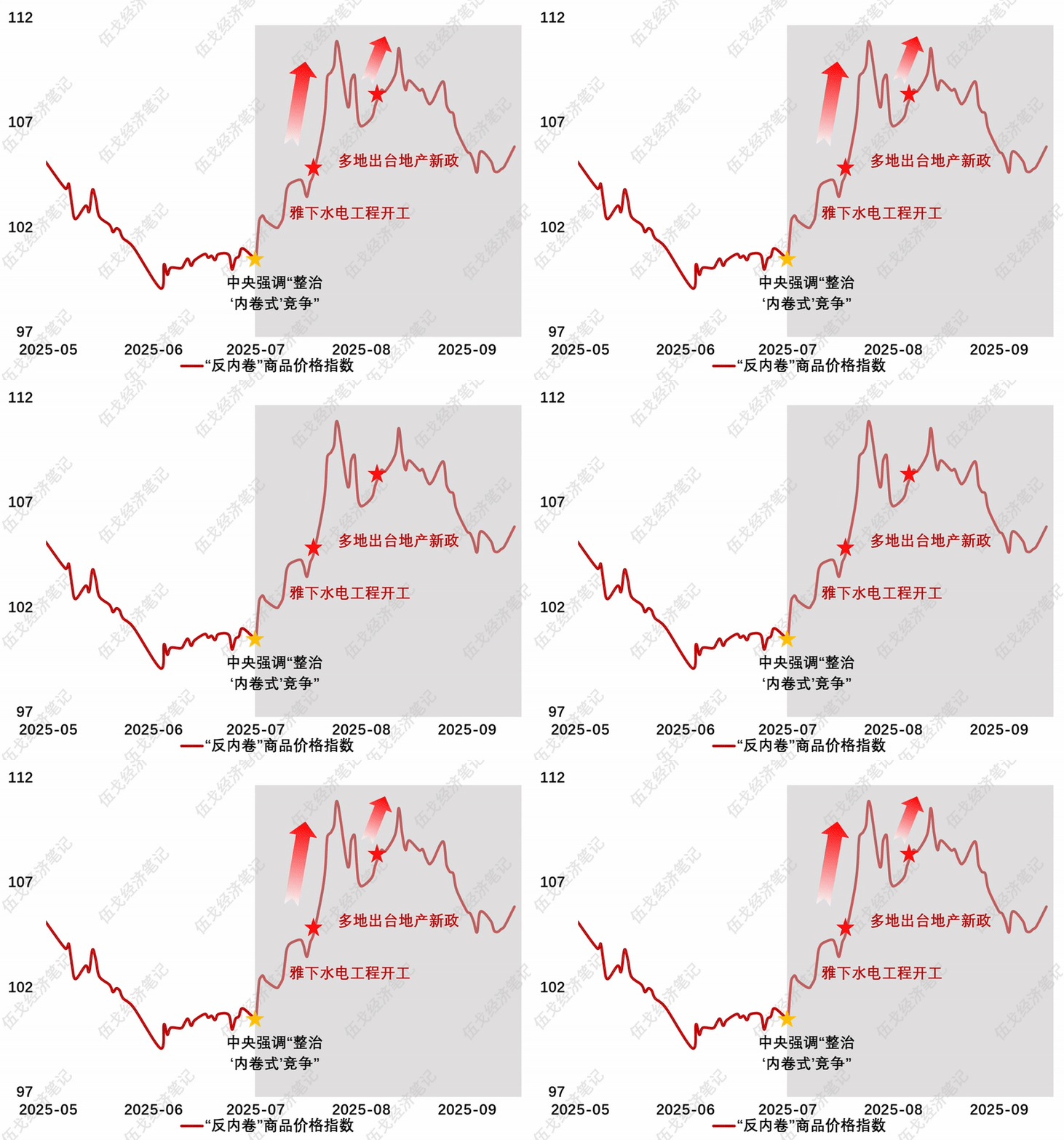
Core Viewpoint - The concept of "anti-involution" emphasizes governance against disorderly competition among enterprises, and is also seen as a crucial tool to reverse the ongoing decline in macro prices. Recent expectations of supply constraints have strengthened, but prices related to "anti-involution" have experienced a short-term spike followed by a decline. The future dynamics will depend on the demand side [2][5][9]. Group 1: Debt Management - Historically, debt management has helped to improve the liquidity situation of local governments and urban investment enterprises to achieve "risk prevention." However, this period of debt management often corresponds with weakened investment demand in infrastructure, which can hinder "stabilizing growth." This explains the divergence between government bond issuance and infrastructure investment trends observed this year [5][9]. - The current round of debt management is accompanied by the clearing of local financing platforms, resulting in negative net financing for urban investment bonds and zero growth in interest-bearing liabilities of urban investment enterprises. This further elucidates the divergence between government bond issuance and infrastructure investment [5][9]. Group 2: Shift in Fiscal Spending - Unlike in the past, the philosophy of fiscal spending is gradually shifting from "investment in objects" to "investment in people." Consequently, various types of social spending have accelerated this year, while infrastructure spending has significantly lagged. "Investment in people" is beneficial for long-term economic development, but its effect on short-term total demand expansion is relatively limited or delayed [7][9]. - Future projections indicate that land transfer income may continue to decline significantly, suggesting persistent debt management pressures. It is also anticipated that "early allocation of part of next year's new local government debt limits and proactive use of debt management quotas" will be necessary [9][10].
8月财政收支放缓,逆周期政策加码必要性上升
Sou Hu Cai Jing· 2025-09-18 08:53
Core Insights - The fiscal data for August indicates a decline in both revenue and expenditure, aligning with weakening economic indicators, suggesting an urgent need for accelerated policy implementation and new investment-promoting measures [1][6] Revenue Summary - From January to August, national general public budget revenue grew by 0.3% year-on-year, with a slight acceleration of 0.2 percentage points compared to the first seven months [1] - In August, the general public budget revenue reached 12,359 billion yuan, reflecting a year-on-year growth of 2.0%, but a deceleration of 0.6 percentage points from the previous month [1] - Tax revenue increased by 3.4% year-on-year, but this was a slowdown of 1.6 percentage points compared to the previous month, while non-tax revenue saw a decline of 3.8%, although the drop was less severe than in the previous month [1][2] Expenditure Summary - General public budget expenditure in August was 18,587 billion yuan, showing a year-on-year increase of 0.8%, but a deceleration of 2.2 percentage points from the previous month [4] - Infrastructure spending saw a notable decline, with four key categories (energy conservation, transportation, urban community affairs, and agriculture) collectively decreasing by 10.1% year-on-year, a significant increase in the rate of decline compared to the previous month [4][5] - Social welfare and health expenditures grew by 10.9% and 2.5% year-on-year, respectively, but both experienced a slowdown compared to the previous month [5] Land and Fund Revenue - Government fund budget revenue in August was 3,325 billion yuan, down 5.7% year-on-year, marking a significant decline of 14.6 percentage points from the previous month [6] - Revenue from state land use rights sales was 2,313 billion yuan, reflecting a year-on-year decrease of 5.8%, with a notable slowdown in the rate of decline compared to the previous month [6] Economic Outlook and Recommendations - Analysts suggest that the current economic downturn is accelerating, indicating a rising necessity for timely policy adjustments to stimulate growth [6][7] - Recommendations include increasing central fiscal expansion and implementing larger fiscal subsidies to stabilize domestic demand [7] - The potential for additional government bond issuance in the fourth quarter is highlighted if budget revenue continues to weaken alongside declining land revenue [7]