风险平价

Search documents
全天候策略再思考:多资产及权益内部的应用实践——数说资产配置系列之十二
申万宏源金工· 2025-06-20 05:35
Group 1 - The core idea of the article revolves around the All-Weather Strategy, which is favored by investors for its robust performance and ability to withstand cyclical fluctuations [1][3] - The All-Weather ETF launched by Bridgewater and State Street in March 2025 has a scale of approximately $204 million as of the end of May, with a leverage level of about 1.8 times [1] - The asset allocation of the All-Weather ETF as of March includes approximately 25% in stocks, 20% in commodities, and 55% in bonds, which is similar to the target allocation of the risk parity product RPAR [3][4] Group 2 - The All-Weather ETF has shown characteristics of a Beta strategy, primarily holding long positions, and has experienced significant fluctuations in the market, with a maximum drawdown of 8.78% shortly after its launch [3][4] - The maximum drawdown of the risk parity ETF RPAR with a leverage level of 1.2 times was about 8%, while the UPAR with a leverage level of 1.7 times had a maximum drawdown of approximately 11% [3] - The All-Weather ETF's drawdown is between the two risk parity ETFs, indicating a strong correlation with similar strategy products [3] Group 3 - The report explores various construction methods for the All-Weather Strategy, starting from the basic risk parity strategy and considering the application of All-Weather thinking within high-correlation equity assets [4][12] - The core idea of risk parity is to equalize the risk contribution of each asset in the portfolio, with a focus on achieving a balanced risk exposure across different macroeconomic scenarios [4][12] Group 4 - The article discusses the concept of "Scenario Parity," which involves identifying asset combinations that benefit from different macroeconomic conditions and allocating them based on risk parity [12][14] - The asset allocation for different macro scenarios includes stocks and commodities during economic growth, nominal bonds and gold during economic downturns, and inflation-protected bonds during rising inflation [12][13] Group 5 - The performance of the "Scenario Parity" strategy has been superior to traditional risk parity, with a static scenario parity combination yielding an annualized return of 5.01% compared to 4.00% for risk parity [17][18] - Dynamic combinations based on macroeconomic factors have shown even better performance, with the dynamic scenario parity strategy achieving an annualized return of 6.57% [17][18] Group 6 - The article emphasizes the importance of macro sensitivity in constructing portfolios, suggesting that using sensitivity measures can lead to more effective asset allocation compared to traditional regression methods [23][24] - The results indicate that portfolios constructed using macro sensitivity measures have better explanatory power and stability compared to those based solely on regression analysis [25][36] Group 7 - The All-Weather strategy can also be applied internally within equity assets, similar to a "barbell strategy," by calculating the exposure of sectors and stocks to various macroeconomic variables [28][29] - The performance of sector-based All-Weather combinations has shown significant improvement, with the scenario parity approach yielding higher returns and lower drawdowns compared to traditional risk parity [34][50]

国泰海通|基金配置:风险逐步释放,配置继续两端走——大类资产配置多维度解决方案(2025年6月)
国泰海通证券研究· 2025-06-19 14:01
Core Viewpoint - The report captures global multi-asset investment opportunities based on market conditions and designs corresponding investment strategies, including equity and bond target allocation, low-volatility fixed income combinations, and global asset allocation strategies [1][2]. Group 1: Investment Strategies - The equity-bond target allocation strategy employs a risk budgeting design to construct a portfolio that achieves the desired allocation level, offering a better long-term risk-return profile compared to fixed allocation strategies [2]. - The low-volatility "fixed income+" strategy combines domestic stocks, bonds, and gold with a target allocation of stocks:gold:bonds = 1:1:4, achieving an annualized return of 6.86% and a volatility of 3.50% over the backtest period from January 1, 2015, to May 30, 2025 [2]. - The global asset allocation strategy I, which includes A-shares, bonds, gold, and US stocks, achieved an annualized return of 11.23% and a volatility of 5.88% over the backtest period from January 2, 2014, to May 30, 2025 [3]. Group 2: Market Outlook and Recommendations - For A-shares, the report suggests maintaining a barbell strategy, focusing on high-quality assets in large caps and trading-type assets in small caps, as risks are gradually released after recent pullbacks [4]. - In the domestic bond market, the report recommends focusing on short-term products while considering medium to long-term interest rate bonds or extending the duration of credit bonds due to ongoing economic pressures [4]. - The report indicates that US stocks may continue to experience wide fluctuations due to uncertainties in economic policies and marginal declines in economic conditions [4]. - Japanese stocks may present short-term investment opportunities due to a positive wage-price spiral and continued foreign capital inflows [4]. - Indian stocks are expected to remain in a volatile pattern due to marginal declines in economic conditions and outflows of foreign capital [4]. - Gold prices are anticipated to experience wide fluctuations due to easing tariff policies and escalating geopolitical conflicts, although the long-term upward trend remains clear [4].

巧用DeepSeek构建多元资产配置框架!“最会用AI做研究的策略首席”王开教你”新套路”
Hua Er Jie Jian Wen· 2025-06-18 12:42
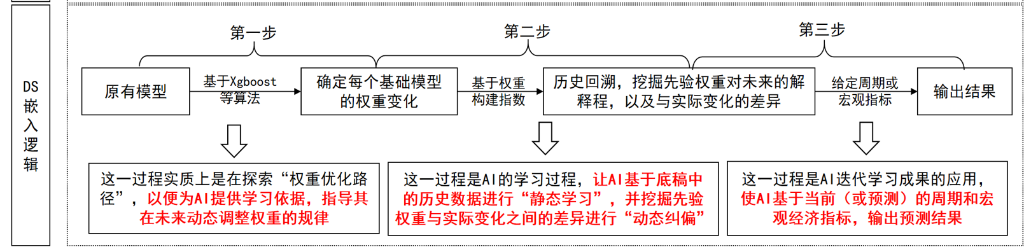
Core Insights - The emergence of DeepSeek in 2025 is revolutionizing the financial industry by enhancing market prediction models with its dynamic self-correction capabilities and advanced data mining abilities [1][10] - Traditional market prediction models often suffer from fixed weight configurations, leading to distorted judgment results, which DeepSeek aims to address [1][10] Group 1: Impact on Financial Industry - DeepSeek's dynamic self-correction ability optimizes weight based on historical data and current realities, improving prediction accuracy [1] - The model's data mining capabilities allow for the discovery of more relevant data, breaking linear thinking and avoiding "black box" issues [1] - DeepSeek enhances overall strategy intelligence through its powerful reasoning and complex decision-making capabilities [1] Group 2: Educational Initiatives - Guosen Securities has reported a 0.27% increase in annualized returns and a 1.08-fold increase in the Sharpe ratio after integrating DeepSeek into their simulation trading [3] - A masterclass titled "DeepSeek Restructures Strategy Investment Paradigm" has been launched to educate users on utilizing DeepSeek for investment [3][7] - The course, led by Wang Kai, covers various topics including asset allocation optimization, risk parity strategies, and understanding policy semantics [3][11] Group 3: Course Content and Structure - The masterclass is divided into eleven parts, focusing on practical techniques for asset allocation and investment strategies using DeepSeek [3][11] - Key topics include the application of AI in multi-asset frameworks, recreating classic investment portfolios, and understanding market timing and sector rotation [11][12] - The course aims to provide insights into the behavior logic behind key financial institution statements and the implications for investment strategies [11][12]


【广发宏观陈礼清】用宏观因子穿透资产
郭磊宏观茶座· 2025-06-14 14:30
Core Viewpoint - The article emphasizes the importance of effectively controlling risks and reducing volatility in asset management, advocating for a "macro factor" risk parity strategy that adapts to changing macroeconomic environments, contrasting it with traditional asset risk parity models [1][13][15]. Group 1: Macro Factor Risk Parity Framework - The construction of a macro factor risk parity framework involves four steps: selecting factors, calculating risk exposure, determining target risk exposure, and matching target risk exposure to asset weights [2][16][17]. - The mainstream methods for constructing macro factors include using low-frequency economic data, principal component analysis (PCA), and regression methods to fit higher-frequency macro factors [3][18][19]. Group 2: Factor Construction and High-Frequency Transformation - The article outlines a refined approach to factor construction, summarizing it as "defining dimensions, screening assets, and high-frequency transformation," which combines the advantages of various methods [3][18][19]. - The transformation of low-frequency macro factors into high-frequency factors is achieved through factor mimicking, which involves regression analysis to identify strong correlations with asset prices [5][29][31]. Group 3: Risk Exposure and Asset Sensitivity - A risk exposure matrix is created to show the sensitivity of assets to different macro variables, using robust OLS regression to capture dynamic features [6][33][34]. - The analysis reveals that large-cap stocks are more sensitive to economic growth, while mid-cap stocks are more sensitive to liquidity conditions [6][35][38]. Group 4: Performance of Different Strategies - The "lightweight" strategy, focusing on growth and inflation factors, has shown an annualized return of 7.7% with a volatility of 5.4% since 2016, outperforming traditional asset risk parity strategies [7][40][41]. - The "three-dimensional" strategy, incorporating M1, BCI, and PPI, has yielded an annualized return of 9.0% with a volatility of 7.8%, indicating a more diversified asset allocation [8][9]. - The "broad-spectrum" strategy, which includes multiple macro factors, has achieved an annualized return of 7.5% with a lower volatility of 4.0%, demonstrating a higher Sharpe ratio compared to simpler models [9][10].

如何平滑波动?这份风格指南表请收好!
雪球· 2025-06-10 08:39
Core Viewpoint - The article emphasizes the importance of constructing a balanced investment portfolio that combines equity and bond assets to manage risk and achieve expected returns. It discusses strategies to reduce portfolio volatility without significantly reducing equity exposure [4][8]. Group 1: Portfolio Construction - The framework for building a portfolio involves a mix of equity and bond assets, where bonds act as a shield and equities as a spear to balance volatility [8]. - The article suggests using a "risk parity" strategy to lower equity weight, thus reducing overall drawdown risk, but notes that this may compromise expected returns [4]. - To mitigate volatility without drastically cutting equity allocation, diversifying across different markets and styles is recommended [5]. Group 2: Index Styles and Characteristics - A detailed document categorizes common indices by style, aiding investors in constructing their portfolios based on style preferences [6]. - The article outlines various index styles, including broad-based indices like the CSI 300 and sector-specific indices that focus on growth, such as the ChiNext and STAR Market indices [16][18]. - It highlights the importance of understanding the characteristics of different indices, such as market capitalization and style orientation, to achieve a balanced portfolio [8][24]. Group 3: Examples of Balanced Portfolios - The article provides examples of balanced portfolios, such as combining the CSI 300 with growth-oriented indices like the ChiNext, illustrating the "barbell strategy" [18]. - It emphasizes the use of core broad-based indices as starting points for portfolio construction due to their diversified nature and balanced style [15]. - The article also discusses the role of strategy indices, which can enhance portfolio diversity and richness by incorporating various investment styles [19][23].

债券产品收益率跌至1.8%以下 私募机构转向跨境复合策略增厚收益
Sou Hu Cai Jing· 2025-06-04 23:48
Group 1 - The current bond market is undergoing significant changes, with risk-free yields continuing to decline and traditional bond investment returns sharply compressed. Many private bond products have seen yields drop below 1.8% in the first five months of this year, contrasting with an average return of 7.91% for the entire previous year. The era of "lying win" is over [1] Group 2 - In response to the reality of significantly reduced yield space, private institutions are upgrading their bond investment strategies. Many are shifting focus towards cross-border composite products to capture cross-market spreads or increase trading frequency to enhance returns. The traditional credit spread has compressed to historical lows, prompting institutions to increase allocations to dim sum bonds and domestic city investment bonds for base returns while controlling product drawdowns [3] Group 3 - The ability to trade effectively is crucial for enhancing returns in a low-interest-rate environment. Both private bond strategy products and public "fixed income +" products require strict drawdown control. The difficulty of active timing and asset switching has increased significantly, making precise timing and asset rotation essential. A disciplined investment strategy with clear risk budgeting and position control frameworks is necessary [4] Group 4 - To improve trading success rates, institutions need to enhance market monitoring and information collection. Keeping a close watch on bond price movements, fund flows, and new bond issuances has become a daily priority. The current bond market lacks trending opportunities and is highly uncertain, often affected by sudden events. Given the unattractive absolute yield levels, institutions must maintain competitive advantages through refined operations and strategic innovations within limited yield spaces [4]

加“好杠杆”变有钱人,加“坏杠杆”变烂赌徒
Hu Xiu· 2025-06-04 12:57
Group 1 - The core idea of the article emphasizes the importance of using "good leverage" in investments, contrasting it with "bad leverage" which amplifies risks without corresponding benefits [2][4][6] - "Good leverage" is defined as a situation where the potential increase in returns significantly outweighs the increase in risk, exemplified by the structure of limited liability companies [8][10] - Successful entrepreneurs often utilize "good leverage" to control substantial wealth while limiting personal financial risk, as seen in the case of Ma Huateng and Tencent [9][10] Group 2 - The article discusses the two necessary conditions for wealth accumulation: "good leverage" and positive cash flow, which together accelerate wealth generation [17] - It highlights that many entrepreneurs face high failure rates in their first ventures, but the limited liability structure encourages more attempts, leading to eventual success [10][11] - The concept of "bad leverage" is illustrated through examples of personal guarantees leading to financial ruin, contrasting with the protective nature of "good leverage" [12][21] Group 3 - The article presents Warren Buffett as an example of someone who effectively uses "premium good leverage" through his investment company, Berkshire Hathaway, which benefits from insurance float [19][20][23] - It explains that Buffett's investment strategy allows him to capitalize on market opportunities during crises, leveraging the unique nature of his funding sources [22][24] - The distinction between professional and amateur investors is made, emphasizing that professional investors should avoid high-risk leverage due to the lack of stable cash flow [26][28] Group 4 - The article introduces two classic examples of "good leverage": leveraged bonds in risk parity strategies and selling put options as a substitute for direct stock purchases [30][32] - It explains how risk parity strategies can enhance returns while managing risk through appropriate asset allocation and leverage [30][31] - The selling of put options is presented as a strategic way to achieve investment goals with lower capital, maintaining the core principles of value investing while generating cash flow [34][37]
海外创新产品周报:另类策略复杂度不断提升-20250603
Shenwan Hongyuan Securities· 2025-06-03 08:15
1. Report Industry Investment Rating No relevant content provided. 2. Core View of the Report The complexity of alternative strategies in the US ETF innovation products is increasing. Gold ETFs have seen a resurgence in inflows, and gold mining ETFs have risen by about 50% this year. US domestic stock funds have experienced outflows, while bond products have maintained high - level inflows [1]. 3. Summary by Relevant Catalogs 3.1 US ETF Innovation Products: Increasing Complexity of Alternative Strategies - Last week, 8 new products were launched in the US, with the complexity of alternative strategies rising. For example, First Trust issued a configuration product with about 60% in covered - call strategy stock products, 35% in bonds, and 5% in commodities. Tidal expanded its Return Stacked series by mixing US stocks with gold/bitcoin strategies [1][6][7]. - Rex issued a NVIDIA options strategy product, providing 105 - 150% exposure and weekly dividends through the covered - call strategy [6]. - Simplify and Kayne Anderson co - issued a credit - bond ETF in the energy and infrastructure sectors, using swaps to control downside risks [7]. 3.2 US ETF Dynamics 3.2.1 US ETF Funds: Gold ETFs Re - enter Inflows - Last week, US stock ETFs had a large - scale re - inflow of over $10 billion, and other asset ETFs also had small inflows. The Nasdaq 100 ETF had the largest inflow. Gold ETFs re - entered inflows during the gold rebound, and short - term bond ETFs had more outflows than long - term bond ETFs [1][8][11]. - Last week, the risk appetite of funds increased, with inflows into broad - based stocks and credit - bond products. Among S&P 500 ETFs, the iShares product had the most outflows [13]. 3.2.2 US ETF Performance: Gold Mining ETFs Up about 50% This Year - Since the beginning of this year, gold has risen by nearly 30%, and gold - related stocks are more elastic. Gold mining ETFs have risen by about 50%, making material - related ETFs the highest - rising sector. Uranium ETFs have also risen by about 20% [1][14]. 3.3 Recent US Ordinary Public Fund Fund Flows - In April 2025, the total amount of non - money public funds in the US was $21.06 trillion, a decrease of $0.12 trillion from March 2025. The scale of US domestic stock products declined by 0.88%, slightly more than the 0.76% decline of the S&P 500 [1][18]. - From May 14th to May 21st, US domestic stock funds had a total outflow of $1.13 billion, with a relatively stable outflow, while bond products maintained a high - level inflow [1][18].
戴弘毅:“固收+”基金交出2025开年震荡市最优解
Sou Hu Cai Jing· 2025-05-30 08:39
Core Viewpoint - The "fixed income +" funds are experiencing a resurgence, with significant net subscriptions and a return to a total scale of over 2 trillion yuan for the first time since 2024 [1][2]. Group 1: Market Performance - As of the end of the first quarter, there were 2,161 "fixed income +" funds with a net subscription of 49.9 billion units, marking a 6.7% quarter-on-quarter increase [1]. - The CSI Convertible Bond Index achieved a year-to-date increase of 3.08%, outperforming the pure bond fund index, which only rose by 0.38% [2]. - Specific funds managed by Huafu Fund, such as Huafu Convertible Bond A and Huafu Anxin A, reported year-to-date returns of 6.13% and 6.45%, respectively, with one-year returns of 11.49% and 11.09% [2]. Group 2: Investment Strategy - The strong performance of "fixed income +" products is attributed to several factors, including the optimization of supply and demand for convertible bonds and positive contributions from bond investments [3]. - The investment strategy emphasizes a systematic approach, focusing on macro hedging and risk parity to manage market volatility and control drawdowns [4]. - The strategy also includes a diversified asset allocation, targeting structural opportunities in AI technology, new consumption, and value dividend stocks [5]. Group 3: Fund Management Insights - Fund manager Dai Hongyi highlights the importance of disciplined investment strategies, including clear risk budgets and dynamic safety margins to manage risk exposure [4][6]. - The investment approach is inspired by Bridgewater's all-weather strategy, tailored to the Chinese market, utilizing macroeconomic indicators to construct diversified asset portfolios [6]. - Huafu Fund has developed a robust team with extensive experience in product creation and investment management, contributing to its growth and innovation in the asset management industry [7].
国泰海通|基金配置:权益稳扎稳打,黄金短期震荡——大类资产配置多维度解决方案(2025年5月)
国泰海通证券研究· 2025-05-13 13:11
Core Viewpoint - The report aims to capture global multi-asset investment opportunities based on market conditions and design corresponding investment strategies, including equity and bond target allocation, low-volatility fixed income combinations, and global asset allocation strategies [1][2]. Group 1: Investment Strategies - The equity-bond target allocation strategy utilizes a risk budget design method to construct a portfolio that achieves the desired allocation level while providing a better long-term risk-return profile compared to fixed allocation portfolios [2]. - The low-volatility "fixed income +" strategy constructs a portfolio with a target allocation of equity: gold: bonds = 1:1:4, achieving an annualized return of 6.91% and a maximum drawdown of -4.92% over the backtest period from January 1, 2015, to April 30, 2025 [2]. - The global asset allocation strategy I, which includes A-shares, bonds, gold, and US stocks, achieved an annualized return of 11.22% with a maximum drawdown of -7.97% over the backtest period from January 2, 2014, to April 30, 2025 [3]. Group 2: Market Outlook and Recommendations - As of May 2025, the report suggests a cautious approach to A-shares due to ongoing tariff impacts, recommending a "barbell strategy" focusing on stable cash flow assets and technology + domestic demand as key themes [5]. - The domestic bond market is expected to benefit from a broad interest rate decline due to the central bank's monetary policy easing, with a focus on short-term securities and potential adjustments in long-term bonds [5]. - For US stocks, the uncertainty surrounding Trump's policies remains, with short-term fluctuations expected as the market reacts to tariff impacts on the US economy [5]. - Japanese stocks may present short-term opportunities due to easing tariffs and improving economic conditions [5]. - Indian stocks are anticipated to experience upward movement due to economic resilience and foreign capital inflows [5][6].