5G通信

Search documents
万华化学,签约高分子龙头!
DT新材料· 2026-01-16 16:05
Core Viewpoint - The strategic cooperation between Wanhua Chemical and Juren New Materials focuses on core raw material supply, quality control, and supply chain optimization to address market fluctuations and quality challenges in the raw material sector [2]. Group 1: Company Overview - Juren New Materials, established in March 2014, is recognized as a national high-tech enterprise and a key leading company in Hunan Province, with multiple rounds of financing from various investors [4]. - The company plans to raise 292 million yuan through an IPO on the Beijing Stock Exchange by June 2025, aimed at funding a 40,000 tons/year special polycaprolactone intelligent chemical plant project and a research center [4]. Group 2: Production Capacity and Achievements - Juren New Materials has become one of the few companies globally capable of industrially producing ε-caprolactone, with its first production line launched in June 2016 [6]. - The company has achieved significant production capacity growth, with ε-caprolactone capacity increasing from 3,500 tons in 2022 to 34,000 tons in 2024 [8]. - In 2023, Juren New Materials successfully trialed a new 50,000 tons/year biodegradable material ε-caprolactone facility, the largest single-unit ε-caprolactone plant globally [6]. Group 3: Market Position and Financial Performance - Juren New Materials holds a 37.21% market share in the domestic ε-caprolactone market as of 2023, making it the largest supplier in this sector [7]. - The company's revenue has shown rapid growth, with figures of 192 million yuan in 2022, 282 million yuan in 2023, and projected 479 million yuan in 2024, alongside net profits increasing from 47.26 million yuan in 2022 to 83.35 million yuan in 2024 [9]. Group 4: Product Applications and Innovations - ε-caprolactone and its derivatives are widely used in various fields, including biodegradable materials, medical applications, and as components in solid-state lithium batteries, showcasing their importance in advanced technology sectors [12]. - The company has developed a range of derivatives from ε-caprolactone, which are utilized in industries such as new energy vehicles, environmental coatings, and biomedical applications [10].



【榆林】首辆无人警用巡逻车启用
Shan Xi Ri Bao· 2026-01-16 00:05
Core Insights - The introduction of the first unmanned police patrol vehicle in Yulin marks a significant advancement in the city's smart policing initiatives [1] - The patrol vehicle integrates advanced technologies such as artificial intelligence, 5G communication, IoT sensing, and autonomous driving, enabling functions like autonomous patrolling, intelligent monitoring, real-time alerts, and remote dispatch [1] Group 1 - The patrol vehicle can autonomously patrol pre-set routes, collect and transmit real-time data and images, and detect anomalies [1] - It utilizes AI algorithms to identify suspicious behaviors, abnormal gatherings, and illegal parking, sending alerts to the command center to enhance police response efficiency [1] - The vehicle can replace some human patrols, providing 24-hour continuous patrols in key areas such as commercial districts, schools, squares, and communities, thus extending police reach and addressing gaps in traditional patrol methods [1] Group 2 - The patrol vehicle is designed to complement, not replace, police personnel, allowing officers to focus on case handling and service work through a "human-machine collaboration" model [2] - Yulin plans to develop a "combined air-ground, human-machine linked" smart defense network, exploring innovative applications of AI and big data in policing to enhance the intelligence level of public security systems [2]
德福科技拟7500万元—1.5亿元回购股份 用于员工持股计划或股权激励
Zheng Quan Shi Bao Wang· 2026-01-15 13:16
Group 1 - The company plans to repurchase shares worth between 75 million to 150 million yuan, with a maximum repurchase price of 53.46 yuan per share, to implement an employee stock ownership plan or equity incentive [1] - The company has obtained a loan commitment of up to 90 million yuan from CITIC Bank to support the share repurchase [1] - The repurchase is based on the company's confidence in its future development and aims to enhance the long-term incentive mechanism and team cohesion [1] Group 2 - The company has terminated the acquisition of 100% equity in CFL, a high-end copper foil enterprise in Luxembourg, due to conflicting conditions imposed by the Luxembourg Ministry of Economy [2] - In lieu of the overseas acquisition, the company plans to acquire at least 51% of Huiru Technology through cash purchase and capital increase, focusing on domestic capacity integration [2] - The company aims to establish a "lithium battery copper foil + electronic circuit copper foil" dual-driven industrial development pattern, targeting high-end products to break the Japanese monopoly [2] Group 3 - The company has signed a cooperation intention with a leading domestic CCL enterprise to supply high-end electronic circuit copper foil products starting in 2026 [3] - In the lithium battery copper foil sector, the company focuses on high-performance products and has established exclusive supply agreements with leading global consumer battery manufacturers [3] - The company has launched three-dimensional structured products for solid-state/semi-solid batteries, which are currently in mass production and being tested by major clients [3]
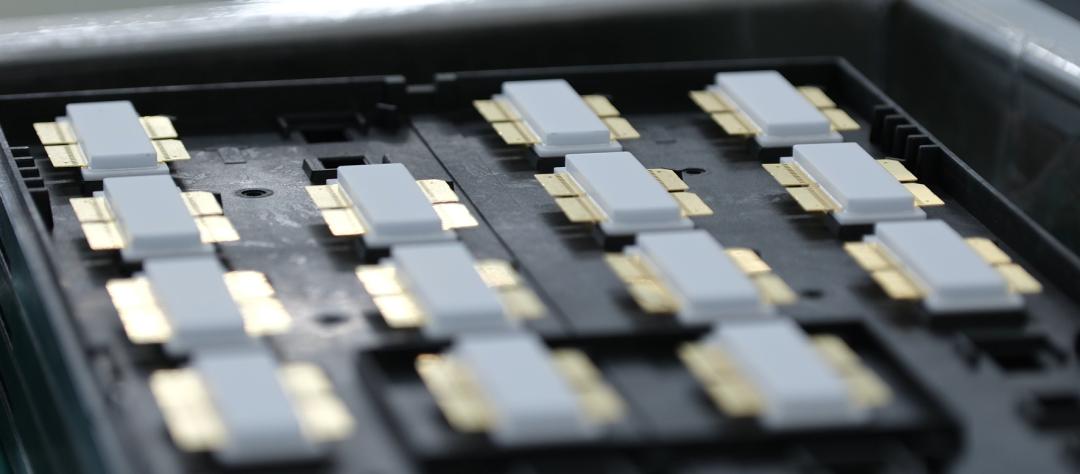
中瓷电子:子公司国联万众的GaN射频芯片主要应用于4G、5G、5G-A等基站通讯领域
Zheng Quan Ri Bao· 2026-01-14 13:44
Group 1 - The core viewpoint of the article highlights that Zhongci Electronics' subsidiary, Guolian Wanzhong, is actively involved in the production of GaN RF chips, which are primarily used in 4G, 5G, and 5G-A base station communication fields [2] - The silicon carbide devices have passed verification and are receiving orders across various application areas, indicating a strong demand and successful market penetration [2]

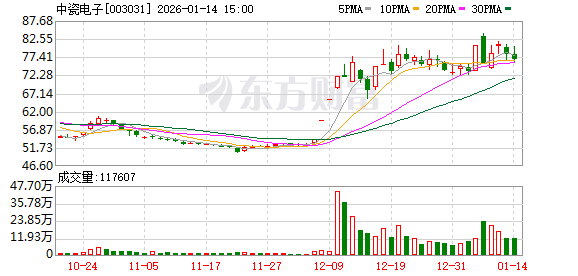
中瓷电子:博威公司募投项目主要面向5G通信、微波通信、卫星通信等领域
Mei Ri Jing Ji Xin Wen· 2026-01-14 10:23
Group 1 - The core viewpoint of the article is that the company is actively engaging with investors regarding its production plans for the Bowei Electronics fundraising project, which focuses on key communication technologies [2] - The Bowei project is primarily aimed at producing products for 5G communication, microwave communication, and satellite communication sectors [2] - The company has indicated that specific progress and future plans for the Bowei project will be disclosed through its designated information disclosure platform [2]
新恒汇(301678) - 301678新恒汇投资者关系管理信息20260114
2026-01-14 09:28
Group 1: Company Overview - New Henghui Electronic Co., Ltd. is focused on the production of eSIM chip packaging and etching lead frame products, primarily serving the IoT and consumer electronics sectors [2][3]. Group 2: Market Competition and Positioning - The eSIM chip packaging market is highly specialized, with limited comparable companies available for reference. New Henghui holds a leading technical advantage over domestic competitors, despite differences in scale and product range compared to international leaders [3]. - The etching lead frame market in mainland China is characterized by a weak manufacturing base and significant capacity shortages, with only a few companies capable of mass production [3]. Group 3: Product Development and Market Demand - New Henghui has developed a range of etching lead frame products, including CuAg, PPF, and Flip Chip series, and plans to introduce automotive-grade products to meet the growing demand in consumer electronics, IoT, automotive electronics, and industrial control sectors [4]. - The company aims to enhance its product structure by focusing on high-end products and deepening strategic partnerships with upstream suppliers, while also investing in new technologies and product lines [4]. Group 4: Strategic Planning - Over the next 3-5 years, the company will concentrate on three main business areas: smart card business, etching lead frame business, and eSIM chip packaging, with a focus on continuous technological and business innovation [5][6]. - The strategy includes enhancing brand recognition, expanding the customer base, and increasing profitability, while also strengthening the marketing team to boost international brand awareness and customer engagement [6].
21亿元,甬矽电子拟在马来西亚建封测基地
Xin Lang Cai Jing· 2026-01-13 11:33
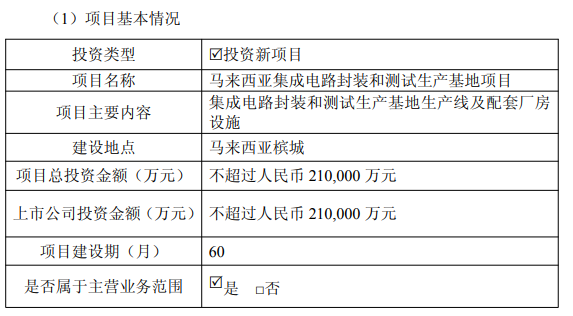
Core Viewpoint - Company plans to invest in a new integrated circuit packaging and testing production base in Malaysia, with a total investment not exceeding 2.1 billion RMB, accounting for approximately 13.68% of the company's total assets [1][5]. Investment Project Details - Investment Type: New Project [2] - Project Name: Integrated Circuit Packaging and Testing Production Base in Malaysia [2] - Main Content: Production lines and supporting facilities for integrated circuit packaging and testing [2] - Location: Penang, Malaysia [2] - Total Investment Amount: Not exceeding 210,000 million RMB [2] - Company Investment Amount: Not exceeding 210,000 million RMB [2] - Construction Period: 60 months [2] - Within Main Business Scope: Yes [2] Strategic Importance - Malaysia holds a significant position in global semiconductor manufacturing, particularly in packaging and testing, with Penang being a key hub attracting major international chip manufacturers [3][7]. - The project aims to leverage the local market environment and industrial foundation to expand the company's overseas market scale and enhance revenue levels, thereby consolidating and improving the company's industry position [3][7]. Financial Performance Forecast - Company expects to achieve operating revenue of 4.2 billion to 4.6 billion RMB in 2025, representing a year-on-year increase of 16.37% to 27.45% [8]. - Projected net profit for 2025 is estimated to be between 75 million and 100 million RMB, with a year-on-year growth of 13.08% to 50.77% [8]. - Expected net profit after deducting non-recurring items for 2025 is projected to be between -50 million and -30 million RMB [8]. Market Dynamics - The global semiconductor industry continues to grow, driven by demand in artificial intelligence, high-performance computing, and data center infrastructure [10]. - The company benefits from the sustained growth of overseas major clients and the development of domestic core SoC customer groups, maintaining revenue growth [10]. - An increase in the proportion of advanced packaging products and optimization of product structure, along with scale effects, have contributed to a decrease in unit manufacturing costs and period expense ratios, driving net profit growth [10].

消费电子出海国别机会洞察
特易资讯· 2026-01-13 06:10
1. Report Industry Investment Rating No relevant content provided. 2. Core Viewpoints of the Report - The consumer electronics industry will undergo a comprehensive upgrade from products to ecosystems. Technological advancements will make devices smarter and more flexible, and environmental protection will become a key requirement. The global consumer electronics market is rapidly differentiating, with emerging markets presenting new opportunities [64]. - Chinese consumer electronics exports face new development opportunities in 2024, with emerging markets playing an increasingly important role. Green compliance and local production are crucial for companies to break through [4]. 3. Summary by Directory 3.1 China's Overall Consumer Electronics Export Situation - In 2024, China's consumer electronics exports had new opportunities. For example, the total export value of laptops was about $78.8 billion, a year - on - year increase of 4.1%. Chinese consumer electronics led globally with full - industrial - chain advantages and technological iteration capabilities [4]. - Emerging markets such as Southeast Asia, Latin America, and the Middle East had increasing contributions. Smartphones dominated in some emerging markets, while wireless headphones and power banks grew explosively in Africa and Southeast Asia through cross - border e - commerce. Green compliance and local production became key factors for companies [4]. 3.2 Export Statistics of Major Chinese Consumer Electronics from 2022 to June 2025 3.2.1 Smartphones - From 2022 to 2024, the total export value of smartphones decreased slightly from $137.31 billion to $133.08 billion. In the first half of 2025, the main export destinations were Hong Kong, China, the US, and Japan, accounting for 47.7% of the total export volume. Japan and the Netherlands had relatively large export increments [6]. 3.2.2 Tablets - From 2022 to 2024, the total export value of tablets decreased from $30.55 billion to $23.34 billion. In the first half of 2025, the main export destinations were Hong Kong, China, the US, and Japan, accounting for 58.5% of the total export volume. Singapore and Japan had relatively large export increments [9]. 3.2.3 Laptops - From 2022 to 2024, the total export value of laptops decreased and then remained stable, from $95.94 billion to $78.85 billion. In the first half of 2025, the main export destinations were the US, the Netherlands, and Japan, accounting for 43.2% of the total export volume. Japan and India had relatively large export increments [12][15]. 3.2.4 Wireless Headphones - From 2022 to 2024, the total export value of wireless headphones first decreased and then increased, from $10.1 billion to $9.85 billion. In the first half of the 2025, the main export destinations were the US, the Netherlands, and Hong Kong, China, accounting for 42.5% of the total export volume. Australia and Germany had relatively large export increments [18]. 3.2.5 Power Banks - From 2022 to 2024, the total export value of power banks decreased from $2.13 billion to $1.86 billion. In the first half of 2025, the main export destinations were the US, Germany, and the Netherlands, accounting for 22% of the total export volume. Mexico and Thailand had relatively large export increments [21][24]. 3.2.6 Multi - Speaker Speakers - From 2022 to 2024, the total export value of multi - speaker speakers remained stable, slowly decreasing from $4.36 billion to $4.04 billion. In the first half of 2025, the main export destinations were the US, the Netherlands, and Germany, accounting for 35.8% of the total export volume. The Netherlands and Poland had relatively large export increments [27]. 3.3 Analysis of Consumer Electronics Procurement and Supply in Emerging Markets from January to June 2025 3.3.1 Russia - From January to June 2025, there were 156 purchasers, 202 suppliers, 5,900 transactions, and the transaction amount was about $400 million. The average transaction amount per purchaser was $2,589,234, with an average of 37 transactions and an average transaction cycle of 142 days. The average transaction amount per of the top 800 suppliers was $1,971,085, with an average of 27 transactions and an average transaction cycle of 145 days [34]. 3.3.2 Mexico - From January to June 2025, there were 164 purchasers, 316 suppliers, 4,500 transactions, and the transaction amount was about $200 million. The average transaction amount per purchaser was $1,217,639, with an average of 28 transactions and an average transaction cycle of 121 days. The average transaction amount per supplier was $581,756, with an average of 12 transactions and an average transaction cycle of 142 days [37]. 3.3.3 Vietnam - From January to June 2025, there were 1,000 purchasers, 2,000 suppliers, 70,000 transactions, and the transaction amount was about $2.25 billion. The average transaction amount per purchaser was $2,244,470, with an average of 69 transactions and an average transaction cycle of 65 days. The average transaction amount per of the top 1000 suppliers was $2,244,746, with an average of 67 transactions and an average transaction cycle of 64 days [44]. 3.4 Briefing on Relevant Policies for Consumer Electronics Imports in Emerging Markets 3.4.1 Russia - It is the 11th largest economy globally, with a growing consumer electronics market but relying on imports. China is the main source of its consumer electronics imports. It has differential tariff policies, requires EAC certification, and restricts parallel imports. Importers are required to use rubles for settlement [52][58]. 3.4.2 Mexico - It is the second - largest consumer electronics market in Latin America. There is a significant "near - shore manufacturing" trend. It has zero - tariff policies for locally assembled products, and all products need NOM certification. There are also tax incentives for new - energy logistics and solar energy transformation in warehousing [55][56]. 3.4.3 Vietnam - It is the fastest - growing consumer electronics market in Southeast Asia. It has differential tariff policies, requires import model registration, and offers tax incentives for foreign technology companies [60]. 3.5 Future Development of the Global Consumer Electronics Industry - The industry will experience a comprehensive upgrade from products to ecosystems. Technology will make devices smarter, and environmental protection will be a hard requirement. The global market pattern is differentiating, and companies need to adopt different strategies in different markets [64]. 3.6 Appendices - Include the top 50 lists of consumer electronics purchasers in Russia, Mexico, and Vietnam [66][68][70].
全球及中国一体成型电感行业头部企业市场占有率及排名调研报告
QYResearch· 2026-01-13 02:44
Core Viewpoint - The integrated molding inductor market is experiencing steady growth, driven by advancements in technology and increasing demand in various sectors such as 5G communication, electric vehicles, and consumer electronics [4][11]. Market Size and Forecast - The global integrated molding inductor market is projected to reach approximately $4.186 billion by 2024, with a compound annual growth rate (CAGR) of about 9.83% from 2020 to 2024. By 2031, the market size is expected to approach $8.538 billion, with a future six-year CAGR of 10.23% [4]. - In China, the market holds about 46.81% of the global share, with a projected market size of approximately $1.960 billion by 2024 and a CAGR of 11.63% from 2020 to 2024. By 2031, it is expected to grow to $4.505 billion, with a CAGR of 11.97% from 2025 to 2031 [8]. Industry Concentration Analysis - The integrated molding inductor industry is dominated by leading passive component manufacturers such as QianKun Technology, TDK, Walsin, and Yageo. These companies maintain a strong position due to large-scale production and comprehensive product lines, particularly in the automotive and communication markets. Some manufacturers from mainland China and Taiwan are also entering the market, focusing on mid-range and cost-effective products [9]. Driving Factors and Opportunities - The demand for integrated molding inductors is expanding due to the rapid development of 5G communication, electric vehicles, consumer electronics, the Internet of Things, and industrial automation. Compared to traditional inductors, integrated molding inductors offer advantages such as compact size, high power density, reliability, and excellent EMI performance, making them suitable for high-frequency and high-current applications [11]. - Key applications include smartphones, wearable devices, servers, high-performance computing chips, and DC-DC converters in electric vehicles. The adoption of new power semiconductors like SiC and GaN will further accelerate the penetration of integrated molding inductors [11]. Challenges and Obstacles - The industry faces challenges such as technical barriers and the need for significant R&D investment, as the production of integrated molding inductors involves complex processes and materials. Manufacturers must continuously innovate materials and improve processes to meet the increasing demand for high-frequency and high-efficiency products [12]. - Cost control and challenges in scaling production are significant, as the production equipment is expensive, and material costs are high. The overall price competition is intense, with customers demanding high performance at lower costs [12]. - The market is also sensitive to fluctuations in downstream application cycles and economic conditions, particularly in sectors like consumer electronics and electric vehicles, which can directly impact inductor demand [12]. Policy Analysis in China - The Chinese government has been actively supporting the electronic components industry, encouraging industrialization and providing a favorable environment for high-tech developments. The electronic information industry is a strategic pillar of the economy, and policies under the 14th Five-Year Plan are expected to stimulate demand for inductors in automotive electronics and consumer electronics [14][15].
恩智浦“退场”,射频PA市场格局重构
3 6 Ke· 2026-01-12 05:48
Core Insights - NXP's decision to exit the RF power amplifier (PA) business marks a significant shift in the market landscape and global supply chain, creating historic opportunities for domestic manufacturers with technical capabilities [1][5][21] Industry Dynamics - The RF PA industry has been a focal point of competition during the transition from 3G to 5G, with NXP's strategic moves reflecting the challenges posed by rapid technological advancements and market demands [2][3] - The shift from LDMOS to GaN-on-SiC technology has become essential for meeting the higher performance requirements of 5G applications [2][3] NXP's Strategic Shift - NXP's acquisition of Freescale in 2015 laid the foundation for its dominance in the 4G market, but the company struggled to adapt to the rapid changes in the 5G landscape, leading to its decision to close the ECHO GaN wafer fab by Q1 2027 [2][4][3] - The company faced declining revenues in its RF business due to mismatches between product offerings and market demands, compounded by internal resource allocation pressures from its automotive and industrial segments [4][5] Market Impact - NXP's exit is expected to create a market space of approximately $150-300 million annually, benefiting competitors like Sumitomo Electric and opening opportunities for domestic firms such as Huatai Electronics [5][7][19] - The withdrawal of NXP has triggered supply chain concerns among dependent manufacturers, leading to increased costs and potential supply interruptions [5][7] Domestic Opportunities - Huatai Electronics is positioned to capitalize on the market gap left by NXP, having developed a comprehensive range of alternative products that meet the needs of key applications in base stations and ISM devices [9][14] - The company emphasizes its vertical integration strategy, which enhances supply chain security and allows for rapid response to market demands [13][19] Future Outlook - The RF PA market is expected to stabilize as new growth drivers emerge, including the commercialization of new frequency bands and advancements in 5G-A technology [17][20] - Huatai Electronics aims to capture market share from NXP's exit while competing with leading global PA manufacturers, focusing on high-value, high-reliability products [20][21]