估值修复

Search documents
重大推荐医疗器械板块,关注反内卷、估值修复和拐点机会
2025-07-28 01:42
Summary of Key Points from the Conference Call Industry Overview - The medical device sector is experiencing accelerated approval policies, which are beneficial for the industry, driven by innovation, internationalization, and mergers and acquisitions [1][2] - Companies like Xinmai Medical, Nanwei Medical, and Chunli Medical are actively transforming and showing significant growth in international business, contributing to valuation recovery in the sector [1][2] Core Insights and Arguments - The optimization of centralized procurement policies is shifting focus from low prices to supporting innovative medical devices, which is expected to benefit the development and valuation of related companies [2][5] - The orthopedic industry is seeing a shift towards increased domestic production rates and concentration among leading companies, with significant growth potential in overseas markets [3][10] - Specific companies such as Xinmai Medical and Nanwei Medical are experiencing valuation recovery, with projected valuations around 22-25 times for 2025 [4][6] Future Opportunities in the Medical Device Industry - Future opportunities in the medical device industry are primarily in innovation, internationalization, and frequent mergers and acquisitions [5][7] - High-value consumables are expected to benefit from policy support, particularly in areas like aortic stents, digestive interventions, and minimally invasive surgical consumables [7][9] Performance Expectations for 2025 - The medical device sector is expected to show positive growth across various sub-sectors in 2025, with companies like Huatai Medical and Weidian Medical anticipated to see performance turning points [8][9] - Companies such as Union Medical and Mindray are expected to achieve significant growth in the third quarter, driven by improved bidding data and product performance [8][9] Specific Company Recommendations - Recommended companies include Xinmai Medical, Nanwei Medical, and Guichuang Tongqiao, which are expected to perform well due to their growth potential and favorable market conditions [6][20] - In the Hong Kong market, companies like Guichuang Tongqiao and Weikang Medical are highlighted for their strong performance and innovation capabilities [18][19] Notable Trends and Developments - The IVD sector is facing challenges due to previous rounds of centralized procurement, but there is optimism for gradual improvement in performance in the latter half of the year [28][29] - The high-value consumables sector, particularly in electrophysiology, is expected to see significant growth, with companies like Huatai Medical benefiting from product launches and market acceptance [26][27] Conclusion - The medical device industry is poised for recovery and growth, driven by policy support, innovation, and international expansion. Investors are encouraged to focus on companies demonstrating strong growth potential and favorable market dynamics [1][5][20]





3600点,牛市新起点
Sou Hu Cai Jing· 2025-07-24 11:21
Group 1 - The current market is in a structural deepening phase driven by incremental capital, with a clear path of "policy catalysis - capital inflow - valuation repair" for sector rotation [1][3] - On July 24, the A-share market continued its strong trend, with major indices rising across the board; the ChiNext Index stood out with a 1.5% increase, indicating a sustained preference for growth-oriented companies [1] - The Shenzhen Component Index and the STAR 50 Index rose by 1.21% and 1.17% respectively, while the Shanghai Composite Index increased by 0.65% to 3605.73 points, marking its first time above the 3600-point threshold since January 2022 [1] Group 2 - In the A-share market, the leading sectors are driven by both policy catalysis and capital rotation; the Hainan Free Trade Zone concept surged due to the implementation of zero-tariff policies, with the proportion of zero-tariff items rising to 74% [2] - The rare earth and lithium sectors continued to perform strongly, supported by the global restructuring of the rare earth industry and the international certification of the "Nd-Huanghe Mine" by Chinese research teams, which provides new logic for resource value reassessment [2] - The beauty and personal care sector led the industry with a 3.1% increase, reflecting the combined effects of consumer upgrade demand and valuation repair strategies in oversold segments [2]
上证指数突破3600点,市场这样预判→
第一财经· 2025-07-23 07:18
Core Viewpoint - The current A-share market is exhibiting a typical slow bull characteristic, with the Shanghai Composite Index breaking through the 3600-point psychological barrier, indicating potential for further upward movement [1][2]. Group 1: Market Performance - On July 23, the Shanghai Composite Index closed at 3608.58 points, up 0.75%, while the Shenzhen Component Index rose 0.31% to 11134.07 points, and the ChiNext Index increased by 0.72% to 2327.48 points [1]. - The trading volume in the Shanghai and Shenzhen markets reached 1.16 trillion yuan, a slight increase of 6 billion yuan compared to the previous day [1]. Group 2: Market Characteristics - The current market trend is characterized by a steady upward movement along the moving average system, with a relatively gentle overall slope [1]. - The average daily trading volume is maintaining a reasonable range around 1.5 trillion yuan, with recent days seeing traditional cyclical sectors rebound significantly, pushing single-day trading volume to 1.8 trillion yuan [1][2]. Group 3: Investment Opportunities - The current market rally is fundamentally a valuation recovery, with four main investment themes identified: innovative drugs, energy metals, artificial intelligence, and sectors related to the Yaxia Hydropower Station project [2]. - Analysts suggest that the recent performance of previously overproduced cyclical industries (such as photovoltaics, steel, and chemicals) may signal the onset of a mid-term bull market, driven by valuation improvements [2]. Group 4: Economic Outlook - The economic environment is expected to maintain a weak recovery trend, with pressures on exports due to declining external demand, while consumption, infrastructure, and manufacturing investment growth may remain high [3]. - Corporate earnings are in a recovery cycle, and liquidity is expected to remain loose, with potential increases in capital inflows from foreign investments, financing, and newly issued funds into the A-share market [3].


上证指数突破3600点,市场预判后市仍可看高一线|市场观察
Di Yi Cai Jing· 2025-07-23 04:50
慧研智投科技有限公司投资顾问李谦向第一财经分析,近期A股市场呈现典型慢牛特征,上证指数已突 破3600点整数关口。从技术面观察,本轮行情呈现两大核心特征:一是股指沿均线系统维持稳健上行趋 势,整体运行斜率较为平缓;二是市场成交量保持温和放大态势,日均成交维持在1.5万亿元左右合理 区间;受雅下水电站项目利好消息刺激,近两个交易日传统周期板块放量反弹,单日成交放大至1.8万 亿元水平。 李谦认为,与2024年9月的脉冲式行情不同,本轮上涨更具可持续性,突破3600点重要心理关口之后, 在当前良性的板块轮动格局下,指数仍具上行空间,有望继续上攻去年10月3674点高点。从投资主线来 看,本轮行情本质是估值修复行情,创新药、能源金属、人工智能及雅下水电站相关板块构成当前市场 四大投资主线,建议投资者可关注这些领域的结构性机会。 信达证券策略分析师樊继拓判断,之前产能过剩的周期行业(光伏、钢铁、化工等)近期开始有所表 现,这种扩散可能是牛市进入中期主升浪的信号,背后主要原因可能来自估值。牛市初期,股市增量资 金较少、涨幅慢,此时能够上涨的板块主要是少部分有产业逻辑有业绩的方向,但进入牛市中后期,居 民资金会增多,大部 ...
后市震荡向上或是主基调,持续大涨的部分题材股可择机适度逢高减持
British Securities· 2025-07-23 02:29
Core Viewpoints - The market is expected to maintain a strong upward trend with structural opportunities, particularly in sectors such as photovoltaic, batteries, energy storage, construction materials, coal, steel, and non-ferrous metals [2][4][9] - The recent surge in traditional sectors is driven by multiple factors, including the significant investment of approximately 1.2 trillion yuan in the Yarlung Tsangpo River downstream hydropower project, which is anticipated to boost related industries and overall economic sentiment [3][4][10] Market Overview - On July 19, the Yarlung Tsangpo River downstream hydropower project officially commenced, with a total investment of around 1.2 trillion yuan, leading to a notable increase in related stocks [7][8] - The A-share market showed a positive trend, with major indices experiencing fluctuations but ultimately closing higher, indicating a robust market sentiment [6][12] Sector Analysis - The traditional sectors, including construction materials, engineering machinery, steel, and coal, have shown strong performance, attributed to the positive impact of the hydropower project and supportive government policies aimed at stabilizing growth in key industries [8][10] - The report emphasizes the importance of focusing on low-valuation leading companies that are directly benefiting from large-scale infrastructure projects, as these are expected to continue their upward trajectory [4][11] Investment Strategy - Investors are advised to selectively reduce holdings in stocks that have seen significant increases while maintaining positions in those that are lagging, as market rotation opportunities may arise [4][11]
基金南下抢筹,港股银行和创新药最受青睐!
券商中国· 2025-07-22 07:51
Core Viewpoint - The Hong Kong stock market has shown a strong rebound this year, with public funds increasingly investing in Hong Kong stocks, particularly in high-growth sectors like innovative pharmaceuticals and high-dividend sectors like banking [1][2]. Fund Positioning - Nearly 1,800 funds increased their Hong Kong stock positions in the second quarter, with some funds raising their allocations by over 50 percentage points. Notable examples include the Green Hong Kong Stock Selection A fund, which raised its Hong Kong stock allocation from 37% to 94.87%, and the Penghua Shanghai-Shenzhen-Hong Kong Internet fund, which increased its allocation from 22.87% to 77.85% [2][3][4]. Investment Focus - The primary sectors for increased investment are innovative pharmaceuticals and banking, reflecting a barbell strategy of high growth and high dividends. Funds have significantly increased their holdings in companies like 3SBio, China National Pharmaceutical Group, and various high-dividend bank stocks [5][6]. Market Dynamics - The influx of southbound funds is driving a recovery in Hong Kong stock valuations. The Hang Seng Technology Index's dynamic P/E ratio is relatively low compared to some overseas market indices, creating an attractive valuation opportunity. Additionally, the correlation of Hong Kong tech stocks with domestic economic recovery enhances their appeal [7]. Future Outlook - Analysts suggest that the market may experience a "seesaw effect" in the near term, with alternating rises in technology and high-dividend sectors. The recent improvement in market sentiment, driven by macro policies and sector breakthroughs, is expected to stabilize and gradually enhance Hong Kong stock valuations [7].

恒指创逾3年半新高,港股互联网板块迎“估值修复x业绩改善”双击
Mei Ri Jing Ji Xin Wen· 2025-07-22 05:34
Group 1 - The Hang Seng Index saw a slight increase of 0.25%, closing at 25,057.11 points, with the Hang Seng Tech Index and Hang Seng China Enterprises Index also showing minor gains [1] - The market regulator held discussions with major platforms like Ele.me, Meituan, and JD.com, urging them to standardize promotional activities and foster a healthy ecosystem for consumers, merchants, delivery riders, and platform companies [1] - Following the discussions, extreme promotional activities such as "0 yuan purchase" have significantly decreased, and excessive subsidies like "0 yuan tea vouchers" have nearly vanished in some regions [1] Group 2 - The ongoing competition in the food delivery sector has led to widespread profit declines among major platform companies, with expectations of continued competition until the end of 2025 or even into 2026 [1] - Regulatory intervention aims to prevent "involutionary competition" in the industry, encouraging companies to return to the essence of service and ensuring sustainable development [1] - The removal of major negative factors suppressing corporate profits presents a dual opportunity for sector improvement and valuation recovery, with tech leaders in Hong Kong transitioning from a "value trap" to a "growth hotspot" [1] Group 3 - The Hang Seng Internet ETF (513330) supports T+0 trading and focuses on the internet platform economy, including major players like Alibaba, JD.com, Tencent, Meituan, Kuaishou, and Baidu [2] - The ETF has a high DeepSeek content of 86%, showcasing a strong focus on "new consumption + new technology," making it a suitable tool for investors looking to invest in AI applications and core assets in the "AI + internet" space [2]


后市A股震荡向上或是主基调,关注传统板块中绩优低估值龙头
British Securities· 2025-07-22 02:56
Core Viewpoints - The report indicates that the A-share market is expected to maintain a strong upward trend with structural opportunities, particularly in traditional sectors such as photovoltaic, battery, energy storage, building materials, coal, steel, and non-ferrous metals [1][8][10] - The recent surge in the A-share market is attributed to the official commencement of the Yarlung Tsangpo River downstream hydropower project, which has a total investment of approximately 1.2 trillion yuan, significantly boosting market sentiment and related industries [2][6][10] - The report emphasizes that the collective strength of traditional sectors is a result of multiple factors, including valuation recovery, policy support, and liquidity easing, with a focus on sectors that are direct beneficiaries of large-scale infrastructure projects [2][9][10] Market Overview - On the day of the report, the three major indices of the A-share market opened high and continued to rise, with the Shanghai Composite Index and the ChiNext Index reaching new highs for the year, while the Shenzhen Component Index surpassed the 11,000-point mark [1][5][8] - The trading volume for the day was approximately 1.7 trillion yuan, indicating active market sentiment and a favorable environment for profit-making [5] Sector Analysis - The Yarlung Tsangpo hydropower project is expected to directly benefit multiple industries, including building materials, steel, non-ferrous metals, power equipment, and engineering machinery, due to its massive investment scale [2][6][9] - The report highlights that the construction of the hydropower project will not only stimulate the hydropower sector but also promote economic development in Tibet and nationwide employment [1][10] - The report notes that traditional sectors are currently experiencing a valuation recovery, with many sectors, such as cement, benefiting from supply-side optimization through production cuts and increased industry concentration, creating a "de-involution" effect [2][9]
嘉实新能源新材料股票A:2025年第二季度利润470.57万元 净值增长率0.46%
Sou Hu Cai Jing· 2025-07-21 04:33
Core Viewpoint - The report highlights the performance of the Jiashi New Energy Materials Stock A fund, indicating a profit of 4.7057 million yuan in Q2 2025, with a net asset value growth rate of 0.46% and a total fund size of 2.059 billion yuan as of the end of Q2 2025 [2][15]. Fund Performance - As of July 18, 2025, the fund's one-year cumulative net value growth rate is 33.18%, ranking 7th out of 44 comparable funds [3]. - The fund's three-month net value growth rate is 8.86%, ranking 34th out of 44 comparable funds, and the six-month growth rate is 6.97%, ranking 22nd out of 44 [3]. - Over the past three years, the fund has experienced a net value growth rate of -44.60%, ranking 21st out of 31 comparable funds [3]. Risk and Return Metrics - The fund's Sharpe ratio over the past three years is -0.3224, ranking 18th out of 31 comparable funds [8]. - The maximum drawdown over the past three years is 63.37%, ranking 3rd out of 31 comparable funds, with the largest single-quarter drawdown occurring in Q3 2022 at 24.88% [10]. Investment Strategy - The fund manager indicates that corporate profit recovery is similar to historical cycles, suggesting potential for exceeding expectations in various industries due to suppressed capital expenditures [2]. - The fund has maintained a high average stock position of 91.71% over the past three years, with a peak of 94.62% at the end of 2023 [13]. - The fund's investment focus is on sectors related to new energy lithium batteries and intelligent driving, adjusting the portfolio dynamically based on market fluctuations [2]. Holdings Concentration - The fund has a high concentration of holdings, with the top ten stocks including Ningde Times, Putailai, Yiwei Lithium Energy, and others, indicating a stable selection of investment targets [18].





易方达张坤大调仓!减持腾讯,“狂饮”白酒,后市聚焦“估值修复”
Sou Hu Cai Jing· 2025-07-21 03:57
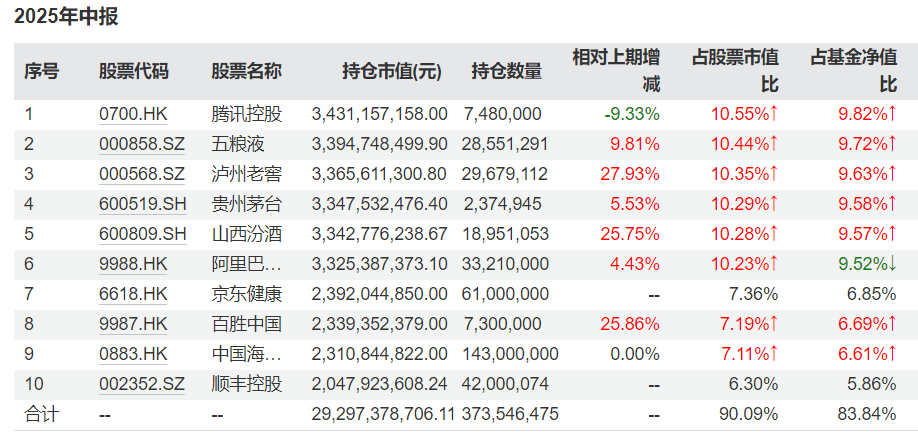
Core Viewpoint - Zhang Kun, managing funds at E Fund, has made significant adjustments in the second quarter, notably increasing positions in liquor stocks while reducing holdings in Tencent Holdings. He emphasizes that the timing of market changes is less important than understanding what will happen in the future [1][11]. Fund Adjustments - The top ten holdings of E Fund have seen notable changes, with new additions including JD Health and SF Holding, while Meituan-W and Yanghe Brewery have exited the top ten [2][3]. - The fund has primarily reduced its stake in Tencent Holdings, while increasing positions in several liquor stocks, including Wuliangye and Moutai [3][5]. Holdings Data - As of the end of Q2, the fund's total holdings in Tencent Holdings decreased by 9.33%, while holdings in Wuliangye increased by 9.81%, and in Luzhou Laojiao by 27.93% [4]. - The fund's total assets under management decreased to below 20 billion shares, with a scale of approximately 349 billion yuan [1]. Market Outlook - Zhang Kun believes that the current valuations of the companies in the portfolio reflect expectations of future profit declines. He asserts that low valuations combined with substantial shareholder returns are attractive for long-term investors [11][12]. - He expresses confidence in the potential for economic growth, suggesting that the pessimistic outlook on domestic demand and the economy is unwarranted. He anticipates that market forces and technological advancements will contribute to sustained economic growth [11][12].