
算力

Search documents
OpenAI年化营收突破两百亿美元,今年专注AI应用落地
Nan Fang Du Shi Bao· 2026-01-20 13:04
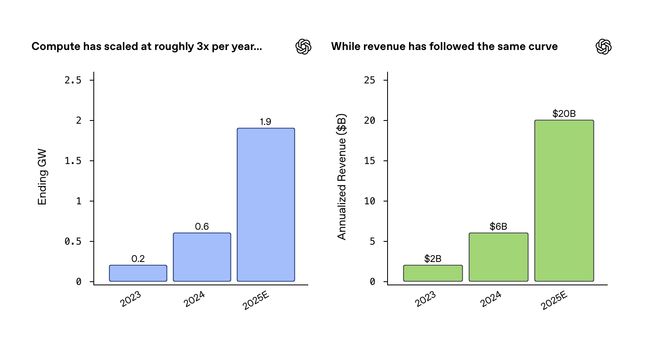
Core Insights - OpenAI's CFO Sarah Friar reported that the company's annualized revenue is projected to exceed $20 billion by 2025, a significant increase from approximately $6 billion in 2024 [1][3] - The company plans to focus on the practical application of AI technology in sectors such as healthcare, science, and enterprise in 2026 [1] Group 1: Revenue and Growth - OpenAI's computing power is expected to grow from 0.2 gigawatts in 2023 to 1.9 gigawatts by 2025, which is a key driver for revenue growth [3] - Annualized revenue is anticipated to rise from about $2 billion in 2023 to over $20 billion in 2025 [3] - The company is experiencing record-breaking weekly and daily active user numbers, indicating unprecedented growth [3] Group 2: Commercialization and Market Strategy - OpenAI is shifting focus from technology development to commercial applications, addressing the gap between AI capabilities and real-world needs, particularly in urgent sectors like healthcare and science [3][4] - The company is testing advertising on ChatGPT to sustain free services and cover high computing costs, with the aim of avoiding a larger digital divide [4] - OpenAI is diversifying its computing supply ecosystem, moving away from reliance on a single supplier, which supports its transformation strategy [4] Group 3: Future Developments - OpenAI plans to release its first hardware device in the second half of 2026, although specific details about the device have not been disclosed [4]

光环新网:截至目前算力业务规模已超过4000P
Zheng Quan Ri Bao· 2026-01-20 12:37
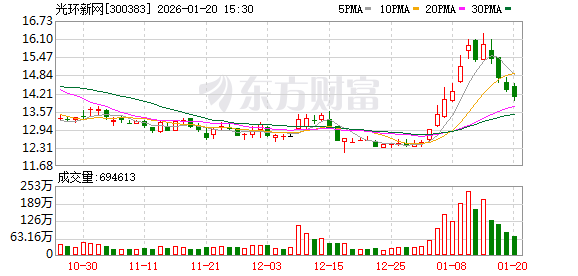
Group 1 - The company, Guanghuan New Network, has deployed high-performance computing hardware at its Beijing and Tianjin data centers to provide advanced computing services [2] - The scale of the computing business has exceeded 4000P, indicating significant growth in their service capacity [2] - The annual contract value for the computing services has surpassed 100 million yuan, reflecting strong demand and revenue generation [2]

东威科技2025年净利同比预增73.23%—102.1% PCB电镀设备订单持续增长
Zheng Quan Shi Bao Wang· 2026-01-20 09:55
Core Viewpoint - Dongwei Technology (688700) expects a significant increase in net profit for the fiscal year 2025, driven by growth in PCB electroplating equipment orders due to the Southeast Asia investment boom and advancements in AI and computing power [1] Group 1: Financial Performance - The company forecasts a net profit attributable to shareholders of between 120 million to 140 million yuan, representing a year-on-year growth of 73.23% to 102.10% [1] - The expected net profit after deducting non-recurring items is projected to be between 116 million to 136 million yuan, indicating a year-on-year increase of 88.09% to 120.63% [1] Group 2: Market Opportunities - The growth in PCB electroplating equipment orders is primarily attributed to the investment boom in Southeast Asia and the rapid development of AI-related big data storage sectors [2] - There is an increasing demand for high-end PCB materials, leading to a significant rise in orders for electroplating equipment, particularly for pulse electroplating devices [2] - The company anticipates that its order amount for 2025 will reach a historical high, with export orders expected to exceed 25% of total orders [2] Group 3: Production Capacity and Order Management - Dongwei Technology has over 400 acres of land and nearly 200,000 square meters of factory buildings, with no current bottlenecks in production capacity [3] - The average order confirmation cycle for PCB electroplating equipment is estimated to be between 6 to 9 months, depending on the order size and customer site limitations [3] - The company is actively coordinating business orders to maintain a high overall capacity utilization rate [2]

人口对我国一级市场的影响
叫小宋 别叫总· 2026-01-20 09:46
Core Viewpoint - The article discusses the impact of declining population on both primary and secondary markets in China, highlighting the challenges and opportunities that arise from this demographic shift [1][2]. Group 1: Negative Aspects - Fundraising pressure is increasing as the population concentrates in a few large cities, putting financial strain on many smaller cities [4]. - Local governments are facing survival pressures, especially those relying on fundraising from smaller cities, as traditional fundraising methods may no longer be effective [5]. - The number of high-net-worth individuals around the age of 50 is rapidly declining, which poses challenges for wealth management institutions that rely on this demographic for fundraising [6]. - The decline in population will affect growth expectations across various industries, leading to a decrease in market valuations for listed companies. Investors are shifting their focus from growth expectations to cash flow security [7]. - Labor-intensive and traditional businesses will face multiple challenges regarding revenue, profit, cash flow, and valuation, necessitating a long-term adjustment across the industry [7]. - There may be an increase in preventive savings among residents, leading to a significant shift of funds from the secondary market back to banks [8]. - Overall demand growth is slowing, putting pressure on consumer sectors, which will see reduced growth potential and no longer command valuation premiums [9][10]. Group 2: Positive Aspects - Certain sectors are expected to benefit from demographic changes, including the silver economy, health care, single economy, self-care economy, innovative pharmaceuticals, and international expansion [11][12]. - The decline in population may lead the primary market to focus more on hard technology and high-end manufacturing, with products and services that can replace human labor being favored [14]. - The article suggests looking at Japan's aging population for insights into potential business changes and new market opportunities [12]. Group 3: Recommendations for Investment Managers - Investment managers in institutions affected by population decline should consider updating their resumes and exploring new job opportunities [16]. - Those not currently focused on hard technology should consider transitioning to this sector unless their current field has a strong competitive advantage [16]. - Utilizing AI tools can significantly enhance information collection and work efficiency, helping investment managers adapt to the changing landscape [17][18].


东威科技发预增,预计2025年度归母净利润同比增长73.23%到102.10%
Zhi Tong Cai Jing· 2026-01-20 08:45
Core Viewpoint - Dongwei Technology (688700.SH) forecasts a net profit attributable to shareholders of the parent company for 2025 to be between 120 million to 140 million yuan, representing an increase of 50.7271 million to 70.7271 million yuan compared to the previous year, with a year-on-year growth of 73.23% to 102.10% [1] Group 1 - The growth in net profit is attributed to the investment boom in Southeast Asia's PCB sector and rapid developments in artificial intelligence and computing power [1] - The company's PCB plating equipment orders have continued to grow, contributing to a steady increase in overall performance [1] - The significant increase in performance compared to the previous year indicates a robust business outlook for the company [1]
东威科技:预计2025年净利润1.2亿元到1.4亿元,同比增长73.23%~102.1%
Mei Ri Jing Ji Xin Wen· 2026-01-20 08:43
Group 1 - The core viewpoint of the article is that Dongwei Technology expects significant growth in net profit for the year 2025, projecting a net profit attributable to shareholders of between 120 million to 140 million yuan, which represents an increase of 50.7271 million to 70.7271 million yuan compared to the previous year, indicating a year-on-year growth of 73.23% to 102.1% [1] - The main reason for the performance change is attributed to the surge in orders for PCB plating equipment driven by the investment boom in Southeast Asia, as well as rapid developments in artificial intelligence and computing power, which have collectively contributed to the company's steady performance improvement [1]
东威科技(688700.SH)发预增,预计2025年度归母净利润同比增长73.23%到102.10%
智通财经网· 2026-01-20 08:43
Core Viewpoint - Dongwei Technology (688700.SH) forecasts a significant increase in net profit for the year 2025, driven by growth in the PCB sector and advancements in artificial intelligence and computing power [1] Financial Performance - The company expects net profit attributable to shareholders to be between 120 million to 140 million yuan for 2025, representing an increase of 50.7271 million to 70.7271 million yuan compared to the previous year [1] - This translates to a year-on-year growth rate of 73.23% to 102.10% [1] Industry Trends - The growth in orders for PCB plating equipment is attributed to the investment boom in Southeast Asia and the rapid development in artificial intelligence and computing power sectors [1] - These factors are contributing to a steady improvement in the company's overall performance, leading to substantial growth compared to the previous year's results [1]
东威科技:预计2025年年度净利润同比增长73.23%—102.10%
Zheng Quan Shi Bao Wang· 2026-01-20 08:26
Group 1 - The core viewpoint of the article is that Dongwei Technology (688700) expects to achieve a net profit attributable to shareholders of the parent company between 120 million and 140 million yuan in 2025, representing a year-on-year growth of 73.23% to 102.1% [1] - The company's performance is driven by the increasing orders for PCB plating equipment, fueled by the investment boom in Southeast Asia and rapid developments in artificial intelligence and computing power [1] - Overall, the company is experiencing steady performance improvement, significantly increasing its results compared to the previous year [1]
河南最大独角兽要IPO了
投资界· 2026-01-20 08:21
Core Viewpoint - The article discusses the upcoming IPO of Chaoguhuan Digital Technology Co., Ltd., a company that has rapidly evolved from a Huawei spinoff into a significant player in the global computing power market, highlighting its growth trajectory and strategic importance in the AI sector [5][6][11]. Company Background - Chaoguhuan was established in September 2021 after Huawei spun off its X86 server business due to external pressures, with the company now being controlled by Henan state-owned assets [6][7]. - The company has retained key personnel from Huawei and has continued to develop its product lines, including the Fusion Server and Kunlun series, quickly entering the market with a focus on general servers, AI servers, and critical business servers [7][8]. Growth and Market Position - Chaoguhuan has become the second-largest player in China's server market, with a compound annual growth rate of over 50% in overseas markets, and ranks sixth globally in server market share [11]. - The company reported sales revenue exceeding 10 billion yuan in 2022 and projected revenues of over 28 billion yuan in 2023 and over 40 billion yuan in 2024, with a target of surpassing 50 billion yuan in 2025 [11][12]. Investment and Financial Backing - Since its inception, Chaoguhuan has completed at least eight rounds of equity financing, attracting over 30 venture capital and private equity firms, with China Mobile's investment being significant at 15.14% [12][13]. - The company is valued at approximately 89.2 billion USD (around 620 billion yuan), ranking 47th among global unicorns, with current estimates suggesting a valuation between 800 billion to 1 trillion yuan [14]. Strategic Importance of Henan - Henan has positioned itself as a key player in the AI and computing power sectors, transitioning from a traditional agricultural base to a hub for advanced computing technologies [16]. - The region has established significant infrastructure, including the Zhengzhou Supercomputing Center and various AI application projects, enhancing its role in the national computing power landscape [16][19]. Future Prospects - The article emphasizes the rapid development of computing power in Henan, with plans to enhance infrastructure and capabilities, aiming to exceed 94 EFLOPS by the end of 2025 [19]. - The establishment of the Henan Computing Power Industry Fund, with a total scale of 10 billion yuan, aims to invest in digital infrastructure and cutting-edge technologies, indicating strong future growth potential for the sector [19].

收评:创业板指跌1.79% 贵金属板块逆市大涨
Xin Hua Cai Jing· 2026-01-20 08:05
Market Overview - The A-share market saw all three major indices close lower, with the ChiNext index leading the decline, dropping nearly 2% [1] - The Shanghai Composite Index closed at 4113.65 points, down 0.01%, with a trading volume of 12.215 billion yuan; the Shenzhen Component Index closed at 14155.63 points, down 0.97%, with a trading volume of 15.563 billion yuan; the ChiNext Index closed at 3277.98 points, down 1.79%, with a trading volume of 7.093 billion yuan [1] Sector Performance - In terms of sector performance, there were more declines than gains, with the precious metals, chemical raw materials, cement building materials, and chemical fiber industries showing the largest gains, while sectors such as communication equipment, photovoltaic equipment, aerospace, power equipment, batteries, computer equipment, and electronic components experienced the largest declines [1] Hot Stocks - The chemical sector saw a surge, with over ten constituent stocks hitting the daily limit, including Hongbaoli, Shandong Heda, Weiyuan Co., and Hongqiang Co. [2] - The precious metals concept continued its strong performance, with Hunan Silver hitting the daily limit [2] - The real estate sector was active, with Dayue City and Urban Investment Holdings also hitting the daily limit [2] - In the AI application sector, stocks like Jiayun Technology, Yue Media, and Zhejiang Wenhe Internet also reached the daily limit [2] - Overall, more than 2100 stocks in the market rose, with over 60 stocks hitting the daily limit [2] Institutional Insights - According to Jifeng Investment Advisors, the market's short-term fluctuations are primarily due to capital switching, but the core logic for a positive market outlook remains unchanged, supported by resilient economic fundamentals and policy easing from the central bank [3] - CITIC Securities highlighted that the AI application sector has become a main line for 2026, with a year-to-date increase of 19%, leading the A-share market [4] - The semiconductor, consumer electronics, AI, robotics, and commercial aerospace sectors are recommended for mid-to-long-term investment opportunities [3] Policy Updates - Four departments announced a policy to provide a 1.5% interest subsidy on fixed asset loans for equipment updates, with a support period not exceeding two years, expanding the scope to include various sectors such as industrial, energy, transportation, and AI [5] - The Ministry of Finance and three other departments extended the personal consumption loan interest subsidy policy until the end of 2026, adjusting the terms to include credit card installment payments and removing previous limits on subsidy amounts [6]
