A股市场

Search documents
刘纪鹏评A股“924”一周年:“没有什么比四个月涨800点更显著”
Xin Lang Zheng Quan· 2025-09-25 07:44
Group 1 - The A-share market has shown a gradual bull trend, with an increase of 800 points over four months since the implementation of the "924" policy, indicating strong effectiveness of the measures taken by the government [1][2] - The central financial work committee has facilitated unprecedented cooperation among the central bank, the banking and insurance regulatory commission, and the securities regulatory commission, supporting the capital market [2] - The central bank has provided 500 billion yuan in swap facilities and 300 billion yuan in low-interest loans to listed companies for stock repurchases, reflecting a significant commitment to enhancing market liquidity [2] Group 2 - The new swap facilities differ from previous arrangements, as they involve the central bank supporting investment banks (securities companies, fund companies, and insurance companies) using ETFs and component stocks as collateral [2] - A total of 2.4 trillion yuan has been mobilized through these mechanisms, with nearly 2 trillion yuan already utilized since April 7, indicating strong liquidity support from the three major investment institutions [2]


市场分析:电池半导体领涨,A股震荡上行
Zhongyuan Securities· 2025-09-24 11:00
Market Overview - On September 24, the A-share market opened lower but rose slightly throughout the day, with the Shanghai Composite Index facing resistance around 3836 points[2] - The Shanghai Composite Index closed at 3853.64 points, up 0.83%, while the Shenzhen Component Index rose 1.80% to 13,356.14 points[6] - Total trading volume for both markets reached 23,475 billion yuan, slightly lower than the previous trading day[6] Sector Performance - Semiconductor, battery, computer equipment, and electronic chemicals sectors performed well, while tourism, banking, coal, and shipbuilding sectors lagged[3] - Over 80% of stocks in the two markets rose, with electronic chemicals, semiconductors, and photovoltaic equipment leading the gains[6] Valuation Metrics - The average price-to-earnings (P/E) ratios for the Shanghai Composite and ChiNext indices are 15.61 times and 49.28 times, respectively, above the median levels of the past three years[3] - The trading volume has consistently exceeded 20 trillion yuan in recent days, indicating strong market activity[3] Economic and Policy Outlook - The State Council has emphasized the need to consolidate the economic recovery, with multiple favorable policies in place to support the market[3] - The monetary policy is expected to maintain a "moderately loose" stance, focusing on structural policies[3] Foreign Investment Trends - In August, foreign investors net bought domestic stocks and bonds, reflecting confidence in Chinese assets[3] - The shift of household savings towards capital markets is creating a continuous source of incremental funds[3] Market Strategy - Investors are advised to remain cautious and avoid blindly chasing high prices, focusing instead on structural optimization to seize market opportunities[3] - Short-term investment opportunities are recommended in the semiconductor, battery, computer equipment, and securities sectors[3]
华泰证券|诈骗分子的千层套路:为何偏偏在近日“股市专家”多了起来?
Xin Lang Ji Jin· 2025-09-24 09:14
Market Performance - The A-share market has shown significant performance in July and August, with the ChiNext index rising by 34.24% and the communication sector index increasing by 48.86% [2][3] - The average daily trading volume reached 1.96 trillion, peaking at 3.20 trillion during this period [3] Investor Behavior - A total of 4.6139 million new A-share investor accounts were opened in the last two months, indicating a surge in interest from novice investors [3] - Many new investors are inexperienced and are seeking guidance on how to invest effectively [3][4] Information and Scams - The rise in market interest has led to increased discussions about investments on social media platforms, with many claiming to provide expert advice [6][7] - There are concerns about potential scams, as fraudsters are targeting new investors by posing as experts or brokers, offering seemingly legitimate investment opportunities [11][12] - A case study illustrates how a new investor was lured into a scam by a fake broker, leading to significant financial loss [12] Investment Caution - The article emphasizes the importance of being cautious and using legitimate channels for investment, especially during times of heightened market interest [12]


“924行情”一周年!股民人均赚5万 每4只股票中就有1只翻倍股
Ge Long Hui· 2025-09-24 06:39
Group 1 - The A-share market has experienced significant changes over the past year, with the North Stock 50 index surging over 150%, leading global markets [1] - The ChiNext index has nearly doubled, while the Hang Seng Tech and Shenzhen Component indices have increased by approximately 60%, and the Hang Seng Index has risen by about 40% [1] - The Shanghai Composite Index has gained 34%, making Chinese assets the top performers in the global stock market [1] Group 2 - As of September 23, a total of 1,435 A-shares have doubled in value, which means that 1 in every 4 stocks has seen a doubling in price among over 5,400 stocks [3] - There are 3 stocks that have increased tenfold and 38 stocks that have increased fivefold, although 167 stocks have seen a decline in price over the past year [3] - The total market capitalization of A-shares has risen from 77.78 trillion yuan to 113.72 trillion yuan, an increase of nearly 36 trillion yuan in one year [3] - The market value held by A-share investors now accounts for one-third of the total A-share market, with an increase of approximately 12 trillion yuan, and the number of A-share investors has surpassed 240 million [3] - This indicates that, on average, each A-share investor has earned around 50,000 yuan since the "924 market" began [3]
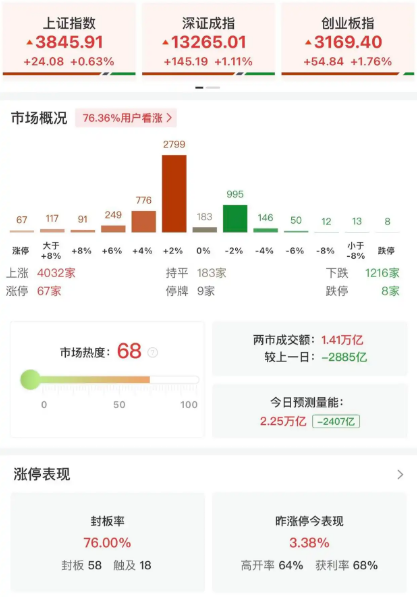
午评:沪指涨0.63% 半导体板块涨幅居前
Zhong Guo Jing Ji Wang· 2025-09-24 03:43
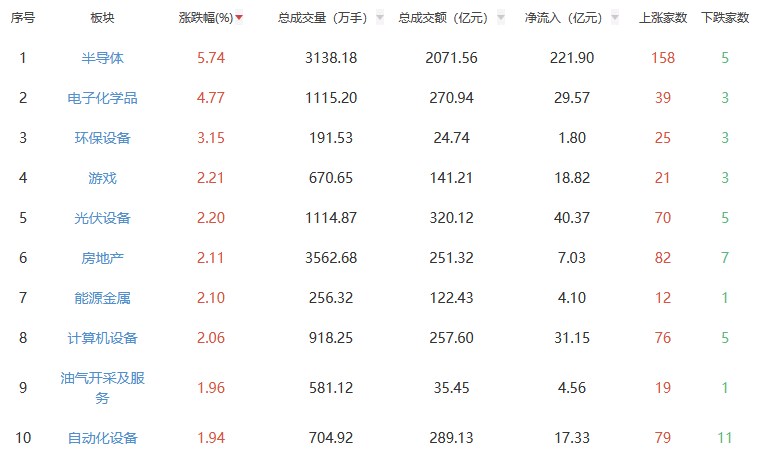
Market Overview - The A-share market saw all three major indices rise in the morning session, with the Shanghai Composite Index at 3845.91 points, up 0.63%, the Shenzhen Component Index at 13265.01 points, up 1.11%, and the ChiNext Index at 3169.40 points, up 1.76% [1] Sector Performance Top Performing Sectors - The semiconductor sector led the gains with a rise of 5.74%, followed by electronic chemicals at 4.77% and environmental protection equipment at 3.15% [1] - Other notable sectors included gaming (up 2.21%), photovoltaic equipment (up 2.20%), and real estate (up 2.11%) [1] Underperforming Sectors - The tourism and hotel sector experienced the largest decline at -1.47%, followed by coal mining and processing at -0.80% and electric machinery at -0.66% [1] - Additional sectors that saw declines included three metals (-0.57%), insurance (-0.32%), and banking (-0.27%) [1] Trading Volume and Net Inflow - The total trading volume for the top-performing sector, semiconductors, was 3138.18 million hands with a net inflow of 221.90 billion [1] - In contrast, the tourism and hotel sector had a trading volume of 711.20 million hands with a net outflow of -6.92 billion [1]
A股三大指数全线翻红,沪指上涨0.01%,深证成指上涨0.01%,创业板指上涨0.02%!近3400股上涨
Ge Long Hui· 2025-09-24 02:03
Group 1 - The three major A-share indices all turned positive, with the Shanghai Composite Index rising by 0.01%, the Shenzhen Component Index increasing by 0.01%, and the ChiNext Index up by 0.02% [1] - Nearly 3,400 stocks in the Shanghai, Shenzhen, and Beijing markets experienced gains [1]

【机构策略】A股市场大概率延续震荡格局
Zheng Quan Shi Bao Wang· 2025-09-24 01:20
Group 1 - The A-share market experienced a rebound after hitting a low, with significant fluctuations observed. Key sectors such as banking, precious metals, engineering construction, and shipping performed well, while tourism, small metals, real estate, and software development lagged behind [1] - The monetary policy is expected to maintain a "moderately loose" stance, with a focus on structural policies. In August, foreign capital showed a net inflow into domestic stocks and bonds, indicating continued confidence in Chinese assets [1] - The trading volume in the Shanghai and Shenzhen markets has consistently exceeded 2 trillion yuan, with a gradual shift of household savings towards the capital market, creating a sustained source of incremental funds [1] Group 2 - The A-share market is showing signs of stabilization, with the ChiNext index turning positive towards the end of the trading day. However, the Shanghai Composite Index has broken below the 5-day moving average, indicating a weakening short-term trend [2] - Despite the current market consolidation, structural opportunities remain significant, particularly in the semiconductor industry, banking, and port shipping sectors, which have shown resilience [2] - The upcoming National Day holiday is prompting some funds to take precautionary measures, especially leveraged funds that are actively closing positions, which is considered a seasonal norm [2]
最新资本市场报告:今年A股市场将稳步成长
Yang Zi Wan Bao Wang· 2025-09-23 11:49
Group 1 - The global IPO market is slowing down entering the third quarter, with the financing scale of the top ten global IPOs expected to be lower compared to the same period last year [1] - Hong Kong Stock Exchange is projected to maintain its position as the global leader in IPO financing due to six large IPOs during the period [1] - The A-share market in China is showing steady growth in new stock numbers and financing amounts, with expectations for this trend to continue until the end of the year, driven by government support for technology and innovation sectors [1] Group 2 - It is anticipated that 78 new stocks will be listed in the mainland A-share market by September 30, 2025, raising 77.1 billion RMB, marking a 13% increase in the number of new stocks and a 61% increase in financing compared to the same period last year [1] - The ChiNext board leads in the number of new stocks, while the Shanghai main board has the highest total financing among various boards, with 25 new stocks expected to raise 45.4 billion RMB [1] - In Hong Kong, 66 new stocks are expected to be listed, raising 182.3 billion HKD, a 47% increase in the number of new stocks and a 228% increase in financing compared to the same period last year [2]
长江商学院调查:股民信心改善,但长期牛市需基本面支撑
Sou Hu Cai Jing· 2025-09-23 10:39
Group 1 - The recent rise in A-shares indicates a recovery in investor confidence, but a long-term bull market requires strong fundamental support [1] - As of September 2025, approximately 63.1% of surveyed investors believe A-shares will rise, an increase of 1.6 percentage points from April 2025 and 15.6 percentage points from July 2024 [1] - The expected return rate for A-shares is around 1.6%, up 1 percentage point from April 2025 and 5.6 percentage points from July 2024 [1] Group 2 - The valuation recovery of A-shares is driven by three main factors: monetary policy, fiscal policy, and technological advancements [1][2] - The central bank has released liquidity through multiple measures, including a total of approximately 2 trillion yuan from two reserve requirement ratio cuts [1] - Public investment in infrastructure, supported by high fiscal deficits, is expected to boost economic growth and improve corporate fundamentals [2] Group 3 - China's technological enterprises have made significant breakthroughs, with companies like Yushun Robotics and DJI gaining international attention, leading to strong performance in related sectors [2] - By August, sectors such as semiconductors and automation equipment saw stock price increases of over 60% year-on-year [2] Group 4 - Strategic responses to US-China trade tensions have bolstered market confidence in China's economic and technological self-reliance [4] - The proportion of China's exports to the US has decreased from 19.3% in 2018 to 11.8% in the first half of 2025 [4] - Efforts to reduce reliance on US high-end AI chips and promote domestic chip development have strengthened China's negotiating position [4] Group 5 - Despite improved market sentiment and strong performance from tech companies, overall earnings growth for non-financial A-share companies remains low [4] - The current rise in A-shares is primarily driven by valuation rather than fundamental improvements, raising concerns about sustainability [4] Group 6 - China's economy grew by 5.3% year-on-year in the first half of the year, aligning with the growth target of around 5% [5] - The inflation rate was nearly zero in the first half, which is unfavorable for corporate profitability [5][6] - Transitioning the economic structure from investment to consumption, along with promoting innovation and upgrading industries, are critical for fundamental development [6]

沪指险守3800!高盛:只有这一种情况能终结牛市行情
天天基金网· 2025-09-23 10:28
Group 1 - The core viewpoint of the article highlights the recent significant market correction, with the Shanghai Composite Index falling below 3800, and a notable decline in the brokerage sector, indicating a bearish sentiment in the market [2]. - Goldman Sachs suggests that the end of the bull market in China's stock market is typically not due to high valuations but rather sudden policy shocks, and unless there is a clear speculative bubble, the likelihood of policy actively suppressing the market is low [3][8]. - The article discusses the reasons behind the recent rise in the Chinese stock market, including expectations of economic recovery and advancements in AI, as well as improved Sino-U.S. relations and a rebound in Hong Kong IPOs [5]. Group 2 - The current bull market in China is characterized as different from other markets, with the Chinese stock market still below its 2021 highs, suggesting room for valuation increases [6]. - The foundation for a "slow bull" market in A-shares appears stronger than ever, driven by market reforms, the introduction of long-term capital, and stricter leverage regulations [7]. - Historical analysis indicates that valuation changes have been the primary driver of returns in bull markets, contributing approximately 80% of realized gains, with current valuations still below historical bull market peaks [7]. Group 3 - Goldman Sachs has developed a new "stock market policy barometer" to monitor policy risks, which currently indicates low levels of policy tightening risk for the stock market [8]. - There is significant potential for incremental capital inflow into the Chinese stock market, as household asset allocation is heavily skewed towards real estate and cash, with only 11% in stocks [9][10]. - The article notes that since 2020, households have accumulated substantial savings, with over 80 trillion yuan in new deposits, and a shift in asset allocation could lead to trillions flowing into the stock market [10]. Group 4 - The article emphasizes the importance of the brokerage sector as a leverage amplifier for the market, suggesting that investors should consider accumulating shares during market corrections to benefit from future rallies [12].