
AI算力

Search documents
暴跌!内存价格闪崩!
国芯网· 2026-02-12 12:00
Core Viewpoint - The article discusses the recent dramatic decline in DDR4 memory prices, marking the end of a prolonged price surge driven by AI demand and speculative trading in the market [2][4]. Group 1: Price Decline and Market Dynamics - DDR4 memory prices experienced a rare flash crash, with an intraday drop nearing 20%, as 8GB prices fell from 260-270 RMB to 180-190 RMB, and 16GB prices dropped from 800 RMB to 650 RMB [2][4]. - The price surge of DDR4, which saw a 386% increase last year, was primarily fueled by the demand for AI computing power, leading major manufacturers like Samsung and SK Hynix to cut DDR4 production capacity [4]. - The market was misled into believing there would be a long-term shortage, resulting in panic buying and speculative trading, which created a price bubble detached from actual market value [4]. Group 2: Future Outlook for DDR4 and DDR5 - By 2025, DDR5 is expected to penetrate 70%-80% of the PC and server markets, while DDR4's market share will drop below 30%, with demand primarily remaining in long-cycle products like medical devices [5]. - Experts predict that as mainstream manufacturers transition to DDR5, DDR4 demand may face a steep decline, further squeezing its market space [5]. - The end of the DDR4 super bull market is anticipated, with the memory market expected to return to rational development driven by supply and demand rather than speculative trading [5].


投资策略点评:液冷的0-1时刻或已到来
KAIYUAN SECURITIES· 2026-02-12 11:43
Core Insights - The report identifies liquid cooling as a strategic investment opportunity, potentially replicating the success of optical modules and PCBs, with strong growth prospects driven by AI computing needs and stringent energy efficiency standards [2][3] - Liquid cooling is characterized by three main features: strong growth, complete narrative, and favorable odds, indicating a favorable market environment for investment [2] - The industry is transitioning from speculative hype to a high-growth phase with confirmed orders, as evidenced by significant order increases from key suppliers like Vidi Technology [3] Industry Trends - The liquid cooling industry is entering a high-growth phase with a 252% year-over-year increase in organic orders reported by Vidi Technology, highlighting strong market demand [3] - Major tech companies like NVIDIA and Google are adopting liquid cooling as a mandatory standard for their next-generation platforms, indicating a shift from optional to essential technology in AI computing [3] - The industry is witnessing a wave of mergers and acquisitions, with companies like Liying Intelligent Manufacturing acquiring liquid cooling suppliers to secure positions in the AI server supply chain [3] Liquid Cooling Industry Chain - The liquid cooling industry chain consists of three main segments: upstream components, midstream system integration and manufacturing, and downstream applications [4] - Upstream includes key technologies and components such as cooling fluids and CDU, which have high technical barriers and value [4] - Midstream integrates upstream components to provide complete liquid cooling server solutions, with technical integration capabilities as a core barrier [4] - Downstream focuses on high-performance data center operators and industry users driving the large-scale adoption of liquid cooling [4]


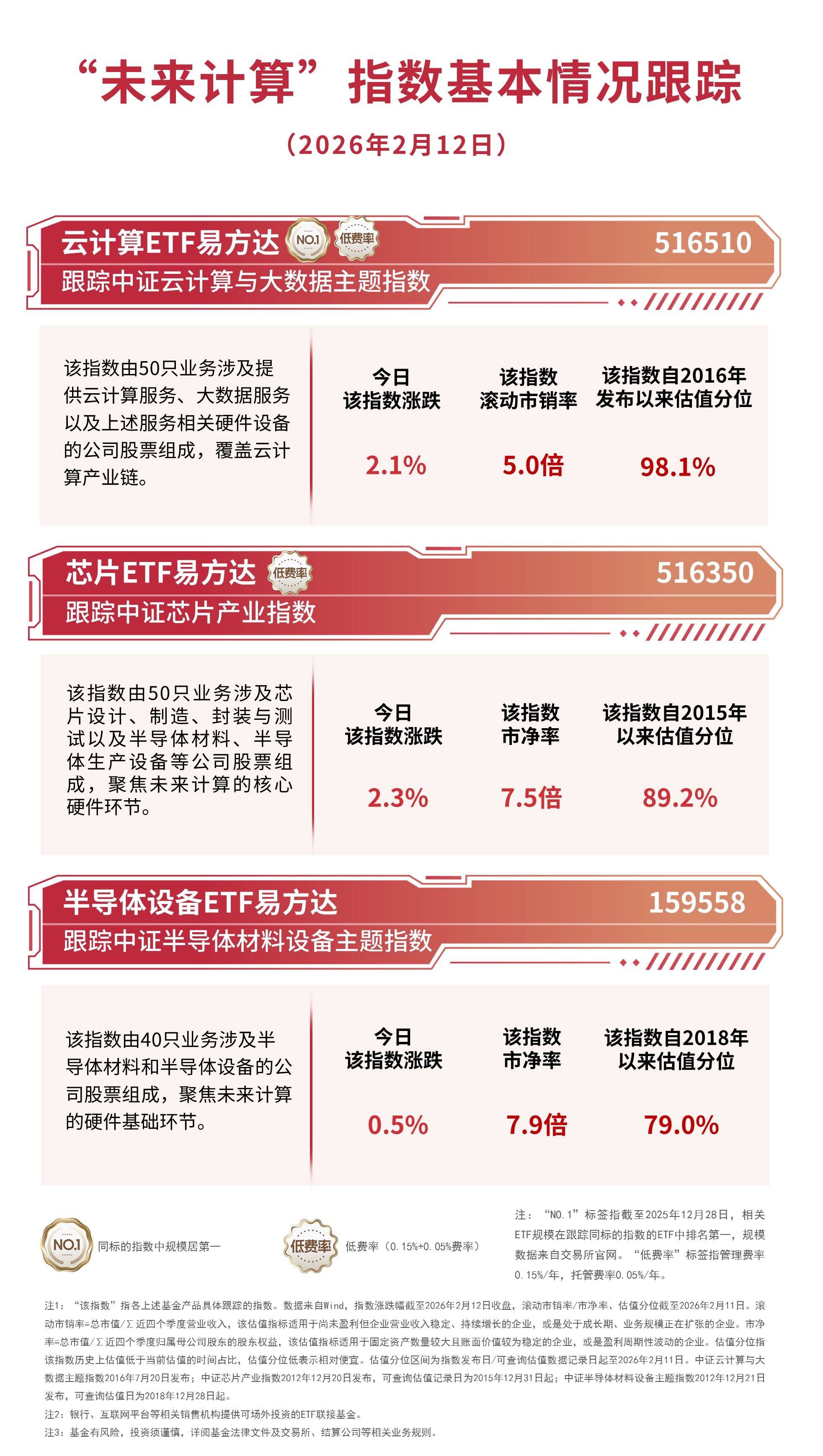
半导体产业链震荡上扬,关注半导体设备ETF易方达(159558)、芯片ETF易方达(516350)等产品投资价值
Sou Hu Cai Jing· 2026-02-12 10:30
Group 1 - The core indices related to the semiconductor industry showed positive performance, with the China Securities Chip Industry Index rising by 2.3%, the China Securities Cloud Computing and Big Data Theme Index increasing by 2.1%, and the China Securities Semiconductor Materials and Equipment Theme Index up by 0.5% [1][5] - The semiconductor equipment ETF managed by E Fund (159558) attracted over 2.5 billion yuan in the past month, bringing its total size to over 5 billion yuan, marking a historical high [1] - China Galaxy Securities indicates that the demand for AI computing power, the upward cycle of storage chips, and the penetration of advanced packaging technology are driving the demand for semiconductor equipment, with strong expectations for market growth through 2026 [1] Group 2 - TSMC is expected to have capital expenditures ranging from 52 to 56 billion USD in 2026, a significant increase from 40.9 billion USD in 2025, highlighting further market opportunities in semiconductor equipment [1] - The semiconductor materials and equipment theme index consists of 40 stocks related to semiconductor materials and equipment, focusing on the hardware foundation of future computing [5] - The semiconductor industry indices are composed of companies involved in chip design, manufacturing, packaging, testing, and semiconductor materials and production equipment, emphasizing the core hardware aspects of future computing [3]
致尚科技股价创新高,行业热度与资金面共振驱动
Jing Ji Guan Cha Wang· 2026-02-12 10:29
Group 1 - The core viewpoint is that Zhishang Technology's stock price increased by 7.69%, closing at 235.00 yuan, reaching a historical high, driven by industry heat, capital and technical resonance, performance expectations, and high valuation pressure [1] Group 2 - The electronic sector rose by 1.73%, with the consumer electronics sector up by 1.24%, and CPO concept stocks performing actively. Zhishang Technology benefits from market interest in AI computing power and high-speed connectors [2] Group 3 - As of February 11, the company's margin financing balance reached 492 million yuan, with an increase of 135 million yuan in the last 10 days. The stock price broke through the upper Bollinger Band, and the MACD indicator shows enhanced bullish momentum. Despite large transactions, institutional special seats net bought 40.25 million yuan [3] Group 4 - For the first three quarters of 2025, the company's net profit was 163 million yuan, a year-on-year increase of 173.36%. The 2025 annual profit forecast is between 82 million and 112 million yuan, with a year-on-year growth of 21.88% to 66.47%. The market is focused on the growth potential of its optical communication products driven by data center demand [4] Group 5 - The current price-to-earnings ratio is 177.06, significantly higher than the average level in the consumer electronics industry. On the same day, the net outflow of main funds was 12.81 million yuan, indicating a divergence in the attitude of large funds [5]
大位科技4连板狂欢,润泽科技却停牌苦等,股民的悲喜并不相通
Sou Hu Cai Jing· 2026-02-12 10:01
Group 1 - The core viewpoint highlights the contrasting fortunes of two companies in the IDC sector, with Dawi Technology experiencing significant stock price increases while Runze Technology faces a prolonged suspension due to asset acquisition [1] - Dawi Technology's stock surged from over 9 to nearly 14, benefiting from a ten-year data center service agreement with ByteDance that generates approximately 163 million yuan annually [1] - Runze Technology, despite being a key supplier for ByteDance, is currently unable to participate in the market due to its voluntary suspension since February 6, awaiting the completion of its asset acquisition [1] Group 2 - Dawi Technology has issued a risk warning, clarifying that its main business involves standardized data center leasing and not the AI computing power leasing that the market is currently favoring, with a rolling P/E ratio already ten times that of its peers, indicating overvaluation [2] - The market's enthusiasm for computing power has led to a frenzy, with investors eager to join, leaving Runze Technology's shareholders in a state of uncertainty as they await the stock's resumption on March 2 [2]


复旦微电发布限制性股票激励计划,股价应声上涨近5%
Jing Ji Guan Cha Wang· 2026-02-12 09:48
Core Viewpoint - The stock price of Fudan Microelectronics (688385) increased by 4.92% on February 12, closing at 87.30 yuan, with a trading volume of 1.824 billion yuan, closely related to the company's announcement of a restricted stock incentive plan for 2026 [1] Group 1: Stock Performance - The company plans to grant 11.16 million shares of restricted stock to 308 incentive targets, accounting for 1.35% of the total share capital, with a grant price of 41.59 yuan per share, approximately 50% of the average trading price before the announcement [2] - The stock price increase is significantly higher than the semiconductor sector's average rise of 2.43%, indicating strong market sentiment [3] Group 2: Financial Implications - The incentive plan is expected to generate share-based payment expenses of approximately 487 million yuan, which will be amortized from 2026 to 2029, potentially suppressing net profit in the short term [4] - The company's net profit for the third quarter of 2025 has already decreased by 22.69% year-on-year, and the current price-to-earnings ratio (TTM) stands at 151.18 times, significantly above the semiconductor industry average, raising concerns about the ability to meet performance expectations [4] Group 3: Industry Context - The semiconductor sector is currently driven by AI computing power demand, and the company's FPGA chip domestic substitution logic further strengthens market expectations for core business growth [5] - The incentive plan is seen as a positive signal for binding core talent and enhancing long-term competitiveness, although the sector's volatility and macro policy changes should be monitored [5]

三变科技业绩预降股价反涨,AI算力概念驱动市场高预期
Jing Ji Guan Cha Wang· 2026-02-12 09:47
Core Viewpoint - The stock price of Sanbian Technology (002112) has risen despite a projected decline in performance for 2025, driven by high market expectations for emerging businesses like AI computing power, creating a short-term divergence from the company's fundamentals [1]. Performance and Operating Conditions - The company forecasts a net profit attributable to shareholders for 2025 between 12 million and 18 million yuan, representing a year-on-year decline of 85.10% to 90.06%. The decline in net profit is primarily due to intensified competition in the transformer market, leading to a decrease in new energy order share, and rising copper prices squeezing gross margins. For the first three quarters of 2025, revenue decreased by 16.91%, net profit fell by 48.84%, and gross margin dropped to 17.45% [2]. Stock Price Movement Reasons - AI computing power concept catalyzed the stock price increase: The company became the main transformer supplier for Musk's xAI Memphis supercomputer center, with initial orders around 50 million yuan, leading to high market expectations for its entry into the global AI industry chain. From January to early February 2026, the stock price surged nearly 100%, closing at 24.92 yuan on February 12, with a year-to-date increase of 87.93% [3]. - Funding and sentiment drove the stock price: Since the beginning of 2026, the stock frequently appeared on the leaderboard, with turnover rates exceeding 40%, indicating intense speculation from retail and institutional investors. However, recent main fund outflows were noted, with a net outflow of 40.17 million yuan on February 12, reflecting significant divergence in market sentiment [3]. Company Fundamentals - Valuation and performance divergence: As of the closing price on February 12, the price-to-earnings ratio (TTM) reached 88.91 times, while net profit significantly declined, indicating a high valuation [4]. - Financial pressures unresolved: By the end of the third quarter of 2025, accounts receivable and inventory stood at 753 million yuan and 776 million yuan, respectively, with low turnover efficiency (accounts receivable turnover days at 168 days). The net cash flow from operating activities was a negative 100 million yuan, and the quick ratio was 0.89, below the safety line [4]. - Traditional business under pressure: Oil-immersed transformers accounted for 58.38% of the business, with capacity utilization dropping to 65% due to a slowdown in grid investment [4]. Institutional Perspectives - Analysts believe the stock price increase is primarily driven by speculative trading, as the current revenue contribution from the AI computing power business is minimal. Future attention should be on order fulfillment and improvements in traditional business. If performance does not meet expectations, the high valuation may face downward pressure [5].

通信行业2026年投资策略:商业航天建设期主线确立,AI算力提供景气强化
Southwest Securities· 2026-02-12 09:35
Core Insights - The commercial aerospace sector has officially entered a construction phase, marking the beginning of a new "constellation-level Capex" cycle in the communication industry, which is identified as the most certain core theme for 2026. The transition from technology validation to large-scale constellation deployment is driven by national strategic priorities and the "14th Five-Year Plan" [4][6] - The investment logic in commercial aerospace has shifted from thematic drivers to a focus on network construction, emphasizing the need for faster, cheaper, and more frequent satellite launches. Key constraints such as rocket capabilities, launch facilities, and ground communication systems are being gradually lifted [4][6] - The demand for high-speed optical connections is increasing as a critical component of AI computing infrastructure upgrades, with optical module port rates evolving towards 800G and 1.6T, indicating strong visibility and early realization of orders [4][6] - Liquid cooling technology is becoming a key structural increment in AI computing infrastructure upgrades, as traditional air cooling solutions face efficiency and space constraints. The penetration rate of liquid cooling is expected to rise alongside capital expenditures in computing [4][6] Industry Review - The communication sector maintained a positive revenue growth of 2.9% year-on-year, reaching a total revenue of 19.5 trillion yuan in the first three quarters of 2025, supported by the 5G-A construction cycle and positive impacts from optical modules and liquid cooling [20][19] - Profit levels in the communication sector improved, with total profits reaching 193.76 billion yuan, a year-on-year increase of 9.1%, indicating a positive trend in profitability [21][19] - The overall expense control was effective, with a sales expense ratio of 6.5% and a management expense ratio of 5.1% in the first three quarters of 2025, both showing a decrease compared to the previous year [26][25] Key Strategies - The first main strategy focuses on the construction phase of commercial aerospace, which is expected to drive a new "constellation-level Capex" cycle in the communication industry [6][36] - The second main strategy emphasizes the ongoing demand for AI computing, which will continue to drive upgrades in communication infrastructure [6][36] Investment Focus - Key stocks to watch include Kunheng Shunwei (688283), Aofei Data (300738), and Guanghuan Xinwang (300383), which are positioned to benefit from the trends in commercial aerospace and AI computing [4][6]
全球股市最大风口,彻底爆了!
商业洞察· 2026-02-12 09:34
Core Viewpoint - The article discusses the significant price surge in storage products, particularly memory chips, driven by increased demand from the AI sector, leading to substantial profits for major manufacturers like SK Hynix and Micron [3][5][10]. Group 1: Price Surge in Storage Products - The average price of memory has increased by 344%, with DDR5 memory prices rising over 300% since September 2025, and DDR4 memory prices increasing by more than 150% [6]. - HDD prices have risen by approximately 50% in four months, with some models seeing increases of up to 66%. SSD prices have surged by around 75%, with 1TB SSD prices jumping from about $60 at the end of 2024 to over $144 in early 2026, a rise of more than 140% [6][7]. - High-end storage products like HBM and DDR5 have seen the most significant price increases, while lower-end products like DDR4 and HDD have also experienced notable price hikes [7]. Group 2: Manufacturer Strategies and Market Dynamics - Major manufacturers, including Samsung, SK Hynix, and Micron, have shifted production capacity towards high-performance storage products for AI servers, significantly reducing capacity for consumer-grade products. Micron has even ceased sales of consumer-grade storage products entirely [8]. - The "controlled quantity price increase" strategy employed by these manufacturers has effectively allowed them to raise prices, as they control over 93% of the global DRAM market [8][9]. - Samsung and SK Hynix plan to increase server DRAM prices by 60%-70% in the first quarter of 2026 compared to the fourth quarter of 2025 [9]. Group 3: Stock Market Impact - Micron's stock price has surged from around $60 in April 2025 to approximately $365, representing a nearly 500% increase [10]. - In South Korea, the KOSPI index has risen from 2284 points in April 2025 to 4935 points recently, a gain of 116%, largely driven by the stock performance of Samsung and SK Hynix [14]. - The article notes that the average profit for South Korean investors has doubled over the past year due to the storage product price boom [16]. Group 4: A-Share Market Performance - Since the price surge in storage products began in the third quarter of last year, several A-share companies have seen significant stock price increases, including Baiwei Storage (up 85%), Demingli (up 274%), Jiangbolong (up 185%), and Shannon Chip (up 408%) [18][19]. - Baiwei Storage expects a net profit of 850 million to 1 billion yuan in 2025, a year-on-year increase of 427.19% to 520.22% [21]. - The demand for memory interconnect chips has also surged, with companies like Lanke Technology projecting a net profit of 2.15 billion to 2.35 billion yuan in 2025, a year-on-year increase of 52.29% to 66.46% [22].





中国银河证券:供给紧俏推升价格 电子布行业迎上行周期
智通财经网· 2026-02-12 09:12
Core Viewpoint - The global supply of specialty fiberglass cloth is currently limited due to high production technology barriers, leading to a supply-demand imbalance and rising prices. This situation is expected to persist, especially with the continued high demand for AI computing power, which will further support the tight supply of high-end specialty fiberglass cloth and impact traditional electronic cloth production capacity [1][2][3]. Group 1: Market Dynamics - The demand for specialty fiberglass cloth is rapidly increasing due to the explosive growth in AI computing power, which drives the need for high-performance materials in electronic products such as AI servers and 5G base stations [2]. - The production capacity for fiberglass is expected to increase by 2025; however, the release of this capacity will face delays, maintaining the supply shortage of specialty fiberglass cloth [2][3]. - Traditional electronic cloth supply is also tightening as manufacturers shift production towards specialty fiberglass cloth, leading to price increases for traditional electronic cloth [3]. Group 2: Financial Performance - Several fiberglass companies, including China National Materials and Honghe Technology, are projected to see significant profit growth in 2025, with expected net profit increases of 173.76%-251.97% and 745%-889%, respectively, driven by rising demand and prices for electronic cloth [4]. - The overall profitability of the fiberglass industry is anticipated to continue recovering, with expectations of further price increases for electronic cloth due to sustained high demand for AI computing [4]. Group 3: Investment Opportunities - Two investment directions are suggested: 1) Focus on companies with specialty fiberglass production capabilities, such as China National Materials and Honghe Technology, which are likely to benefit from the ongoing high demand and price growth [5]. 2) Consider companies like China Jushi that have advantages in traditional electronic cloth production capacity and cost, as they are expected to benefit from the tightening supply and rising prices [5].
