服务消费

Search documents
直线拉升,一则消息突然引爆
Zheng Quan Shi Bao· 2025-11-05 11:02
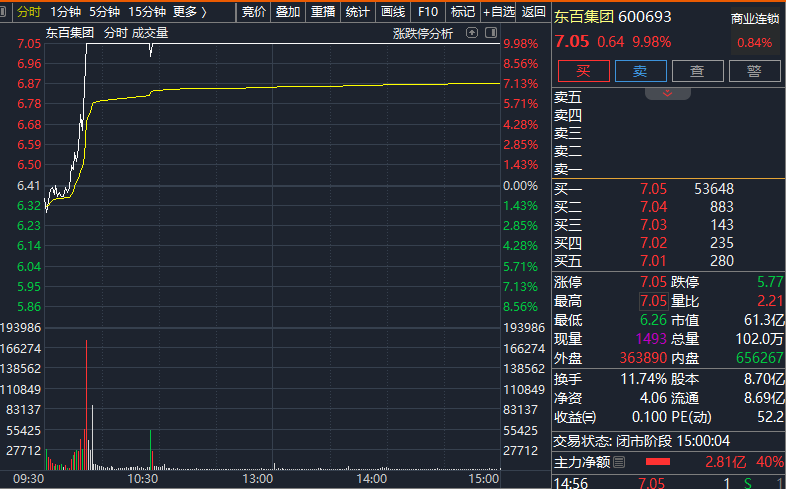
Group 1: Market Performance - The A-share market indices rebounded today, with significant gains in consumer sectors such as retail chains, duty-free, hotel and catering, and tourism [1][3] - Notable stocks like Dongbai Group and Caesar Travel reached their daily limit up, indicating strong market interest [1][3] Group 2: Holiday Impact - The announcement of the longest Spring Festival holiday in history, lasting from February 15 to February 23, 2026, has stimulated the consumer sector [1][5] - Online travel booking platforms reported a doubling in search volume for train and international flight tickets shortly after the holiday announcement [4][5] Group 3: Duty-Free Sector - Duty-free concept stocks have seen a significant rise, with the sector increasing over 2% today, driven by upgraded duty-free policies effective from November [7][9] - Key players like Pingtan Development, Caesar Travel, and Hainan Development reached their daily limit up, reflecting strong investor confidence [7][8] Group 4: Policy Support for Consumption - The Chinese government is focusing on boosting consumption through various measures, including enhancing service consumption as a key investment theme [11][12] - The "14th Five-Year Plan" emphasizes the importance of expanding quality consumer goods and services, which is expected to benefit sectors like tourism, education, and healthcare [12][13][14]


直线拉升!一则消息,突然引爆!
券商中国· 2025-11-05 10:20
Core Viewpoint - The announcement of the longest Spring Festival holiday in history in 2026 is driving a surge in the consumer sector, particularly in hospitality, tourism, and retail [1][3][5]. Consumer Sector Performance - Major consumer sectors such as hotel and restaurant, tourism, and retail chains saw significant gains, with stocks like Dongbai Group and Caesar Travel hitting the daily limit [1][3]. - The upcoming nine-day Spring Festival holiday from February 15 to February 23, 2026, is expected to boost travel and spending, leading to increased search volumes for travel bookings [3][5]. Policy Support for Service Consumption - Analysts believe that strong policy support will position service consumption as a key investment theme, with a focus on enhancing consumer spending [2][10]. - The government is expected to implement measures to stimulate consumption, including optimizing public service spending and enhancing consumer rights protection [10][11]. Duty-Free Market Developments - Recent policy upgrades for duty-free shops have led to a notable increase in duty-free stock prices, with significant gains observed in companies like Pingtan Development and China Duty Free Group [6][8]. - The new duty-free policies aim to enhance consumer experience and expand the range of products available, which is anticipated to attract more customers and boost sales [8][9]. Future Investment Opportunities - The service sector, particularly in tourism and duty-free retail, is projected to benefit from ongoing policy support and consumer demand recovery, making it a promising area for investment [10][11]. - Companies involved in traditional consumer goods manufacturing and those in education, healthcare, and tourism are expected to gain from favorable policies and market expansion [11].




国泰海通|“启航新征程”2026年度策略会观点集锦(上)——总量、周期
国泰海通证券研究· 2025-11-04 12:09
Macro Overview - The core viewpoint is that China's economy has significant growth potential in the medium to long term, with a stable macroeconomic total in 2025 but noticeable structural differentiation, requiring policy solutions for weak domestic demand in 2026 [2] - Price stability is crucial for growth, as price indicators are central to understanding changes in domestic demand [2] Investment Strategy - The "transformation bull market" in China is expected to continue, with the stock market entering a significant growth cycle starting in 2025, driven by capital market reforms and economic structural transformation [7] - The Shanghai Composite Index reaching 4000 points again is a significant milestone, with further upward potential anticipated [8] - The underlying logic of the Chinese stock market is shifting, with three core factors that previously led to valuation discounts now being dismantled: improved confidence in handling US-China risks, a return to economic construction focus, and the end of the renminbi asset contraction cycle [8][9] Sector Analysis - Urbanization as a growth driver is fading, with reform and transformation becoming the primary focus [9] - The three main drivers of the "transformation bull market" include the decline of risk-free returns, capital market reforms enhancing market investability, and increased certainty in China's transformation development [9] - Investment opportunities are identified in technology growth sectors, manufacturing expansion, cyclical consumption, and financial stocks, with a focus on quality strategies over barbell strategies [10] Hong Kong Market Strategy - The Hong Kong stock market is positioned for upward potential, with a significant inflow of capital expected, particularly from foreign investors [13][14] - The technology sector is highlighted as a key focus for 2026, with opportunities in innovative drugs and brokerage firms [15] Fund Evaluation - The public fund industry is shifting towards a focus on equity, benchmarks, and long-term performance, with a growing emphasis on active equity funds and passive index funds [30][31] - The sales environment for public funds is evolving towards a model that prioritizes long-term client interests and diversified asset allocation [32] Fixed Income Strategy - The fixed income market is expected to experience a shift in macroeconomic anchors, with a focus on multi-asset investment opportunities in a low-interest-rate environment [35][36] Real Estate Outlook - The real estate market is anticipated to undergo changes, with a focus on marginal improvements and long-term growth potential [39][40] Transportation Sector - The aviation industry is expected to enter a "super cycle," driven by recovering demand and a favorable pricing environment [52][53] - The shipping industry is also poised for growth, with increasing demand for oil and dry bulk shipping [56][57] Coal Industry - The coal sector is expected to enter a new upward cycle, driven by recovering demand and supply constraints [74][75] Steel Industry - The steel industry is projected to stabilize, with demand recovering and supply constraints expected to support profitability [80][81]

服务产业迎政策利好,新消费景气持续
Haitong Securities International· 2025-11-04 10:31
Group 1 - The service industry is expected to benefit from favorable policies, with a significant increase in service consumption anticipated in 2026 due to continuous policy support and demand dividends [3][7][11] - The report highlights the structural growth in emotional value and symbolic consumption, particularly in the IP toy industry, which is rapidly realizing commercial value [3][7][9] - The retail industry is undergoing a transformation towards a decentralized model, with traditional retail facing intense competition and new channels like discount stores and community supermarkets emerging [3][7][9] Group 2 - The report emphasizes the importance of optimizing holiday arrangements and integrating cultural tourism to stimulate demand, particularly for families with children [12][15] - The service consumption structure in China shows significant room for growth, with the current per capita service consumption being much lower than that of developed countries [29][30][32] - The tea and coffee beverage market in China is experiencing rapid growth, with the market size expected to increase significantly, driven by consumer demand in lower-tier cities [56][58][59] Group 3 - The online travel agency (OTA) market is projected to maintain stable profit margins, with companies like Trip.com leading in growth despite slight slowdowns in overseas markets [48][54] - The hotel industry is seeing a gradual improvement in operating data, with a narrowing decline in revenue per available room (RevPAR) expected to continue [37][40][43] - The report indicates that the demand for travel and tourism services is stable, with business travel being a significant source of fluctuations in demand [40][41]




旅游板块发力走高,大连圣亚涨停,长白山等拉升
Zheng Quan Shi Bao Wang· 2025-11-04 06:57
Core Viewpoint - The tourism sector is experiencing significant growth, with stocks like Dalian Shengya reaching historical highs, driven by policies aimed at boosting service consumption and domestic demand [1] Group 1: Market Performance - Dalian Shengya has hit the daily limit up and reached a historical high [1] - Changbai Mountain has increased by approximately 7%, while Xiyu Tourism and Lingnan Holdings have risen by about 5% [1] Group 2: Policy Impact - Current economic support measures are focused on stabilizing growth and enhancing domestic demand, leading to a shift in service consumption towards becoming the mainstay of resident spending [1] - The implementation of various measures from the "Several Policy Measures for Expanding Service Consumption" is expected to gradually yield positive effects [1] Group 3: Investment Recommendations - In the cultural tourism sector, there is a dual driving force from inbound tourism and youth travel demand, suggesting a focus on leading inbound travel agencies and scenic spots that align with the spring and autumn travel rhythm [1] - In the sports sector, the economic impact of events is significant, with potential in tourism, dining, and IP products derived from events, recommending attention to sports companies involved in event operations and related services [1]




美股异动 | 亚朵(ATAT.US)涨逾4% 机构:关注经营边际改善的酒店集团
智通财经网· 2025-11-03 15:52
Core Viewpoint - The article highlights the positive market response of hotel stocks, specifically Atour (ATAT.US) and Huazhu (HTHT.US), following the announcement of China's 14th Five-Year Plan, which aims to boost consumption and service sectors [1] Group 1: Market Performance - Atour (ATAT.US) shares increased by over 4% [1] - Huazhu (HTHT.US) shares rose by over 2% [1] Group 2: Policy Implications - The 14th Five-Year Plan emphasizes the implementation of special actions to stimulate consumption and expand the supply of quality consumer goods and services [1] - Key focuses include easing market access, integrating business formats, enhancing brand leadership, upgrading standards, and applying new technologies to promote the expansion and upgrading of goods consumption [1] Group 3: Investment Opportunities - Huachuang Securities suggests that China's service consumption is currently in a transformative phase, with strong policy support indicating that service consumption could become a key investment theme [1] - The report recommends paying attention to hotel groups that are showing improvements in operational margins [1]


王世杰常委代表民革中央的发言:激发服务消费活力 打造“十五五”发展新动能
Sou Hu Cai Jing· 2025-11-03 08:57
转自:人民政协报 中共二十届四中全会重点研究"十五五"规划建议问题,旨在更好发挥国家发展规划的战略导向作用,推动事关中 国式现代化全局的战略任务取得重大突破。中国国民党革命委员会坚决拥护中共中央决策部署,将深入学习贯彻 中共二十届四中全会精神,为确保基本实现社会主义现代化取得决定性进展贡献智慧和力量。 三、创新服务消费场景和平台载体。紧扣数字化、绿色化、品质化发展潮流,进一步健全城乡服务消费网络及功 能,着力推动线上线下深度融合与业态跨界融合,加快构建智慧商圈、智慧街区、智慧门店等消费新场景。总结 推广"中国农民丰收节""草莓音乐节""苏超"等成功经验,鼓励各地因时制宜、因地制宜,强化互动合作,举办特 色鲜明的服务消费主题活动。深化国际消费中心城市建设,支持打造具有全球吸引力的消费环境,引领全国服务 消费提质扩容。 四、丰富优质多元服务消费供给。聚焦"一老一小"等重点群体需求,推动医疗、养老、托幼、家政等服务提质升 级,加快培育健康管理、旅居、研学等新业态。顺应个性化消费新趋势,引导文化娱乐、旅游休闲、体育运动、 餐饮购物等服务向创意性、沉浸式、定制化发展。深化服务业对外开放,拓展电信、医疗、教育等领域开放试 ...

31省份消费三季报:西部发力 服务、乡村消费“上分”
2 1 Shi Ji Jing Ji Bao Dao· 2025-10-31 16:40
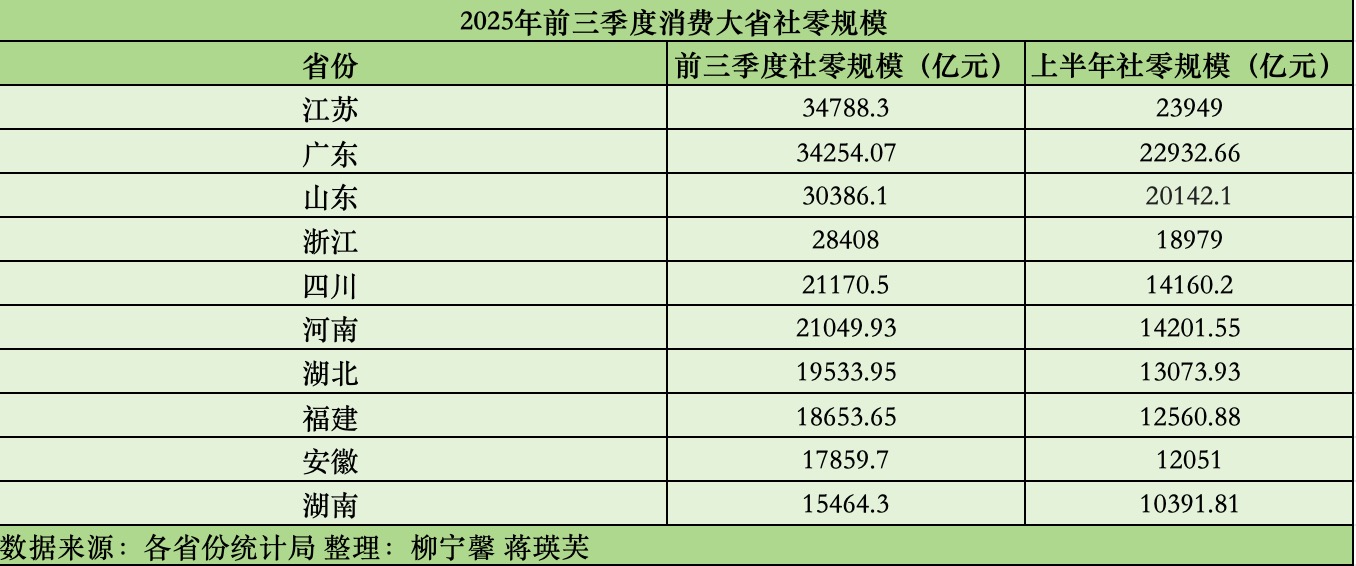
Core Insights - The growth of service consumption outpaces that of goods consumption, and rural consumption growth exceeds urban consumption, indicating significant optimization in China's consumption structure [1][9][15] - In the first three quarters, final consumption expenditure contributed 53.5% to economic growth, an increase of 9 percentage points compared to the previous year [1] - The total retail sales of consumer goods reached 36,587.7 billion yuan, with a year-on-year growth of 4.5% [1] Consumption Growth by Region - Jiangsu, Guangdong, and Shandong are the only provinces with retail sales exceeding 30,000 billion yuan, with figures of 34,788.3 billion yuan, 34,254.07 billion yuan, and 30,386.1 billion yuan respectively [6][7] - Hainan leads the nation with an 8.6% growth rate, followed by Inner Mongolia at 7.2%, and several provinces in central and western China also show strong growth [4][5] Changes in Consumption Structure - The consumption structure is shifting, with significant growth in spending on daily necessities, education, culture, and entertainment services [3][9] - The "old-for-new" policy has effectively stimulated consumption, particularly in home appliances and new energy vehicles, with notable growth rates in Inner Mongolia and Shanxi [5][9] Rural vs Urban Consumption - Rural consumption growth is outpacing urban consumption, with Jiangsu's rural consumption growth exceeding urban by 1.4 percentage points, and Guizhou by 1.7 percentage points [14][15] - The shift from basic to improved consumption in rural areas is driven by the "old-for-new" policy and the enhancement of consumption infrastructure [14][16] Policy Implications - The "14th Five-Year Plan" emphasizes boosting consumption and enhancing public service spending to increase residents' consumption capacity [8][14] - Future expansion of county-level markets is expected to support rural consumption as a new growth curve for national retail sales [16]
31省份消费三季报:西部发力,服务、乡村消费“上分”
2 1 Shi Ji Jing Ji Bao Dao· 2025-10-31 13:01
Core Insights - The growth of service consumption outpaces that of goods consumption, and rural consumption growth exceeds urban consumption, indicating an important signal for the optimization of China's consumption structure [1][12][18] Economic Contribution - In the first three quarters, final consumption expenditure contributed 53.5% to economic growth, an increase of 9 percentage points compared to the previous year [1] - The total retail sales of consumer goods reached 36,587.7 billion yuan, with a year-on-year growth of 4.5% [1] Provincial Performance - Fourteen provinces outperformed the national average in retail sales growth, with five provinces exceeding 6%: Hainan, Inner Mongolia, Shanxi, Henan, and Shaanxi [1][5] - The top ten provinces by retail sales in the first three quarters were Jiangsu, Guangdong, Shandong, Zhejiang, Sichuan, Henan, Hubei, Fujian, Anhui, and Hunan [3][8] Consumption Structure Changes - The consumption structure is shifting, with significant growth in spending on daily necessities, education, culture, and entertainment services [3][12] - The rural areas are showing strong consumption potential, with rural consumption growth driven by the replacement of large goods and upgrades in daily consumption [17][18] Policy and Future Outlook - The "14th Five-Year Plan" emphasizes boosting consumption and implementing special actions to stimulate consumption [3][17] - The expansion of quality consumer goods and services supply is highlighted, with a focus on enhancing service consumption [17][19] Digital and Service Consumption Trends - Digital consumption is on the rise, with significant growth in online retail sales in various provinces [10][12] - Service consumption, particularly in tourism and cultural sectors, is a key driver of growth, with notable increases in visitor numbers and revenue in several provinces [15][16]
国泰海通|批零社服:服务产业迎政策利好,新消费景气持续
国泰海通证券研究· 2025-10-31 10:39
Group 1: Service Consumption Catalysts - The promotion of service consumption has a higher marginal increment, with the Ministry of Commerce and nine departments recently releasing policies to expand service consumption, highlighting structural focus [1] - Historically, the structural proportion of service consumption has increased, with the ability to sustain price increases; enhancing vacation markets and flexibility will lead to higher demand elasticity [1] - In service consumption, the education sector shows rigid demand with volume and price still benefiting; policies have expanded high school education, while leading tea and coffee brands have significant expansion space and competitive advantages [1] Group 2: Symbolic Consumption and Emotional Value - Emotional value and experiential consumption address demand pain points and are rapidly realizing commercial value; industries like IP toys essentially consume symbolic and content value [2] - Interesting retail has become a clear trend in offline business development; the Chinese IP toy industry is still in a high growth phase, with leading IPs breaking through demographics, regions, and scenarios [2] - The craftsmanship of gold products is enhancing their added value, driven by consumer attributes, with innovations like ancient gold meeting young consumers' aesthetic and preservation needs [2] Group 3: New Channels Reshaping the Industry Chain - The trend in China's distribution system transformation is shifting from manufacturer-led deep distribution to consumer-driven efficient retail, with core retail capabilities evolving from site selection to product selection [3] - Retail in China is diversifying across categories and scenarios, with positive competition expected among discount snacks, community retail, and hypermarket remodels [3] - Competition in food delivery and instant retail is ongoing, with changes in fulfillment systems and differing demand attributes leading to significant shifts in competitive dynamics [3] - AI technology is being applied to new physical devices, with advancements in efficiency and commercialization in sectors like human resources, e-commerce, and education [3]