
量化紧缩

Search documents
英国央行货币政策委员曼恩:随着英国央行开始降息,量化紧缩的影响已成为当前更为突出的议题。
news flash· 2025-06-02 17:17
Core Viewpoint - The impact of quantitative tightening has become a more prominent issue as the Bank of England begins to lower interest rates [1] Group 1 - The Bank of England's decision to start cutting interest rates indicates a shift in monetary policy focus [1] - Quantitative tightening is now highlighted as a significant topic in the current economic landscape [1]
全球陷入债务反思,债市暴雷惨过希腊,为什么最先“倒下”的是日本?
Sou Hu Cai Jing· 2025-05-30 10:33
Core Viewpoint - Japan's bond market is facing a significant crisis, with concerns escalating over its debt situation, which is reportedly more severe than Greece's, while India is projected to surpass Japan in GDP by 2026 [1][5][15]. Group 1: Japan's Debt Crisis - Japan's government is primarily responsible for the current debt crisis, stemming from "Abenomics," which involved negative interest rates and extensive bond purchases by the Bank of Japan [5][15]. - The Bank of Japan holds 52% of the market share in Japanese government bonds, and its recent shift towards quantitative tightening has led to soaring bond yields [5][9]. - Japan's debt-to-GDP ratio stands at 260%, the highest among major economies, indicating significant room for bond yield increases compared to other countries [9][15]. Group 2: Market Reactions and Implications - The recent rise in Japan's 10-year bond yield to approximately 1.55% reflects a 44 basis point increase since early April, diverging from the Bank of Japan's policy rate [8][12]. - Concerns are growing regarding the potential for increased government borrowing due to upcoming elections, which could exacerbate the bond market's instability [8][12]. - The crisis in Japan's bond market may have broader implications for global financial stability, potentially triggering a financial crisis that could impact China, although China's risk exposure is mitigated by its strong foreign exchange controls [15][16]. Group 3: Global Context and Comparisons - The U.S. federal government's debt is projected to reach $36.2 trillion by the end of 2024, with foreign investors holding over $9 trillion, highlighting a global trend of rising debt levels [6][15]. - Germany, with a debt-to-GDP ratio below 100%, may emerge as a relative winner in the current debt crisis landscape, contrasting sharply with Japan's situation [13][15]. - The interconnectedness of global financial markets means that Japan's debt crisis could have ripple effects, influencing investor sentiment and market stability worldwide [16].


日本34年来首失全球最大债权国地位:近5年来海外总资产是GDP两倍,债市酝酿危机明日面临大考
Mei Ri Jing Ji Xin Wen· 2025-05-27 09:52
Group 1 - Japan's net foreign assets reached a historical high of 533.05 trillion yen (approximately 3.7 trillion USD) by the end of 2024, marking the first time it exceeded 500 trillion yen [1][5][7] - Despite the increase in net foreign assets, Japan lost its status as the world's largest creditor nation for the first time in 34 years, primarily due to the depreciation of the yen [1][7][9] - The depreciation of the yen has boosted Japan's foreign currency assets, leading to an increase in both overseas assets and liabilities, with the growth of assets outpacing liabilities [8][9][11] Group 2 - Japan's current account surplus for 2024 is projected to be 29.4 trillion yen (approximately 1.8 billion euros), while Germany's surplus is significantly higher at 248.7 billion euros [5][9] - The trend of capital outflow from Japan has become a norm, with overseas assets consistently exceeding twice the nominal GDP since 2020 [9][11] - Japanese companies have shown strong growth in foreign direct investment (FDI), particularly in the US and UK, with significant investments in finance, insurance, and retail sectors [8][11] Group 3 - The Japanese bond market is facing significant challenges, with concerns about fiscal sustainability leading to volatility in long-term bond yields [2][12][18] - A recent auction of 20-year Japanese government bonds saw weak demand, resulting in a drop in bid-to-cover ratio to 2.5, the lowest since August 2012 [15] - The upcoming auction of 40-year bonds is critical, as weak demand could further increase yields and exacerbate selling pressure in the market [2][19]

日本长期国债收益率缘何连创新高
2 1 Shi Ji Jing Ji Bao Dao· 2025-05-26 17:16
Group 1 - Japan's 20-year government bond auction on May 20 had a subscription rate of only 2.5 times, the lowest since August 2012, indicating a lack of investor interest [1] - The tail difference in the auction reached 1.14 yen, the highest level since 1987, reflecting poor bidding conditions [1] - The rising yields on Japanese government bonds are linked to increasing yields on U.S. government bonds, influenced by international trends such as the U.S. government's "equivalent tariffs" [1][2] Group 2 - Domestic long-term bond investors in Japan are primarily banks, life insurance companies, pension funds, and foreign investors, with life insurance companies and pension funds being the main long-term holders [2] - Life insurance companies are not increasing their purchases of long-term bonds due to regulatory requirements to strengthen capital by 2025, while banks have been selling long-term bonds to avoid paper losses [2] - Foreign investors have become the main buyers of Japan's long-term bonds, with a net inflow of 2.3 trillion yen in April, marking a historical high for three consecutive months [4] Group 3 - The Japanese government's budget plan for fiscal year 2025 anticipated increased tax revenue and reduced spending, but uncertainties from U.S. tariff policies have clouded economic forecasts [3] - Political pressures from upcoming elections may lead to proposals for tax cuts without adequate revenue guarantees, risking fiscal instability similar to the "Truss shock" in the UK [3] - The Bank of Japan (BOJ) has indicated that the rise in long-term bond yields is not abnormal and has not taken measures to counteract it, which may further undermine confidence in long-term bonds [4][5] Group 4 - The BOJ's plan to reduce long-term bond purchases and the expectation of interest rate hikes contribute to domestic financial institutions' reluctance to invest in long-term bonds [4][5] - Despite the challenges, foreign investors view the depreciation of the yen and rising bond yields as an attractive investment opportunity [4] - The sustainability of Japan's fiscal situation is at risk due to the lack of domestic investors, making it difficult for the government to issue bonds [5] Group 5 - To address the investor shortage, the BOJ may need to signal a pause in interest rate hikes, which could depend on the yen's appreciation or significant rate cuts by the Federal Reserve [6] - The Japanese government should focus on ensuring fiscal revenue and developing sound fiscal policies to reduce reliance on bond issuance, aiming to bring bond yields back to rational levels [6]
美国债务危机:现状、影响与未来展望
Di Yi Cai Jing· 2025-05-25 12:40
Group 1 - The U.S. debt issue has become a global economic focus, affecting both the stability of the U.S. economy and the global financial market [1][14] - Moody's downgraded the U.S. debt rating from Aaa to Aa1, marking the first downgrade of U.S. sovereign debt by a major rating agency [1][2] - The downgrade has led to significant fluctuations in long-term bond yields, reaching the highest levels since 2008, with 10-year U.S. Treasury yields rising to 4.48%-4.54% and 30-year yields nearing 4.97% [1][2] Group 2 - Moody's report highlights systemic risks in U.S. federal finances, predicting a structural deterioration in the fiscal deficit, which could reach 9% of GDP by 2035 [2] - The Congressional Budget Office (CBO) projects that if current policies persist, federal debt could reach 180% of GDP by 2050, with interest payments rising from 1.6% of GDP in 2023 to 6.7% [2] - Political polarization is hindering necessary reforms, with ongoing conflicts between the Republican and Democratic parties over tax cuts and welfare expansion [2][3] Group 3 - The current administration's tax cut proposals could lead to a $4.2 trillion reduction in fiscal revenue over ten years, exacerbating the deficit and debt situation [3] - The projected budget indicates a 33% increase in the deficit, driven by rising interest payments and social security expenditures [3] - Comparisons are drawn to the UK's fiscal situation, noting that the U.S. deficit is significantly higher than the UK's at the time of its crisis [3] Group 4 - Rising U.S. bond yields are prompting a global asset repricing, with long-term bond yields increasing while stock markets decline [4] - As of May 2025, the U.S. national debt has surpassed $35 trillion, with $7 trillion maturing within the next 12 months [4] - Foreign investors are gradually reducing their exposure to U.S. securities, with notable sell-offs from countries like China and Japan [4] Group 5 - Central banks, including China's, are increasingly interested in gold, leading to a record high in global central bank gold purchases [5][6] - China's central bank increased its gold reserves by 280 tons, raising the proportion of gold in its foreign reserves from 3.3% to 7.8% [6] Group 6 - The rising cost of borrowing for the U.S. government is projected to consume 22% of tax revenue by the 2030s for debt interest payments [7] - The Federal Reserve's shift from quantitative easing to tightening has increased market supply pressure on bonds, contributing to rising yields [7][11] - The potential for a return to quantitative easing raises concerns about inflation, especially given the recent inflation rates [7][12] Group 7 - The U.S. faces a pressing need to refinance $7 trillion in maturing debt, with rising yields making borrowing more expensive than in the past decade [11] - The reversal of quantitative easing has led to increased bond supply, while demand remains weak, resulting in falling bond prices and rising yields [11] Group 8 - Political gridlock poses a significant challenge to addressing the debt crisis, with both parties showing little willingness to compromise on fiscal policies [13] - Public sentiment largely opposes cuts to social security and other welfare programs, complicating efforts to reduce the deficit [13] Group 9 - Long-term economic growth trajectories will be crucial in determining the sustainability of U.S. debt levels, with potential declines in innovation and productivity posing risks [14] - The U.S. must navigate the balance between fiscal responsibility and political feasibility to address its growing debt challenges [14]
高盛:日债崩盘推动了美债大跌
Hua Er Jie Jian Wen· 2025-05-24 12:14
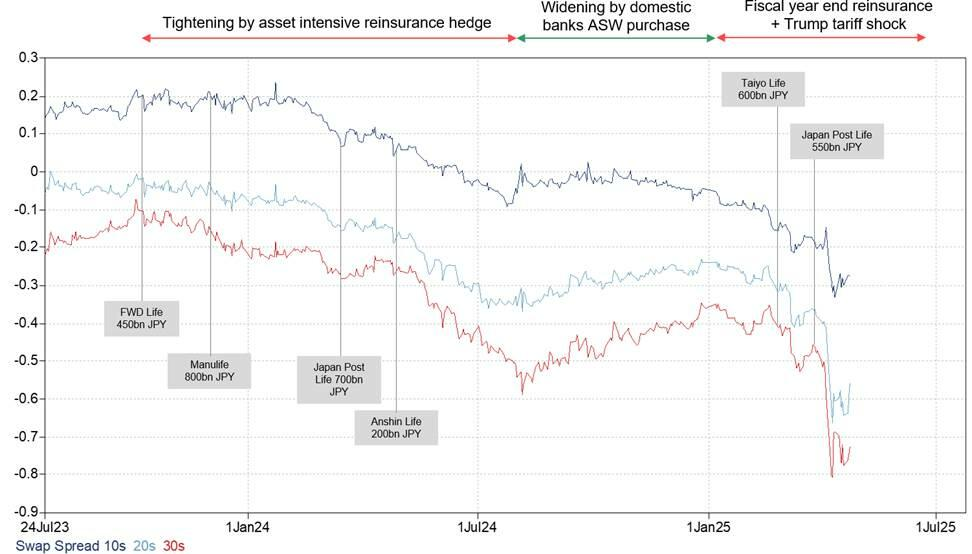
24日,据追风交易台消息,高盛认为,日本长期国债收益率飙升的核心原因在于供需严重失衡。寿险公司因久期缺口扩大而需求锐减,加上政府财政担忧 加剧以及资产密集型再保险交易引发的抛售,共同构筑了长期国债市场的抛压。这些因素导致日本国债市场买家稀少,流动性极差,即便日本央行持有大 量国债也无力回天。 高盛还强调,虽然日本国债抛售目前尚未传导至日本股市或汇市,但其对全球债市的溢出效应已愈发显著。数据显示,自今年年初以来,30年期日本国债 已为G4(美、欧、日、英)国家收益率贡献了约80个基点的上行压力,成为最大的看跌动能来源。这意味着,过去一个月美国国债收益率的飙升,很可 能大部分是日本长期国债市场动荡的"副产品"。 展望未来,日本国债市场的波动性仍将持续。尽管日本政府可能考虑减少长期国债发行或回购,但高盛认为,若无实质性的宏观经济政策应对高通胀,这 种波动将反复出现。日本央行的货币政策走向,特别是其量化紧缩路径的调整,将成为短期内影响市场走势的关键。 日本长期国债收益率为何飙升? 高盛日本利率交易员Yusuke Ochi指出,日本长期国债收益率近期急剧上涨,主要原因在于供需平衡的显著恶化,这包括寿险公司需求的变化以及 ...

美国的股市,日本的债市,中国的楼市
吴晓波频道· 2025-05-23 00:41
Group 1: Global Financial Market Overview - The global financial market is currently facing significant turmoil, with the U.S. stock market, Japanese bond market, and Chinese real estate market being highlighted as the three most in need of rescue [1][8] - Japan's recent 20-year government bond auction was notably poor, with a bid-to-cover ratio of only 2.5, the lowest since 2012, and a "tail" spread reaching 1.14, the worst since 1987 [2] - The U.S. bond market also experienced a "black Wednesday," with the 20-year Treasury yield surpassing 5%, marking the second time in history this threshold has been crossed [4][12] Group 2: U.S. Market Dynamics - Moody's downgraded the U.S. sovereign credit rating, citing unsustainable debt levels and a growing deficit, which has led to a loss of investor confidence in U.S. Treasuries [10][12] - The U.S. stock market reacted negatively to the downgrade, with major indices like the Dow Jones dropping over 800 points, reflecting the interconnectedness of the bond and equity markets [4][6] - The U.S. government is projected to increase its debt by an additional $3.8 trillion due to the recent tax cuts proposed by the Trump administration, exacerbating the existing debt crisis [20][21] Group 3: Japanese Debt Situation - Japan's public debt has reached 234.9% of GDP, significantly higher than Greece's 142.2%, indicating a severe fiscal challenge [26] - The Japanese government faces a dilemma between continuing quantitative easing to support bond purchases or tightening monetary policy to combat rising inflation [32] - The recent surge in Japanese bond yields is attributed to the Bank of Japan's reduced bond purchases, leading to concerns about the sustainability of Japan's fiscal situation [28][29] Group 4: Chinese Real Estate Market - China's real estate market is under pressure, with a 0.1% month-on-month decline in residential sales prices and a 4.5% year-on-year decrease, indicating ongoing challenges [7][35] - Goldman Sachs predicts a 40% reduction in new home sales over the next decade, while anticipating a significant increase in second-hand home transactions, which could reshape the housing market dynamics [43][44] - The shift towards a "stock" market for real estate, driven by aging properties and community operations, is expected to create new opportunities in related sectors such as building materials and home renovation [46]

BancFirst (BANF) - 2025 FY - Earnings Call Transcript
2025-05-22 15:30
Financial Data and Key Metrics Changes - The company reported a strong performance in Q1 2024 with earnings of $1.5 per share, exceeding the consensus estimate of $1.39 [19] - Loan growth was significant, increasing by $246 million to a total of $7.9 billion, representing a 3.2% growth [20] - The margin improved to 3.71% in Q1 2024 from 3.67% in Q4 2023, indicating a positive trend in profitability [22] - Non-interest income is expected to decline in 2024 due to the full-year impact of the Durbin amendment, which is projected to be a $23 million pretax reduction [23] Business Line Data and Key Metrics Changes - The company experienced good growth in its trust, insurance, and treasury businesses, contributing positively to non-interest income [23] - Asset quality remains strong with no systemic movement in classified assets, indicating resilience compared to peers [24] Market Data and Key Metrics Changes - The company has shifted its deposit mix back to above pre-pandemic levels, although the composition has changed [20] - Liquidity remains robust at over $2.2 billion, with core deposits funding the operations without reliance on broker deposits [27] Company Strategy and Development Direction - The company has switched its primary federal regulator from the FDIC to the Federal Reserve, which is seen as a positive change with expectations for better regulatory alignment [25][26] - The outlook for the remainder of the year is cautiously optimistic, with the company well-positioned to capitalize on potential opportunities regardless of economic conditions [28] Management's Comments on Operating Environment and Future Outlook - Management acknowledged the challenges posed by quantitative tightening but expressed confidence in the company's ability to navigate these issues [2] - The company anticipates that it will continue to perform better than peers in tougher economic conditions [24] - There is uncertainty regarding the Federal Reserve's potential rate cuts in the second half of the year, but the company feels prepared for various scenarios [28] Other Important Information - The company reported a quorum of 88.1% of shares outstanding represented at the meeting, indicating strong shareholder engagement [4] - All proposals presented at the meeting were approved with significant support, reflecting shareholder confidence [18] Q&A Session Summary Question: What is the outlook for the company's performance in the current economic environment? - Management expressed a positive outlook for the remainder of the year, emphasizing the strength of the balance sheet and readiness for upcoming opportunities [28] Question: How is the company managing its asset quality amid economic challenges? - Management noted that asset quality remains very good, with no significant movement in classified assets, and they expect to perform better than peers in tougher times [24] Question: What impact will the Durbin amendment have on non-interest income? - The company anticipates a decline in non-interest income due to the full-year impact of the Durbin amendment, estimating a $23 million pretax reduction [23]

债券拍卖遇冷,日本国债大跌,石破茂:日本财政状况比希腊还差
Mei Ri Jing Ji Xin Wen· 2025-05-22 08:43
Core Viewpoint - The structural risks of Japan's ultra-long-term government bonds are rising as yields continue to increase, with the 40-year yield reaching its highest level since issuance in 2007, indicating potential challenges for Japan's fiscal sustainability and global market stability [1][2][4]. Group 1: Bond Market Dynamics - Japan's long-term bond yields are on the rise, with the 40-year yield increasing by 6 basis points to 3.675%, the highest since 2007 [1]. - The 10-year and 5-year government bond yields have also risen, reaching 1.56% and 1.02% respectively [1]. - The recent auction of 20-year bonds saw the lowest bid-to-cover ratio since 2012, dropping to 2.5 times, indicating weak market demand [2][4]. Group 2: Central Bank Challenges - The Bank of Japan holds 52% of the Japanese government bond market, acting as a stabilizer but facing a dilemma between continuing quantitative tightening (QT) and the risk of market volatility [5]. - If QT continues, long-term bond yields may rise further, leading to significant losses for bondholders and potentially forcing the Bank of Japan to reintroduce yield curve control (YCC) or negative interest rates [5]. - Conversely, if the Bank of Japan opts for quantitative easing (QE), it may alleviate market volatility but exacerbate inflationary pressures and lead to a depreciation of the yen [5]. Group 3: Economic Sentiment - A recent survey indicated that 65% of Japanese companies are calling for the Bank of Japan to pause its interest rate hike plans, reflecting concerns over economic contraction and uncertainty from external factors [6]. - The total national debt of Japan is projected to reach 1,323.7155 trillion yen by the end of the fiscal year 2024, marking a continuous increase and raising concerns about fiscal sustainability [7]. - The Japanese government is facing a fiscal dilemma, with rising expenditures due to inflation not being fully covered by tax revenues, leading to a precarious financial situation [8].
【财经分析】日本国债拍卖“崩了” 投资者需警惕“连锁反应”
Xin Hua Cai Jing· 2025-05-20 11:31
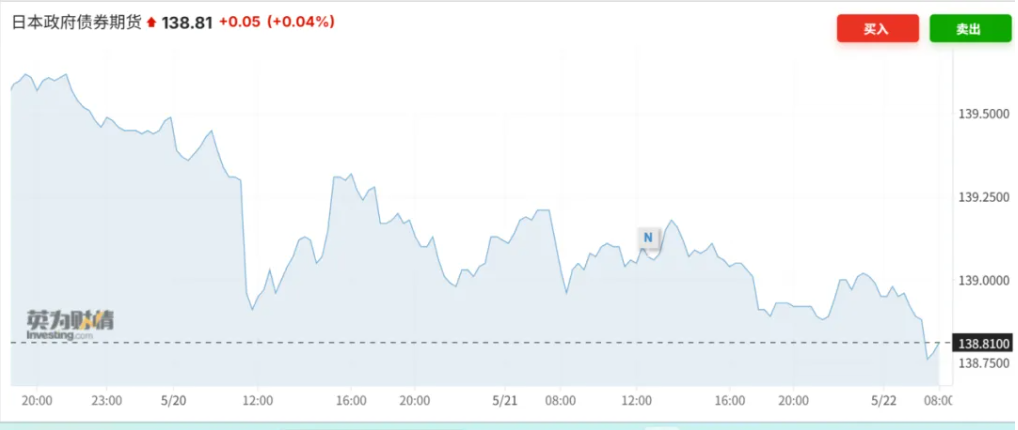
当全球金融市场的焦点集中在美债走势之时,日本超长期国债的结构性风险正悄然的攀升,"供需错 位"导致日本债券拍卖遇冷,超长期日债收益率跳涨或导致全球金融市场震动,而作为日本国债最大的 买家,日本央行的量化紧缩能否持续推进再次出现了较大的不确定性。 截至5月20日发稿,日本20年期国债收益率跃升至2.555%,为2000年10月以来的最高水平;日本30年期 国债收益率上涨13个基点至纪录高点3.10%;40年期国债收益率则跃升10个基点至3.591%的历史最高 点。日本基准10年期国债收益率一度升至1.525%,为3月底以来高位。 日本债券市场的供需失衡也令日本央行陷入两难局面,一方面若日本央行持续推进量化紧缩(QT), 可能导致长端债券收益率继续上行,引发债市剧烈波动,使持债机构面临巨大账面损失,最终甚至可能 迫使央行重启收益率曲线控制(YCC)或重新实施负利率。 另一方面,如果日本央行选择提前放弃紧缩政策,重新启动量化宽松(QE),虽然有助于缓解市场波 动,但可能加剧通胀压力,导致日元大幅贬值、资本外流。 日债收益率上升的"连锁反应" 日本央行的量化紧缩能否持续? 当地时间5月20日,日本财务省进行的1万亿日 ...