算力

Search documents
AI应用热潮延续,龙头股强势翻倍!创业板人工智能ETF(159363)放量上扬3.5%,涨幅、成交额双双领跑同类
Xin Lang Cai Jing· 2026-01-14 11:28
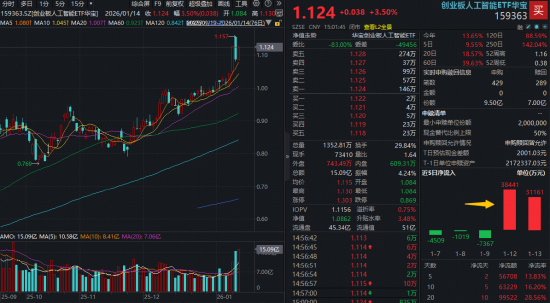
光模块CPO方面则可以关注业绩催化。国盛证券认为,算力产业链高景气周期背景下,光模块头部厂商 在大陆和泰国加速扩产,预计光模块行业2026年一季度将迎来产能集中释放,驱动业绩进入新一轮爬坡 期。该机构表示,继续看好算力板块,坚定推荐算力产业链相关企业,如光模块行业龙头。* 当前AI发展从算力建设走向应用落地,一键布局"算力+AI应用"的创业板人工智能ETF(159363)及场 外联接(A类023407、C类023408),更直接受益于AI技术商业化爆发的增长红利。从赛道看,创业板 人工智能约六成仓位布局算力(光模块+IDC),约四成仓位布局AI应用,不仅是"算力"核心,更是真 正的"AI应用"代表。 周三(1月14日),乘风AI应用爆发,创业板人工智能放量大涨。其中,易点天下大涨超16%再创新 高,今年以来股价已上涨100%实现翻倍,拓尔思大涨超15%,润和软件、长亮科技、东方国信等多股 涨超5%。此外,IDC(数据中心)这一低位算力板块午后显著启动,概念股润泽科技大涨超12%,易华 录涨超11%! 热门ETF方面,不惧市场宽幅震荡,双线布局"AI应用+算力"的创业板人工智能ETF(159363)场内收 涨3 ...


龙虎榜 | 深南东路、宁波桑田路会师利欧股份,消闲派3.71亿打板山子高科
Sou Hu Cai Jing· 2026-01-14 11:19
Group 1 - A-shares trading volume reached a record high of 3.99 trillion yuan, with over 2,700 stocks rising, particularly in the medical services, AI applications, computing hardware, and semiconductor sectors [2] - Key stocks include Jia Mei Packaging with 14 consecutive trading limits, Youbang Ceiling with 8 limits in 10 days, and Galaxy Electronics with 7 limits in 8 days [2] - The market saw significant activity in stocks related to AI and computing, indicating strong investor interest in these sectors [2] Group 2 - Stock performance highlights include Hongxiang Co. with a 20.03% increase, LaKala with a 20.02% rise, and Qida Chemical with a 20.01% gain, all showing strong trading activity [1][3] - The top net buying stocks on the day included Shanzikao Technology, Guangxun Technology, and Huasheng Tiancai, with net purchases of 9.97 billion yuan, 8.35 billion yuan, and 7.70 billion yuan respectively [4][6] - Conversely, the top net selling stocks included Yanshan Technology, Haige Communication, and Leike Defense, with net sales of 6.27 billion yuan, 5.78 billion yuan, and 5.41 billion yuan respectively [5][7] Group 3 - Shanzikao Technology is actively involved in the restructuring of Nezha Automobile and has reported a net profit of 437 million yuan for the first three quarters, indicating a turnaround [11] - Guangxun Technology is focusing on next-generation optical modules and has seen significant growth in its product shipments, positioning itself as a leader in the optical device market [15] - Huasheng Tiancai is advancing its AI and computing strategy, with a notable increase in revenue from AI-related products, reflecting strong market demand [20]


多只权重股,尾盘现巨额压单
证券时报· 2026-01-14 09:14
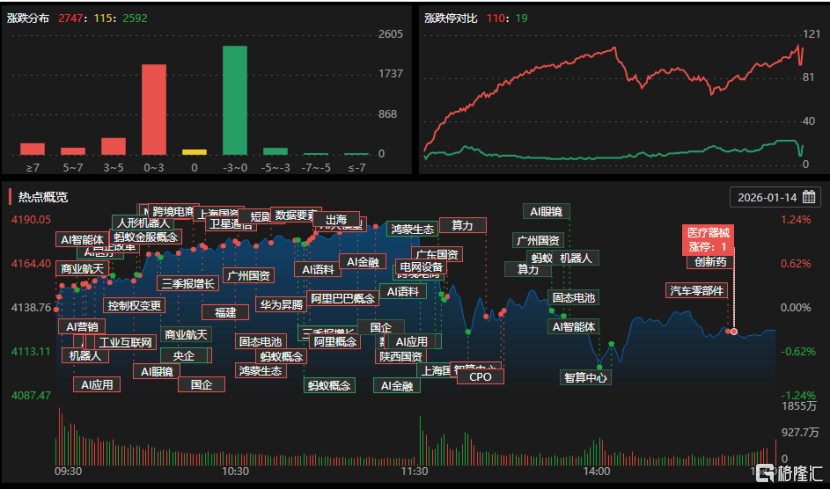
Market Overview - The Shanghai Composite Index experienced a strong rise in the morning, approaching 4200 points, but fell back into the red in the afternoon, closing down 0.31% at 4126.09 points [1] - The Shenzhen Component Index rose by 0.56%, and the ChiNext Index increased by 0.82%, while the STAR Market 50 Index gained 2.13% [1] - The total trading volume of the A-share market reached approximately 3.99 trillion yuan, an increase of about 288 billion yuan compared to the previous day [1] Sector Performance - The financial sector, including insurance and banking, saw a significant decline in the afternoon, with China Life Insurance dropping nearly 3% and major banks like China Merchants Bank and Industrial Bank falling over 2% [3][4] - The brokerage sector also retreated in the afternoon, with firms like Guosen Securities and Haitong Securities declining nearly 2% [3] - In contrast, the semiconductor sector showed strong performance, with stocks like Zhaoxin Technology rising nearly 15% and Jingfeng Mingyuan increasing over 13% [8] - AI application concepts remained active, with stocks such as Zhidema hitting the daily limit and achieving a cumulative increase of over 80% in four trading days [12] Regulatory Changes - The China Securities Regulatory Commission approved an adjustment to the financing margin ratio, increasing the minimum margin requirement for investors from 80% to 100% when buying securities on margin [6] AI and Semiconductor Trends - The semiconductor sector is expected to see continued demand improvement, driven by growth in PCs, smartphones, and AI servers, with a focus on domestic production as U.S. policies remain stringent [10] - AI applications are gaining traction, with companies exploring new marketing paradigms and enhancing user interaction through generative AI technologies [14]



A股市场成交额逼近4万亿元,再创历史新高
Cai Jing Wang· 2026-01-14 09:06
1月14日,沪指早盘强势上扬,一度涨超1%逼近4200点,午后回落翻绿;深证成指、创业板指等涨幅均 有所收窄,全A成交额逼近4万亿元大关,再创历史新高。 截至收盘,沪指跌0.31%报4126.09点,深证成指涨0.56%,创业板指涨0.82%,科创50指数涨2.13%,沪 深北三市成交约3.99万亿元。 来源:证券时报网 作者:吴永芳 盘面上看,保险、银行、地产、酿酒、券商等板块走低,传媒、半导体、石油等板块上扬,AI应用、 云计算、算力概念等活跃。 东莞证券表示,年初以来,股市整体走势强劲,沪指连续放量突破4000点和4100点关口,形成向上突破 态势。市场交投活跃,不过在短期快速上涨、成交量显著放大后,市场也需警惕潜在的调整。但阶段性 的震荡整理或更有利于基本面的不断改善以消化指数估值,吸引增量资金持续流入,推动A股延续震荡 上行格局。在配置上,可关注石油石化、建筑装饰、有色金属、TMT及煤炭等板块。 ...
远东股份(600869):首次覆盖报告:主营稳健增长,新兴市场强势赋能
Guolian Minsheng Securities· 2026-01-14 07:58
Investment Rating - The report gives a "Buy" rating for the company, Far East Holdings (600869.SH) [5] Core Views - Far East Holdings has established itself as a global service provider in smart energy and smart city solutions, focusing on three main industries: smart cables, smart batteries, and smart airports [2][15] - The company is expected to achieve steady revenue growth driven by its core business in smart cables and the expansion into emerging markets [10][11] Summary by Relevant Sections Company Overview - Far East Holdings is a subsidiary of Far East Holding Group, focusing on smart cables, smart batteries, and smart airports, and has become a leader in the global smart energy and smart city service market [2][15] Smart Airport Business - The global airport infrastructure market is projected to grow from USD 77.85 billion in 2022 to USD 139.14 billion by 2030, with a CAGR of 7.5% [3] - The smart airport segment achieved revenue of CNY 1.267 billion in the first three quarters of 2025, a year-on-year increase of 15.75%, with net profit rising by 47.88% to CNY 111 million [3][68] Smart Cable Business - The smart cable segment generated revenue of CNY 17.826 billion in the first three quarters of 2025, reflecting a year-on-year growth of 9.59%, with net profit increasing by 8.69% to CNY 315 million [9][31] - The company has secured contracts worth CNY 177.64 billion, marking a 13.95% increase year-on-year [31] Smart Battery Business - The smart battery segment reported revenue of CNY 1.039 billion in the first three quarters of 2025, a significant year-on-year growth of 30.92%, although it still recorded a net loss of CNY 256 million [57] - The company has established a complete supply chain from cell technology to energy storage system integration, focusing on high-end industries and accelerating overseas expansion [57][60] Financial Forecasts - Revenue projections for 2025-2027 are CNY 296.49 billion, CNY 344.28 billion, and CNY 400.12 billion, with year-on-year growth rates of 13.6%, 16.1%, and 16.2% respectively [4][76] - The net profit for the same period is expected to be CNY 2.34 billion, CNY 6.57 billion, and CNY 10.72 billion, with growth rates of 173.6%, 180.7%, and 63.2% respectively [4][76] Valuation Analysis - The report indicates that the company's future PE ratios for 2025-2027 are 101x, 36x, and 22x, which are below the industry average, suggesting investment potential [4][78]

低费率云计算ETF华夏(516630)持仓股数据港、石基信息涨停!“智谱+华为”联合打造首个国产芯片训练多模态SOTA模型
Xin Lang Cai Jing· 2026-01-14 06:39
Group 1 - The technology sector experienced a narrowing of gains, with the cloud computing ETF Huaxia (516630) seeing its increase shrink to 3.01%, while stocks Data Harbor and Shiji Information hit the daily limit up [1] - The AI-focused cloud computing ETF Huaxia (516630) tracks an index with a high AI computing power content, covering popular concepts such as optical modules, computing leasing, data centers, AI servers, and liquid cooling [3] - The launch of the GLM-Image model by Zhipu in collaboration with Huawei marks a significant advancement, being the first state-of-the-art multimodal model trained entirely on domestic chips, with a cost of generating an image at only 0.1 yuan [1] Group 2 - The joint issuance of the "AI + Manufacturing" implementation opinions by eight national departments aims to promote the deep integration of AI and manufacturing, which is expected to accelerate AI application penetration in the B-end market [2] - Major internet companies in China are rapidly expanding their C-end applications, leveraging their large user bases and mature AI model technology to embed intelligent systems into existing products and business frameworks [2] - The Huaxia Entrepreneurial AI ETF (159381) tracks the entrepreneurial board AI index, focusing on companies with AI as their main business, with significant weight in optical modules and a high elasticity in performance [3]

行业迎来密集催化!大数据ETF、大数据ETF华夏、云计算ETF广发、云计算ETF易方达涨超4%
Ge Long Hui· 2026-01-14 06:26
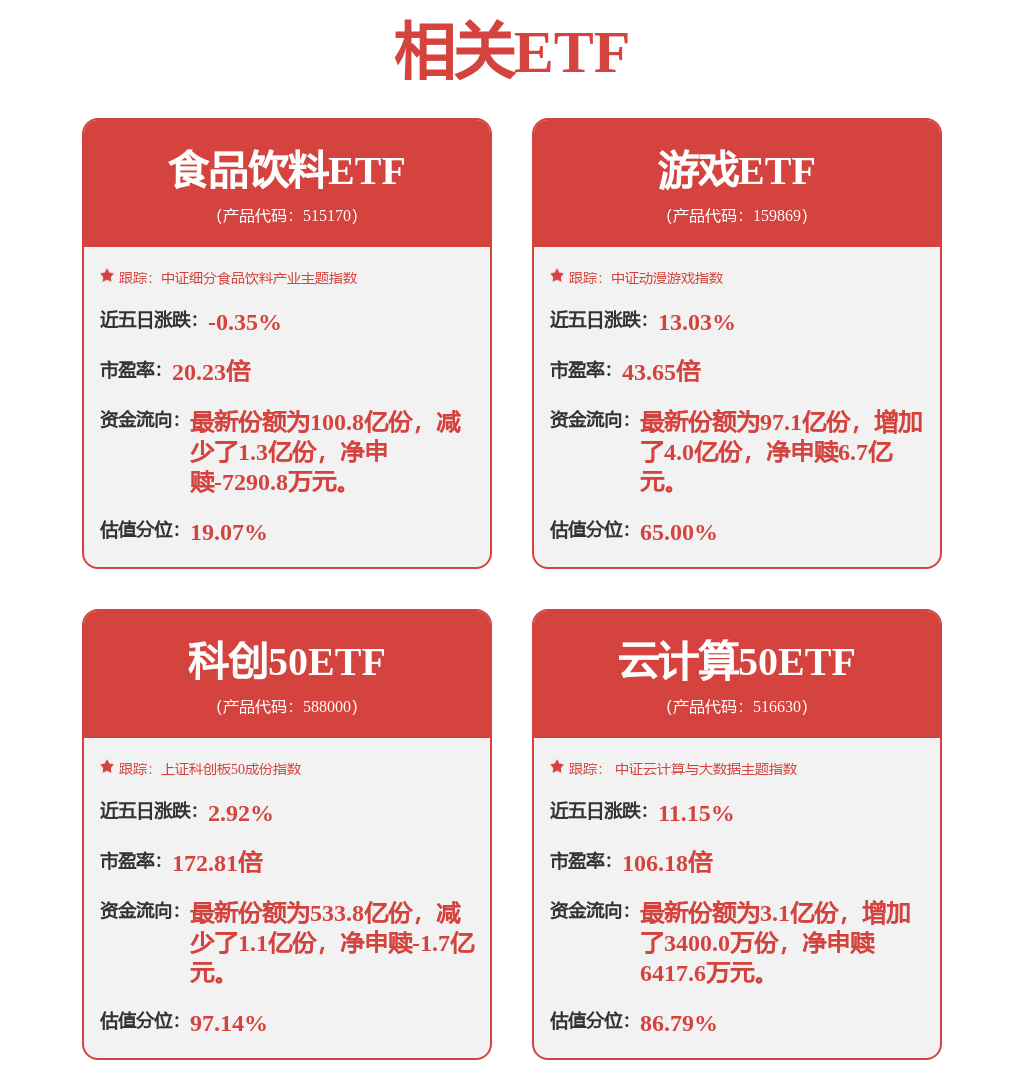
Core Viewpoint - The A-share market is experiencing increased volatility, with AI-related sectors leading the gains [1] Group 1: ETF Performance - As of the report, various ETFs such as Big Data ETF, Financial Technology ETF, and Cloud Computing ETFs have risen over 4% [2] - The Cloud Computing ETF from Huaxia focuses on domestic AI software and hardware capabilities, with a combined weight of computer software, cloud services, and computer equipment reaching 83.7%, and deep learning applications exceeding 40% [2] - The Big Data ETF tracks the CSI Big Data Industry Index, heavily investing in sectors like data centers and cloud computing, with major holdings in leading companies such as Inspur, iFlytek, and China Software [2] Group 2: Industry Catalysts - The industry is witnessing a series of catalysts, including DeepSeek's recent paper on conditional memory modules for large models, which is expected to be a core modeling primitive for the next generation of sparse large models [3] - Speculation arises regarding DeepSeek's next-generation model V4, anticipated to be released around the Spring Festival, based on recent research developments [4] Group 3: Company Developments - On January 8, Zhipu AI became the first global large model company to list on the Hong Kong Stock Exchange, followed by MiniMax on January 9, marking a competitive rush in the sector [5] - Alibaba's total capital expenditure for FY2026 Q2 reached 31.501 billion yuan, a year-on-year increase of 80.10%, with Alibaba Cloud planning to further invest in AI cloud computing infrastructure [6] Group 4: Market Dynamics - The demand for computing power is expected to grow significantly due to the AI wave, with domestic AI development striving to catch up [6] - The domestic AIDC (Artificial Intelligence Data Center) is rapidly developing, with the total number of operational computing center racks reaching 10.85 million and intelligent computing capacity at 788 EFLOPS (FP16) by June 2025 [6] - Supply-side constraints are evident, with high-end chip shortages persisting due to geopolitical factors, leading to a mismatch between supply and demand [7] Group 5: Trends and Future Outlook - The AI development is driving an increase in chip power consumption, with supernode deployment becoming a significant trend, and the demand for computing power leasing is surging amid US-China tensions [8] - The leasing market for computing power is thriving, with significant orders being secured by related companies, and the resale value of high-performance servers remains robust [8]
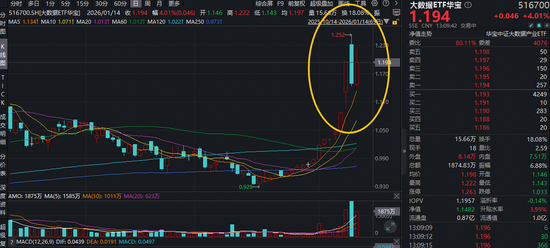
ETF盘中资讯|浅歇一日后,再续12连阳雄风?GEO概念继续活跃,易点天下创新高!大数据ETF华宝(516700)盘中暴涨6.45%
Sou Hu Cai Jing· 2026-01-14 05:48
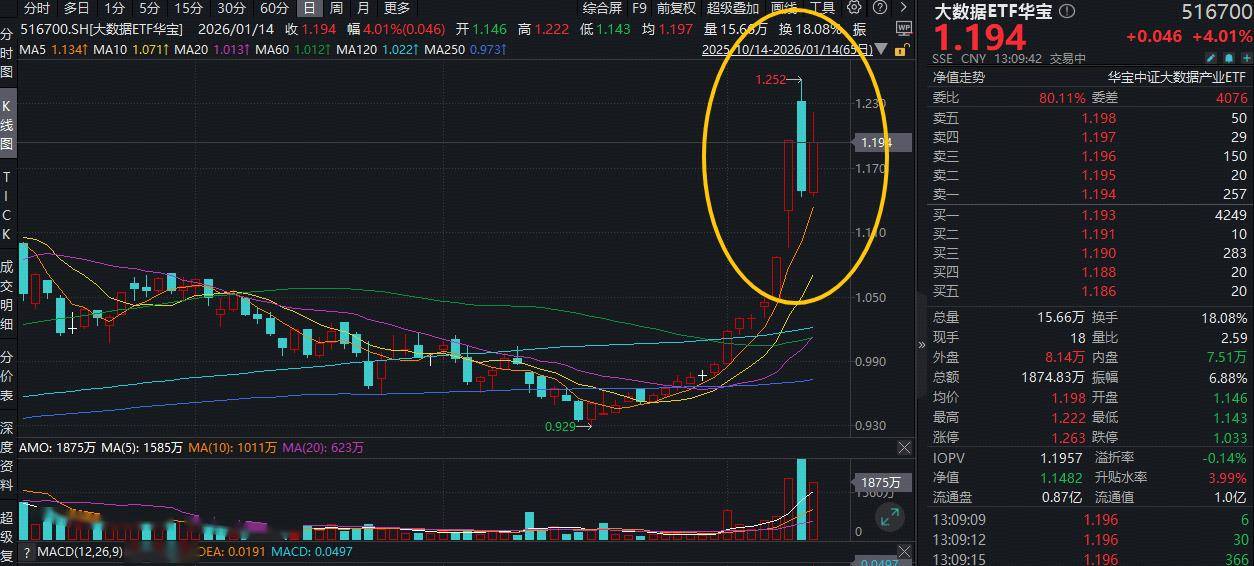
Core Viewpoint - The Huabao Big Data ETF (516700) is focusing on computing power and AI applications, showing strong market performance with significant inflows and stock price increases, indicating investor optimism in the AIDC (AI Data Center) sector [1][6]. Group 1: ETF Performance - The Huabao ETF experienced a price increase of 6.45% during intraday trading, with a current rise of 4.01% [1]. - Over the past two days, the ETF has seen a net inflow of 11.1 million yuan, reflecting positive market sentiment towards AIDC [1]. Group 2: Component Stocks - Key stocks such as Yonyou Network, Tax Friend, Data Port, and Shiji Information reached their daily limit up, while Zhongke Xingtong surged over 15% and Yidian Tianxia increased by more than 14% [2][3]. - The performance of component stocks indicates strong investor interest in the underlying sectors of the ETF [3]. Group 3: Industry Growth Potential - The GEO market in China is projected to grow by 215% year-on-year by Q2 2025, with a significant shift in traffic from traditional search engines to AI chatbots [4][5]. - Companies are enhancing marketing efficiency, with AI recommendations improving conversion rates by 2.8 times compared to traditional search methods [5]. Group 4: Strategic Focus Areas - The Huabao ETF is heavily invested in domestic computing power (IDC, servers) and AI applications, tracking the CSI Big Data Industry Index [7]. - The ETF's major holdings include leading companies in data centers, cloud computing, and big data processing, indicating a focus on technology self-reliance [7][8]. Group 5: Future Outlook - The demand for data centers is expected to grow due to the high demand for computing power, particularly in North America and China, with a rebound anticipated after recent constraints [5][6]. - The ongoing push for technological independence and the acceleration of domestic alternatives are expected to create favorable conditions for investment in the sector [8].
浅歇一日后,再续12连阳雄风?GEO概念继续活跃,易点天下创新高!大数据ETF华宝(516700)盘中暴涨6.45%
Xin Lang Ji Jin· 2026-01-14 05:30
Core Viewpoint - The Huabao Big Data ETF (516700) is focusing on computing power and AI applications, showing strong market performance with a recent increase in trading volume and price, reflecting investor optimism in the AIDC (AI Data Center) sector [1]. Group 1: ETF Performance - The Huabao ETF hit a historical high after a strong performance, with a peak intraday increase of 6.45% and a current rise of 4.01% [1]. - The ETF has seen a net inflow of 11.1 million yuan over the past two days, indicating positive market sentiment towards AIDC [1]. Group 2: Market Trends and Predictions - The GEO market in China is expected to grow significantly, with a projected year-on-year increase of 215% by Q2 2025, as traditional search engine traffic is anticipated to decline by 25% by 2026 [2][3]. - The implementation of GEO is expected to enhance marketing efficiency, with AI recommendations improving customer conversion rates by 2.8 times and reducing decision-making time by 40% [3]. Group 3: Company Developments - Companies like Liou Co. have made substantial advancements in AI technology, developing solutions such as "intelligent response optimization" and participating in industry standard formulation [3]. - The data center sector is identified as a core infrastructure for AI, with a growing demand for computing power driving significant growth in the IDC industry [3]. Group 4: ETF Composition and Focus - The Huabao ETF's index composition shows that computing power concepts account for 40.91% and AI application concepts account for 37.43% of the index [5]. - The ETF is heavily invested in sectors such as data centers, cloud computing, and big data processing, focusing on leading companies in these areas [6].
A股早盘涨近1%
Wind万得· 2026-01-14 03:01
Market Overview - As of January 14, the Shanghai Composite Index rose nearly 1% to 4177 points, while the ChiNext Index increased by over 2% [2] - More than 4500 stocks in the market experienced an increase, indicating a broad market rally [2] Index Performance - The CSI 300 Index reached 4803.22, up by 42.19 points or 0.89% [4] - The CSI 500 Index increased by 191.74 points, or 2.35%, to 8335.02 [4] - The CSI A500 Index rose by 77.59 points, or 1.31%, to 5978.80 [4] - The CSI 1000 Index saw an increase of 185.92 points, or 2.27%, reaching 8389.05 [4] - The Shenzhen Component Index rose by 70.27 points, or 1.19%, to 5989.25 [4] Sector Performance - The internet sector led the gains with a rise of 7.20%, followed by software at 5.82% and cultural media at 5.53% [4] - Other notable sectors included education (+3.95%), computer hardware (+3.53%), and energy equipment (+3.67%) [4] Conceptual Sector Highlights - The GEO concept surged by 10.61%, while marketing communication and Pinduoduo partnerships increased by 8.73% and 8.56%, respectively [5] - Aerospace equipment and the industrial internet sectors also showed strong performance, rising by 7.99% and 7.67% [5] Investment Insights - Zhongyuan Securities suggests that investors should closely monitor macroeconomic data, overseas liquidity changes, and policy trends due to effective volume expansion and positive policy expectations [7] - Caixin Securities notes that the current level of capital activity in A-shares remains high, although there is increasing divergence among high-performing sectors and stocks [7] - Bridgewater Associates has recently posted a job for a "China Policy AI Research Assistant" to deepen their understanding of the Chinese policy environment and its impact on assets and the economy [7]