绿色经济

Search documents
湖北省商务厅答21记者问:探索建立“校友资源库”,以全生命周期服务体系护航
2 1 Shi Ji Jing Ji Bao Dao· 2025-06-10 04:48
Group 1 - The Hubei provincial government is launching a series of actions titled "Grasp Entrepreneurship and Promote Employment," focusing on the "Return of Alumni" to attract investment and innovation [2][3] - Hubei's Commerce Department emphasizes the importance of alumni as a unique advantage and strategic resource for high-quality development in the province [2] - The government plans to establish a comprehensive and dynamic "Alumni Resource Database" to accurately grasp alumni resources and facilitate investment opportunities [2] Group 2 - The government aims to enhance platform construction by leveraging major events such as the "Spring Cherry Blossom Economic and Trade Fair" and the "Chuchang Conference" to connect alumni with development resources [3] - Focus areas include technology transfer, digital economy, and green economy, with targeted cooperation between key parks, industries, and enterprises [3] - A comprehensive service system for alumni investment projects will be established, providing personalized and dedicated support for high-impact projects [3]
丝路响起新“驼铃”(环球热点)
Ren Min Ri Bao· 2025-06-09 21:34
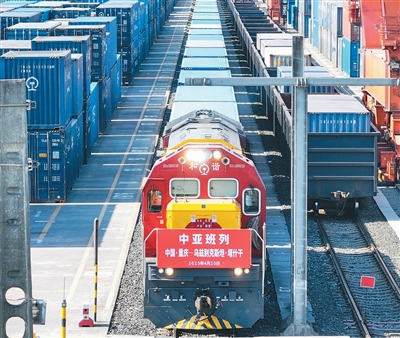
Core Insights - In 2024, trade between China and Central Asian countries reached a record high of 94.8 billion USD, with cumulative Chinese investment exceeding 30 billion USD in the region [1] - The cooperation between China and Central Asia is characterized by rapid progress, significant potential, and promising prospects, driven by stable political relations and strong economic development needs [1] Trade and Investment Growth - China has become the largest trading partner and primary source of investment for Central Asia, with bilateral trade and mutual investment increasing over a hundredfold since diplomatic relations were established over 30 years ago [2][3] - The trade volume between China and Kazakhstan in 2024 is projected to be 43.8 billion USD, reflecting a year-on-year growth of 6.8% [4] Sectoral Cooperation - Energy cooperation has diversified Central Asian energy exports, with the China-Central Asia natural gas pipeline being a significant source of natural gas imports for China [3] - Agricultural cooperation is thriving due to the complementary agricultural resources between China and Central Asia, with China exporting agricultural technology and products to the region [3] Infrastructure Development - The construction of the China-Kyrgyzstan-Uzbekistan railway marks a significant step in enhancing regional connectivity, which is crucial for trade facilitation [5][6] - Major projects like the China-Central Asia natural gas pipeline and the China-Kazakhstan oil pipeline have strengthened logistics networks, promoting mutual benefits [6] Emerging Fields of Cooperation - The recent discussions on digital economy and green development highlight the importance of these sectors as new growth points for cooperation between China and Central Asia [8] - The collaboration in artificial intelligence and other emerging industries is seen as a natural progression, driven by the need for technological advancement and infrastructure development [9]
渣打高恕年:中国-东盟自贸区3.0版发出倡导贸易开放“最强音”
Xin Hua Cai Jing· 2025-06-09 08:29
Core Viewpoint - The completion of the China-ASEAN Free Trade Area 3.0 negotiations is timely and sends a strong message advocating for multilateralism and trade openness, which will accelerate the development of the China-ASEAN trade corridor and create a multiplier effect for global growth [1][2]. Group 1: Trade Relations and Economic Cooperation - China and ASEAN have become each other's largest trading partners, with trade volumes continuing to grow. The completion of the Free Trade Area 3.0 negotiations signals a commitment to multilateralism and open trade amidst global protectionism [2][3]. - The 3.0 version of the Free Trade Area includes key areas such as digital economy, green economy, and supply chain resilience, making it more modern and forward-looking. Its implementation will enhance cooperation in various sectors, including digital economy, artificial intelligence, e-commerce, and smart manufacturing [2][3]. Group 2: Investment Trends and Strategies - Chinese enterprises are expected to continue investing in ASEAN, particularly those focusing on local market development rather than solely on exports to the U.S. The investment trend remains strong despite uncertainties in U.S. tariff policies [4][6]. - The "China +1" strategy has evolved into a "2.0 version," where Chinese companies are increasingly establishing complete supply chains overseas, indicating a deeper understanding of local markets and partnerships [4][6]. Group 3: Market Potential and Future Outlook - The ASEAN market presents significant long-term investment opportunities due to its political stability, a rapidly growing young population, and a large consumer market. The rise of the middle class in Southeast Asia will create more consumption and investment opportunities for various enterprises, including Chinese firms [6][7]. - Investment from China to ASEAN is projected to grow, with a reported increase of 12.6% year-on-year, primarily directed towards countries like Singapore, Indonesia, and Thailand, and focusing on sectors such as leasing, business services, and manufacturing [7].
坚定不移维护自由贸易与开放合作
Jing Ji Ri Bao· 2025-06-08 21:41
2025年5月20日,中国与东盟经贸部长共同宣布全面完成中国—东盟自贸区3.0版谈判。在全球经济格局 深刻调整的背景下,这一里程碑式的成果不仅为区域经济一体化注入新动能,更为世界经济的稳定与繁 荣贡献了"中国—东盟方案"。 作为中国首个对外商谈并建立的自贸区,同时也是东盟框架下的首个自贸协定,中国—东盟自贸区的发 展历程堪称区域合作的典范。从2010年中国—东盟自贸区1.0版聚焦货物贸易、服务贸易和投资领域, 到2015年中国—东盟自贸区2.0版进一步扩大市场开放,再到2022年启动的中国—东盟自贸区3.0版本升 级谈判,双方用十余年时间构建起日益紧密的经贸合作网络。 数据显示,我国已连续16年保持东盟第一大贸易伙伴地位,东盟自2020年开始连续保持我国第一大贸易 伙伴地位,双方投资规模持续扩大。中国和东盟成员国各具比较优势,在要素资源、产业结构和消费结 构方面存在差异,形成了产业链供应链的深度合作关系。例如,双方在电子产品、机械设备、农产品等 传统领域形成深度产业链合作,同时在数字经济、绿色经济等新兴领域不断开拓合作空间。双方在产业 园区建设等方面也持续推进,建立了境外经贸合作区、"两国双园"等合作项目。 ...
生态治理圈也是绿色经济圈
Bei Jing Ri Bao Ke Hu Duan· 2025-06-07 19:52
Core Viewpoint - The ecological restoration in the Beijing-Tianjin-Hebei region is a significant achievement driven by systemic reforms, emphasizing the importance of water as a lifeline for regional development [1][2]. Group 1: Ecological Governance - Water ecological governance is a systematic project that requires comprehensive planning, overall policies, and multiple measures [2]. - The Beijing-Tianjin-Hebei region has broken down administrative barriers to establish a collaborative governance system with unified standards, monitoring, and enforcement [2]. - Collaborative mechanisms have been explored to address pollution issues in the Bohai Sea, effectively controlling nitrogen discharge and enhancing water quality [2]. Group 2: Economic Transformation - The restoration of water systems, wetlands, and coastal ecosystems is translating ecological value into economic benefits in tourism and green consumption [3]. - Projects like the integration of cultural tourism in Nandagang and the establishment of green manufacturing in Tianjin are examples of how ecological resources are being leveraged for economic development [3]. - The development of bird-watching and other eco-tourism activities at Hengshui Lake is attracting significant tourist traffic, contributing to the local economy [3]. Group 3: Future Prospects - The ecological governance in the Beijing-Tianjin-Hebei region is progressing towards a broader future, enhancing the quality of life and sense of happiness for local residents [3].


【高端访谈】中国经验助力巴西东北部能源转型——访巴西国开行董事兼巴西发展协会主席玛丽亚·费尔南达·科埃略
Xin Hua Cai Jing· 2025-06-06 14:00
Core Insights - The Brazilian National Development Bank (BNDES) is focusing on renewable energy and sustainable urban development, drawing on China's experiences in these areas to aid Brazil's energy transition [1][2] - The northeastern region of Brazil, rich in wind and solar resources, is becoming a key area for renewable energy development, with significant investments from Chinese companies [1][2] - BNDES announced a credit line of 100 billion Brazilian Reais (approximately 127 billion RMB) to support energy transition and decarbonization efforts in the northeastern region [2][5] Group 1: Renewable Energy Development - The northeastern region of Brazil is a core area for wind and solar power, contributing significantly to the country's renewable energy capacity [1] - Chinese companies such as State Grid, China General Nuclear Power Group, and BYD are actively investing in the region to promote clean energy development [1] - The focus on renewable energy is expected to drive industrialization in one of Brazil's poorest regions [1][4] Group 2: Sustainable Urban Development - The "sponge city" model from China, aimed at sustainable water resource management and disaster prevention, is being studied by BNDES as an innovative example for urban planning [2] - This model is seen as a response to extreme climate events while promoting urban sustainability [2] Group 3: Financial Support and Investment - BNDES plays a crucial role in Brazil's industrialization plans, aiming to attract investments and build a strong, sustainable industrial system [2][3] - The Federal Financial Institutions Regional Committee, which includes BNDES, has been reactivated to support industrialization strategies in the northeastern region [3][4] - The Brazilian government is committed to revitalizing the northeastern economy, with significant funding allocated for strategic business plans targeting cooperatives and investments exceeding 10 million Reais [5]
欧盟经济面临复杂挑战
Jing Ji Ri Bao· 2025-06-05 22:00
Core Viewpoint - The European Commission's Spring Economic Outlook for 2025 has downgraded growth forecasts for the EU and Eurozone due to global trade uncertainties, U.S. tariff policies, and geopolitical risks, projecting EU GDP growth at 1.1% and Eurozone growth at 0.9% for 2025 [1][2] Economic Growth Projections - The EU's GDP growth forecast for 2025 has been revised down from 1.5% to 1.1%, while the Eurozone's growth forecast has been reduced from 1.3% to 0.9% [1] - The growth outlook for 2026 is also pessimistic, with projections of 1.5% for the EU and 1.4% for the Eurozone [1] Structural Economic Issues - Germany, as the Eurozone's economic engine, is experiencing stagnation with a projected growth rate of 0% for this year, impacting the entire Eurozone [2] - Other major economies within the Eurozone are also facing low growth expectations, with France at 0.6%, Italy at 0.7%, and Austria contracting by 0.3% [2] - In contrast, some EU member states like Malta (4.1%), Denmark (3.6%), and Ireland (3.4%) are showing stronger economic performance, highlighting regional disparities within the EU [2] Economic Policy Focus - The EU's economic policy for this year will focus on balancing monetary and fiscal policies, with the Eurozone's inflation rate expected to approach the European Central Bank's (ECB) target of 2% [3] - The ECB has implemented seven consecutive interest rate cuts to stimulate economic growth, with an anticipated further cut of 25 basis points in September [3] - Fiscal policy faces challenges due to strict limits set by the Stability and Growth Pact, particularly for countries like Italy and France with high deficits [3] Structural Challenges and Reforms - The EU aims to address structural challenges by enhancing competitiveness, particularly in light of Germany's manufacturing decline and high energy costs [4] - The EU's green and digital transitions require significant investment, but disparities in fiscal capacity and policy coordination among member states pose obstacles [4] - The European Commission has proposed a mid-term budget reform to focus resources on overcoming structural challenges and promoting sustainable development [4]
【环球财经】巴西2025能源会议聚焦可再生能源与工业化前景
Xin Hua Cai Jing· 2025-06-05 12:49
Group 1 - The 2025 Brazil Energy Conference opened in Teresina, Piauí, attracting over 800 representatives from various sectors to discuss renewable energy development and industrialization in Brazil's poorest regions [1] - Piauí state is highlighted as a key player in Brazil's energy transition, with 99.75% of its energy sourced from renewables, making it an attractive destination for international investment [1] - The conference agenda includes forums, workshops, and exhibitions focused on clean technologies, solar, wind, green hydrogen, and bioenergy success stories [1] Group 2 - China is recognized as a global leader in renewable energy, while Brazil ranks fifth in the world, emphasizing the potential for collaboration in this sector [1] - China General Nuclear Power Corporation (CGN) has invested over 5 billion Brazilian Reais (approximately 6.5 billion RMB) in Piauí since 2019, with a renewable energy capacity exceeding 600 MW [2] - CGN plans to establish a multi-energy complementary base in Piauí with a capacity exceeding 1,400 MW and an additional investment of over 3 billion Brazilian Reais (approximately 3.9 billion RMB) [2] Group 3 - CGN intends to set up a Sino-Brazil Clean Energy Innovation Center to promote project development in cutting-edge fields such as R&D, energy storage technology, and green hydrogen demonstration projects [3] - The conference is seen as a pivotal moment for Piauí and Brazil to solidify their leadership in the green economy, connecting governments and businesses with promising industries [4] - The United Nations Development Programme representative highlighted the conference's role in advancing energy transition and improving quality of life through renewable energy-driven industrialization [4]
中国东盟自贸区3.0版将如何改变你的钱袋子? 7万亿市场爆发,机会来了!
Sou Hu Cai Jing· 2025-06-05 02:52
Group 1 - The core viewpoint of the news is the successful completion of the China-ASEAN Free Trade Area (FTA) 3.0 negotiations in 2024, which symbolizes a deepening cooperation and lays a solid foundation for future joint development [1][3]. - The FTA 3.0 version includes nine new chapters focusing on digital economy, green economy, and economic and technological cooperation, reflecting the rapid advancement of regional economic integration and the unprecedented expansion of cooperation areas [5]. - China and ASEAN have been each other's largest trading partners for several consecutive years, with a trade volume approaching 7 trillion RMB in 2024, accounting for 15.9% of China's total foreign trade, highlighting the economic complementarity and the significant achievements of the FTA [5]. Group 2 - The deepening economic cooperation with ASEAN holds profound strategic significance for China, creating a large market covering over 2 billion people, which stabilizes China's exports and global trade [7]. - The young population and rising middle class in Southeast Asia present substantial market potential, providing opportunities for Chinese technology and products, such as Huawei's 5G technology and China's high-speed rail and C919 aircraft [7]. - The FTA 3.0 implementation will facilitate smoother trade, investment, and personnel exchanges, expanding cooperation space in the Southeast Asian market, which is expected to be a highlight of global economic growth over the next 20 years [7][8].

中国—中亚地方合作亮点纷呈(环球热点)
Ren Min Ri Bao Hai Wai Ban· 2025-06-04 21:56
新华社记者 唐 奕摄 6月1日至2日,第二届中国—乌兹别克斯坦地方合作论坛在乌兹别克斯坦撒马尔罕举办。陕西省作为本 届论坛的中国牵头省份,与乌方一同开展经贸、文化、教育等多个领域的交流活动。 近年来,中国与中亚国家地方间合作如火如荼,取得实打实、沉甸甸的成果。对此,本报采访国务院发 展研究中心欧亚社会发展研究所副所长、中亚研究室主任许涛以及新疆师范大学"天池英才"特聘教授邓 浩,解读中国—中亚地方合作的进展、动能与潜力。 地方往来热络,增进相互了解 【观察】 6月2日,以"和合之美 文化陕西"为主题的第二届中国—乌兹别克斯坦地方合作论坛陕西文化展在乌兹 别克斯坦撒马尔罕开展。凤翔泥塑、华州皮影、耀州瓷等陕西元素纷纷亮相,受到当地民众广泛欢迎。 地方合作作为国家层面合作的一种补充,能够更好发挥中国和中亚国家地方层面的积极性,更加充分地 调动市场因素,并在合作的模式、制度等方面进行有益探索与经验积累,从而推动中国与中亚国家的整 体务实合作更加顺畅、更具可持续性。 近年来,陕西与乌兹别克斯坦等中亚国家多地往来密切。中国陕西省—乌兹别克斯坦撒马尔罕州企业商 务论坛等多项交流活动接连举办,达成众多合作成果。今年,陕西苹 ...