
净息差

Search documents
部分服务费不降反增,银行“花式”增收意欲何为?
Chang Sha Wan Bao· 2025-06-16 13:23
Core Viewpoint - Recent increases in service fees by banks are a response to the pressure on net interest margins, aiming to enhance profitability in a challenging economic environment [1][4]. Group 1: Fee Increases by Major Banks - Major banks, including state-owned banks and local banks, are collectively raising service fees, with adjustments to credit card transaction fees and other banking services [2][3]. - China Bank plans to adjust its credit card service fee structure, effective June 10, 2025, with new fees based on a percentage of the withdrawal amount [2]. - Local banks like Uihai Bank and Chouzhou Commercial Bank are also introducing new fees for various services, including personal credit certificates and international mailing [3]. Group 2: Financial Performance and Challenges - The banking sector is facing significant pressure on profitability, with the net interest margin reported at 1.43% as of the first quarter of 2025, a year-on-year decrease of 11 basis points [4]. - Chouzhou Commercial Bank reported a decline in net profit by 36.94% year-on-year, despite a slight increase in revenue, indicating a challenging operating environment [4]. - Analysts suggest that while banks are increasing fees to alleviate revenue pressure, this may not be a sustainable long-term solution [4]. Group 3: Strategic Recommendations - Experts recommend that banks focus on business innovation and enhancing core competitiveness rather than solely relying on fee increases [6]. - It is suggested that banks should deeply understand local market behaviors and tailor their services accordingly to improve competitiveness [6]. - The emphasis should be on innovative business practices that are unique to local banks, rather than pursuing growth through increased fees during periods of narrowing interest margins [6].
银行行业月报:关注财政投放节奏-20250616
Wanlian Securities· 2025-06-16 09:07
Investment Rating - The industry investment rating is "Outperform the Market" indicating an expected relative increase of over 10% in the industry index compared to the broader market within the next six months [23]. Core Insights - In May, the social financing (社融) stock growth rate was 8.7%, remaining stable compared to April, with new social financing of 2.29 trillion yuan, which is an increase of 0.2 trillion yuan year-on-year. This growth is primarily driven by policy factors, particularly the accelerated issuance of government bonds [3][10]. - The net financing scale of government bonds in May was 1.46 trillion yuan, also reflecting a year-on-year increase of 0.2 trillion yuan. The total social financing stock reached 426 trillion yuan by the end of May [3][10]. - Demand from enterprises remains weak, with new loans to enterprises in May amounting to 530 billion yuan, a decrease compared to the previous year. However, short-term loans and bond financing showed some improvement due to low base effects and policy influences [3][15]. Summary by Sections Social Financing and Loan Growth - The social financing stock growth rate in May was 8.7%, consistent with April's rate, with a total stock of 426 trillion yuan [3][10]. - New RMB loans in May totaled 620 billion yuan, significantly lower than the 960 billion yuan in May 2024, with the total loan balance reaching 266.3 trillion yuan, growing at 7.1% year-on-year [12][14]. Investment Strategy - Fiscal deposits remain high, indicating potential for further fiscal spending, which is expected to support economic growth. The focus of monetary policy is on the implementation of existing policies, with a need to monitor the recovery of demand [4][20]. - The banking sector's performance is anticipated to gradually recover due to the positive contribution of deposit repricing to net interest margins and a decrease in bond market volatility [4][20]. M1 and M2 Growth - M2 growth in May was 7.9%, with a slight decrease of 0.1% compared to the previous month. M1 growth was 2.3%, showing an increase of 0.8% from the previous month, primarily due to a low base effect from the previous year [19][22].
银行业2025年中期投资策略:确定性稀缺时代对相对安全边际的追逐
Dongguan Securities· 2025-06-13 09:38
银行指数走势 投资要点: 银行业 超配(维持) 确定性稀缺时代对相对安全边际的追逐 银行业 2025 年中期投资策略 2025 年 6 月 13 日 推荐 分析师:吴晓彤 SAC 执业证书编号: S0340524070001 电话:0769-22119430 邮箱: wuxiaotong@dgzq.com.cn 银行指数 深 资料来源:IFinD,东莞证券研究所 本报告的风险等级为中风险。 本报告的信息均来自已公开信息,关于信息的准确性与完整性,建议投资者谨慎判断,据此入市,风险自担。 请务必阅读末页声明。 投 资 策 略 行 业 研 究 证 券 研 究 报 告 ◼ 复盘:板块 ROE 处于中上游水平,各子板块全面普涨。银行板块 ROE 受到宏观环境的影响有所下行,但是与其他 30 个行业横向比较,银 行板块超过 10%的 ROE 仍处于中上游水平。今年前五个月银行板块 贯穿始终,源于低利率环境下股息率的优越性、不确定环境中的确定 性以及政策托底。除此以外,险资等增量资金持续流入是重要行情支 撑要素之一。 ◼ 基本面展望:政策呵护,负债成本已进入改善通道。(1)量:全方位 扩大国内需求,信贷投放有望温和修复。 ...






5年期大额存单悄然下架,投资者还能如何选?
Xin Lang Cai Jing· 2025-06-12 00:48
Core Viewpoint - The long-standing high-yield large-denomination certificates of deposit (CDs) have quietly disappeared, with most banks now offering rates below 2% for three-year CDs, marking a significant decline in deposit interest rates across the banking sector [1][2][3]. Summary by Category Current Market Situation - Major state-owned banks have removed five-year large-denomination CDs from their mobile banking apps, and three-year CDs now have rates as low as 1.55% [2][3]. - The highest annualized rates for three-year CDs at state-owned banks are now 1.55%, while some private banks like Xishang Bank and Sushang Bank offer rates as high as 2.3% [1][5][8]. Interest Rate Changes - Recent adjustments have seen the annualized rates for one-year and two-year CDs at major banks drop to 1.2%, with three-year and five-year rates also reduced [3][14]. - The latest round of deposit rate cuts marks the seventh adjustment since September 2022, with rates for various terms reduced by 15 to 25 basis points [14][15]. Investment Alternatives - Financial advisors are recommending alternatives such as savings bonds, which offer stable returns, and savings insurance products, which provide a combination of insurance and savings benefits [9][11]. - The current five-year savings bond has an interest rate of 1.7%, while three-year bonds are at 1.63% [9][11]. Banking Sector Challenges - The banking sector is facing ongoing pressure on net interest margins, leading to a tightening of large-denomination CD offerings as banks seek to manage costs [15][16]. - The net interest margin for banks has decreased to 1.43%, down from 1.54% year-on-year, indicating a challenging environment for profitability [16][17].

五年期大额存单难觅 投资者该怎么选?
Zhong Guo Jing Ying Bao· 2025-06-10 07:37
Core Viewpoint - The trend of large-denomination certificates of deposit (CDs) with a five-year term is declining as banks adjust their strategies to manage interest margin pressures due to falling asset yields and high funding costs [1][2][3]. Group 1: Changes in Large-Denomination CDs - Many banks have reduced the maximum term for large-denomination CDs to two years, reflecting a broader trend of shortening deposit terms [2][3]. - The interest rates for three-year CDs have dropped significantly, with rates now in the range of 1.55% to 1.75%, down approximately 80 basis points compared to the same period in 2024 [3][4]. - The withdrawal of five-year CDs is part of a strategy to optimize the liability structure and reduce funding costs, as these long-term products are seen as high-cost liabilities [2][4]. Group 2: Impact on Banking Strategies - Banks are actively promoting short-term and structured deposit products to maintain flexibility in their funding strategies and to attract customers away from high-cost long-term deposits [4][5]. - The narrowing of net interest margins has prompted banks to lower deposit rates across various terms, indicating a strategic shift to manage costs effectively [4][5]. - Regulatory guidance is also influencing banks to adjust their liability structures, with a focus on reducing high-interest long-term deposit products to support economic financing [3][4]. Group 3: Investor Strategies - Investors are advised to reconsider their asset allocation strategies in light of the changing landscape of deposit products, with recommendations to diversify into short-term deposits, government bonds, and structured financial products [5][6]. - The current environment suggests that over-reliance on traditional deposits may lead to returns that lag behind inflation, prompting a need for a more balanced investment approach [5][6]. - For investors with higher risk tolerance, there is an encouragement to explore equity assets alongside fixed-income products to enhance long-term returns [5][6].
纷纷下架!银行5年期大额存单逐渐消失,有客户经理建议买国债
Sou Hu Cai Jing· 2025-06-10 04:39
Core Viewpoint - The trend of major banks in China, including Industrial and Commercial Bank of China, China Merchants Bank, and CITIC Bank, is to withdraw five-year large denomination certificates of deposit (CDs) and shorten the maximum term of available CDs to two years, in response to declining interest margins [1][3]. Group 1: Bank Actions - Major banks are actively reducing long-term liabilities by lowering the interest rates on long-term large denomination CDs or even suspending the issuance of three and five-year products to mitigate the risk of future cost-revenue inversion [1][4]. - As of recent searches, five-year large denomination CDs are no longer available on the apps of major state-owned banks, with the longest available term being three years at a rate of 1.55% [1]. - China Merchants Bank has also removed three and five-year large denomination CDs from sale, currently offering only products with terms of two years or less, with rates below 2.15% [3]. Group 2: Interest Rate Trends - The average interest rates for one-year, two-year, three-year, and five-year large denomination CDs are reported as 1.719%, 1.867%, 2.197%, and 2.038% respectively, indicating a general decline in rates [4]. - The interest rates for three-year large denomination CDs have decreased by approximately 80 basis points compared to the same period in 2024, with current rates concentrated between 1.55% and 1.8% [3]. - The latest seven-day annualized yield for Tianhong Yu'ebao has reached 1.18%, which is close to the one-year large denomination CD rate of 1.2%, highlighting the diminishing advantage of large denomination CDs in terms of interest rates [3]. Group 3: Industry Context - The banking sector is currently facing low net interest margins, with the net interest margin further declining to 1.43% in the first quarter of 2025, down 9 basis points from the end of 2024 [4]. - The pressure on net interest margins is exacerbated by the continuous decline in loan yields due to multiple reductions in the Loan Prime Rate (LPR), while the trend of increasing fixed-term deposits intensifies the burden of high-interest liabilities [4][5]. - The suspension of five-year large denomination CDs and the reduction of medium to long-term deposit products are necessary measures for banks to lower funding costs and stabilize net interest margins [5].

多家银行,暂停发售这类产品
Zhong Guo Ji Jin Bao· 2025-06-09 16:07
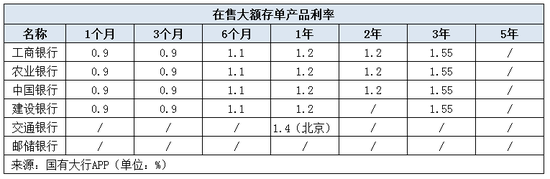
Core Viewpoint - The recent trend shows that medium to long-term large-denomination certificates of deposit (CDs) are being quietly withdrawn from sale by several major banks, with a focus on three-year and five-year terms, leading to a significant drop in interest rates for these products [1][2][4]. Group 1: Market Changes - Major banks such as Industrial and Commercial Bank of China, China Construction Bank, and China Merchants Bank have removed five-year large-denomination CDs from their offerings, with some also discontinuing three-year CDs [2][4]. - Currently, most banks are only offering large-denomination CDs with a maximum term of two years, and the availability of three-year CDs is limited or restricted to select clients [2][4]. Group 2: Interest Rate Trends - The interest rates for available large-denomination CDs have collectively dropped to the "1" range, with specific rates for different terms: for example, ICBC offers rates of 0.9% for one month and 1.55% for three years [3][4]. - The overall interest rates for two-year and shorter large-denomination CDs are concentrated between 0.9% and 1.4%, while three-year rates range from 1.55% to 1.75% [3]. Group 3: Bank Strategies - Banks are increasingly focusing on managing their funding costs, which has led to the withdrawal of medium to long-term large-denomination CDs as a strategy to stabilize net interest margins [4]. - The banking sector is under pressure to reduce funding costs, especially in a declining interest rate environment, which affects their willingness to attract long-term deposits at higher costs [4].

固收:利率为何会创新低
2025-06-09 15:30
Summary of Key Points from Conference Call Industry Overview - The conference call primarily discusses the fixed income market and interest rate trends in the context of the broader financial environment in China, particularly focusing on government bonds and corporate financing costs. Core Insights and Arguments - **Interest Rate Trends**: There is a prevailing expectation that interest rates will continue to decline, with current rates for certain bonds nearing historical lows. For instance, the rate for 30-year government bonds is approximately 1.9% and for corporate bonds like Shidai New Materials, it is around 1.66% [3][12]. - **Market Dynamics**: The decline in interest rates is attributed to easing concerns at the end of the quarter and the central bank's liquidity support. Banks have been buying older bonds, especially short-term ones, due to reduced pressure on profitability [2][4]. - **Impact of Deposit Rates**: The rapid decrease in deposit rates, with major banks reducing rates by 50 to 70 basis points, has significantly lowered overall funding costs in the market. This trend is expected to continue, further affecting fixed income asset yields [7][8]. - **Corporate Financing Costs**: As corporate financing costs decrease, financial institutions face challenges in balancing liabilities and net interest margins. The decline in funding costs is a key factor driving down overall market yields [6][10]. - **Broad vs. Policy Interest Rates**: Broad interest rates, which include yields on loans and other alternative assets, are more reflective of market conditions than policy rates, which tend to lag behind. Currently, actual funding costs are higher than the policy benchmark by approximately 1.4% [5][12]. - **Future Market Expectations**: The market anticipates a new downward phase for interest rates, driven by changes in supply and demand dynamics and increased liquidity from the central bank. The government bond supply is expected to slow down in the third quarter [3][14]. Additional Important Insights - **Insurance Sector Impact**: The insurance industry has seen a reduction in preset rates to around 2.13%, which may further decrease, affecting the cost of liabilities and the return expectations for financial institutions [10]. - **Net Interest Margin Trends**: Banks have experienced a decline in net interest margins, with the average dropping to about 1.4% in the first quarter, indicating pressure on profitability due to lower asset yields [11]. - **Trade Negotiations**: The impact of U.S.-China trade negotiations on the Chinese bond market is considered limited in the short term, with a focus on actual trade data rather than negotiation progress. Investors are advised to adopt strategies that leverage short-term positions while extending duration on long-term bonds [15].
这类存款产品正悄然“下架”
Jin Rong Shi Bao· 2025-06-08 10:04
6月8日,记者收到光大银行的大额存单发售提示,了解后发现,该行当前在售的大额存单最长期限为3 年。其他银行的情况也类似,工商银行、建设银行、浦发银行、招商银行……包括多家地方城商行在 内,近期发售的产品中5年期大额存单已经悄然"下架",部分银行在售大额存单的最长期限为2年期。 银行在售的特色存款中,中长期产品也难觅踪迹,记者查询银行APP发现,多家商业银行在售的特色存 款产品期限均不超过1年。 利率方面,当前商业银行在售的大额存单产品中,股份制银行3年期大额存单的利率大多为1.75%,国 有大行3年期大额存单的利率则均为1.55%。 与整存整取的定期存款相比,大额存单产品此前具备的"利率优势"正在缩小。以工行、建行为例,当前 3年期大额存单利率与定期存款利率最高均为1.55%,已然拉平。3个月期、6个月期等部分期限较低的 存款产品中,大额存单利率仅较定存产品高出10个基点。部分农商行等地方中小银行的在售产品中,更 是已经难觅大额存单产品的踪迹。 在业内人士看来,当前银行普遍暂停五年期大额存单发行,不再提供中长期特色存款等是为了降低负债 成本,保持合理净息差水平的需要。当部分商业银行3年期、5年期定期存款产品出 ...
年中检视:美国市场十大问题Q&A(美银更新版 )
Zhi Tong Cai Jing· 2025-06-06 05:51
2.客户活动会反弹吗? 回答:可能(调整为"中性偏乐观",原回答为"是") 3.银行监管会发生重大变化吗? 回答:是(维持原判) 核心逻辑: 利率(Rates):结构性高利率环境对净息差(NIM)有利,长期利率中枢上移可能提升银行盈利 能力。 监管(Regulations):政策转向更平衡的监管环境,资本与流动性要求有望下调,推动市盈率 (P/E)重估。 活动反弹(Rebounding Activity):尽管短期受关税等因素扰动,企业并购(M&A)、贷款需求 等有望在2025年下半年改善。 市场表现:全球系统重要性银行(GSIB)股票及每股收益(EPS)修正年初至今(YTD)表现优于 标普500指数,而地区性银行表现落后。 风险提示:通胀反弹可能迫使美联储重启加息,贸易摩擦升级或抑制经济活动,股市波动引发"负 财富效应"。 现状与挑战: 2025年初受特朗普政府关税政策(如对加拿大、墨西哥加征关税)影响,企业信心受挫,并购 活动创十年最低开局,债务发行短期波动。 近期中美关税摩擦边际缓和,部分银行(如高盛、摩根士丹利)5月后观察到交易活动边际改 善。 未来展望: 若贸易环境稳定,预计2025年下半年并购、I ...