财政政策

Search documents
财政部发布2025年上半年中国财政政策执行情况报告 2.2万科创类中小企业获贷约900亿
Chang Jiang Shang Bao· 2025-11-09 23:28
Core Insights - The report highlights the strong vitality and resilience of China's economy in the first half of 2025, with significant achievements in high-quality development and proactive fiscal policies aimed at stabilizing employment, enterprises, markets, and expectations [1] Fiscal Performance - China's fiscal operations in the first half of 2025 were generally stable, with good budget execution. The central government allocated 300 billion yuan for long-term special bonds to support the consumption of old goods, doubling the funding compared to 2024 [2] - A total of 1,620 billion yuan of these special bonds has been pre-allocated, driving sales exceeding 16 trillion yuan and contributing to a 5% year-on-year increase in retail sales of consumer goods, which is 1.5 percentage points higher than the full year of 2024 [2] - The central government issued 5,550 billion yuan in special bonds in the first half of 2025, with a new special bond limit of 4.4 trillion yuan fully allocated to local governments [2] Support for Innovation and Employment - The central budget for basic research increased by 12.1% compared to the previous year, with 6 billion yuan allocated to support local technological development [3] - Over 2,200 small and medium-sized enterprises in technology innovation received approximately 90 billion yuan in loans through a special guarantee plan [3] - Employment support funds of 66.74 billion yuan were allocated to assist local implementation of social insurance and vocational training subsidies [3] Future Fiscal Policy Directions - Future fiscal policies will focus on six areas: effectively utilizing proactive fiscal policies, supporting employment and foreign trade, fostering new development momentum, improving living standards, preventing risks in key areas, and enhancing fiscal governance [3] - The Ministry of Finance aims to ensure efficient budget execution and improve the effectiveness of fund usage while promoting consumption and supporting key sectors [4] Employment and Trade Stability - The Ministry of Finance plans to intensify employment stabilization policies, support public employment services, vocational training, and job retention efforts [4] - There will be a focus on helping enterprises stabilize orders, transition to domestic sales, and expand markets, addressing practical challenges faced by businesses [4]

利好来了!国办重磅发文!商务部最新调整,涉对美出口管制!证监会、财政部发布!影响一周市场的十大消息
券商中国· 2025-11-09 10:40
Group 1 - The State Council issued an implementation opinion focusing on the large-scale application of new scenarios, highlighting five key areas including new fields, industry transformation, and social governance [2] - The National Bureau of Statistics reported that the Consumer Price Index (CPI) rose by 0.2% year-on-year and month-on-month in October, while the core CPI increased by 1.2%, marking the sixth consecutive month of growth [3] - The Producer Price Index (PPI) decreased by 2.1% year-on-year in October, but the decline narrowed by 0.2 percentage points from the previous month, with a month-on-month increase of 0.1% [3] Group 2 - As of the end of October, China's foreign exchange reserves reached $3.343 trillion, an increase of $4.7 billion from September, marking the highest level since December 2015 [4] - The People's Bank of China has increased its gold reserves for 12 consecutive months, with the official gold reserves reaching 74.09 million ounces, up by 30,000 ounces from the previous month [4] Group 3 - The China Securities Regulatory Commission and the Ministry of Finance jointly released a revised management method for the securities settlement risk fund, effective from December 8, 2025, with differentiated adjustments to the contribution ratio [5] - The Ministry of Finance reported that since 2025, fiscal policy has become more proactive, focusing on stabilizing employment, enterprises, and market expectations [6] Group 4 - The Ministry of Commerce announced the suspension of certain export controls on dual-use items to the United States, effective immediately until November 27, 2026 [7] - Upcoming macroeconomic data for October, including industrial added value and fixed asset investment, is set to be released on November 14 [8] Group 5 - U.S. stock markets ended mixed, with the Nasdaq down 0.21% and the S&P 500 up 0.13%, marking the end of a three-week rally [9] - The China Securities Regulatory Commission approved IPO registrations for two companies, with new stock issuances scheduled for the week of November 10-14 [10] Group 6 - A total of 33 companies will have their restricted shares released this week, amounting to 1.407 billion shares with a total market value of approximately 24.715 billion yuan [12] - The companies with the highest market value of released shares include Youyan Silicon (9.991 billion yuan) and Xinnoway (4.948 billion yuan) [12]




等你来投!《清华金融评论》12月刊 “ 前瞻美债与美元 : 长周期视角 ” 征稿启事
清华金融评论· 2025-11-08 09:31
Group 1 - The uncertainty of the U.S. government's tariff and fiscal policies has shaken investor confidence in U.S. Treasuries and the dollar [4][2] - As of October 2025, the U.S. national debt has exceeded $37.86 trillion, with a federal budget deficit of $1.8 trillion for FY 2025, remaining at historically high levels [4] - The net interest cost of U.S. public debt has surpassed $1 trillion for the first time, reflecting an approximately 8% increase from FY 2024, driven by rising debt and high interest rates [4] Group 2 - Future U.S. Treasury yields may remain volatile at high levels, and the strong position of the dollar may gradually weaken [4][2] - Investors are advised to closely monitor U.S. government policy dynamics, economic data, and global market changes to assess risks and make informed investment decisions [4][2] - A call for submissions has been made by the editorial team of Tsinghua Financial Review, focusing on the long-term perspective of U.S. Treasuries and the dollar [4][3]

金价暴跌背后:美国搅动市场,全球央行分化加剧,机会与陷阱并存
Sou Hu Cai Jing· 2025-11-08 06:18
Core Insights - Recent fluctuations in international gold prices have surprised many investors, with prices recently peaking near $4,400 before dropping to around $4,000, raising questions about whether to buy the dip or avoid becoming the last buyer [1] Central Bank Actions - Central banks worldwide have shifted their strategies regarding gold, with some countries considering reducing their gold holdings while others, like South Korea, are looking to increase their reserves. India is also repatriating gold to its national treasury [3] - The total amount of gold held by global central banks now exceeds that of U.S. Treasury bonds, indicating a declining confidence in the U.S. dollar [3] U.S. Economic Uncertainty - The return of Trump to the White House has created turmoil in the U.S. financial markets, with calls for the replacement of Federal Reserve Chair Powell and pressure for interest rate cuts, increasing uncertainty around fiscal and monetary policies [5] - This uncertainty raises concerns about the stability of the U.S. dollar, prompting global investors to be wary of holding dollars [5] Market Dynamics - The current market environment has led to increased demand for gold as a safe-haven asset, with more individuals purchasing gold bars and exploring gold-related investment channels. However, high gold prices have deterred many ordinary consumers, resulting in a decline in gold jewelry sales in the third quarter [7] - The dual role of gold as both an investment and a consumer good has created a complex market atmosphere, where demand for gold as a protective asset contrasts with reduced consumer purchases due to high prices [7] Analyst Perspectives - Analysts are divided on the future of gold prices, with some predicting further increases while others fear a significant drop. Historically, gold bull markets are often followed by deep corrections [9] - Despite differing opinions, many analysts agree that gold's status as a "safe haven" asset is unlikely to change in the near term [10] Investment Strategy - For ordinary investors, focusing solely on price fluctuations can lead to confusion. It is suggested to view gold as a stable asset for portfolio diversification rather than a quick profit opportunity [12] - Given the ongoing internal and global uncertainties, both central banks and individual investors are advised to maintain a cautious approach to risk management, recognizing gold's enduring significance in turbulent times [12]

上半年财政政策执行报告:1.1万亿元支持养老金发放
Di Yi Cai Jing· 2025-11-07 22:53
Core Insights - The report highlights the implementation of China's fiscal policy in the first half of 2025, emphasizing increased investment in social welfare and measures to control local government hidden debt [1][2]. Group 1: Social Welfare Investments - The fiscal policy has increased investment in social welfare, with a 2% rise in basic pension levels for retirees and a 20 yuan increase in the minimum standard for urban and rural residents' basic pensions [1]. - The central government allocated 1.1 trillion yuan in subsidies to support timely and full payment of basic pension benefits [1]. Group 2: Control of Hidden Debt - The report indicates effective measures to curb new hidden debt, prohibiting government expenditures and investment projects not included in the budget [2]. - A lifelong accountability system for government borrowing has been established, along with a mechanism for tracing debt issues, ensuring that any new hidden debt is identified and addressed promptly [2]. Group 3: Tax Reforms - The report mentions ongoing tax reforms, particularly the adjustment of consumption tax collection to enhance local revenue sources and improve the consumption environment [3]. - The specifics of which tax items will be shifted to the wholesale and retail stages and how the revenue will be distributed between central and local governments remain to be clarified [3]. Group 4: Future Fiscal Policy Outlook - The report outlines six key tasks for future fiscal policy, including the use of more proactive fiscal measures, support for employment and foreign trade, and improvement of social welfare [3]. - Emphasis is placed on enhancing services for the elderly and children, providing subsidies for elderly care, and implementing free preschool education [3]. - The Ministry of Finance will continue to enforce policies to manage hidden debt and strengthen financial monitoring and emergency response [3].
财政部上半年补助1.1万亿元支持养老金发放
Di Yi Cai Jing Zi Xun· 2025-11-07 13:59
Core Insights - The report highlights the implementation of China's fiscal policy in the first half of 2025, emphasizing increased investment in social welfare and measures to control local government hidden debts [2][3]. Group 1: Social Welfare Investments - The fiscal policy has increased investment in social welfare, including a 2% rise in basic pension levels for retirees and a 20 yuan increase in the minimum standard for urban and rural residents' basic pensions [2]. - The central government allocated 1.1 trillion yuan in subsidies to support timely and full payment of basic pension benefits [2]. Group 2: Control of Hidden Debts - The report indicates effective measures to curb new hidden debts, prohibiting government expenditures and investment projects not included in the budget [3]. - A lifetime accountability system for government borrowing has been implemented, along with a mechanism for tracing debt issues, ensuring strict accountability for any new hidden debts discovered [3]. Group 3: Tax Reforms - The report outlines ongoing tax reforms, particularly the adjustment of consumption tax collection to enhance local revenue sources and improve the consumption environment [4]. - The specifics of which tax items will be shifted to the wholesale and retail stages and how the revenue will be distributed between central and local governments are still under observation [4]. Group 4: Future Fiscal Policy Outlook - The report identifies six key tasks for future fiscal policy, including the use of more proactive fiscal measures, support for employment and foreign trade, and further improvement of social welfare [4][5]. - Emphasis will be placed on risk prevention, with continued implementation of a comprehensive debt replacement policy and strict accountability for any new hidden debt behaviors [5].

财政部上半年补助1.1万亿元支持养老金发放
第一财经· 2025-11-07 12:55
Core Viewpoint - The article discusses the execution of China's fiscal policy in the first half of 2025, highlighting increased investment in people's livelihoods and measures to control local government hidden debts [3][4]. Group 1: Fiscal Policy Implementation - The Ministry of Finance reported a 2% increase in the basic pension level for retirees and a 20 yuan increase in the minimum standard for urban and rural residents' basic pensions [3]. - A total of 1.1 trillion yuan was allocated in subsidies to support timely and sufficient payment of basic pension benefits [3]. Group 2: Control of Hidden Debts - The report indicates effective measures to curb new hidden debts, including prohibiting government expenditures and investment projects not included in the budget [4]. - A lifelong accountability system for government borrowing has been implemented, with strict measures to investigate and hold accountable any new hidden debt or false reporting [4]. Group 3: Tax Reform and Local Revenue - The report emphasizes the acceleration of tax reforms, particularly the adjustment of consumption tax collection to enhance local revenue sources and improve the consumption environment [5]. - The specifics of which tax items will be shifted to local collection and how revenues will be distributed between central and local governments remain to be clarified [5]. Group 4: Future Fiscal Policy Outlook - The report outlines six key tasks for future fiscal policy, including the use of more proactive fiscal measures, support for employment and foreign trade, and improvement of people's livelihoods [5]. - Specific measures include providing subsidies for elderly care services and implementing free preschool education and childcare subsidies [5]. - The Ministry of Finance plans to continue a comprehensive debt management policy while monitoring and addressing new hidden debt behaviors promptly [5].

货币市场日报:11月7日
Zhong Guo Jin Rong Xin Xi Wang· 2025-11-07 12:18
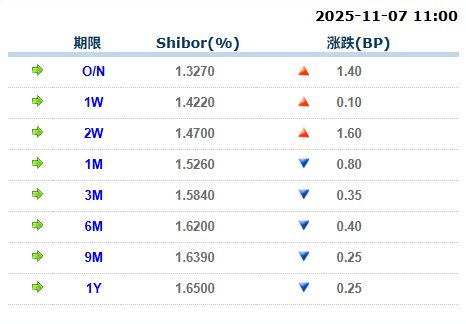
Group 1 - The People's Bank of China conducted a reverse repurchase operation of 141.7 billion yuan at a fixed rate of 1.4%, resulting in a net withdrawal of 913.4 billion yuan from the open market due to maturing reverse repos [1] - The Shanghai Interbank Offered Rate (Shibor) for overnight and 7-day tenors increased slightly, with overnight Shibor rising by 1.40 basis points to 1.3270% and 7-day Shibor increasing by 0.10 basis points to 1.4220% [1] - The interbank pledged repo market showed slight increases in overnight and 14-day rates, with DR001 and R001 weighted average rates rising by 1.6 basis points and 2.9 basis points, respectively [3] Group 2 - The funding environment turned slightly tight on November 7, with reduced supply from major state-owned banks, leading to higher transaction rates for overnight and 7-day repos [8] - A total of 95 interbank certificates of deposit were issued on November 7, with an actual issuance volume of 76.8 billion yuan [8] - The trading sentiment for primary certificates of deposit was generally average, with secondary market yields showing narrow fluctuations across various tenors [9]
财政部上半年财政政策执行报告:1.1万亿元支持养老金发放
Di Yi Cai Jing· 2025-11-07 11:44
Core Insights - The Ministry of Finance has outlined six major deployments for future fiscal work, emphasizing the importance of fiscal policy execution and its impact on citizens and businesses [1] Group 1: Fiscal Policy Implementation - The report highlights an increase in investment in the livelihood sector, with a nationwide increase of 2% in basic pension levels for retirees and a 20 yuan increase in the minimum standard for urban and rural residents' basic pensions [1] - Central government has allocated 1.1 trillion yuan in subsidies to support timely and full payment of basic pension benefits [1] Group 2: Management of Hidden Debt - The report indicates effective measures to curb new hidden debt, including a prohibition on government expenditures and investment projects not included in the budget [2] - A lifelong accountability system for government borrowing has been established, along with a mechanism for tracing debt issues, ensuring that any new hidden debt is identified and addressed promptly [2] Group 3: Tax Reform Initiatives - The report mentions ongoing tax reforms, particularly the adjustment of consumption tax collection to enhance local revenue sources and improve the consumption environment [3] - Specific details on which tax items will be shifted to the wholesale and retail stages and how revenue will be distributed between central and local governments are still under observation [3] Group 4: Future Fiscal Policy Outlook - The report outlines six key tasks for future fiscal policy, including the use of more proactive fiscal measures, support for employment and foreign trade, and enhancement of social welfare [3] - Emphasis is placed on strengthening services for the elderly and children, providing subsidies for elderly care, and promoting free preschool education [3] - The Ministry of Finance plans to continue implementing a comprehensive debt reduction policy while monitoring and addressing new hidden debt behaviors [3]
新华财经晚报:央行连续第12个月增持黄金 截至10月末我国外汇储备规模为33433亿美元
Xin Hua Cai Jing· 2025-11-07 10:09
Domestic News - The State Council issued an implementation opinion on accelerating the cultivation and large-scale application of new scenarios, focusing on five areas including new fields and new track application scenarios, industrial transformation, and social governance services [1] - In the first ten months of 2025, China's total goods trade value reached 37.31 trillion yuan, with a year-on-year growth of 3.6%. Exports were 22.12 trillion yuan, up 6.2%, while imports were 15.19 trillion yuan, roughly unchanged from the previous year [1] - As of the end of October 2025, China's foreign exchange reserves stood at $33,433 billion, an increase of $47 billion from the end of September, marking a rise of 0.14% [2] - The People's Bank of China reported that gold reserves reached 7.409 million ounces (approximately 2304.457 tons) at the end of October, with an increase of 30,000 ounces (about 0.93 tons), marking the 12th consecutive month of gold accumulation [2] - The Ministry of Finance plans to implement more proactive fiscal policies, enhance budget execution responsibility, and stimulate consumption in key areas through fiscal subsidies [2] Regulatory Developments - The State Administration for Market Regulation approved several important national standards, including those for cross-border e-commerce and logistics, to guide risk prevention and improve transaction information management [3] - The National Energy Administration released guidelines to promote the integration of coal and new energy, encouraging the development of photovoltaic and wind power industries in mining areas [3] - The railway sector is implementing a flexible pricing mechanism, offering discounts on over 1,300 high-speed train services to stimulate domestic demand and enhance service consumption [4] International News - France's official reserve assets increased to €350.04 billion in October, a record high, with gold reserves rising to €273.25 billion [5] - Germany's adjusted trade balance for September was €15.3 billion, lower than the expected €16.8 billion [6]