A股市场

Search documents
【机构策略】短期A股市场或进入震荡整理期
Zheng Quan Shi Bao Wang· 2025-09-04 01:13
Group 1 - The A-share market is currently in a favorable environment with intertwined domestic and foreign policy benefits and ample liquidity, as indicated by the significant improvement in market funding conditions and continuous trading volume exceeding 2 trillion yuan [1][2] - The TMT sector is expected to maintain high growth in earnings due to the dual drivers of the AI wave and domestic substitution, which will likely lead to increased industry performance [1][2] - The market is experiencing a mixed performance with various sectors showing different trends, where gaming, photovoltaic equipment, electronic chemicals, and batteries performed well, while aerospace, shipbuilding, and small metals lagged [1] Group 2 - The market is anticipated to enter a phase of consolidation after rapid rotation, but the medium-term positive trend remains unchanged, driven by liquidity [2] - There is an expectation for continued balance-seeking between technology growth and defensive sectors, indicating a significant structural market characteristic [2] - The Federal Reserve's signals for potential interest rate cuts provide space for subsequent monetary policy adjustments, which may accelerate the recovery of the economic fundamentals [1][2]
主动权益基金发行升温 有产品一天募超五十亿元
Zheng Quan Shi Bao· 2025-09-03 18:13
Core Viewpoint - The A-share market has shown signs of recovery this year, leading to a significant increase in the number and scale of newly launched active equity funds, with some funds raising over 5 billion yuan in a single day [1][2]. Group 1: Fund Performance and Trends - The newly launched active equity fund, the China Merchants Balanced Preferred Mixed Fund, set a fundraising cap of 5 billion yuan and exceeded this amount on its first day of sale, indicating strong investor interest [1]. - As of September 2, 2023, there are 10 funds that have raised over 5 billion yuan this year, including 2 FoFs and 8 bond funds, while only 2 ETF-linked funds in the equity category have raised over 4 billion yuan [1]. - The top-performing active equity funds include Dachen Insight Advantage, E Fund Value Return, China Europe Core Selection, and Huashang Zhiyuan Return, each raising between 2 billion to 2.5 billion yuan [2]. Group 2: Market Conditions and Investor Sentiment - The increase in active equity fund issuance is closely linked to the positive changes in the stock market, with a notable recovery in investor confidence towards active equity funds [2]. - Over 40 funds have doubled their performance this year, reflecting a significant improvement in the performance of active equity funds amid rising A-share indices [2]. - Morgan Stanley's analysis suggests that the current A-share market is driven by liquidity, with improving investor sentiment towards Chinese assets contributing to the appreciation of the yuan, which is favorable for the A-share market [2]. Group 3: Sector Focus and Risks - There is a notable shift in capital towards the technology sector, which is experiencing accelerated cycles of market and funding, indicating a crowded space that may require higher standards for upward momentum [3]. - Investors are advised to be cautious of short-term market dynamics, particularly regarding the interplay between profit-taking and chasing high prices, as well as structural changes in incremental capital [3].
东吴国企改革混合A:2025年上半年利润9.99万元 净值增长率1.09%
Sou Hu Cai Jing· 2025-09-03 13:43
Core Viewpoint - The AI Fund Dongwu State-Owned Enterprise Reform Mixed A (002159) reported a profit of 99,900 yuan for the first half of 2025, with a weighted average profit per fund share of 0.007 yuan. The fund's net value growth rate was 1.09%, and its total scale reached 11.03 million yuan by the end of the first half of the year [3]. Fund Performance - As of September 2, the fund's unit net value was 0.843 yuan. The fund manager, Zhou Jian, oversees five funds, all of which have achieved positive returns over the past year. The Dongwu Configuration Optimization Mixed A fund had the highest one-year return at 76.05%, while the Dongwu Youyi Bond A had the lowest at 10.99% [3]. - The fund's performance over various time frames includes a three-month net value growth rate of 4.33% (ranked 843 out of 880), a six-month growth rate of 7.53% (ranked 791 out of 880), a one-year growth rate of 17.64% (ranked 798 out of 880), and a three-year growth rate of 4.11% (ranked 468 out of 872) [6]. Market Outlook - The fund management expressed optimism for the A-share market in the second half of the year, suggesting that systemic risks are relatively low and structural opportunities may be abundant. They believe the A-share market is currently at three bottoms: valuation bottom, policy bottom, and performance bottom, indicating significant mid-to-long-term investment value [3]. Valuation Metrics - As of June 30, 2025, the fund's weighted average price-to-earnings (P/E) ratio was approximately 11.33 times, compared to the industry average of 15.75 times. The weighted average price-to-book (P/B) ratio was about 0.98 times, while the industry average was 2.52 times. The weighted average price-to-sales (P/S) ratio was around 0.59 times, against an industry average of 2.16 times, indicating that the fund's valuations are below the industry average [11]. Growth Metrics - For the first half of 2025, the weighted average revenue growth rate of the stocks held by the fund was -0.02%, and the weighted average net profit growth rate was 0.11%. The weighted annualized return on equity was 0.09% [19]. Fund Composition - As of June 30, 2025, the fund had a total of 1,784 holders, with a total of 13.3967 million shares held. The fund's top ten holdings included major companies such as China Life Insurance, China Ping An, and Agricultural Bank of China, indicating a high concentration in its stock holdings [37][42].


缩量,今日市场情绪指数来了
第一财经· 2025-09-03 12:59
Market Overview - The three major A-share indices showed mixed performance, with the Shanghai Composite Index exhibiting a "high open and low close" characteristic, while the ChiNext Index was the only one to close higher among the three indices [4] - A total of 277 stocks rose, indicating a broad market decline despite some sectors performing well [4] Trading Volume - The trading volume in the two markets decreased significantly, down approximately 510.9 billion yuan compared to the previous trading day, reflecting a decline in market activity and a strong wait-and-see sentiment among investors [5] Capital Flow - There was a clear risk-averse characteristic in institutional capital, with major funds withdrawing from high-valuation technology sectors and moving into undervalued defensive sectors [7] - Northbound funds significantly reduced holdings in semiconductor and AI chip sectors, while showing slight inflows into gold and banking sectors [7] - Retail investors maintained high leverage levels, indicating a defensive stance, with enthusiasm for market participation remaining relatively unchanged [7] Investor Sentiment - Retail investor sentiment showed a mixed picture, with a notable percentage of investors either increasing or decreasing their positions, reflecting uncertainty in market direction [12][15]

瑞达期货股指期货全景日报-20250903
Rui Da Qi Huo· 2025-09-03 09:37
Report Summary 1) Report Industry Investment Rating - No investment rating information is provided in the report. 2) Core View of the Report - After continuous significant rallies, the upward momentum has slowed, and the market may experience short - term consolidation. The A - share semi - annual reports have been fully disclosed, and the market will enter a performance and policy vacuum period. In the current low - interest - rate environment, the transfer of household deposits will inject liquidity into the market. Previous policies on the entry of medium - and long - term funds will help optimize the A - share investment structure. With the high valuation of the US stocks, A - shares with reasonable valuations continue to attract foreign capital inflows. Due to the poor economic data, there are still expectations for policy intensification. It is recommended to lightly position and buy on dips [2]. 3) Summary by Related Catalogs Futures Disk - All main and sub - main contracts of IF, IH, IC, and IM showed price declines. For example, the IF main contract (2509) dropped from the previous value by 42.8 to 4430.0, and the IF sub - main contract (2512) dropped by 50.4 to 4401.8. Various spreads also decreased, such as the IF - IH current - month contract spread which dropped by 7.4 to 1481.0. The differences between quarterly and current - month contracts mostly declined, e.g., IF current - quarter minus current - month decreased by 8.2 to - 28.2 [2]. Futures Position - The net positions of the top 20 traders in IF, IH, and IM decreased, with the IF top 20 net position dropping by 2380.0 to - 30,656.00, while the IC top 20 net position increased by 204.0 to - 17,402.00 [2]. Spot Price - The spot prices of the Shanghai and Shenzhen 300, Shanghai Composite 50, CSI 500, and CSI 1000 all declined. For instance, the Shanghai and Shenzhen 300 dropped by 30.6 to 4459.83. The basis of the corresponding futures contracts also mostly decreased, like the IF main contract basis dropping by 20.6 to - 29.8 [2]. Market Sentiment - A - share trading volume decreased by 5167.41 billion yuan to 23,956.82 billion yuan. The margin trading balance decreased by 85.39 billion yuan to 22,884.52 billion yuan. However, the north - bound trading volume increased by 247.72 billion yuan to 3670.85 billion yuan. The proportion of rising stocks decreased by 8.02 percentage points to 15.15% [2]. Industry News - In August, China's official manufacturing PMI, non - manufacturing PMI, and comprehensive PMI were 49.4%, 50.3%, and 50.5% respectively, with month - on - month increases of 0.1, 0.2, and 0.3 percentage points. As of August 31, 2025, nearly 60% of A - share listed companies had year - on - year revenue growth, and over 75% were profitable. A - share major indexes generally closed lower, with large - cap stocks more resilient than small - and medium - cap stocks. The trading volume in the Shanghai and Shenzhen stock markets dropped significantly, and most industry sectors declined [2]. Key Data to Follow - On September 3 at 22:00, pay attention to the US JOLTs job openings in July. From 19:30 - 20:30 on September 4, focus on the US Challenger job cuts, ADP employment, and trade balance in July. At 20:30 on September 5, watch the US non - farm payrolls, unemployment rate, and labor participation rate in August [3].
【机构策略】当前A股市场交投情绪仍较为火热
Zheng Quan Shi Bao Wang· 2025-09-03 01:03
Group 1 - The A-share market experienced a day of volatility and adjustment, with the ChiNext index leading the decline, indicating a mixed performance among individual stocks [1][2] - The TMT sector's trading volume exceeded 40% by the end of August, suggesting a high level of congestion in certain tracks, which may pose risks [1] - Defensive sectors such as banking, precious metals, and electricity showed resilience, while technology growth sectors faced significant declines, reflecting a strong risk-averse sentiment among investors [1][2] Group 2 - The recent trading activity saw a notable increase in both transaction volume and margin financing, with both metrics surpassing 20 trillion [1][2] - The market's adjustment is attributed to profit-taking from previous rapid gains, indicating a need for consolidation despite maintaining an overall upward trend [2] - The current market sentiment remains optimistic as long as the broad market indices do not show significant breakdowns [1][2]
经济基本面改善 人民币走强有支撑
Shang Hai Zheng Quan Bao· 2025-09-02 18:27
Core Viewpoint - The recent strong rebound of the RMB against the USD reflects its resilience, supported by improving economic fundamentals in China and various influencing factors for future trends [1][3]. Exchange Rate Performance - As of August 29, the onshore RMB appreciated from 7.1805 to 7.1330 against the USD, marking a nearly 10-month high. The offshore RMB also surged to 7.1182, gaining over 340 points [2]. - In August, the onshore RMB rose by 0.83%, reversing the previous month's decline and recording the largest increase in three months. The offshore RMB increased by 1.21%, the highest monthly gain since September 2024 [2]. - The RMB's central parity rate strengthened from 7.1321 on August 22 to 7.1030 on August 29, with a nearly 1.2% increase since the beginning of the year [2]. Economic Fundamentals - The core driver behind the RMB's appreciation is the overall improvement in China's economic fundamentals, with GDP growth reaching 5.3% in Q2 [3]. - Several international investment banks have raised their forecasts for China's economic growth, shifting their asset allocation recommendations from neutral to "overweight" [3]. - The market's positive sentiment towards RMB is bolstered by strong export performance and increased global interest in Chinese equity assets [3]. Market Sentiment and Predictions - Hedge funds are increasing their bets on RMB appreciation, with targets set for the exchange rate to exceed 7.0 by year-end [4]. - The consensus in the market suggests that the RMB will gradually stabilize and appreciate, although specific predictions on the extent of appreciation vary [5]. Future Outlook - Analysts indicate that September will be a critical period to observe if the RMB can break the 7.0 mark, particularly if the USD weakens post the Federal Open Market Committee meeting [6]. - Predictions suggest that the RMB could appreciate to 6.98 against the USD within the next 12 months, supported by strong fundamentals [6]. - Potential factors influencing RMB fluctuations include the release of accumulated settlement funds and the guidance of the central parity rate [6].
8月“新股民”,数据出炉!
Zheng Quan Shi Bao Wang· 2025-09-02 10:54
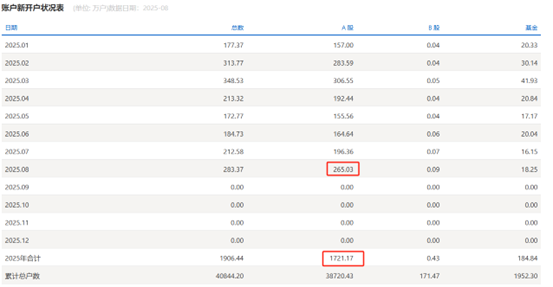
Core Insights - The A-share market has seen a significant increase in new account openings, with August 2025 recording 2.6503 million new accounts, a 34.97% month-on-month increase and a 165.21% year-on-year increase [1][2][4] - The overall performance of the brokerage industry has improved, with total revenue for the first half of 2025 reaching 251.036 billion yuan, a 23.47% increase year-on-year, and net profit reaching 112.280 billion yuan, a 40.37% increase year-on-year [1][5][7] New Account Opening Data - In August 2025, individual investors accounted for the vast majority of new accounts, totaling approximately 2.6403 million, while institutional investors accounted for about 10,000 accounts [2] - The total number of new accounts opened in the first eight months of 2025 reached 17.2117 million, a 47.9% increase compared to the same period in 2024 [4] Brokerage Industry Performance - The brokerage industry has experienced widespread growth, with 85% of the 128 brokerages reporting profits in the first half of 2025 [1][5] - The brokerage sector's revenue structure remains stable, with proprietary trading being the largest source of income, followed by brokerage services, net interest income, investment banking, and asset management [7] Margin Trading and Financing - The margin trading balance has reached a historical high of 2.296991 trillion yuan, surpassing the previous peak of 2.2728 trillion yuan in June 2015 [5][6] - The influx of funds through margin trading has been a significant factor driving the market's upward momentum [6]
“国家队”增持、基金公司大手笔降费......基金半年报信息量大
券商中国· 2025-09-02 08:10
Core Viewpoint - The article highlights the significant reduction in management fees and trading commissions in the public fund industry, alongside an increase in institutional investment in stock funds, indicating a positive outlook for the A-share market in the medium to long term [1][2][3]. Fee Reduction and Impact - The public fund industry has seen a notable decrease in management fees and trading commissions, with equity funds' management fee income dropping by 1.7 billion yuan and trading commissions decreasing by 2.334 billion yuan compared to the same period last year [3][4]. - Mixed funds, a major contributor to management fees, experienced a reduction in management fee income by 1.598 billion yuan, with a year-on-year decline rate of 8.26%, reducing their share from 32% to 28.81% [3][4]. - The introduction of floating management fee funds has become a regular practice, benefiting investors continuously [5]. - The implementation of new regulations in July 2024 has led to a significant reduction in trading commissions, with public funds' commission payments dropping by over 35% compared to 2023 [6]. Institutional Investment Trends - Institutional investors have significantly increased their holdings in stock funds, with their share rising from 34.44% to 40.49%, an increase of 6 percentage points year-on-year [7][8]. - Central Huijin and other institutional investors have played a crucial role in stabilizing the market by increasing their investments in ETFs [8]. - Conversely, both institutional and individual investors have reduced their holdings in mixed funds, making it the only fund type to see simultaneous reductions from both groups [9]. Market Outlook - Fund managers express optimism about the A-share market, suggesting that the era of value creation is upon us, with opportunities for low-valuation dividends expanding [10][11]. - The overall market valuation remains low, with potential for significant upward movement if corporate earnings improve [11]. - Specific sectors such as high-end manufacturing, technology innovation, and consumer goods are highlighted as having strong growth potential [12].


午评:沪指半日跌0.79% 贵金属板块涨幅居前
Zhong Guo Jing Ji Wang· 2025-09-02 03:55
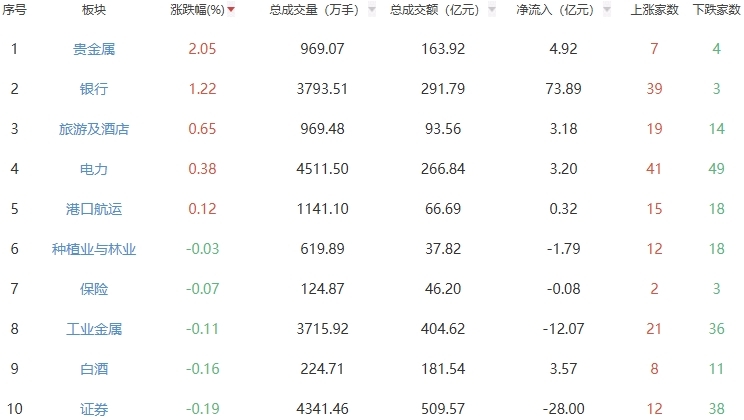
Market Overview - The three major indices in the A-share market experienced a collective decline, with the Shanghai Composite Index closing at 3844.84 points, down 0.79%, the Shenzhen Component Index at 12545.82 points, down 2.21%, and the ChiNext Index at 2870.72 points, down 2.90% [1] Sector Performance - The sectors that showed the highest gains included precious metals, banking, and tourism & hotels, while the sectors with the largest declines were communication equipment, components, and consumer electronics [1] Detailed Sector Analysis - The audio sector led with a gain of 2.05%, achieving a total trading volume of 969.07 million hands and a total transaction amount of 163.92 billion [2] - The banking sector increased by 1.22%, with a trading volume of 3793.51 million hands and a transaction amount of 291.79 billion, alongside a net inflow of 73.89 billion [2] - The tourism & hotel sector rose by 0.65%, with a trading volume of 969.48 million hands and a transaction amount of 93.56 billion, resulting in a net inflow of 3.18 billion [2] - In contrast, the communication equipment sector saw a significant decline of 5.53%, with a trading volume of 2280.10 million hands and a transaction amount of 1219.80 billion, alongside a net outflow of 118.44 billion [2] - The components sector fell by 5.47%, with a trading volume of 1548.55 million hands and a transaction amount of 592.03 billion, resulting in a net outflow of 56.11 billion [2] - The consumer electronics sector decreased by 4.57%, with a trading volume of 2562.84 million hands and a transaction amount of 655.60 billion, leading to a net outflow of 81.47 billion [2]