
利率下行

Search documents
【环球财经】贵金属市场再掀涨势 银价年内涨幅远超黄金
Xin Hua Cai Jing· 2025-12-01 10:52
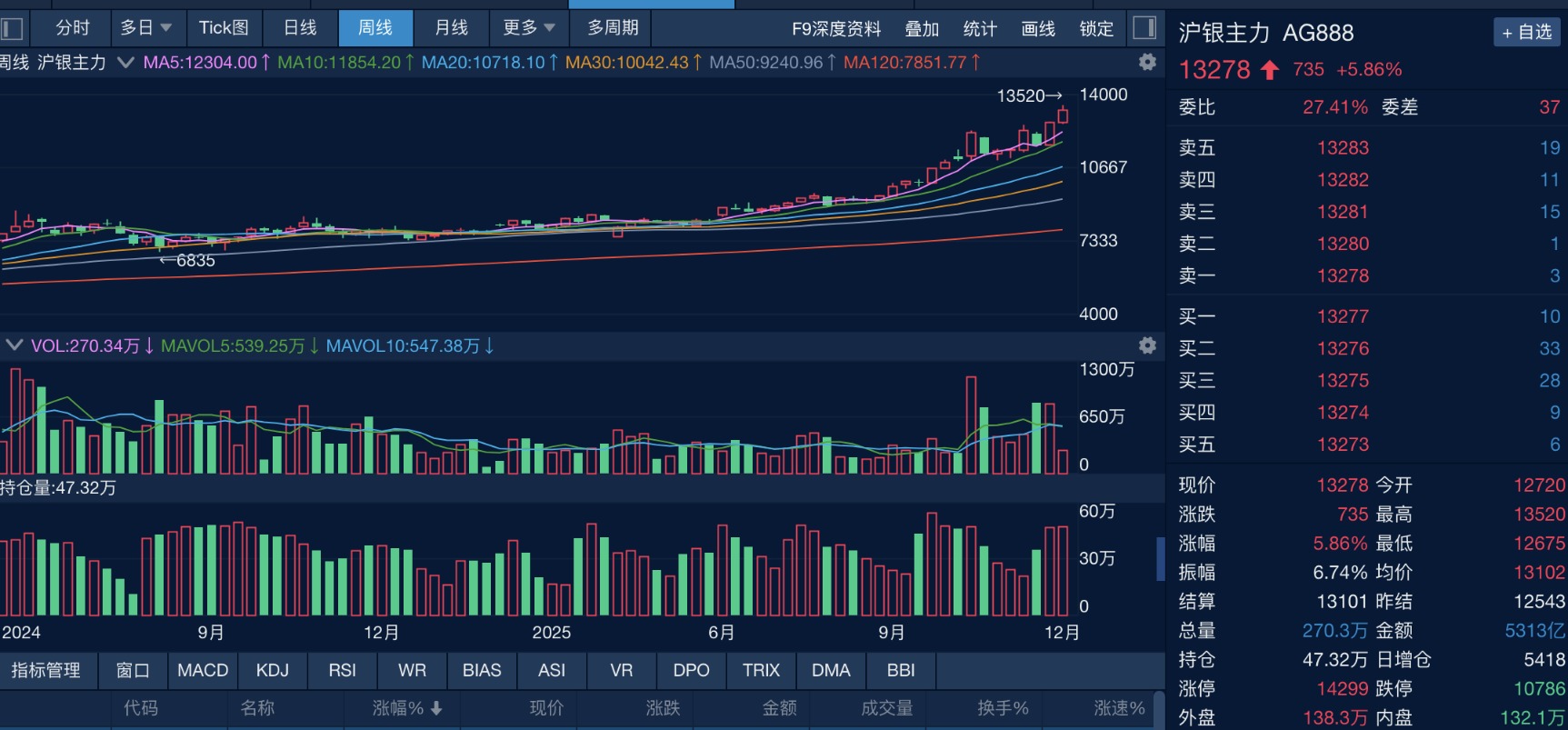
新华财经上海12月1日电 近期全球贵金属及有色板块强势延续,白银价格不断创出新高,领涨市场。截至发稿,伦敦现货白银历史首次站上每盎司57美元上 方,日内涨超2%,年内涨幅接近100%;COMEX白银主力期货合约首次突破每盎司58美元,年内涨幅超过98%;沪银期货主力合约收盘涨近6%,刷新历史 新高,年内涨幅超过77%。 国信期货首席分析师顾冯达接受新华财经采访时表示,在年末交割月临近的背景下,白银市场低库存与实物流动性紧缩共同推升价格走势,同时全球资本对 战略性金属资源的配置需求与投机资金形成共振,进一步强化了市场易涨难跌的格局。 白银年内涨近100%背后 今年以来,白银接近100%的涨幅成为表现最好的资产之一,超过黄金市场61%和纳指21%的涨幅。面对通货膨胀、地缘政治担忧以及利率下行,投资者正将 贵金属视为"避风港"。此外,与黄金不同,白银的涨势还受到了人工智能、电动汽车和能源转型热潮的推动。 "白银价格短期调整后,快速上涨并突破新的历史新高,背后是宏观环境、供需格局和资金情绪三重共振的结果。"光大期货研究所有色金属研究总监展大鹏 对新华财经表示,一是当前市场对美联储12月降息的预期已升至近90%,该因素 ...

李扬:并购市场迎来新机遇,已成为上市公司实现快速成长和转型升级的核心动力(附演讲PPT)
Xin Lang Zheng Quan· 2025-12-01 06:10
专题:2025分析师大会:资本市场"奥斯卡"!机构称A股迎全球资本涌入的大牛市 炒股就看金麒麟分析师研报,权威,专业,及时,全面,助您挖掘潜力主题机会! 11月28日,2025分析师大会举行,中国社会科学院学部委员、国家金融与发展实验室理事长、中国资本 市场学会学术委员会主任李扬主旨演讲《中国金融结构正在发生积极变化》。 李扬表示,大力发展资本市场是"十五五"金融改革的重点之一。当前,中国经济已经基本结束了过去40 余年不断扩大增量的发展路径,进入了存量调整为主的时代。并购是存量调整的主要载体和手段。 并购作为一种重要的企业战略行为,已成为上市公司实现快速成长和转型升级的核心动力。2024年9月 24日,中国证监会发布《关于深化上市公司并购重组市场改革的意见》(简称"并购六条"),明确提出 鼓励上市公司通过并购重组实现转型升级。 这一政策的出台,为上市公司并购提供了更加宽松的政策环境,也为新一轮经济周期的启动注入了强大 动力。 附演讲PPT: C MILD 国 标题 1. 社会融资结构的变化 NIFO 日 22463 1.2 融资结构变化在货币供给结构上的映射 货币供给M2持续增长, MI 相对增长更快,表明 ...

浙商证券李超:2026年市场“直观云帆济沧海”,动态配置两大主线
Xin Lang Zheng Quan· 2025-12-01 05:37
Core Insights - The 2025 Analyst Conference highlighted optimism for the A-share market, predicting a significant influx of global capital and a bull market ahead [1] Group 1: Economic Analysis Framework - Li Chao emphasized a four-tier analytical framework for understanding China's economy, which includes US-China relations, social stability, structural transformation, and economic growth [3] - The framework suggests that maintaining economic growth is contingent upon addressing the first three layers, with a focus on leveraging export advantages to sustain growth [3] Group 2: Investment Strategy - The primary investment focus is on sectors benefiting from declining interest rates, specifically technology stocks and dividend stocks [4] - Technology stocks are expected to see increased valuations as investors become more willing to price future cash flows favorably in a low-interest environment [4] - Dividend stocks are positioned as attractive alternatives in a low-yield bond market, providing stability and potential for value re-evaluation [4] Group 3: Market Outlook - Li Chao expressed a positive outlook for the capital market in 2026, driven by liquidity and structural opportunities, urging investors to adopt an optimistic stance [5]


浙商证券李超:大家要对市场有信心 看好科技与红利
Xin Lang Zheng Quan· 2025-12-01 05:37
Core Viewpoint - The 2025 Analyst Conference and the 7th Sina Finance "Golden Unicorn" Best Analyst Awards highlighted a positive outlook for China's economy and capital markets in 2026, driven by high-quality development and structural transformation [1][3]. Economic Analysis Framework - The four-tier analysis framework proposed by Li Chao emphasizes understanding China's economic fundamentals, identifying four key decision variables: US-China relations, social stability, structural transformation, and economic growth, with a clear prioritization [3]. - The framework indicates that 2026 will focus on high-quality development leading structural transformation, which is expected to proceed steadily while maintaining growth resilience [3]. Market Dynamics - The core driver of the market is identified as the decline in interest rates, which has facilitated the transmission of liquidity to capital markets since 2025, with expectations for continued confidence recovery into 2026 [4]. - Historical examples from the US and Japan demonstrate that a declining interest rate environment can support both stock and bond markets, suggesting that China is in a position to replicate this trend [5]. Investment Directions - Li Chao identifies two primary investment categories benefiting from declining interest rates: technology stocks and dividend stocks, each appealing to different risk appetites influenced by US-China relations [6]. - Technology stocks are expected to see long-term valuation re-pricing due to lower discount rates on future cash flows, supported by a 9.6% year-on-year increase in high-tech manufacturing value added [6]. - Dividend stocks offer relative yield advantages in a low interest rate environment, making them a stable choice for asset allocation, with significant valuation recovery potential in the A-share market [6]. Strategic Allocation - A clear allocation strategy is proposed: focus on dividend stocks during heightened US-China tensions and lower risk appetite, while shifting to technology stocks when relations improve and risk appetite increases [7].
债券市场跟踪周报(11.24-11.28):市场修复行情仍可期-20251201
Southwest Securities· 2025-12-01 05:12
1. Report Industry Investment Rating No relevant content provided. 2. Core Viewpoints of the Report - The bond market's interest rate curve widened to 43.95BP last week due to the stable funding situation and volatile market sentiment. Short - term interest rates remained resilient, while long - term and ultra - long - term interest rates fluctuated significantly. The market may experience a repair trend around key events in December. Although short - term fluctuations are inevitable, the expectation of "loose money" is strong, which is expected to create a window for interest rate decline. It is recommended to adopt a left - hand layout strategy, prioritize 3 - 5 - year treasury bonds and policy financial bonds in early December, and gradually extend the duration as the policy signal becomes clear, with the overall duration of the portfolio controlled within 5 - 7 years [3][90][91]. 3. Summary by Relevant Catalogs 3.1 Important Matters - In November 2025, the net MLF injection was 100 billion yuan, and the outstanding scale reached 7.15 trillion yuan, approaching the historical peak [6]. - On the evening of November 26, Vanke announced that it would hold a creditor's meeting to discuss the extension of "22 Vanke MTN004", and the meeting will be held on December 10 [9]. - On November 28, the China Securities Regulatory Commission drafted the "Announcement on Launching the Pilot Program of Commercial Real Estate Investment Trust Funds (Draft for Comment)" and solicited public opinions. The announcement includes product definition, registration and operation management requirements, responsibilities of fund managers and professional institutions, and regulatory responsibilities [10]. 3.2 Money Market 3.2.1 Open Market Operations and Funding Rate Trends - The central bank conducted 7 - day reverse repurchase operations, with a total injection of 1.5118 trillion yuan and maturity of 1.676 trillion yuan, resulting in a net injection of - 164.2 billion yuan. The funding situation was generally loose at the beginning and middle of the week, but the funding stratification intensified on Friday. As of November 28, the R001, R007, DR001, and DR007 rates changed by 3.75BP, 2.70BP, - 1.76BP, and 2.60BP respectively compared to November 21 [11][13][15]. 3.2.2 Certificate of Deposit (CD) Rate Trends and Repurchase Transaction Volume - In the primary market, the CD issuance scale last week was 559.55 billion yuan, with a net financing of - 242.49 billion yuan. The issuance scale of urban commercial banks was the largest, with a net financing of - 827 million yuan. The issuance rates of state - owned banks, joint - stock banks, urban commercial banks, and rural commercial banks for 3 - month and 1 - year CDs changed to varying degrees compared to the previous week. In the secondary market, the yields of CDs with a term of less than 3 months declined, while those with a term of more than 3 months increased [20][23][31]. 3.3 Bond Market 3.3.1 Primary Market - The supply of interest - rate bonds increased last week, mainly due to the growth of local government bond supply. The actual issuance of interest - rate bonds was 716.069 billion yuan, with a net financing of 490.648 billion yuan. From January to November, the financing of local government bonds and treasury bonds was approaching the end. The cumulative net financing of various treasury bonds and local government bonds in 2025 was about 6.23 trillion yuan and 7.12 trillion yuan respectively, showing an obvious increase compared to the average from 2021 to 2024. As of last week, the issuance of special refinancing bonds had reached 2.24 trillion yuan, mainly in long - term and ultra - long - term maturities [34][38][40]. 3.3.2 Secondary Market - The funding situation was relatively stable at the end of the month. Short - term interest rates were stable, while medium - and long - term interest rates fluctuated significantly during the week and slightly recovered on Friday. The spreads between the active and sub - active bonds of 10 - year treasury bonds and national development bonds were relatively stable. The term spread of 10 - year and 1 - year treasury bonds widened to 43.95BP, and the variety spreads of 10 - year and 30 - year local government bonds over treasury bonds also widened [46][53][59]. 3.4 Institutional Behavior Tracking - The scale of leveraged trading was generally stable last week and declined on Friday due to approaching the end of the month. In terms of the cash bond market trading volume, state - owned banks significantly increased their net purchases of treasury bonds with a term of less than 5 years and also increased their purchases of 5 - 10 - year treasury bonds. Rural commercial banks sold treasury bonds with a term of less than 5 years throughout the week but increased their purchases of other term and variety interest - rate bonds, especially 5 - 10 - year policy financial bonds. Insurance companies' willingness to hold treasury bonds with a term of more than 10 years increased significantly. Securities firms and funds were the main sellers, with funds mainly selling treasury bonds with a term of more than 10 years and 5 - 10 - year policy financial bonds. The leverage ratio of all institutions in the inter - bank market in October was about 118.77% [65][74][77]. 3.5 High - Frequency Data Tracking - Last week, the settlement price of rebar futures decreased by 0.73% week - on - week, the settlement price of wire rod futures remained flat, the settlement price of cathode copper futures increased by 1.58%, the cement price index decreased by 0.69%, and the Nanhua Glass Index increased by 4.38%. The CCFI index decreased by 0.09%, and the BDI index increased by 12.53%. The wholesale price of pork decreased by 0.45%, and the wholesale price of vegetables increased by 1.40%. The settlement prices of Brent crude oil futures and WTI crude oil futures decreased by 100.00% and increased by 1.02% respectively. The central parity rate of the US dollar against the RMB was 7.08 [88]. 3.6 Market Outlook - The market may experience a repair trend around the Central Economic Work Conference and the Federal Reserve's interest - rate meeting in December. The "loose money" expectation is strong, which is expected to create a window for interest rate decline. It is recommended to adopt a left - hand layout strategy, prioritize 3 - 5 - year treasury bonds and policy financial bonds in early December, and gradually extend the duration as the policy signal becomes clear, with the overall duration of the portfolio controlled within 5 - 7 years [90][91][92].

多资产周报:回调后的债市-20251130
Guoxin Securities· 2025-11-30 11:50
Group 1: Bond Market Analysis - The bond market experienced a significant pullback this week, with short-term bonds supported by central bank liquidity and demand, maintaining stable yields[1] - Long-term bonds faced pressure due to policy concerns and profit-taking, but later recovered as fundamental expectations solidified and institutional buying resumed[1] - The recent actions of major banks to withdraw large-denomination certificates of deposit have raised expectations for interest rate declines, providing policy support for a potential bond market recovery[1] Group 2: Market Performance Overview - From November 22 to November 29, the CSI 300 index rose by 1.65%, the Hang Seng Index increased by 2.54%, and the S&P 500 gained 3.73%[2] - The 10-year China bond yield increased by 2.47 basis points, while the 10-year U.S. Treasury yield decreased by 4 basis points[2] - The U.S. dollar index fell by 0.72%, and the offshore RMB appreciated by 0.49%[2] Group 3: Inventory and Fund Behavior - The latest weekly crude oil inventory stood at 44,355 million tons, up by 2.78 million tons from the previous week[3] - The latest week saw a decrease in long positions in the U.S. dollar by 177 contracts, while short positions increased by 1,611 contracts[3] - The gold ETF size rose to 3,361 million ounces, an increase of 160,000 ounces from the previous week[3]
浙商证券李超:2026年“直观云帆济沧海”,牛市可期
Xin Lang Zheng Quan· 2025-11-28 08:22
Core Insights - The 2025 Analyst Conference highlighted the importance of high-quality development in China's economy for 2026, as articulated by Li Chao, the chief economist of Zheshang Securities [1] - Li Chao introduced a "Four-Level Analytical Framework" to understand China's economic policies and developments, emphasizing the need to consider multiple factors beyond mere economic growth [3] Group 1: Four-Level Analytical Framework - The first level focuses on the US-China rivalry, which is a primary consideration for decision-making [3] - The second level emphasizes social stability as the foundation for economic development [3] - The third level addresses structural transformation, which is the core path to high-quality development [3] - The fourth level pertains to maintaining reasonable economic growth under the previous three considerations [3] Group 2: Market Outlook for 2026 - Li Chao expressed optimism for the capital market in 2026, suggesting that liquidity will drive a potential bull market [4] - Historical global trends indicate that even during economic downturns, stock markets can experience bullish trends due to liquidity easing, which boosts asset valuations [4] - Confidence in the market has been gradually improving since 2025, and this trend is expected to continue into 2026, indicating a forthcoming bull market [4] Group 3: Investment Strategy - The primary investment focus should be on sectors benefiting from declining interest rates, particularly technology and dividend stocks [5] - Technology stocks are expected to see increased valuations as investors become more willing to price long-term cash flows in a low-interest environment [5] - Dividend stocks will serve as attractive alternatives when bond yields are low, providing stability and value appreciation [5] - A clear investment strategy is to allocate to dividend stocks during US-China tensions and to technology stocks during cooperation, as the dynamics of US-China relations significantly influence market risk preferences [5]

浙商证券李超:大家要对牛市有信心,看好科技与红利
Xin Lang Zheng Quan· 2025-11-28 08:17
Group 1 - The 2025 Analyst Conference and the 7th Sina Finance "Golden Unicorn" Best Analyst Awards highlighted optimistic projections for China's economy and capital markets in 2026, led by Li Chao's team from Zheshang Securities, which won first place in macroeconomic analysis [1] - Li Chao introduced a four-level analytical framework that emphasizes high-quality development as the core anchor for economic growth, addressing key variables such as US-China relations, social stability, structural transformation, and economic growth [3] - The framework indicates that 2026 will focus on structural transformation under high-quality development, with exports providing essential support for economic growth despite trade friction [3] Group 2 - Li Chao predicts a bull market in 2026 driven by declining interest rates, a trend observed globally where liquidity boosts asset valuations even during economic downturns [4] - Previous declines in interest rates in China did not lead to a bull market due to suppressed market risk appetite, but confidence has been improving since 2025, paving the way for liquidity to flow into capital markets [5] - The current interest rate environment and the trend of confidence recovery in China create conditions for replicating the historical bull market patterns seen in the US and Japan during their respective long-term interest rate declines [5] Group 3 - Investment strategies focus on two main asset types benefiting from lower interest rates: technology stocks and dividend stocks, each responding differently to risk appetite influenced by US-China relations [6] - Technology stocks are expected to see long-term valuation re-pricing due to lower discount rates on future cash flows, supported by a 9.6% year-on-year increase in high-tech manufacturing value added [6] - Dividend stocks offer relative yield advantages in a low bond yield environment, making them a stable choice for asset allocation, with significant valuation recovery potential in the A-share market [6][7] Group 4 - Li Chao's investment strategy suggests prioritizing dividend stocks during heightened US-China tensions and shifting to technology stocks when risk appetite improves, providing a practical decision-making framework for investors [7] - The outlook for 2026 is based on a systematic analysis of economic fundamentals, policy logic, and market trends, emphasizing the importance of understanding the marginal changes in key variables [8] - The overall message encourages maintaining an optimistic view of the market while being mindful of the ongoing structural transformation towards high-quality development [8]
李扬:资产管理与并购重组成为资本市场发展的关键抓手
Xin Lang Zheng Quan· 2025-11-28 07:31
Group 1 - The 2025 Analyst Conference has commenced, gathering top researchers, fund managers, and scholars to explore investment opportunities amidst market cycles [1] - Li Yang emphasized that asset management and mergers & acquisitions (M&A) are crucial for the development of capital markets, with the wealth management market expected to exceed 32 trillion yuan by 2025 [3][4] - There has been a notable change in social financing structure, with RMB deposits reaching 325.55 trillion yuan and loans at 270.61 trillion yuan, indicating a trend of "disintermediation" that has persisted for three years [3] Group 2 - Interest rates have been on a downward trend since 2015, with the 10-year government bond yield at 1.8210% and the 30-year yield at 2.1586% as of November 24, 2025 [4] - The average interest rate on new loans dropped to 3.24% in September, reflecting a broader decline in money market rates [4] - The continuous reduction in the reserve requirement ratio has further contributed to lower interest rates, which, along with global trends, has prompted a shift in financial institutions towards capital market development [4][5] Group 3 - The "Six Guidelines for M&A" have been introduced to ease conditions for M&A targets and simplify review processes, supporting cross-industry mergers and technology acquisition [5]
李扬:利率下行带来多重影响 倒逼金融机构转型
Xin Lang Zheng Quan· 2025-11-28 07:26
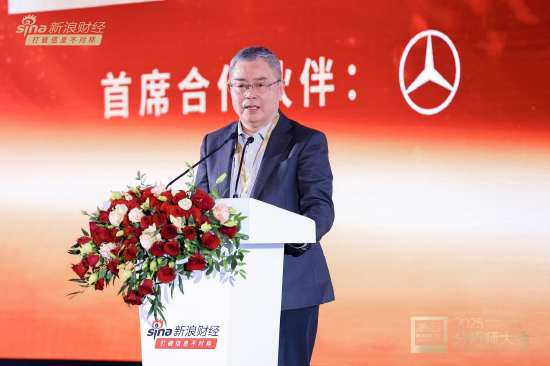
专题:2025分析师大会:资本市场"奥斯卡"启幕 李扬表示,利率下行带来多重影响,既降低了实体经济财务成本,也使商业银行净息差收窄至1.42% 的 历史低位,倒逼金融机构转型。 李扬介绍说,今年前十个月,社会融资结构的变化尤为突出。数据显示,人民币存款余额325.55万亿 元,贷款余额270.61万亿元,存款较贷款多增8.35万亿元,其中住户存款多增10.65万亿元,资金 "脱媒" 现象已持续3年。货币供给层面,M2持续增长且 M1 增速更快,货币流动性改善;金融部门杠杆率方 面,2025年初资产方与负债方杠杆率差距缩小,资金呈现从银行系统外流的趋势,为资本市场发展营造 了良好环境。 利率下行成为我国金融运行的重要常态。自2015年起,我国利率水平开启下降通道,10年期和30年期国 债收益率持续走低。2025年11月24日数据显示,中债国债10年期收益率为 1.8210%,30年期为 2.1586%;9 月新发放贷款加权平均利率降至 3.24%,同业拆借、质押式回购等货币市场利率也同步下 行。存款准备金率的持续下调进一步助推利率走低,而全球范围内,美国、日本、欧元区也长期处于超 低利率甚至负利率状态。究其原因 ...