即时零售

Search documents
美团管理层沟通会——王兴:坚定国际化,聚焦即时零售
Zhong Guo Xin Wen Wang· 2026-03-13 09:04
Group 1 - The core viewpoint of the article emphasizes Meituan's commitment to internationalization while focusing on core areas, particularly "instant retail" [2] - Meituan's CEO Wang Xing stated that the company's confidence in internationalization is strong and its determination is clear, but it will not pursue blind expansion across all business lines [2] - The company has successfully covered major countries in the Gulf region and is expanding into Brazil, which is seen as a market with significant long-term value [2] Group 2 - In Brazil, Meituan plans to approach market entry selectively, focusing on suitable locations rather than a broad rollout, and will refine its business model before further expansion [2] - The company aims to learn from its previous successes and adapt its strategies to the new market environment in Brazil [2]


外卖大战一周年:硝烟和补贴都没了,只剩不够AI的美团
3 6 Ke· 2026-03-13 03:57
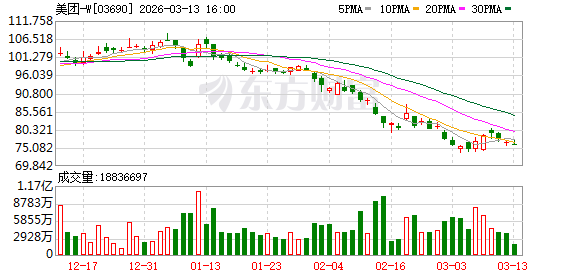
Core Insights - The article discusses the significant changes in the food delivery market in China, particularly the decline in subsidies from major platforms like Meituan and Alibaba, leading to increased prices for consumers [2][3][4] - The competitive landscape has not changed substantially despite the massive subsidies, with Meituan remaining the leader and Alibaba in second place, although the gap has narrowed [3][4] - Both companies have faced substantial financial losses, with Meituan's market value dropping over 600 billion HKD and experiencing a shift from profit to significant losses in its core local business [4][6] Group 1: Market Dynamics - The reduction in subsidies has led to higher prices for consumers, making previously affordable items like coffee and lunch more expensive [1][2] - The intense competition between Meituan and Alibaba, characterized as a "last battle of the internet," has resulted in no clear winner, with both companies suffering financially [3][4] - Meituan's stock price has been on a downward trend since the beginning of the year, reflecting investor concerns over its profitability and market position [6] Group 2: Financial Performance - Meituan's losses for 2025 are projected to be between 25.6 billion to 26.7 billion HKD, a stark contrast to its previous profitability [4][6] - Alibaba's aggressive marketing strategies have led to increased operational costs and a significant drop in operating profits, despite its large scale [6][10] - The financial struggles of both companies highlight the challenges in the food delivery sector, where profitability remains elusive [4][16] Group 3: Strategic Shifts - Alibaba is shifting its focus towards AI and cloud services, indicating a strategic pivot away from the food delivery market [8][10] - Meituan is expanding its instant retail business and investing in AI technologies to enhance operational efficiency and customer service [11][24] - The competition in the food delivery market may evolve into a new phase centered around AI, with both companies needing to adapt to changing consumer behaviors and technological advancements [21][27] Group 4: Future Outlook - The article suggests that the food delivery battle may not resume as expected, with a consensus emerging around more pragmatic approaches to competition [27] - Meituan's future strategies will likely focus on expanding its product offerings and improving AI capabilities to remain competitive [23][24] - The potential for AI to redefine business models in the industry is significant, with implications for how companies engage with consumers and manage operations [21][22]

华润啤酒(0291.HK)2025年业绩预告点评:白酒商誉减值落地 啤酒主业表现优异
Ge Long Hui· 2026-03-12 21:07
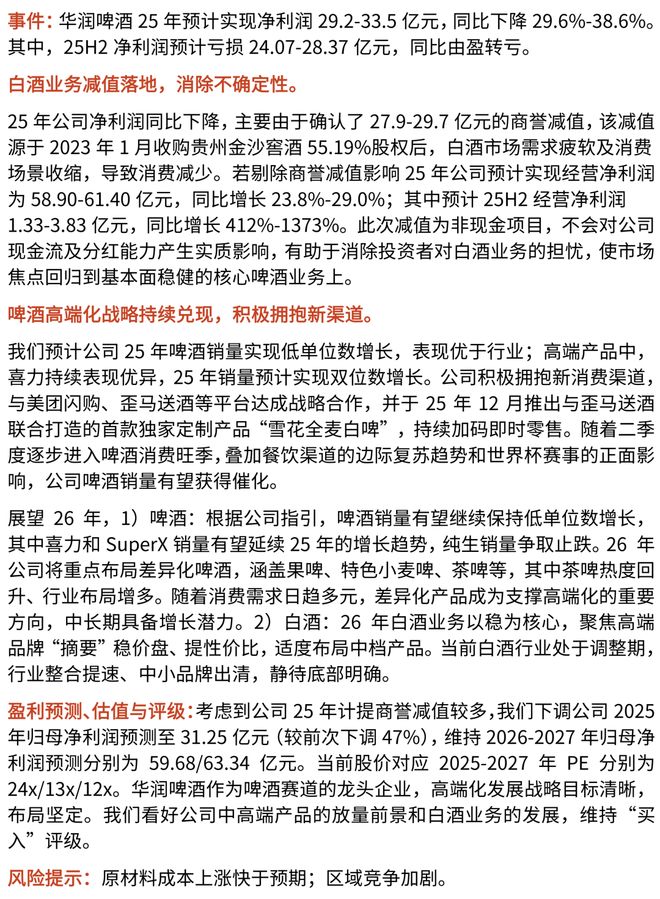
Core Viewpoint - China Resources Beer is expected to achieve a net profit of 2.92-3.35 billion yuan in 2025, representing a year-on-year decline of 29.6%-38.6% [1] - The company anticipates a net loss of 2.407-2.837 billion yuan in H2 2025, marking a shift from profit to loss [1] Group 1: Financial Performance - The decline in net profit for 2025 is primarily due to the recognition of goodwill impairment of 2.79-2.97 billion yuan, stemming from the acquisition of a 55.19% stake in Guizhou Jinsha Distillery in January 2023, amid weak demand in the liquor market [1] - Excluding the impact of goodwill impairment, the company expects to achieve an operating net profit of 5.89-6.14 billion yuan in 2025, reflecting a year-on-year growth of 23.8%-29.0% [1] - The anticipated operating net profit for H2 2025 is projected to be 133-383 million yuan, indicating a significant year-on-year increase of 412%-1373% [1] Group 2: Strategic Initiatives - The company is actively embracing new consumption channels, having established strategic partnerships with platforms like Meituan Flash Purchase and Yima Delivery, and plans to launch an exclusive product "Snow Beer Whole Wheat White Beer" in December 2025 [2] - The beer sales are expected to achieve low single-digit growth in 2025, outperforming the industry, with Heineken expected to see double-digit growth [2] - In 2026, the company aims to maintain low single-digit growth in beer sales, focusing on differentiated products such as fruit beer, specialty wheat beer, and tea beer, which are anticipated to support the high-end strategy [2] Group 3: Profit Forecast and Valuation - The company's net profit forecast for 2025 has been revised down to 3.125 billion yuan, a 47% reduction from previous estimates, while the forecasts for 2026 and 2027 remain at 5.968 billion yuan and 6.334 billion yuan respectively [3] - The current stock price corresponds to a PE ratio of 24x for 2025, 13x for 2026, and 12x for 2027 [3] - The company is viewed positively for its clear high-end development strategy and the potential growth of its mid-to-high-end products and liquor business, maintaining a "buy" rating [3]

【光大食饮&海外】华润啤酒(0291.HK):白酒商誉减值落地,啤酒主业表现优异
Xin Lang Cai Jing· 2026-03-12 01:40
Core Viewpoint - The company, China Resources Beer (0291.HK), is expected to face a significant decline in net profit for 2025, primarily due to goodwill impairment related to its white liquor business, while its core beer business remains robust and is expected to grow in the long term [2][4]. Financial Performance - The projected net profit for 2025 is estimated to be between 2.92 billion and 3.35 billion RMB, representing a year-on-year decline of 29.6% to 38.6% [2]. - The second half of 2025 is expected to incur a net loss of 2.407 billion to 2.837 billion RMB, marking a shift from profit to loss [2]. - The company recognized a goodwill impairment of 2.79 billion to 2.97 billion RMB, attributed to the acquisition of a 55.19% stake in Guizhou Jinsha Jiao Liquor and a downturn in white liquor market demand [2][3]. - Excluding the impact of goodwill impairment, the operating net profit for 2025 is projected to be between 5.89 billion and 6.14 billion RMB, indicating a growth of 23.8% to 29.0% year-on-year [2]. Beer Business Outlook - The company anticipates low single-digit growth in beer sales for 2025, outperforming the industry average [3]. - High-end products, particularly Heineken, are expected to see double-digit growth in sales for 2025 [3]. - The company is actively engaging with new consumption channels, forming strategic partnerships with platforms like Meituan and launching exclusive products [3]. - The beer consumption peak season is expected to catalyze sales growth, aided by a recovery in dining channels and positive impacts from events like the World Cup [3]. Future Projections - For 2026, beer sales are expected to continue low single-digit growth, with a focus on differentiated products such as fruit beer and tea beer, which are gaining popularity [3]. - The white liquor business will focus on stabilizing high-end brands and moderately expanding mid-range products, as the industry undergoes consolidation [3]. Valuation and Estimates - The company's net profit forecast for 2025 has been revised down to 3.125 billion RMB, a 47% decrease from previous estimates, while projections for 2026 and 2027 remain at 5.968 billion and 6.334 billion RMB respectively [4]. - The current stock price corresponds to a price-to-earnings ratio of 24x for 2025 and 12x for 2026-2027 [4]. - The company is viewed positively due to its clear high-end development strategy and potential for growth in both beer and white liquor segments [4].
S26新机开售,三星称即时零售带来惊喜:美团闪购成预售量最高平台之一
Ge Long Hui· 2026-03-11 10:14
Group 1 - Samsung's new flagship smartphone Galaxy S26 series officially launched on March 11, featuring the world's first "privacy screen" anti-peeping function and Galaxy AI in collaboration with Gemini, resulting in high pre-sale demand [1] - In South Korea, the Galaxy S26 set a record for the highest pre-sale figures in the series, with the Galaxy S26 Ultra being the most popular among consumers [1] - In the Chinese market, the rise of instant retail channels has become a significant sales trend for Samsung's new devices, with Meituan Flash Purchase being a key platform for pre-sales and first sales [1][3] Group 2 - Meituan Flash Purchase has over 1,200 authorized Samsung experience stores participating in the pre-sale and first sale, offering a rapid delivery service within 30 minutes [1] - The General Manager of Samsung's Mobile Communications Retail Division in Greater China stated that Meituan Flash Purchase became one of the top platforms for pre-sale sales of the S26 series, highlighting the surprise success of instant retail [1] - Instant retail has gained popularity in China since last year, with consumers increasingly choosing these platforms for purchasing digital appliances, prompting brands to enhance their presence in this channel [3]

叮咚买菜:创始人辞任CEO,正式进入“美团时代”?
Sou Hu Cai Jing· 2026-03-11 02:44
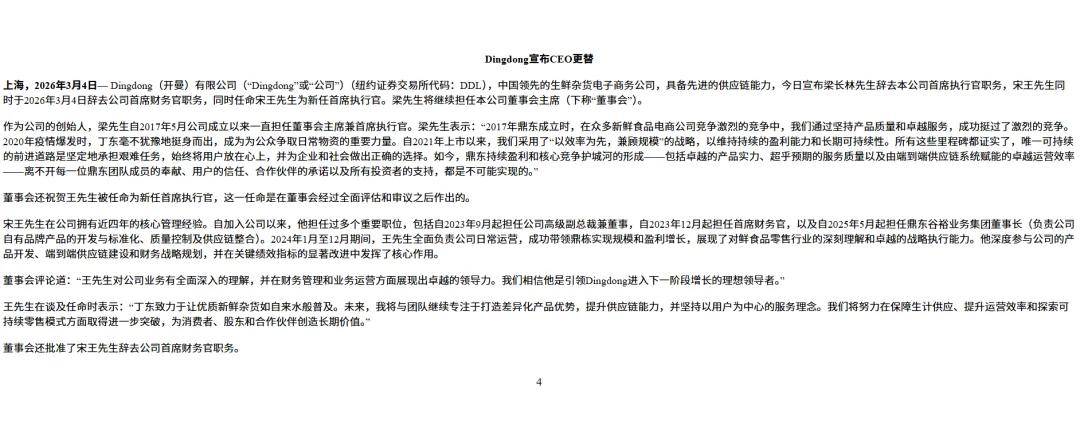
Core Viewpoint - The recent management changes at Dingdong Maicai, including the resignation of founder Liang Changlin as CEO and the appointment of former CFO Wang Song, signal a strategic shift towards a dual-track approach aimed at both domestic profitability and international expansion [1][3][4]. Group 1: Management Changes - Founder Liang Changlin resigns as CEO but remains as Chairman, focusing on international strategy while Wang Song takes over as CEO to enhance domestic performance [1][4]. - Wang Song has nearly 20 years of experience in the fast-moving consumer goods and finance sectors, which positions him well to lead Dingdong Maicai towards profitability [3]. - The management transition occurs shortly after Meituan's acquisition of Dingdong Maicai's Chinese operations for $717 million, indicating a potential shift in operational dynamics [1][4]. Group 2: Strategic Implications - The dual-track strategy aims to optimize domestic operations while exploring international markets, with Liang Changlin focusing on global expansion and Wang Song managing current operations [3][4]. - Dingdong Maicai is currently the only publicly listed fresh food e-commerce company with clear profitability, raising questions about its integration with Meituan's Xiaoxiang Supermarket [1][4]. - Analysts suggest that the collaboration between Dingdong Maicai and Meituan could lead to a more robust ecosystem in the fresh food sector, especially as regulatory scrutiny on price wars increases [7][8]. Group 3: Market Position and Challenges - Meituan holds a significant market share in the instant retail sector, with a GMV market share of 52%, which could further solidify its position if it successfully integrates Dingdong Maicai's business model [8]. - The integration poses challenges, including overlapping customer bases and the need to balance brand identities between Dingdong Maicai and Xiaoxiang Supermarket [8]. - The future strategic direction of the "Meituan + Dingdong Maicai" combination remains to be seen as the management changes take effect [8].

消费品零售业2025下半年度报告-毕马威
KPMG· 2026-03-10 06:35
Investment Rating - The report does not explicitly state an investment rating for the consumer retail industry, but it indicates a cautious optimism regarding investment opportunities in certain segments [6]. Core Insights - The macroeconomic environment shows steady progress, with China's GDP growing by 5.0% in 2025, surpassing 140 trillion yuan for the first time, and total retail sales of consumer goods exceeding 50 trillion yuan, marking a 3.7% increase [6][7]. - The luxury goods sector is stabilizing, driven by rising precious metal prices, while the apparel and footwear industry is undergoing significant restructuring, with sportswear leading the market [6]. - Investment activity is showing signs of recovery, but capital remains cautious, favoring lower-risk, stable-return projects [6]. - Government policies are increasingly supportive, with measures such as equipment upgrades, consumption vouchers, and tax optimization aimed at boosting consumer spending [6]. Summary by Relevant Sections Macroeconomic Overview - GDP growth of 5% and retail sales surpassing 50 trillion yuan, with service retail growth outpacing goods retail by 1.7 percentage points [6][7]. Luxury Goods and Fashion - The luxury sector is in a stable growth phase, with jewelry retail sales reaching 373.6 billion yuan, a 12.8% increase [7]. Apparel and Footwear - Retail sales in clothing, footwear, and textiles exceeded 150 billion yuan, growing by 3.2% [7]. Health and Beauty - The beauty and personal care sector is recovering, with exports of cosmetics reaching 7.82 billion USD, a 9.1% increase [7]. Food and Beverage - The trend towards health-oriented and functional products is evident, with a notable rise in low-alcohol beverages [6]. Dining Sector - The dining industry saw a 3.2% increase in revenue, accounting for 11.6% of total retail sales [7]. Investment Activity - Investment in the consumer retail sector is showing localized recovery, with a preference for head projects that attract significant capital [6]. Policy Environment - Continuous government initiatives, including trade-in programs and tax incentives, are expected to further stimulate consumer spending [6].
京东的反转时刻:在所有人唱衰时,它开始重新增长
美股研究社· 2026-03-06 12:39
Core Viewpoint - JD.com has demonstrated resilience and growth in a challenging e-commerce environment, achieving a revenue of 1.3 trillion yuan in 2025, representing a 13% year-on-year increase, indicating a potential recovery from previous difficulties [2][29]. Group 1: Industry Context - The Chinese e-commerce sector has undergone a significant cyclical adjustment over the past two years, with macroeconomic recovery slowing and increased competition among platforms leading to reduced growth rates for many internet companies [6][7]. - Major players like Alibaba and Pinduoduo have shifted their strategic focus from scale to efficiency in response to these challenges [6][7]. Group 2: JD.com's Growth Strategy - JD.com has adapted by diversifying its revenue sources, expanding its daily necessities and platform service income, which grew by 15% and 19% respectively, to mitigate the volatility in electronic product sales [10]. - The company is transitioning from a "pure electronics retail platform" to a "comprehensive consumption platform," enhancing its user lifecycle value by offering a wider range of products [10]. Group 3: Profitability Improvement - JD.com's core retail business operating profit margin improved by 62 basis points to 4.6% in 2025, marking a significant milestone for the company [11]. - The company's logistics network, previously a cost center, is becoming a competitive advantage as efficiency improves and fulfillment costs decrease [13]. Group 4: Technological Integration and New Business - JD.com is embedding AI technology into its e-commerce framework, significantly increasing the usage of its self-developed model JoyAI, which enhances conversion efficiency [19][20]. - The company is also seeing improvements in its new business segments, such as its food delivery service, which has reduced losses over four consecutive quarters, indicating progress in the instant retail sector [24]. Group 5: Market Perception and Future Outlook - The market's perception of JD.com has shifted from skepticism about its growth story to recognizing its potential for long-term value, especially as it diversifies its growth sources [25][32]. - While challenges remain in the competitive e-commerce landscape, the indicators suggest that JD.com may have emerged from its most difficult period [29][31].

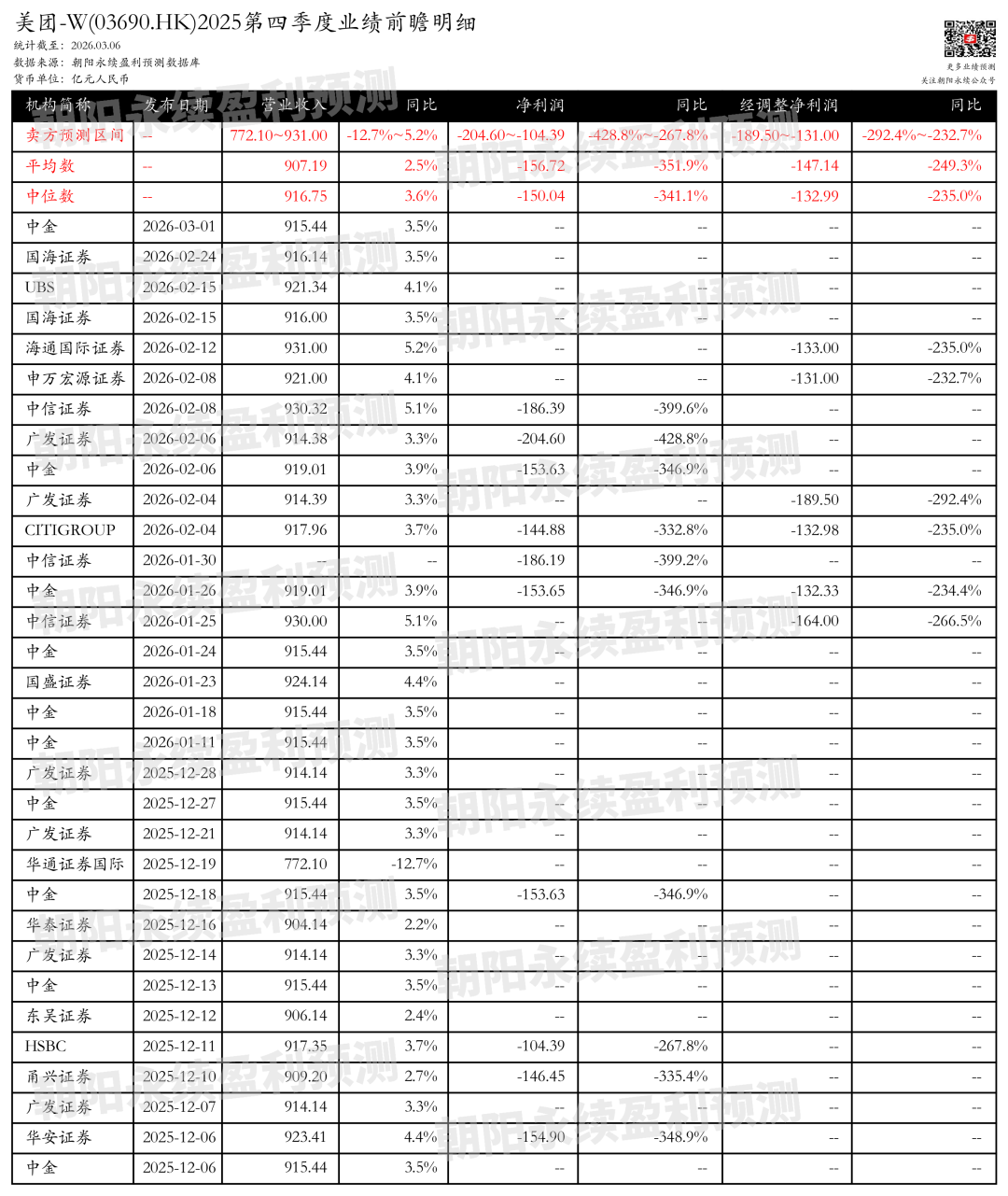
美团-W:营收增长放缓,亏损扩大,预测第四季度营业收入772.10~931.00亿元,同比变动-12.7%~5.2%
Xin Lang Cai Jing· 2026-03-06 12:36
Core Viewpoint - Meituan-W is expected to report a mixed performance for Q4 2025, with revenue forecasts ranging from 772.10 to 931.00 billion RMB, reflecting a year-on-year change of -12.7% to 5.2% [1][7]. Revenue Forecast - The predicted total revenue for Q4 2025 is between 772.10 and 931.00 billion RMB, with an average estimate of 907.19 billion RMB, indicating a 2.5% year-on-year growth [2][8]. - The median revenue forecast is 916.75 billion RMB, representing a 3.6% increase year-on-year [2][8]. Profit Forecast - The expected net profit for Q4 2025 is projected to be between -204.60 and -104.39 billion RMB, showing a significant year-on-year decline of -428.8% to -267.8% [1][7]. - The adjusted net profit is forecasted to range from -189.50 to -131.00 billion RMB, with a year-on-year change of -292.4% to -232.7% [1][7]. Business Segment Analysis - **Core Local Business**: Expected revenue of 648 billion RMB, a decline of 1% year-on-year, with the food delivery segment projected to generate 391 billion RMB, down 11% [3][9]. - **Flash Purchase Business**: Anticipated revenue of 89 billion RMB, reflecting a 32% year-on-year increase, with order volume expected to grow by 30% [4][10]. - **In-store and Travel Business**: Forecasted revenue of 162 billion RMB, up 11% year-on-year, with Gross Transaction Value (GTV) expected to increase by 15% [4][11]. - **New Business**: Projected revenue of 268 billion RMB, a 17% increase year-on-year, but with an expected operating loss widening to 45 billion RMB [4][11]. Competitive Landscape - The company is increasing investments in its ecosystem to address competition in the instant retail sector, including enhanced marketing, rider incentives, and merchant support [3][9]. - The competitive pressure is expected to ease slightly in Q4 2025, with total revenue anticipated at 931 billion RMB, a 5.3% year-on-year growth [5][11]. Future Outlook - The adjusted net loss for Q4 2025 is expected to be 133 billion RMB, an improvement from 160 billion RMB in Q3 2025 [5][11]. - The company anticipates a reduction in unit economic losses in the food delivery segment from 2.6 RMB per order to 2 RMB per order due to decreased winter subsidies [5][11]. - For 2027, the adjusted net profit is projected to reach 234 billion RMB, with a target price of 84 HKD based on a 20x price-to-earnings ratio [5][11].
京东健康(06618):25年Non-IFRS盈利增速超36%,品类扩充+即时零售业务布局亮眼
Xinda Securities· 2026-03-06 12:34
Investment Rating - The investment rating for JD Health (6618.HK) is "Buy" [1] Core Insights - The company reported a revenue of 73.441 billion yuan for 2025, representing a year-on-year growth of 26.28%. The pre-tax profit was 6.03 billion yuan, up 25.7%, and the net profit attributable to shareholders was 5.367 billion yuan, reflecting a 29.1% increase. The non-IFRS profit was 6.533 billion yuan, showing a growth of 36.3% [2][3] - The growth in revenue is driven by an increase in active users, category expansion, and improved penetration rates. The number of active users reached 218 million in 2025, a year-on-year increase of approximately 19% [3] - The company has strengthened its position as the "first station for the launch of new drugs online," with over 100 new drugs launched in 2025, compared to over 30 in 2024 [3] - The AI healthcare services have been expanded, providing comprehensive health management services, including an AI doctor that has completed hundreds of millions of interactions with a 98% satisfaction rate [3][4] Financial Summary - For 2026, the projected revenue is approximately 87.602 billion yuan, with a year-on-year growth rate of 19%. The net profit is expected to be around 5.437 billion yuan, with a growth rate of 1% [5][6] - The gross margin is projected to improve to 25.57% in 2026, with a net profit margin of 8.9% [5][6] - The earnings per share (EPS) for 2026 is estimated at 1.69 yuan, with a price-to-earnings (P/E) ratio of 25.15 [5][6]