市场波动性

Search documents
特朗普搅局全球市场,华尔街大行在“动荡”中赚翻了!
Hua Er Jie Jian Wen· 2025-07-16 06:19
Group 1: Trading Revenue Surge - Major banks in Wall Street reported record trading revenues in Q2, driven by market volatility from Trump's tariff policies [1] - JPMorgan's fixed income trading generated $5.69 billion, while equity trading reached $3.25 billion, marking the best Q2 performance ever [1] - Citigroup's equity trading revenue was $1.61 billion, and fixed income trading surged 20% to $4.27 billion, exceeding forecasts [1] Group 2: Investment Banking Recovery - Investment banking fees showed unexpected growth, with JPMorgan's fees increasing by 7%, contrary to analysts' expectations of a 14% decline [2] - Citigroup's investment banking fees rose 13% year-over-year, surpassing $1 billion [2] Group 3: Mixed Performance Among Banks - Wells Fargo did not achieve similar success, with investment banking fees growing about 9% but falling short of analyst expectations [3] - Market volatility has led to cautious behavior among clients regarding borrowing and investment, impacting Wells Fargo's trading revenue [3]


美股狂飙之际现不祥之兆 卖压低迷预示回调将近?
智通财经网· 2025-07-11 11:01
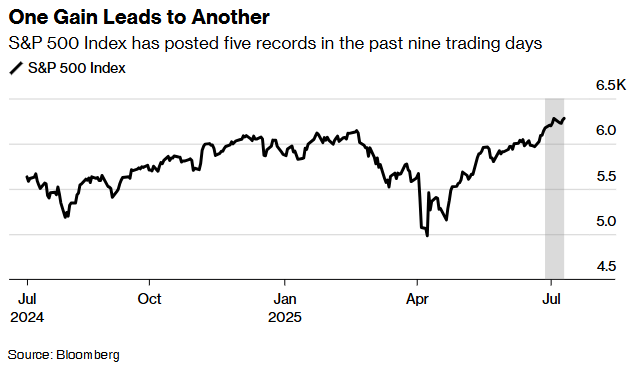
Group 1 - The core viewpoint indicates that the current market conditions, characterized by a lack of selling pressure and a high concentration of trading in large tech stocks, may suggest an overly optimistic sentiment among investors, potentially leading to a market correction [1][4][5] - The S&P 500 index has reached record highs multiple times recently, with a notable increase of approximately 26% since late April, yet the volume of declining stocks has dropped to its lowest level since 2020, indicating a possible overconfidence in the market [1][4] - Historical data shows that similar market conditions in the past have often preceded declines of at least 5% in the S&P 500, suggesting that a correction could be on the horizon, although it may be limited to a 3% to 5% range [1][3] Group 2 - Investors are currently favoring aggressive sectors such as technology and finance over defensive sectors, reflecting a strong risk appetite, which may lead them to view any market pullback as a buying opportunity [3][4] - The Chicago Board Options Exchange Volatility Index (VIX) has fallen to its lowest level since late February, indicating a decrease in demand for protection against market downturns, which could be interpreted as a sign of investor complacency [4][5] - Despite the low VIX levels, it is suggested that this does not indicate a lack of awareness regarding risks, as investors have already priced in known uncertainties such as trade tensions and economic growth concerns [5]

美大行下周发布财报,全球银行料因关税动荡获10%交易收入提振
智通财经网· 2025-07-10 09:40
Group 1 - Global banks, including top U.S. banks, are expected to see a 10% growth in market revenue, driven by traders capitalizing on changes in U.S. tariff policies [1] - The forecast is based on a 15% increase in trading revenue for 12 global banks in Q1, which includes major players like JPMorgan Chase, Bank of America, and Goldman Sachs [1][2] - Executives from Bank of America and Citigroup anticipate mid to high single-digit percentage growth in market revenue for Q2 following a strong Q1 performance [1] Group 2 - Analysts suggest that market revenue may exceed expectations when major U.S. banks report Q2 earnings next week, with significant trading activity noted after President Trump's tariff announcement in April [2] - Tradeweb Markets reported a 38.6% year-over-year increase in average daily trading volume in April, reaching $2.7 trillion, following the tariff policy announcement [2] - Mollie Devine from Crisil Coalition Greenwich noted that volatility is beneficial for market revenue, with tariff announcements acting as positive catalysts for trading departments [2] Group 3 - Stock trading revenue is projected to grow by 18% year-over-year in Q2, while bond trading revenue is expected to increase by 5% [3] - Analysts indicate that ongoing uncertainties related to tariffs, interest rates, and geopolitical factors are sustaining high levels of trading activity [3] - Predictions suggest that trading revenue for major U.S. banks will grow by 8% in the first half of the year, slowing to 5% in the second half, with low single-digit growth expected next year [3]


芝商所2025年第二季度国际市场日均交易量达到创纪录的920万份合约 同比增长18%
Zhi Tong Cai Jing· 2025-07-10 09:08
Group 1 - CME Group announced a record average daily trading volume of 9.2 million contracts in Q2 2025, representing an 18% year-over-year increase, driven by record volumes in Europe, the Middle East, Africa, and Asia-Pacific regions [1] - The average daily trading volume in the Europe, Middle East, and Africa (EMEA) region reached 6.7 million contracts, up 15% year-over-year, with significant growth in equity indices, energy, interest rates, and metal products [1] - The Asia-Pacific region saw an average daily trading volume of 2.2 million contracts, a 30% increase from the previous year, with energy products growing by 67% and metal products by 34% [1] Group 2 - In Canada, the average daily trading volume for Q2 2025 was 190,000 contracts, a 17% increase year-over-year, with interest rate and equity index products growing by 19% and 35%, respectively [2] - The Latin America region reported an average daily trading volume of 18,900 contracts, a 4% increase from 2024, with foreign exchange and metal products reaching new quarterly highs [2] - Globally, CME Group's average daily trading volume for Q2 2025 reached a record 30.2 million contracts, reflecting a 16% year-over-year increase, primarily driven by new highs in interest rates, agricultural products, and metal products [2]

韩国称,随着波动性上升,将密切监控市场,如有必要将采取措施。
news flash· 2025-06-23 00:01
Core Viewpoint - South Korea will closely monitor the market as volatility increases and will take necessary measures if needed [1] Group 1 - The South Korean government is responding to rising market volatility [1] - There is an indication of potential intervention in the market if conditions worsen [1]
帮主郑重解读:美军这波操作,油价周一开盘恐迎“本能反应”
Sou Hu Cai Jing· 2025-06-22 04:20
Core Viewpoint - The recent military action by the U.S. against Iranian nuclear facilities is expected to influence oil prices and market reactions, particularly with an initial spike in oil prices due to heightened risk and uncertainty [3][4]. Group 1: Market Reactions - Following the U.S. military strike, investors anticipate a potential rise in oil prices when markets reopen, driven by instinctive risk-averse behavior [3]. - Mark Spindel, CEO of Potomac River Capital, suggests that initial market reactions may include panic, leading to an increase in oil prices [3]. - The uncertainty surrounding the safety of U.S. personnel abroad may contribute to increased market volatility, especially in the oil sector [3]. Group 2: Long-term Considerations - While short-term fluctuations in oil prices are likely, long-term investors should focus on broader trends rather than immediate market noise [4]. - The impact of geopolitical events on oil prices is influenced by various factors, including supply-demand dynamics, global economic conditions, and monetary policies [4]. - Investors are advised to remain calm and analyze how the market digests the news before making decisions, emphasizing the importance of a long-term perspective in investment strategies [5].

特朗普动手了!原油、黄金和美股会如何?
Hua Er Jie Jian Wen· 2025-06-22 02:09
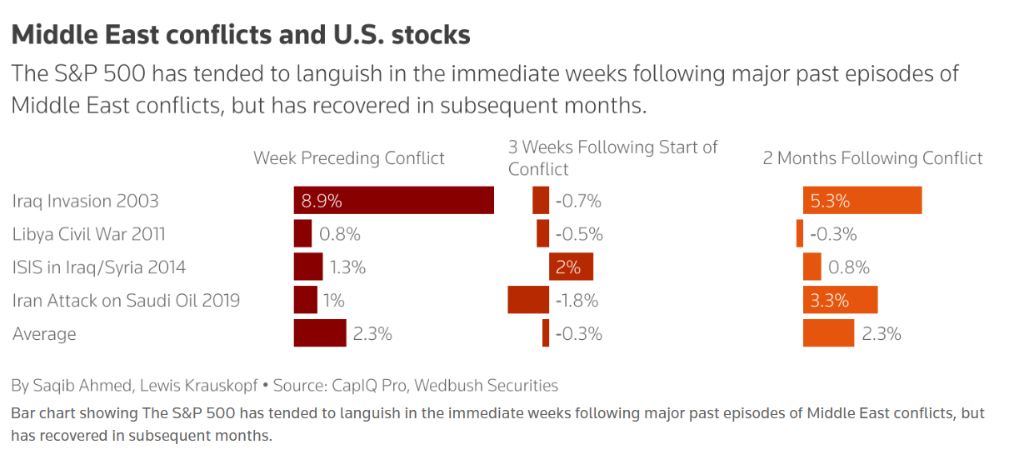
Group 1: Geopolitical Tensions and Market Impact - The geopolitical tensions in the Middle East are redefining the global market landscape, with direct military confrontation between Israel and Iran creating unprecedented uncertainty for investors [1] - The recent U.S. military strikes on Iranian nuclear facilities mark a significant escalation in the conflict, prompting market participants to reassess risk exposure across various asset classes [1] - Oil prices are expected to rise significantly, with Oxford Economics modeling a worst-case scenario of approximately $130 per barrel, potentially pushing U.S. inflation close to 6% by year-end [1] Group 2: Oil Market Volatility - The oil market has experienced significant volatility, with WTI crude futures rising about 10% and Brent crude futures increasing 18% since June 10, reaching a near five-month high of $79.04 [2] - Traders are exiting oil futures positions at record speed, with a drop of 367 million barrels in open contracts, representing a decline of about 7% since June 12 [2] - The volatility in the oil market is attributed to the unpredictability of U.S. actions regarding the conflict, leading to increased pressure on derivative books [2] Group 3: Transportation Costs and Risks - Transportation costs for crude oil from the Middle East to China have surged nearly 90% since the Israeli attacks, with shipping rates for gasoline and aviation fuel also rising significantly [3] - The safety of the Strait of Hormuz is under close scrutiny, as it accounts for about one-fifth of global oil production and consumption, with GPS signals of nearly 1,000 vessels being disrupted [3] - Recent incidents, including oil tankers colliding and exploding, highlight the increasing risks faced by vessels in the region [3] Group 4: Currency and Stock Market Reactions - The escalation of the Middle East conflict has a complex impact on the U.S. dollar, which may initially benefit from safe-haven demand but could weaken in the long term due to geopolitical uncertainties [4] - The U.S. stock market has shown a relatively mild reaction to the conflict, with the S&P 500 index initially declining but stabilizing thereafter, indicating potential for a rebound based on historical trends [4][5] - Historical data suggests that the S&P 500 typically experiences a slight decline in the initial weeks of conflict but tends to recover in the following months [5] Group 5: Gold Market Dynamics - The rapid decline in geopolitical risk premium for gold may be misleading, as historical patterns indicate that such premiums often peak 8-20 trading days after a crisis [10][12] - Despite the ongoing conflict, gold prices have recently dropped, with spot gold falling below $3,370, marking a decline of over 1.8% [7] - Deutsche Bank anticipates that gold will likely rebuild its risk premium in the coming weeks due to the severity of the Israel-Iran conflict and U.S. military actions [12]
华尔街准备度假,市场却不答应?投资者警惕波动风险
Jin Shi Shu Ju· 2025-05-27 10:15
Market Overview - The overall stock market has returned to early-year levels, but corporate earnings and consumer confidence indicators are showing signs of weakness [1] - Uncertainties in the market are largely stemming from Washington, particularly regarding tariff and tax policy disputes, with no short-term resolution in sight [1] Historical Summer Performance - Historical data from American Century Investments indicates that summer markets have recorded gains in 38 out of the last 50 years, with an average increase of approximately 3.9% from May 1 to October 31 [2] - Despite this positive historical performance, the current market conditions for the summer of 2025 present several warning signals, including a near 21 times forward P/E ratio for the S&P 500, approaching levels seen in the late 1990s [2] Current Market Sentiment - The first quarter earnings season showed strong performance, with 78% of S&P 500 companies exceeding earnings expectations, slightly above the five-year average of 77% [3] - However, there has been an increase in the mention of "recession" during earnings calls, marking the highest frequency since 2022 [3] - Analyst sentiment is also cautious, with Yardeni Research reporting the worst record in two years for the ratio of analysts raising versus lowering earnings and revenue forecasts [3] Key Events Impacting Summer Market - Ongoing disputes over tariffs and tax policies are contributing to market volatility, with significant fluctuations often following President Trump's trade policy announcements [3] - Upcoming trade negotiations between the U.S. and Japan are set for May 30, with Japan seeking to expand investments in the U.S. and modify import regulations, although the U.S. remains cautious regarding auto tariffs [4] - The U.S. and EU trade talks have gained momentum after Trump backed off from imposing tariffs, but uncertainty remains among EU businesses regarding the outcome of these negotiations [4] Legislative Developments - A new tax and spending bill proposed by Republicans, referred to as the "Beautiful Bill," is facing resistance due to concerns over increasing the deficit, with key senators expressing the need for significant modifications [5] - The bond market is showing signs of unease, with 30-year Treasury yields exceeding 5%, nearing the highest levels since 2007 [5] Federal Reserve's Role - The Federal Reserve is expected to maintain high short-term interest rates to combat inflation, with meetings scheduled for June 17-18 and July 29-30 [6] - Current market expectations suggest a greater than 70% probability that the Fed will keep rates unchanged, but any unexpected rate cuts could lead to a stock market rebound unless economic data indicates a looming recession [6]
Marex Group plc(MRX) - 2025 Q1 - Earnings Call Transcript
2025-05-15 14:00
Marex Group (MRX) Q1 2025 Earnings Call May 15, 2025 09:00 AM ET Speaker0 Day, and thank you for standing by. Welcome to the Marek's Q1 twenty twenty five Earnings Call. At this time, all participants are in a listen only mode. After the speakers' presentation, there'll be a question and answer session. Please be advised that today's conference is being recorded. I would now like to hand the conference over to your first speaker today, Adam Strachan, Head of Investor Relations. Please go ahead. Speaker1 Goo ...
华尔街接受这个事实吧:波动性是好事
Sou Hu Cai Jing· 2025-05-14 10:42
Core Viewpoint - The market is experiencing volatility at the beginning of Trump's second term, but this may not be a significant issue as some strategists believe it could lead to beneficial outcomes for investors [1][3]. Group 1: Market Reactions and Predictions - Following the November 5 election, the market surged as investors anticipated a business-friendly approach from President Trump [1]. - During Trump's first 100 days, the Dow Jones Industrial Average and S&P 500 both fell over 4%, while the Nasdaq Composite dropped nearly 8% [3]. - Strategists are finding reasons to believe that Trump may not fulfill his campaign promises, leading to skepticism about the market's optimistic outlook [3]. Group 2: Uncertainty and Its Implications - Albert Edwards argues that uncertainty, often seen as a market enemy, could actually benefit Wall Street by keeping investors alert [3][4]. - The term "uncertainty" has become prevalent in discussions, especially after Fed Chair Jerome Powell used it extensively in a March press conference [3]. - Edwards suggests that excessive certainty can lead to increased debt levels, which could be detrimental to the market [4][5]. Group 3: Economic Conditions and Corporate Impact - The Federal Reserve's attempts to ensure a soft landing and reduce volatility may inadvertently encourage credit and financial bubbles [6][7]. - Edwards warns that the current political climate, characterized by populist interventionist policies, could undermine the stock market's bullish trend [10]. - He highlights the issue of price gouging during the pandemic, where unit costs rose while corporate profit margins reached record highs, indicating a potential shift in regulatory stance under Trump [10]. Group 4: Future Regulatory Changes - Edwards anticipates that Trump may push for stronger competition regulations, which could negatively impact corporate profit margins as companies are forced to absorb increased costs from tariffs [10]. - The potential for regulatory changes could create further uncertainty in the market, which may not be the worst outcome for investors [11].