
网络效应

Search documents
Stablecoin Disruption: Time to Sell Your Visa Stock?
The Motley Fool· 2025-06-22 22:05
Group 1: Stablecoin Legislation - The United States Senate approved stablecoin legislation known as the GENIUS Act, which aims to regulate stablecoins and require issuers to maintain sufficient reserves and undergo regular audits [1] - This legislation is expected to encourage customer adoption of stablecoins, posing a potential threat to Visa's payment volume [2] Group 2: Merchant Adoption of Stablecoins - Major retailers like Walmart and Amazon are exploring the creation of their own stablecoins to reduce high credit card transaction fees, which range from 2% to 3% [3] - By adopting stablecoins, these retailers could save billions annually in fees currently paid to the financial system [4] Group 3: Challenges for Stablecoins - Replicating Visa's scale and the rewards associated with credit cards presents a significant challenge for stablecoins, as Visa has a vast network accepted by 150 million merchants and processes over $15 trillion in payments annually [8] - The network effect creates a competitive advantage for Visa, making it difficult for stablecoins to achieve similar acceptance and usage [9] Group 4: Visa's Competitive Position - Despite concerns over stablecoins, Visa maintains a strong competitive advantage and scale that stablecoin issuers are unlikely to match in the near future [11] - Visa's earnings per share (EPS) grew 10% year over year, indicating steady growth, although the stock trades at a premium price-to-earnings ratio of 34 [12]



Cursor 融资 9 亿 ARR 超 5 亿美金,其最关键的一次决策和早期 14 人团队
投资实习所· 2025-06-08 06:15
Core Insights - Cursor has completed a $900 million Series C funding round, achieving a valuation of $9.9 billion, led by Thrive with participation from Accel, a16z, and DST [1] - The company's Annual Recurring Revenue (ARR) has surpassed $500 million, making it one of the fastest companies to reach this milestone in history [1] - Cursor's Net Dollar Retention (NDR) stands at an impressive 200%, one of the highest in the SaaS industry [1] Funding and Valuation - Cursor's recent funding round raised $900 million, bringing its valuation to $9.9 billion [1] - The company has a strong backing from notable investors, including Thrive, Accel, a16z, and DST [1] Revenue Growth - Cursor's ARR exceeded $500 million, with a rapid growth trajectory that saw it reach $100 million ARR within 12 months of launching its product [1] - The ARR doubled approximately every two months, growing from $300 million in April to over $500 million now [1] Team and Operational Efficiency - The team remains small, consisting of approximately 40-60 members, which contributes to its agile operational structure [2] - The growth strategies discussed online emphasize the product's quality and timing as key factors for success [2] Product Features and Innovation - Cursor's free trial model allows users to experience the full value of the product, leading to high conversion rates [3] - The next-edit-prediction models developed by Cursor significantly enhance its code completion capabilities, providing intelligent suggestions based on broader context [4] - The ability to perform fast code rewrites through natural language instructions adds substantial value for developers [4] Network Effects - As more developers use Cursor, the data collected improves AI models, enhancing accuracy and utility for all users [5] - Increased collaboration among teams using Cursor fosters knowledge sharing, making the tool more valuable [5] - The developer community benefits from shared knowledge and best practices, accelerating onboarding for new users [6] Strategic Positioning - Cursor's dual-track innovation strategy aligns with its product positioning, contributing to its rapid growth and market relevance [8]

稳定币第一股上市在即!投资价值解析→
第一财经· 2025-06-04 14:36
Core Viewpoint - The article discusses the upcoming IPO of Circle, the issuer of USDC, highlighting its advantages over competitors and the potential impact on the cryptocurrency market and global monetary systems [1][2][3]. Group 1: Circle's IPO and Market Position - Circle is set to go public on the New York Stock Exchange, with an expected IPO date around June 5 or 6, aiming to raise up to $896 million by issuing 32 million shares priced between $27 and $28 each [3][4]. - USDC's circulation has surpassed $61 billion, growing by 40% over the past year, while USDT's growth was only 10% [1][4]. - Circle's business model primarily relies on earning interest from the reserves backing USDC, which are held in safe short-term assets [7][8]. Group 2: Competitive Landscape - USDC is viewed as more compliant and transparent compared to USDT, which has faced criticism for its lack of transparency and regulatory issues [8][9]. - The network effect is crucial for USDC's competitive advantage, as early entrants in the stablecoin market can create user loyalty that is difficult for new entrants to overcome [10][11]. Group 3: Implications for the Cryptocurrency Market - The emergence of compliant stablecoins like USDC is expected to reshape the cryptocurrency landscape, serving as a bridge between traditional finance and the crypto market [14][15]. - The article suggests that stablecoins could transform cross-border payment systems by allowing transactions to occur outside traditional banking frameworks, thus reducing costs and processing times [15][16]. Group 4: Future Challenges and Developments - Despite its advantages, USDC's market share has declined from 35% to below 20%, while USDT's share exceeds 70%, indicating challenges ahead for Circle [12]. - The article notes that while stablecoins may enhance the internationalization of currencies, they also pose regulatory challenges related to anti-money laundering and counter-terrorism financing [16].

稳定币第一股Circle上市在即!投资价值全解析
Di Yi Cai Jing· 2025-06-04 13:05
Core Viewpoint - The emergence of stablecoins, particularly USDC, is poised to reshape the cryptocurrency landscape and potentially the global monetary system [1][9]. Group 1: Circle's IPO and Market Position - Circle, the issuer of USDC, plans to go public on the New York Stock Exchange, with a target date around June 5 or 6, aiming to raise up to $896 million by issuing 32 million shares priced between $27 and $28 each [2][4]. - The company has seen significant growth, with USDC's circulation increasing from $42.5 billion at the end of 2021 to over $61 billion, marking a 40% growth in the past year, compared to USDT's 10% growth [2][5]. - Circle's business model primarily relies on earning interest from the reserves backing USDC, which are held in safe short-term assets [5]. Group 2: Competitive Landscape - USDC's compliance and transparency give it a competitive edge over USDT, which has faced criticism for its lack of transparency regarding reserve assets [6][7]. - Despite USDC's advantages, its market share has decreased from 35% in early 2022 to below 20%, while USDT's share exceeds 70%, attributed to USDC's strict compliance measures [8]. Group 3: Implications for the Cryptocurrency Market - The introduction of compliant stablecoins like USDC is expected to bridge traditional finance and cryptocurrency markets, lowering the cost for traditional funds to enter the crypto space [9][10]. - The rise of stablecoins may transform cross-border payment systems by allowing transactions to occur outside traditional banking frameworks, enhancing efficiency and reducing costs [10]. Group 4: Future Developments - The Hong Kong government is moving towards issuing a Hong Kong dollar stablecoin, with companies like JD.com preparing to enter the stablecoin market, indicating a growing trend in stablecoin adoption [11].
深度解读:京东打不赢美团外卖,为什么还要打?
Sou Hu Cai Jing· 2025-05-29 00:51
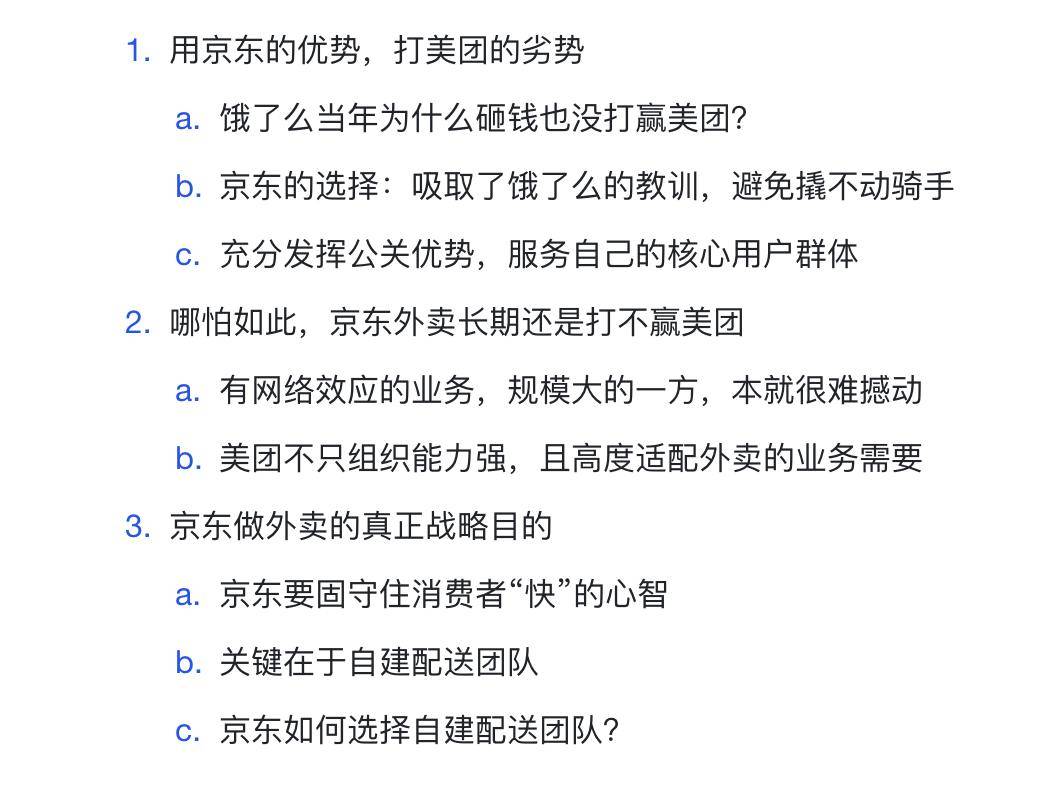
Core Viewpoint - The public relations battle between JD and Meituan has significantly benefited JD, with its daily orders for food delivery skyrocketing from zero to over 10 million in less than three months [2][8]. Group 1: Competitive Strategies - JD has effectively utilized its strengths to exploit Meituan's weaknesses, particularly by focusing on public relations and social responsibility, such as providing social insurance for delivery riders [13][30]. - The strategy of JD contrasts with the failed approach of Ele.me, which attempted to compete with Meituan through heavy subsidies without addressing the simultaneous growth of users, merchants, and riders [13][14]. - JD's public relations efforts have included high-profile actions by its founder, such as delivering food and engaging with riders, which have resonated positively with consumers [36][38]. Group 2: Long-term Outlook - Despite the short-term success in public relations, JD is unlikely to surpass Meituan in the long run due to the latter's established competitive advantages, including a deeper market penetration and organizational capabilities [8][56]. - The network effects inherent in the food delivery business favor Meituan, as its larger order volume leads to lower delivery costs, making it difficult for JD to compete effectively [58][65]. - JD's organizational structure lacks the adaptability and decision-making capabilities that Meituan has developed, which are crucial for managing the complexities of the food delivery market [70][85]. Group 3: Strategic Intent - JD's primary goal in entering the food delivery market is not necessarily to dominate but to maintain consumer perceptions of speed and quality, which are critical to its brand identity [91][92]. - By establishing a food delivery service, JD aims to create a stable order volume that can support its logistics team, thereby reinforcing its commitment to fast delivery [112][114]. - The investment in food delivery is seen as a strategic move to reclaim the "fast" mindset among consumers, especially as competition from Meituan intensifies [99][102].


月薪5千和月薪2万没有本质区别
虎嗅APP· 2025-05-22 11:41
Core Viewpoint - The article emphasizes that increasing salary does not fundamentally change the status of workers, as they remain dependent on selling their labor, and highlights the importance of changing income and lifestyle strategies to achieve financial security and independence [10][11][12]. Income Strategy - The article discusses the devaluation of labor in the current era, noting that most physical labor jobs offer low hourly wages, typically between 20 to 45 yuan, with some even as low as 12 yuan [15][16]. - It highlights the potential for higher earnings through participation in the internet's "network effect," using the example of top video editors who can earn up to 1 million yuan annually by leveraging their skills in a high-demand market [19][20][23]. - The article suggests that to increase income, individuals should move away from selling their time and instead create products or services that can be replicated, such as self-media, live streaming, or app development [25][26]. Lifestyle Strategy - The article points out that there is no essential difference between earning 5,000 yuan and 10,000 yuan if spending habits remain unchanged, as both scenarios can lead to financial instability [27][29]. - It emphasizes the importance of saving and managing expenses, suggesting that those who save a portion of their income can build financial security and reduce anxiety about job loss [32][33]. - The article argues that the goal of increasing income should not just be to improve living standards but to achieve financial independence, allowing individuals to take risks and pursue opportunities without fear of losing their jobs [38][39].

宁德时代,企图用换电解决一个“重量级”难题
远川研究所· 2025-05-21 12:25
Core Viewpoint - The article discusses the value of battery swapping models in the electric vehicle industry, highlighting both explicit and implicit benefits, and emphasizes the importance of standardization for widespread adoption, particularly in the heavy-duty truck sector [1][4][9]. Group 1: Explicit and Implicit Value of Battery Swapping - The explicit value of battery swapping includes faster battery replacement (5 minutes), reduced purchase barriers, and alleviation of concerns regarding battery lifespan [1][4]. - Implicit benefits include lower land usage, higher power capacity utilization, reduced impact on the power grid, and enhanced social externalities [1][4]. - The battery swapping model has been recognized in government reports and has attracted investments from companies seeking optimal solutions, such as CATL [1][4]. Group 2: Heavy-Duty Truck Market Dynamics - Battery swapping is essential for heavy-duty trucks due to their operational characteristics, allowing for a 30%-50% reduction in initial purchase costs compared to traditional fuel trucks [4][5]. - The efficiency of battery swapping allows heavy-duty trucks to achieve full charge in 5 minutes, comparable to LNG refueling, while traditional charging methods take significantly longer [4][5]. - The unified management of batteries in a swapping model can extend battery life and reduce maintenance costs, enhancing the overall lifecycle value of the batteries [5][6]. Group 3: Standardization and Network Effects - The article emphasizes that battery standardization is crucial for expanding battery swapping from closed to open scenarios, enabling interoperability across different brands and regions [9][12]. - The current market for battery swapping in heavy-duty trucks is limited, with only about 15% of trucks utilizing this model in long-haul logistics, primarily due to fragmented standards [12][31]. - Achieving a unified battery standard is essential for creating a nationwide efficient energy network, which would facilitate the widespread adoption of battery swapping [12][32]. Group 4: CATL's Role and Future Prospects - CATL has been proactive in developing solutions for the heavy-duty truck market, launching standardized battery packs and comprehensive battery swapping solutions [17][19]. - The company aims to establish a network of 300 battery swapping stations in key regions by 2025, with a long-term goal of creating a national battery swapping network covering major logistics routes [26][31]. - The successful implementation of battery swapping could lead to significant cost savings for operators and contribute to the broader goal of carbon neutrality in the transportation sector [20][32].


月薪5千和月薪2万没有本质区别
Hu Xiu· 2025-05-20 06:42
Core Points - The article discusses the perception of salary increases and the reality of being a wage worker, emphasizing that higher salaries do not fundamentally change one's status as a laborer [11][12][13] - It highlights the diminishing value of labor in the current economy, where most jobs offer low hourly wages, and suggests that individuals should seek alternative income methods [20][22][39] - The importance of saving and managing expenses is stressed, indicating that lifestyle choices can significantly impact financial security and opportunities for wealth accumulation [44][46][57] Group 1 - The article reflects on the initial satisfaction with a monthly salary of 5500, which later increased to 8000 and 12000, but ultimately concludes that these changes do not alter the fundamental nature of being a worker [1][8][10] - It points out that in lower-tier cities, a salary of 5000 may be acceptable, but in first-tier cities, it is insufficient for a comfortable lifestyle, leading to financial stress [5][6][9] - The narrative suggests that regardless of salary increases, individuals remain vulnerable to job loss and economic instability, as their income is tied to their labor [12][14][16] Group 2 - The article emphasizes that the current labor market devalues work, with most physical labor jobs offering low hourly rates, typically between 20 to 45 yuan, and highlights the rarity of higher-paying positions [22][24][27] - It introduces the concept of "network effects" in the internet economy, where individuals can significantly increase their income by participating in high-demand fields like video editing for social media influencers [28][36] - The article advises that to improve financial outcomes, individuals should move away from traditional labor models and explore opportunities in self-media, live streaming, and other scalable ventures [39][40] Group 3 - The article discusses the misconception that higher income should automatically lead to improved living standards, arguing that spending habits are crucial in determining financial stability [48][50][52] - It contrasts two scenarios: one where a person spends most of their income and another where they save a portion, illustrating how savings can provide security and opportunities for investment [45][47][56] - The conclusion encourages individuals to pursue salary increases not as an end goal but as a means to achieve financial independence and security, ultimately aiming to reduce reliance on traditional employment [58][60]
自动驾驶的大赢家!Uber 的增长之路为何才刚刚起步
美股研究社· 2025-05-12 10:48
Core Viewpoint - Uber has transformed from a company with low profitability and weak unit economics to a profitable entity with a strong growth trajectory, making it an attractive investment opportunity with a valuation of approximately $83 per share [3]. Business Overview - Uber, founded in 2009, has expanded its services to include online food delivery, retail, package delivery, and freight, operating in over 15,000 cities with 171 million monthly active users and an annual order volume of $180 billion [2]. Financial Performance - In 2023, Uber achieved profitability and has been steadily increasing its profit margins while growing revenue at a rate of 20% annually, which has helped it capture market share and innovate its services [3]. Competitive Advantage - Uber's dual-platform model for ride-hailing and delivery creates a significant competitive edge, allowing drivers to maximize their income potential through multiple revenue streams [4]. - The interoperability of Uber's services enhances user experience and loyalty, with multi-product consumers spending 3.4 times more than single-product consumers [5]. Operational Efficiency - Uber's scale and user liquidity contribute to operational efficiencies, allowing the company to share economic benefits with drivers and customers, thus improving profitability [6]. - The company has a lower commission rate compared to competitors like Lyft, which positions it favorably in terms of value creation for drivers and passengers [6]. Cost Management - Uber is implementing technology initiatives to reduce insurance costs, which are significant for ride-hailing and delivery platforms, thereby improving gross margins [7]. - The introduction of the Uber One subscription service has led to increased customer loyalty and transaction frequency, with subscribers spending three times more than non-subscribers [8]. Advertising Revenue - Uber's advertising business, launched in 2022, is expected to enhance profitability, with a projected revenue run rate of $1.5 billion and a gross margin of at least 70% [9]. Autonomous Vehicles (AV) Impact - The rise of autonomous vehicles presents both a threat and an opportunity for Uber, as it may face competition from AV operators but also has the expertise in fleet management that is crucial for AV commercialization [10][11]. - Uber's extensive user base provides a significant market for AV operators, ensuring fleet utilization and maximizing revenue potential [12]. Market Valuation - Compared to global competitors, Uber's stock appears undervalued, with a price-to-free cash flow ratio that is 30% lower than its peers for 2025, suggesting strong growth prospects and a dominant market position [15].


京沪高铁(601816):京沪增长放缓,京福扭亏在即
Changjiang Securities· 2025-05-05 08:43
Investment Rating - The investment rating for the company is "Buy" and is maintained [5]. Core Views - The report indicates that the growth of Beijing-Shanghai High-Speed Railway is slowing down, while the Beijing-Fuzhou line is on the verge of turning profitable. The company is expected to remain in a profit ramp-up period due to improved capacity utilization and a stable competitive landscape [2][4]. Financial Performance Summary - In 2024, the company achieved an operating revenue of 42.157 billion yuan, a year-on-year increase of 3.6%, and a net profit attributable to shareholders of 12.768 billion yuan, up 10.6% year-on-year. For Q1 2025, the operating revenue was 10.223 billion yuan, a 1.2% increase year-on-year, with a net profit of 2.964 billion yuan, remaining stable compared to the previous year [4][7]. - The company plans to distribute a cash dividend of 5.783 billion yuan for the year 2024, maintaining a dividend payout ratio of 50% [4][7]. Operational Insights - The passenger volume for the main line of Beijing-Shanghai High-Speed Railway decreased by 2.3% year-on-year, with limited growth potential. However, cross-line train mileage increased by 11.4% year-on-year, indicating a shift in operational focus [7][8]. - The average ticket price for main line passengers increased by 0.8% year-on-year, while cross-line train prices decreased by 3.8% year-on-year, highlighting the need to monitor pricing adjustments for cross-line services [7][8]. Cost and Profitability Analysis - The company's operating costs increased by 0.6% year-on-year to 22.179 billion yuan, with depreciation costs remaining rigid. The report notes that the company's profit margins are under pressure due to rising costs outpacing revenue growth [7][8]. - The report forecasts net profits for 2025 to 2027 at 13.6 billion, 15.1 billion, and 16.9 billion yuan, respectively, with corresponding price-to-earnings ratios of 21, 19, and 17 times [7][8].
