
规模效应

Search documents
“开门红”效应初显,太保、新华最新保费公告实现稳健增长
Xin Lang Cai Jing· 2026-01-20 13:39
Core Insights - The insurance premium income in China continues to grow at a high rate, with China Pacific Insurance (CPIC) reporting a total original insurance premium income of RMB 461.68 billion for 2025, reflecting a steady growth trend [1][8] - CPIC's life insurance segment achieved a premium income of RMB 258.11 billion, a year-on-year increase of 8.1%, while the property insurance segment reported RMB 203.56 billion, with a modest growth of 0.2% [1][10] - New China Life Insurance also reported a premium income of RMB 195.90 billion for 2025, marking a 15% increase compared to the previous year, indicating a similar steady growth trend [1][10] - China Taiping announced a significant expected net profit growth of 215-225% for 2025, driven by improved net investment performance and a one-time impact from new tax policies [1][9] Life Insurance Performance - CPIC's life insurance premium income surpassed RMB 258 billion, growing 8.1% year-on-year, significantly outpacing the growth of property insurance and highlighting CPIC's competitive advantage in the life insurance sector [10] - The positive growth in CPIC's property insurance, despite market challenges, is noteworthy, as it maintained a stable scale amid intensified competition and regulatory changes in the auto insurance sector [10][12] Channel Structure - The distribution channels for CPIC's insurance premiums show a diverse performance, with the bancassurance channel achieving a remarkable growth of 42% year-on-year, generating RMB 56.53 billion [11][12] - New business in the bancassurance channel grew by 30.6%, while renewal business surged by 66.2%, indicating a significant improvement in customer retention [12] - The insurance agent channel reported a slight decline of 0.7% in premium income, totaling RMB 182.75 billion, while other distribution channels showed strong growth, particularly the group and government channels, which grew by 9% and 154.7% respectively [12] Business Structure Optimization - In the property insurance segment, CPIC reported a premium income of RMB 203.56 billion, with a minimal growth of 0.2%, demonstrating resilience in a challenging market environment [12] - The motor vehicle insurance segment generated RMB 110.51 billion, growing 3% and accounting for 54.3% of total property insurance premiums, serving as a stabilizing force [12] - Non-motor vehicle insurance faced challenges, with a premium income of RMB 93.05 billion, reflecting a 3% decline due to intense market competition [12][4] Scale Effect - The Chinese insurance market exhibits significant potential for growth while also demonstrating considerable scale effects, where larger insurance institutions can offer more comprehensive services and competitive pricing, thereby capturing greater market share [5][13]



北汽蓝谷的“翻身”困局
Hua Er Jie Jian Wen· 2026-01-20 11:43
Core Viewpoint - Beiqi Blue Valley's 2025 performance report reveals a complex picture of "growth and losses coexisting," with an expected net loss of 4.35 billion to 4.65 billion yuan, despite a significant reduction from the previous year's loss of 6.948 billion yuan [2] Group 1: Financial Performance - The company's net loss for 2025 is projected to be between 4.35 billion and 4.65 billion yuan, a notable decrease from the 6.948 billion yuan loss in 2024, yet still at a high level [2] - Sales volume reached 209,600 units in 2025, marking an 84.06% year-on-year increase, but this growth has not translated into improved profitability [2][3] - Historical losses from 2020 to 2024 were 6.482 billion yuan, 5.244 billion yuan, 5.465 billion yuan, 5.400 billion yuan, and 6.948 billion yuan respectively, indicating a persistent trend of financial challenges [2] Group 2: Strategic Investments and Challenges - The paradox of increasing sales but ongoing losses stems from substantial strategic investments, particularly in R&D, which rose to 1.573 billion yuan in the first three quarters of 2025, a 43.26% increase from the previous year [3] - The company's traditional B-end market, primarily the EU series, which contributed 70%-80% of sales, is being disrupted, leading to a shift in brand perception [4] - The transition to new high-end brands, such as Arcfox and Xiangjie, is ongoing, but the sales from these new models have not yet compensated for the decline in sales from older models [5] Group 3: Partnerships and Technological Advancements - A significant focus is on the collaboration with Huawei, which has resulted in the high-end brand "Xiangjie" becoming a new growth engine, raising the average selling price by 8,000 yuan [7] - The partnership has evolved into a "strategic community," with plans for a 20 billion yuan investment over three years to establish dedicated departments and supply chains [8] - The company has also achieved a milestone by obtaining the first batch of L3 conditional autonomous driving permits for its Arcfox Alpha S model, positioning itself at the forefront of autonomous driving commercialization in China [10] Group 4: Future Outlook and Market Position - Despite ongoing losses, the increase in sales has instilled some confidence among analysts, with expectations for continued growth in 2026 due to new model launches [13] - The current focus on L3 technology is seen as a long-term investment, requiring sustained R&D and market development, with limited immediate financial impact [12] - The company faces the challenge of transforming its brand perception and market recognition while relying on Huawei's support to establish a solid high-end market presence [13]


中国中免(601888):收购DFS大中华区业务 与LVMH集团深度合作
Xin Lang Cai Jing· 2026-01-20 06:25
Core Viewpoint - The company's acquisition of DFS stores and related assets in the Hong Kong and Macau regions will rapidly expand its retail presence locally, while the partnership with LVMH and subsequent H-share issuance will strengthen their collaboration, allowing both retailers and brands to leverage complementary advantages, further consolidating China Duty Free Group's position in the global travel retail market. Post-issuance, China Tourism Group will maintain a solid controlling stake, supporting its long-term international strategy [1]. Group 1: Transaction Overview - The company announced that its wholly-owned subsidiary, China Duty Free International, will acquire DFS's Greater China travel retail business for up to $395 million in cash [2]. - The acquisition includes nine DFS stores in Hong Kong and Macau, as well as related intangible assets in Greater China [3]. - The final price of the transaction will be determined based on an agreed price adjustment mechanism [6]. Group 2: Strategic Partnerships - A strategic cooperation memorandum was signed with LVMH to establish a partnership in the retail sector, aligning with LVMH's current business model [7]. - The collaboration is expected to enhance LVMH's brand presence in China Duty Free's channels, particularly benefiting from high-quality customer traffic in duty-free zones [4]. Group 3: H-Share Issuance - The company will issue up to 11,967,500 H-shares at a price of HKD 77.21 per share, which represents less than 0.58% of the total share capital post-issuance [5]. - This issuance will bind the two parties at the equity level, with the potential to increase overseas retail revenue by over 4 billion yuan according to projected financials for 2024 [5][11]. - The issuance will not significantly dilute existing shares, maintaining China Tourism Group's controlling stake at 50.01% [9]. Group 4: Asset Valuation - The valuation of the nine DFS stores in Hong Kong and Macau is approximately RMB 313.38 million, translating to about $44.1 million, with an assessed appreciation rate of 1701.84% [10]. - The transaction is based on a total enterprise value of $400 million, subject to customary adjustments [10]. Group 5: Financial Projections - The company maintains its profit forecasts for 2025 to 2027 at RMB 4.149 billion, RMB 5.190 billion, and RMB 6.348 billion, respectively, with current share prices corresponding to P/E ratios of 47X, 37X, and 30X [5][11].

销量暴增84.06%仍未形成规模效应,北汽蓝谷2025年预亏43.5亿-46.5亿元
Ju Chao Zi Xun· 2026-01-20 03:18
Core Viewpoint - The company, Beiqi Blue Valley, has announced a projected net loss for the year 2025, indicating ongoing challenges despite significant sales growth in the electric vehicle market [2] Financial Performance - The expected net profit attributable to shareholders for 2025 is projected to be between -465 million and -435 million yuan [2] - The expected net profit attributable to shareholders after deducting non-recurring gains and losses is projected to be between -495 million and -465 million yuan [2] - In comparison, the net profit attributable to shareholders for 2024 was -694.8 million yuan, with a net profit of -732.3 million yuan after deducting non-recurring gains and losses [2] - The earnings per share for 2024 was reported at -1.2466 yuan [2] Strategic Initiatives - The company is focusing on its "three-year leap" strategy to capitalize on opportunities in the electric vehicle market, which involves significant investment in product research and development as well as channel construction [2] - Despite achieving a sales volume of 209,576 vehicles in 2025, representing an 84.06% year-on-year increase, the company is still in a loss phase due to the insufficient realization of scale benefits [2] - The company anticipates that profitability may improve as new products are launched according to plan and cost reduction and efficiency enhancement measures are further implemented [2]

联合动力:发挥规模效应去构建中长期核心竞争力
Zheng Quan Ri Bao Wang· 2026-01-19 12:13
Core Viewpoint - The company aims to enhance cost control through product and technology cost reduction, supply chain and production optimization, business and customer value reconstruction, and service and model innovation [1] Group 1 - The company will focus on product and technology cost reduction as part of its cost control strategy [1] - Supply chain and production optimization will be key areas for the company to improve efficiency [1] - The company plans to reconstruct business and customer value to enhance its market position [1] Group 2 - Continuous technological innovation will be a priority for the company to maintain competitiveness [1] - The company intends to leverage economies of scale to build long-term core competitiveness [1]
对手更惨,特斯拉第四季度美国电动汽车份额大增至59%
Feng Huang Wang· 2026-01-14 01:08
Core Insights - The article highlights Tesla's significant increase in market share in the U.S. electric vehicle (EV) market, reaching 59% in Q4, up from 41% in the previous quarter, as competitors struggle without government subsidies [1] - Tesla sold 138,000 electric vehicles in the U.S. during Q4, benefiting from economies of scale that allow it to maintain profitability while keeping prices relatively low [1] Group 1: Tesla's Performance - Tesla's Cybertruck sales were disappointing, with only 20,237 units sold in the U.S. last year, which is nearly half of the expected sales for 2024, and a 68% year-over-year decline in Q4 [2] - Despite the Cybertruck's poor performance, Tesla's overall market dominance remains strong due to its production efficiency and scale [5] Group 2: Competitors' Struggles - Most competitors lack the sales volume and production efficiency of Tesla, leading to higher manufacturing costs and potential losses [3] - Ford's market share in Q4 was only 6%, Rivian's was 4%, and General Motors managed just over 10%, with GM incurring a $6 billion charge due to cuts in its U.S. EV plans [3] - Ford abandoned a large EV project due to unprofitability, resulting in a $20 billion impairment charge, while Rivian continues to operate at a loss [3][4] Group 3: Industry Trends - The end of federal EV subsidies has led many manufacturers to reconsider or abandon their EV plans, as achieving large-scale production is critical to avoid ongoing losses [4] - Companies like Mercedes and Stellantis have halted or scaled back their EV initiatives, indicating a broader trend of caution in the industry [3]

这些ETF改名了!低费率ETF速览
Sou Hu Cai Jing· 2026-01-13 08:21
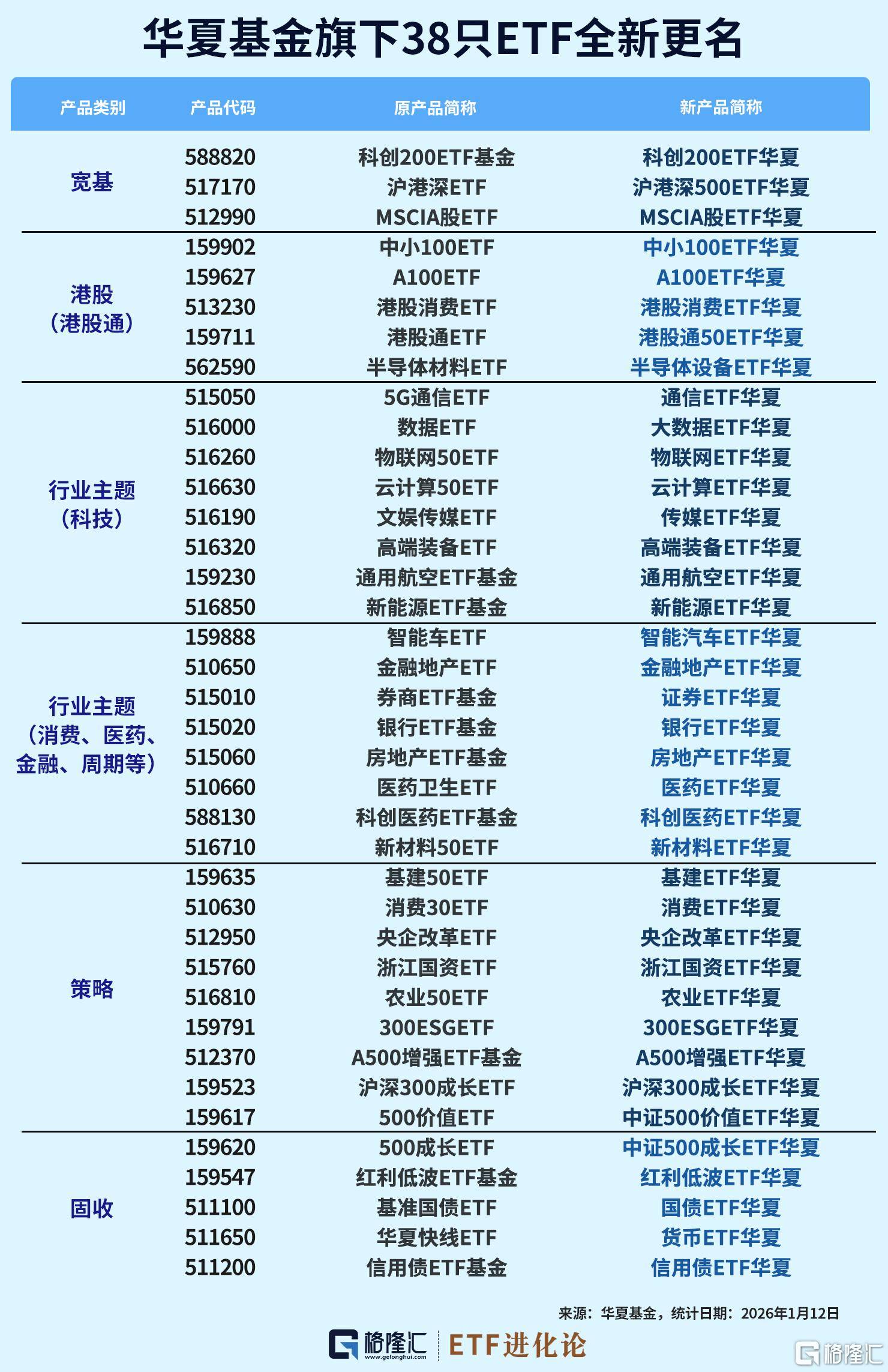
Core Viewpoint - The Chinese ETF market is transitioning from "rapid growth" to "high-quality development," with significant changes occurring as it approaches a scale of 6 trillion yuan [1]. Group 1: Market Transformation - The ETF market in China has surpassed 4 trillion and 5 trillion yuan, indicating a shift towards a more mature asset management era [1]. - A fundamental transformation is underway in the second-largest ETF market globally, with a focus on standardization and clarity in product naming [1][6]. Group 2: Standardization of Naming - 华夏基金 has initiated a collective renaming of 38 ETFs to a standardized format of "core investment target + ETF + 华夏," enhancing product recognition for investors [1][7]. - This change aims to reduce cognitive costs for investors and improve decision-making efficiency by clearly presenting the investment target and management entity [7][8]. Group 3: Transparency and Trust - The renaming initiative is a supply-side reform aimed at increasing transparency in the ETF market, which is crucial as ETFs evolve into core assets for wealth allocation [8]. - By embedding the management brand in product names, 华夏基金 strengthens its brand commitment and enhances investor trust in product quality [8][9]. Group 4: Low Fee Strategy - 华夏基金 has reduced management fees for 30 ETFs to the lowest tier of 0.15% per year, covering over 710 billion yuan in assets, providing cost-effective options for investors [9][10]. - The low-fee strategy is part of a larger trend where scale leads to operational efficiency, ultimately benefiting investors [14][15]. Group 5: Comprehensive Product Offering - 华夏基金 manages 117 ETFs, creating a diverse range of investment options across various asset classes, enhancing liquidity and market stability [17][24]. - The firm aims to be a "super Lego" in asset management, allowing investors to flexibly assemble their portfolios with granular and widely covering asset categories [17]. Group 6: Global Perspective - 华夏基金 is recognized as a leading player in the global ETF market, having achieved significant growth and innovation since launching China's first ETF in 2004 [25][26]. - The recent renaming of ETFs serves as a branding opportunity, enhancing visibility and trust, which may lead to increased capital inflow and improved investor experience [26][27]. Group 7: Future Outlook - The comprehensive renaming of ETFs is not merely a technical adjustment but a reflection of the maturation and standardization of the Chinese capital market [28]. - The evolution of ETFs is seen as a vital link between the real economy and individual wealth, with 华夏基金 taking a leading role in promoting high-quality development in the industry [28][30].
胜负已分!美国研发的可再生能源技术,中国用它做到了全球第一
Sou Hu Cai Jing· 2026-01-12 22:48
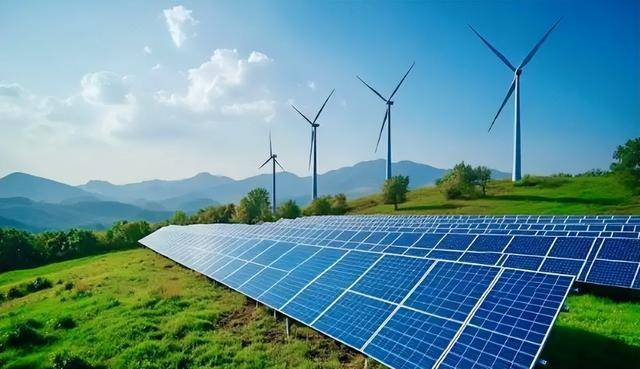
Core Insights - The leading scientific journal "Science" recognized "global renewable energy growth" as the top scientific breakthrough of the year, attributing this transformation primarily to China [1][21] Group 1: Renewable Energy Production - China produces 80% of the world's solar panels, 70% of wind turbines, and 70% of lithium batteries, indicating a significant dominance in renewable energy manufacturing [2][11] - Since 2016, China has been the largest producer of renewable energy, surpassing the U.S., and has increased its renewable energy generation capacity from 40% to 60% as part of its 14th Five-Year Plan [5][11] Group 2: Investment and Economic Impact - In 2024, China's investment in clean energy technology manufacturing is projected to be nearly $680 billion, surpassing the combined investments of the U.S. and the EU [11] - The contribution of green technology to China's economic growth is expected to exceed 10% in 2024, indicating that renewable energy is becoming a significant economic driver rather than just a superficial initiative [11][13] Group 3: Technological Leadership and Global Influence - China is not only manufacturing products but is also exporting standards and solutions in renewable energy technology, positioning itself as a global leader [14][18] - The advancements in technology, such as rapid electric vehicle charging solutions, showcase China's capability to address global energy challenges effectively [16][18] Group 4: Geopolitical Implications - The shift in renewable energy leadership from the U.S. to China signifies a change in global power dynamics, where countries with advanced renewable technologies will hold significant geopolitical leverage [18][21] - The ability to meet global climate goals, such as those outlined in the Paris Agreement, is increasingly dependent on China's technological advancements in renewable energy [18][19]
从规模冲刺到结构优化 车企2026年销量目标透露发展新逻辑
Zheng Quan Ri Bao· 2026-01-12 17:00
Core Viewpoint - The 2026 sales targets of various automotive companies reflect a divergence in strategy, with new energy vehicle companies focusing on aggressive growth while traditional automakers prioritize stability and gradual progress [1][3]. Group 1: New Energy Vehicle Companies - New energy vehicle companies, such as Leap Motor, NIO, and Xiaomi, have set ambitious sales targets for 2026, with Leap Motor aiming for 1 million units, representing a year-on-year growth of approximately 67.6% [2]. - NIO's sales target ranges from 456,400 to 489,000 units, indicating a year-on-year growth of about 40% to 50%, while Xiaomi targets 550,000 units, reflecting a growth of around 34% [2]. - The aggressive targets are driven by the need for scale and market share, with companies like Leap Motor focusing on overseas expansion and local production to support their goals [2]. Group 2: Traditional Automakers - Traditional automakers, including Geely, Chery, and Great Wall Motors, have set more conservative sales targets, with Geely aiming for 3.45 million units and Chery targeting 3.2 million units, which represents a year-on-year growth of about 14% [3]. - Great Wall Motors has a target of 1.8 million units, reflecting a year-on-year growth of approximately 36%, while Dongfeng Group aims for 3.25 million units [3]. - The conservative approach is influenced by market pressures, policy changes, and the need to balance profitability with product structure, as the domestic market shows signs of weakening [3][4]. Group 3: Strategic Focus - Chery Group emphasizes a multi-faceted strategy involving "new fuel, new energy, new overseas markets, new businesses, and new technologies" to achieve its sales targets [4]. - The focus on overseas expansion is critical for traditional automakers, as uncertainties in export growth, particularly for electric vehicles, are anticipated in 2026 [4]. - Overall, the differentiation in sales targets reflects the industry's competitive landscape, with new energy vehicle companies aiming for rapid scale while traditional automakers focus on maintaining profitability and structural resilience [4].



德福科技终止海外并购 转道收购国内电解铜箔制造商
Xin Lang Cai Jing· 2026-01-12 09:30
Core Viewpoint - Defu Technology announced the termination of its planned acquisition of Circuit Foil Luxembourg due to the lack of unconditional approval from foreign authorities, reflecting the challenges faced by Chinese companies in global expansion and strategic adjustments [1][2][3] Group 1: Acquisition Details - The original plan was to acquire 100% of Circuit Foil Luxembourg for €174 million (approximately RMB 1.413 billion), but the deal was called off after six months, resulting in the return of a €17.4 million deposit [1][3] - Concurrently, Defu Technology revealed a new acquisition plan to obtain at least 51% of Huiru Technology, a manufacturer of electrolytic copper foil, which will become a subsidiary upon completion [1][2] Group 2: Financial Performance and Capacity - Defu Technology's current capacity utilization is nearing saturation, with revenue of RMB 8.5 billion and a net profit of RMB 66.59 million for the first three quarters of 2025, indicating potential performance constraints due to capacity bottlenecks [4][5] - The acquisition of Huiru Technology is expected to increase Defu Technology's total capacity to 195,000 tons per year, reinforcing its position as the largest electrolytic copper foil producer globally [2][5] Group 3: Market Reaction and Strategic Shift - Following the announcement of the terminated acquisition, Defu Technology's stock price opened at RMB 31.44 per share, a decrease of 11.41% from the previous closing price, indicating negative market sentiment [2][5] - The case of Defu Technology highlights the difficulties of cross-border acquisitions in high-tech sectors, suggesting that domestic industry consolidation and organic growth may be more prudent strategies [2][5]