AI热潮

Search documents
每日机构分析:12月9日
Sou Hu Cai Jing· 2025-12-09 10:59
Group 1: Euro and European Central Bank (ECB) - The strong euro may force the European Central Bank (ECB) to implement 1-2 rate cuts before next summer [1] - Barclays Bank's strategy chief indicates that the euro is significantly overvalued from a trade-weighted perspective, suggesting its actual value is higher than nominal rates reflect [1] - HSBC economists warn that if the trade-weighted euro index rises by about 5%, it could compel the ECB to adopt additional easing measures, potentially leading to multiple rate cuts [1] Group 2: Federal Reserve and Interest Rates - Barclays predicts the Federal Reserve will lower rates by 25 basis points to a range of 3.50%-3.75% in the upcoming meeting, while signaling a hawkish tone for future meetings [2] - Nomura Securities has adjusted its forecast, now expecting a 25 basis point cut from the Federal Reserve, citing sufficient dovish signals for a "risk management-style" cut [3] - Analysts from BNY state that the market has fully priced in the Fed's rate cut expectations, with further easing dependent on weaker economic data in the first half of 2026 [3]

瑞银预测:美光传统内存DDR毛利率将首次超过HBM
美股IPO· 2025-12-09 07:15
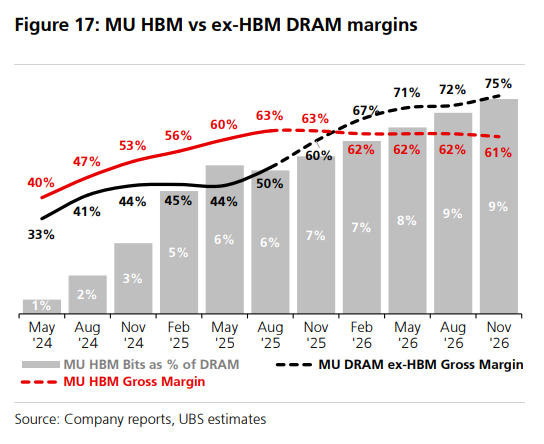
Core Viewpoint - UBS believes that the traditional DRAM market is experiencing a significant shift due to a supply squeeze, leading to enhanced pricing power and profitability for traditional DRAM, which is expected to surpass HBM margins starting in Q2 2026 [1][3][4]. Group 1: Market Dynamics - The shift in industry capacity towards HBM has resulted in a tightening supply of traditional DRAM, while demand remains robust, creating a mismatch that drives up pricing power [7]. - UBS forecasts that traditional DRAM gross margins will reach 67% in Q2 2026, surpassing HBM's 62% for the first time, with margins expected to further increase to 71% in Q3 and 75% in Q4 [5][11]. Group 2: Financial Projections - For Q1 FY2026, traditional DRAM revenue is projected to be $8.22 billion, with a mere 1% increase in shipment volume but a significant 16% rise in average selling price [5]. - UBS's revenue and EPS forecasts for Micron in Q1 FY2026 are significantly higher than management's guidance, driven primarily by improved pricing [12]. Group 3: HBM Business Outlook - Although HBM remains a core growth story for Micron, UBS anticipates a slowdown in HBM revenue growth due to capacity constraints, with Q1 FY2026 HBM revenue expected to grow approximately 35% quarter-over-quarter [8]. - For the full year, UBS estimates HBM revenue will reach $13.05 billion in FY2026 and increase to $21.24 billion in FY2027, with HBM's share of total revenue rising from 17% in FY2025 to 26% in FY2027 [11]. Group 4: Long-term Market Trends - UBS emphasizes that the current semiconductor cycle may last longer than market expectations due to HBM's significant consumption of wafer capacity, effectively creating a "crowding out" effect on the traditional storage market [11][12]. - The report indicates that the structural supply shortage provides a durable competitive advantage for major players like Micron [11].



瑞银预测:美光传统内存DDR毛利率将首次超过HBM
Hua Er Jie Jian Wen· 2025-12-09 03:49
Core Insights - UBS indicates that despite high market attention on Micron's HBM business, traditional DDR memory is experiencing unprecedented profit margin growth due to capacity constraints [1][2]. Group 1: Market Dynamics - The memory industry is undergoing a structural shift, with traditional DRAM profitability expected to surpass that of HBM due to increased supply tightness [1][2]. - UBS forecasts that traditional DRAM gross margins will reach a historical high of 67% by Q2 2026, surpassing HBM's gross margin of 62% [2][5]. Group 2: Financial Projections - For Q1 2026, traditional DRAM revenue is projected to be $8.22 billion, with a 1% quarter-over-quarter increase in shipment volume and a 16% increase in average selling price [2][6]. - UBS predicts that Micron's Q1 2026 revenue will be $13.2 billion, with an EPS of $4.27, driven primarily by price increases [6][7]. Group 3: HBM Business Outlook - HBM revenue growth is expected to slow due to capacity limitations, with Q1 2026 HBM revenue projected to grow approximately 35% quarter-over-quarter [6]. - HBM's contribution to total revenue is anticipated to rise from 17% in FY2025 to 26% in FY2027 [6]. Group 4: Long-term Industry Trends - The current semiconductor cycle is expected to be more prolonged than market expectations, driven by HBM's significant consumption of wafer capacity, which is creating a "crowding out" effect on traditional storage markets [5][6]. - UBS maintains a target price of $275 for Micron, citing favorable risk-reward dynamics due to the current supply-demand landscape [7].
美股年末行情大反转!华尔街押注2026年经济复苏 狂买滞涨板块
Zhi Tong Cai Jing· 2025-12-08 12:31
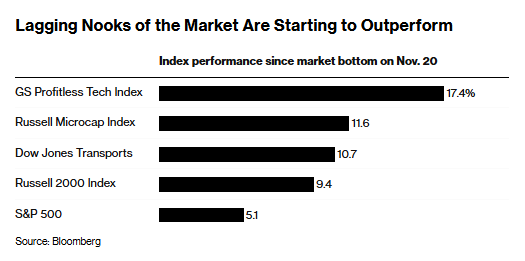
Group 1 - Investors are shifting away from technology giants and moving towards underperforming small-cap stocks and traditional economic sectors like transportation, as evidenced by the Russell 2000 index rising 9.4% since November 20, compared to a 5.1% increase in the S&P 500 index [1] - The market is questioning the sustainability of the "AI boom" that has previously driven tech stocks, with major players like Nvidia and Microsoft seeing stagnation in their stock performance [1] - There is growing optimism about a U.S. economic recovery in the first half of 2026, prompting investors to favor value stocks over growth stocks [1] Group 2 - Strategas Asset Management recommends overweighting an equal-weighted S&P 500 index over a traditional market-cap weighted version, anticipating that upcoming tax reforms and events like the World Cup will boost economic growth [4] - Bank of America suggests that sectors closely tied to the economic cycle, such as residential construction, retail, and transportation, will see the best relative returns [4] - Oppenheimer Asset Management predicts an 18% increase in the S&P 500 index to around 8100 points in 2026, based on expectations of steady economic growth and loose monetary policy [4] Group 3 - In November, the equal-weighted S&P 500 index rose 1.7%, while the traditional market-cap weighted version only increased by 0.3%, indicating a shift in market leadership [5] - The healthcare sector led the market in November with a 9.1% increase, while the information technology sector fell by 4.4%, highlighting a reversal in the performance of value versus growth stocks [5] - Momentum stocks have significantly underperformed the market, suggesting a transition in market leadership from previously dominant sectors to those that had lagged [5] Group 4 - The rotation within the market continues, with the Russell 2000 index outperforming both the S&P 500 and Nasdaq 100 indices [6] - Concerns over AI spending data following tech earnings reports have triggered this rotation, allowing previously underperforming sectors to catch up [6] - Despite a recent pullback, the technology sector has still shown substantial gains over the year, with over two-thirds of its components trading above their 200-day moving average [6]
AI热潮下,存储产业迎来“超级周期”
Ke Ji Ri Bao· 2025-12-07 23:56
Core Viewpoint - In November, SanDisk, a leading NAND flash memory manufacturer, announced a significant price increase of 50% for NAND flash contracts, marking its third price hike this year. This increase surpasses market expectations and is part of a broader trend that may signal the beginning of a "super cycle" in the storage industry driven by supply-demand imbalances and shifts in the industry landscape [1] Group 1: Price Increases - SanDisk has raised prices multiple times this year, with a 10% increase in April and another 10% increase in early September, culminating in a 50% increase in November [1] - The December contract prices are expected to continue rising, indicating a sustained upward trend in the market [1] Group 2: Market Dynamics - The current wave of price increases in the storage sector is attributed to a significant imbalance between supply and demand [1] - The ongoing AI revolution is reshaping the market demand landscape for storage, contributing to the heightened demand for NAND flash memory [1]
力拓(RIO.US)认可锂战略地位 携手智利国家铜业公司押注下一个锂周期
智通财经网· 2025-12-05 03:56
Core Viewpoint - The joint lithium mining project between Codelco and Rio Tinto in Chile is progressing as planned, despite Rio Tinto signaling a slowdown in its battery metal ventures. This indicates a strategic approach to lithium resources rather than a withdrawal from the market [1][2]. Group 1: Project Development - Codelco's chairman confirmed that discussions with Rio Tinto's CEO focused on the Maricunga lithium project and copper exploration in Chile, with both parties aligned on the future direction of these projects [2]. - Rio Tinto has committed to invest up to $900 million in the Maricunga project, contingent on obtaining necessary approvals and final investment decisions [3]. - The collaboration between Codelco and Rio Tinto is seen as a long-term strategic move to secure lithium resources, indicating that lithium is a critical industry for the coming years [2][4]. Group 2: Market Dynamics - The global lithium industry is experiencing a resurgence driven by unprecedented demand for energy storage systems (ESS), particularly due to the AI boom and electric vehicle expansion [5][6]. - The share of ESS in total global battery demand is expected to rise from approximately 20% last year to over one-third by 2030, solidifying lithium's position as the primary technology for energy storage [6]. - Lithium-ion batteries dominate the electric vehicle and new ESS projects, with other technologies struggling to compete in terms of scale and market acceptance [6]. Group 3: Strategic Implications - The partnership between Codelco and Rio Tinto signals a cautious yet strategic investment approach in lithium, moving away from a previous era of indiscriminate spending [4]. - The current market sentiment suggests that while lithium prices may not see immediate changes, the long-term demand driven by energy storage and electric vehicles remains robust [4]. - The focus on high-quality resources and leading companies indicates a shift towards a more selective investment landscape in the lithium sector [4].

估值狂飙至70亿美元! AI算力租赁新星Fluidstack获谷歌青睐 剑指“下一个CoreWeave”
智通财经网· 2025-12-05 02:29
Group 1 - Fluidstack is negotiating to raise approximately $700 million in a new funding round, which will elevate its valuation to around $7 billion, positioning it as a significant player in the AI cloud computing infrastructure sector [1][5] - The company is comparable to CoreWeave, a leading AI cloud computing rental giant with a market valuation of $42.7 billion, indicating investor expectations for Fluidstack to become a similar success [1][7] - Fluidstack has secured two major deals with Google, which has acted as a backstop in these transactions, ensuring creditor payments in case of default [2][3] Group 2 - Fluidstack is part of a new wave of "neocloud" companies focused on providing AI developers with streamlined cloud rental computing power, attracting significant investments from major tech firms like Microsoft [2][5] - The company plans to establish its new headquarters in New York City, moving from its previous registration in the UK, reflecting its growth and ambition in the AI infrastructure market [2][5] - Fluidstack's business model involves transforming existing cryptocurrency mining data centers into large-scale AI data centers, which can quickly adapt to the massive workloads required for AI training and inference [3][6] Group 3 - The funding landscape for data center financing is becoming increasingly complex, with companies like Meta Platforms Inc. raising substantial amounts for data center construction, indicating a broader trend in the industry [3][6] - Fluidstack is a key component of French President Macron's AI commitments, with plans to build a €10 billion (approximately $11.5 billion) "super AI computer" in France, expected to be operational by 2026 [3][5] - The demand for AI computing resources is experiencing explosive growth, pushing the limits of existing infrastructure and highlighting the urgent need for new AI data centers [7][8]
存储超级周期之下市场疯抢HDD 花旗押注“高容量存储双雄”超级牛市
智通财经网· 2025-12-03 04:20
Core Viewpoint - The storage sector, particularly HDD leaders Seagate and Western Digital, is experiencing unprecedented growth driven by a "storage supercycle" fueled by AI data center demands and strong product pricing dynamics [1][2][4]. Group 1: Stock Performance - Seagate and Western Digital have seen stock price increases of 215% and 256% respectively year-to-date, reflecting strong market performance [1]. - SanDisk, a spinoff from Western Digital, has experienced an astonishing 500% increase in stock price this year [1]. Group 2: Market Dynamics - The demand for storage products is surging due to the rapid expansion of AI data centers, which require various storage solutions including HBM, SSD, and HDD [2][3]. - The HDD industry has maintained supply discipline, which, combined with a recovery in NAND cycles and long-term contracts with cloud providers, has led to increased visibility in orders and pricing for Seagate and Western Digital [2]. Group 3: Future Outlook - Analysts predict that the current storage supercycle will last at least until mid-2027, with expectations of continued price increases and strong demand for high-performance storage products [4][7]. - Citigroup has raised the target price for Seagate from $275 to $320 and for Western Digital from $180 to $200, indicating confidence in their continued growth [6]. Group 4: Competitive Landscape - Major players in the storage chip market, including SK Hynix, Samsung, and Micron, are also benefiting from the AI boom, with significant price increases expected for traditional DRAM and NAND products [6][7]. - The competitive advantage of SK Hynix in HBM storage systems positions it favorably among major AI clients like NVIDIA and Google [6].


特斯拉遭“大空头”狙击,伯里最新泡沫警告!
Ge Long Hui· 2025-12-02 02:15
因《大空头》而闻名的投资人伯里周日晚间在其Substack平台上发帖称特斯拉"估值过高",此前他曾披 露做空英伟达和 Palantir。 "特斯拉目前的市值被严重高估,而且这种情况已经持续了很长时间。"伯里写道,并补充说,他预计马 斯克1万亿美元的薪酬方案将继续稀释公司的股份。 伯里估算,特斯拉每年因发行新股而使股东持股遭稀释约3.6%,且在公司没有实施回购的情况下,股 东稀释问题将持续恶化。 他指出,若马斯克能确保特斯拉达成一系列营运与财务里程碑,这份史上最大规模的薪酬方案,未来10 年可能让马斯克再获得高达1兆美元的股票。 在估值水平上,特斯拉的市盈率仍远高于市场整体。根据LSEG数据,特斯拉目前的预估市盈率约为209 倍,不仅比自身过去五年的平均值94倍高出一倍以上,也远高于标普500的约22倍水准。 伯里将特斯拉的粉丝们描绘成兴高采烈地从一个妄想的故事跳到另一个妄想的故事,他写道: 做空者迈克尔·伯里(Michael Burry)正在挑战世界各大科技巨头——现在他又向埃隆·马斯克发起了挑 战。 他称这家电动汽车巨头"估值过高",并抨击马斯克的薪酬方案,这是他多年来对该公司最尖锐的攻击。 大空头伯里:特 ...

“铜博士”起飞!供应危机带来超级行情 伦铜创历史新高
Zhi Tong Cai Jing· 2025-12-01 08:24
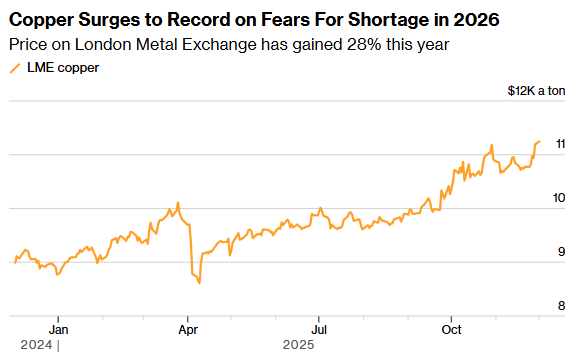
Core Viewpoint - The copper market is experiencing significant price increases due to supply shortages, geopolitical tensions, and structural demand driven by energy transition and AI data centers [1][11][12]. Supply Dynamics - Supply disruptions from major mines, such as the Grasberg mine in Indonesia and the Cobre Panama mine in Chile, are leading to a tightening of global copper supply [4][5]. - Predictions indicate that global mine supply growth will be minimal, with estimates for 2026 being only +1.4%, significantly lower than earlier forecasts [4]. - The current supply situation is exacerbated by a mismatch in global copper inventories, as traders rush to ship copper to the U.S. in anticipation of potential tariffs [4][8]. Price Movements - LME copper prices reached a historic high of $11,294.5 per ton, with a 0.9% increase, while Comex futures rose by 1.6% [1]. - The weakening U.S. dollar is contributing to higher copper prices, as it lowers costs for foreign buyers and encourages investment in hard assets like copper [10][11]. Demand Factors - The demand for copper is being driven by the growth of electric vehicles, renewable energy investments, and the expansion of data centers, which are all critical for decarbonization efforts [11][12]. - The AI boom is expected to significantly increase copper demand, with projections indicating that data centers will require an additional 47,500 tons of copper by 2026 [15]. Market Outlook - Analysts predict a clear deficit in the copper market, with expected supply gaps of approximately 330,000 tons by 2026, driven by ongoing supply constraints and increasing demand [16]. - UBS has revised its supply gap forecasts for 2025 and 2026, indicating a significant increase in expected shortages compared to previous estimates [16].