
M2增速

Search documents
前8个月人民币贷款增加13.46万亿元——金融支持实体经济稳固有力
Sou Hu Cai Jing· 2025-09-12 22:48
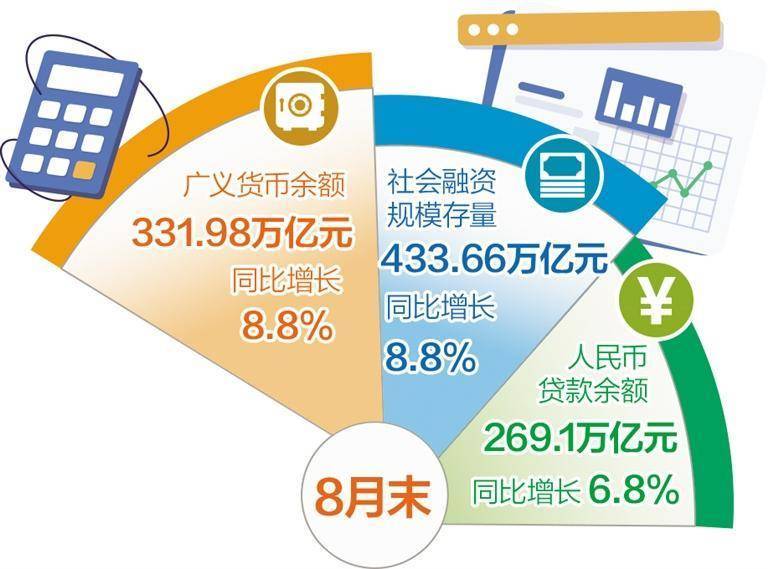
Group 1 - The People's Bank of China reported that as of the end of August, the broad money supply (M2) reached 331.98 trillion yuan, with a year-on-year growth of 8.8%, indicating a moderately loose monetary policy that supports the real economy [2] - The total social financing stock was 433.66 trillion yuan, also growing by 8.8% year-on-year, reflecting strong financial support for economic stability [2] - The net financing scale of government bonds for the first eight months of the year was 1.027 trillion yuan, an increase of 463 billion yuan year-on-year, demonstrating the effectiveness of proactive fiscal policies [2] Group 2 - As of the end of August, the narrow money supply (M1) was 111.23 trillion yuan, with a year-on-year growth of 6%, indicating a narrowing gap between M1 and M2, which is beneficial for consumption and investment [3] - The increase in RMB loans for the first eight months was 1.346 trillion yuan, showing strong credit support for the real economy [3] - The issuance of special refinancing bonds has provided significant funding support for resolving hidden local government debts, with 190 billion yuan issued for this purpose by the end of August [3] Group 3 - The proportion of direct financing channels, such as corporate bonds and government bonds, has steadily increased from 26.7% at the end of 2018 to 31.6% by the end of August 2025, indicating a diversification in financing sources for the real economy [4] - Factors such as industry recovery, resilient exports, and supportive real estate policies have contributed to credit growth in August [4] - Manufacturing loans have seen a significant increase, with new manufacturing loans accounting for 53% of new corporate loans in the first eight months, reflecting a recovery in production [4] Group 4 - High demand for financing has been observed in industries such as textiles, specialized equipment, and computer communications, driven by seasonal factors and market expansion efforts [5] - Personal loan growth has been stimulated by traditional summer consumption peaks and supportive consumption policies, with cities implementing measures to meet housing demand [5] - The continuous reduction in reserve requirements and interest rates by the People's Bank of China has resulted in lower financing costs for the real economy [6] Group 5 - Since 2020, the People's Bank of China has cut policy rates nine times, leading to a significant decline in loan rates for both enterprises and personal housing loans, enhancing the financing environment for the real economy [6] - The macroeconomic policies are expected to remain consistent and stable, with a focus on addressing deeper structural issues and promoting key sector reforms [6]

8月金融数据预测:社融增速如期调整
CMS· 2025-09-11 12:04
Financial Data Forecast - In August, the expected new social financing (社融新增) is approximately 1.98 trillion RMB, with a growth rate of 8.7%[7] - The forecast for new credit (信贷新增) in August is around 350 billion RMB, with a growth rate of 6.7%[4] - M2 growth is projected at 8.6% year-on-year, with an estimated increase of 12,985 billion RMB in total M2[10] Loan and Financing Insights - Expected new household loans are around -100 billion RMB, significantly lower than the previous year's 190 billion RMB[4] - Corporate loans are anticipated to be approximately 6,500 billion RMB, with a notable decline from the previous year's average of 3,000 billion RMB[4] - The total expected new loans from non-bank financial institutions is about 3,500 billion RMB, down from an average of 12,000 billion RMB over the past three years[10] Government Debt and Financing - Government net financing is estimated at 13,290 billion RMB for 2025, with a breakdown of 8,489 billion RMB from national bonds and 4,801 billion RMB from local bonds[8] - In August, the net financing from government bonds is projected to be around 13,000 billion RMB, compared to 18,000 billion RMB in the same month last year[10] Market Trends - The real estate market remains weak, with a decline in average daily transaction area for new homes in 30 cities by 0.1% month-on-month[4] - The auto market shows improvement, with a 22% year-on-year increase in wholesale sales of passenger cars[4]
社融增速或开始回落
Hua Yuan Zheng Quan· 2025-08-31 06:02
Group 1: Investment Ratings - No industry investment rating provided in the report Group 2: Core Views - Forecasts for August 2025 include 850 billion yuan in new loans, 2.6 trillion yuan in social financing, M2 reaching 331.4 trillion yuan with a YoY increase of 8.6%, new - caliber M1 YoY growth of 5.9%, and a social financing growth rate of 8.8% [2] - Predicts that new loans in August may be low due to weak credit demand, with expected individual loans of +18 billion, corporate loans of +70 billion, and non - bank inter - bank loans of - 5 billion. Also anticipates short - term individual loans of +10 billion, long - term individual loans of +8 billion, short - term corporate loans of - 20 billion, long - term corporate loans of +40 billion, and bill financing of +50 billion [3] - Expects the new - caliber M1 growth rate to rebound and the M2 growth rate to slightly decline in August. Forecasts the new - caliber M1 growth rate at 5.9% (up month - on - month) and the old - caliber M1 growth rate at 5.4% (up month - on - month), and the M2 growth rate at 8.6% (down slightly month - on - month) [3] - Suggests that the social financing growth rate may start to fall. Predicts a social financing increment of 2.6 trillion yuan in August (less than the 3.03 trillion yuan in August 2024), with the social financing growth rate at 8.8% at the end of August, down 0.2 percentage points month - on - month. Expects new loans (social financing caliber) to be slightly less year - on - year, government bond net financing to expand significantly year - on - year, and the social financing growth rate to rise first and then fall, reaching around 8.1% at the end of the year [3] - Recommends going long on the bond market in September, based on expectations of central bank easing, potential economic downturn in the second half of the year, and banks increasing bond allocation due to weak credit demand and falling liability costs. Suggests focusing on 10Y China Development Bank bonds, 30Y treasury bonds, and 5Y capital bonds [3] Group 3: Summary by Related Catalogs New Loans - Due to weak credit demand, new loans in the beginning of the quarter are usually low. The low 1 - month term transfer discount rate at the end of August reflects average credit issuance. Forecasts 850 billion yuan in new loans in August, close to the same period last year, with individual loans of +18 billion, corporate loans of +70 billion, and non - bank inter - bank loans of - 5 billion [3] M1 and M2 Growth Rates - Since January 2025, the central bank has used a new - caliber M1. Forecasts the new - caliber M1 growth rate at 5.9% and the old - caliber M1 growth rate at 5.4% at the end of August, both up month - on - month. Expects the M2 growth rate at 8.6% at the end of August, down slightly month - on - month [3] Social Financing - Predicts a social financing increment of 2.6 trillion yuan in August 2025, less than the 3.03 trillion yuan in August 2024. The decrease mainly comes from credit and government bond net financing. Expects 88 billion yuan in RMB loans to the real economy, +3 billion yuan in undiscounted bank acceptance bills, 15 billion yuan in corporate bond net financing, and 135 billion yuan in government bond net financing in August. Forecasts the social financing growth rate at 8.8% at the end of August, down 0.2 percentage points month - on - month, and anticipates it to reach around 8.1% at the end of the year [3] Bond Market - Recommends going long on the bond market in September, based on central bank easing, potential economic downturn in the second half of the year, and banks increasing bond allocation due to weak credit demand and falling liability costs. Suggests focusing on 10Y China Development Bank bonds, 30Y treasury bonds, and 5Y capital bonds [3]
存款搬家如何演绎
2025-08-27 15:19
Summary of Conference Call Records Industry or Company Involved - The discussion primarily revolves around the Chinese stock market and the phenomenon of "deposit migration" within the financial sector. Core Points and Arguments 1. **Market Adjustment and Support Levels** The recent market adjustment is viewed as a healthy correction within a bull market, with the Shanghai Composite Index needing to confirm a new trading range after breaking through 3,700 points, which may serve as strong support [2][1][11] 2. **Macroeconomic and Market Liquidity** Current macroeconomic conditions show a slight reversal in liquidity, with the Federal Reserve's preventive rate cuts requiring adjustments in trading strategies. A shift from growth to value investment styles is recommended, particularly in anticipation of the economic peak seasons in September and October [3][1][11] 3. **Nature of Deposit Migration** Deposit migration is characterized as a structural adjustment of currency holders, occurring when M2 growth lags behind the growth of household deposits, typically in low-interest-rate environments. Historical instances of deposit migration have been linked to various economic stimuli [5][1][6] 4. **Historical Examples of Deposit Migration** Key historical events include: - 2007: Stock market rise due to stock reform and RMB appreciation expectations - 2009: Fiscal stimulus and low-interest rates prompting residents to migrate deposits - 2014-2015: Monetary easing leading to significant capital flow into the stock market - 2021: Regulatory changes causing funds to shift from bank wealth management to public funds - 2023-2024: A shift from passive wealth management products to active stock market investments as interest rates decline [6][1][7] 5. **Impact of U.S. and Japanese Experiences** The U.S. experience since the 1980s shows that rising stock markets and declining interest rates encourage funds to move from savings to capital markets, which is relevant for China's current low-interest environment. Japan's experience indicates a more tempered migration behavior, influenced by low risk appetite and prolonged low-interest rates [7][9] 6. **Potential of Excess Savings in China** Since 2018, China has accumulated approximately 33.57 trillion yuan in excess savings. If 5% of these savings flow into financial products, it could represent a potential of nearly 2 trillion yuan, which may gradually transition from low-risk products to equity investments, providing substantial support for the capital market [10][1][11] 7. **Prospects for Capital Market Absorption of Deposit Migration** Given the current weak consumption in real estate, the stock market, bond market, and financial assets are well-positioned to absorb deposit migration. The presence of excess savings indicates significant potential for capital market support, suggesting a bullish outlook for the market's future development [11][12] Other Important but Possibly Overlooked Content - The discussion emphasizes the cyclical nature of market adjustments and the importance of strategic shifts in investment styles based on macroeconomic indicators and historical patterns of deposit migration [3][1][2]
固定收益研究:7月信贷偏弱怎么看
Great Wall Securities· 2025-08-15 02:17
Report Industry Investment Rating No information provided in the given text. Core Viewpoints - In July, the social financing scale showed a seasonal decline after the cross - quarter period, with an increment of 1.16 trillion yuan, an increase of 38.93 billion yuan year - on - year but a significant drop from the previous month. The net financing of government bonds was 1.24 trillion yuan, an increase of 55.9 billion yuan year - on - year, strongly supporting the social financing. Credit financing shrank significantly, with a decrease of 426.3 billion yuan in the month and an additional decrease of 345.5 billion yuan year - on - year. Off - balance - sheet non - standard financing decreased by 166.6 billion yuan, and direct financing was not enough to make up for the traditional financing gap [1][7]. - In July, M1 growth continued to rise, with a year - on - year increase of 5.6%, 1.0 percentage point faster than the previous month, reaching a 29 - month high, mainly due to the low - base effect, improvement of enterprise cash flow, and the conversion of deposits to investments. M2 increased by 8.8% year - on - year, with a 0.5 - percentage - point increase from the previous month. Although the M2 - M1 gap narrowed, the (M2 - M1)/M1 indicator was still at a high level [1][12]. - The new RMB loans were unexpectedly - 5 billion yuan, an additional decrease of 31 billion yuan year - on - year, the first single - month negative growth since August 2005, indicating weak real - economy financing demand. The enterprise - side financing structure deteriorated slightly, and the household - side long - and short - term loans both shrank. On August 13, the implementation plan for the fiscal discount policy for personal consumption loans was released to relieve the pressure on the household side [2][17]. Summaries According to Related Catalogs 7 - Month Social Financing Seasonal Decline - Social financing scale: In July, the social financing scale increment was 1.16 trillion yuan, an increase of 38.93 billion yuan year - on - year but a significant decline from the previous month. It mainly relied on the net financing of government bonds (1.24 trillion yuan, an increase of 55.9 billion yuan year - on - year). Credit financing decreased by 426.3 billion yuan in the month, an additional decrease of 345.5 billion yuan year - on - year. Off - balance - sheet non - standard financing decreased by 166.6 billion yuan, and direct financing was not sufficient to fill the traditional financing gap [1][7]. - M1 and M2: M1 growth continued to rise, with a year - on - year increase of 5.6%, 1.0 percentage point faster than the previous month, reaching a 29 - month high. M2 increased by 8.8% year - on - year, with a 0.5 - percentage - point increase from the previous month. The M2 - M1 gap narrowed to 3.2% (previous value 3.7%), but the (M2 - M1)/M1 indicator was still at a high level [1][12]. - New RMB loans: The new RMB loans were - 5 billion yuan, an additional decrease of 31 billion yuan year - on - year, the first single - month negative growth since August 2005. The enterprise - side financing structure deteriorated slightly, and the household - side long - and short - term loans both shrank. The government released a policy to relieve the pressure on the household side [2][17].
7月金融数据点评:M1同比增速持续攀升
Great Wall Securities· 2025-08-14 09:02
Group 1: Monetary Supply and Financing - In July, the new social financing scale reached 1.16 trillion yuan, an increase of 0.39 trillion yuan year-on-year, with a year-on-year growth rate of 9%[2] - M1 growth accelerated to 5.6% in July, up from 4.6% in the previous month, marking the highest growth since January 2023[3] - M2 growth improved to 8.8% in July, up from 8.3% in June, with the M2-M1 gap narrowing to 3.2%[3] Group 2: Loan Demand and Government Financing - Government bond issuance from January to July reached 890 billion yuan, accounting for 75% of the annual issuance plan, significantly higher than the five-year average of 47%[3] - Corporate loan demand showed a contraction, with July's corporate loans decreasing by 700 billion yuan year-on-year, the lowest level in five years[4] - Residential loans in July also fell below the five-year average, with long-term and short-term loans decreasing by 1.1 trillion yuan and 3.8 trillion yuan respectively[4] Group 3: Economic Outlook and Risks - Overall liquidity has improved, but credit remains volatile due to seasonal factors, with only a slight decline in new loans compared to June[5] - The government is currently in a process of leveraging while the private sector is de-leveraging, necessitating improved efficiency in fiscal spending to stabilize demand[5] - Risks include potential underperformance of domestic macroeconomic policies and the possibility of slower government bond issuance if special treasury bonds are not issued[5]
固定收益点评:“搬家”的存款还是存款
GOLDEN SUN SECURITIES· 2025-08-14 06:36
1. Report Industry Investment Rating - Not provided in the content 2. Core Viewpoints of the Report - The "relocated" deposits remain as deposits and do not reduce the allocation power in the bond market. Even if residents' deposits move to the stock market, they still exist in the form of margin deposits, so the overall bank deposits do not decrease, and the asset - side allocation power will not decline [1]. - Credit showed negative growth and relied on bills, indicating weak financing demand. Both corporate and household credit demand was weak in July, with high - frequency data showing a weakening in real - estate sales [2][9]. - Government bonds are still the main support for social financing. However, if there is no new fiscal budget, government bond supply may decrease year - on - year in the future, and social financing may face pressure again [3][4][14]. - The base effect pushed up the M1 growth rate, and non - bank deposits drove the M2 growth rate to rebound. As the government bond issuance pace slows down, fiscal deposits may decrease year - on - year, increasing market liquidity [5][20]. - The bond market may experience short - term or periodic fluctuations and is waiting for a breakthrough. As the commodity and stock markets cool down, the bond market is expected to oscillate in the short term, and interest rates may break through downward as the fundamentals change and the asset shortage evolves, more likely around or in the fourth quarter [6][23]. 3. Summary by Relevant Contents Credit Situation - In July, new credit was - 500 billion yuan, a year - on - year decrease of 310 billion yuan. Corporate long - term loans decreased year - on - year, short - term loans were flat compared with the previous year, and bill financing increased year - on - year. Household new long - term and short - term loans both decreased year - on - year, and high - frequency data showed weak real - estate sales and household credit demand [2][9]. Social Financing Situation - In July, new social financing was 1.16 trillion yuan, a year - on - year increase of 389.3 billion yuan, with a year - on - year growth rate of 9.0%. Government bonds were the main support, with an increase of 555.9 billion yuan year - on - year to 1.244 trillion yuan. Non - government bond social financing growth was weak, and if there is no new budget, government bond supply may decrease year - on - year in the future, putting pressure on social financing growth [3][4][14]. Monetary Supply Situation - In July, the M1 growth rate rebounded from 4.6% to 5.6% mainly due to the base effect, and there was no trend - like increase in the two - year compound growth rate. The M2 growth rate was 8.8%, a 0.5 - percentage - point increase from the previous month, mainly driven by the year - on - year increase in non - bank deposits. As the government bond issuance pace slows down, fiscal deposits may decrease year - on - year, increasing market liquidity [5][17][20]. Bond Market Outlook - The bond market may experience short - term or periodic fluctuations. As the commodity and stock markets cool down, the 10 - year and 30 - year treasury bonds are expected to oscillate in the short term. As the fundamentals change and the asset shortage evolves, interest rates may break through downward, more likely around or in the fourth quarter [6][23].
2025年7月份金融数据点评:信贷扩张季节性回落,存款资金入市节奏提速
EBSCN· 2025-08-14 02:54
Investment Rating - The report maintains a "Buy" rating for the banking industry, indicating an expected investment return exceeding 15% over the next 6-12 months compared to the market benchmark index [1]. Core Insights - The report highlights a seasonal decline in credit expansion, with a notable increase in the pace of deposit funds entering the market. The July financial data shows a year-on-year increase in M2 by 8.8% and M1 by 5.6%, while new RMB loans decreased by 500 billion, reflecting a drop of 3.1 trillion year-on-year [3][4][35]. Summary by Sections Credit Market Overview - In July, new RMB loans decreased by 500 billion, with a growth rate of 6.9%, down 0.2 percentage points from June. Economic activity showed signs of slowing, with the manufacturing PMI at 49.3, indicating contraction [4][5]. - Cumulatively, from January to July, new RMB loans totaled 12.9 trillion, a decrease of 660 billion year-on-year, with the second quarter seeing a similar trend [5][18]. Corporate Loans - New corporate loans in July amounted to 600 billion, down 700 billion year-on-year. The report notes a significant seasonal decline in short-term loans, with a negative growth of 5.5 trillion in July [17][19]. - The report indicates that the demand for medium to long-term loans remains weak due to economic uncertainties, with the average interest rate for new corporate loans at 3.2% [19][31]. Retail Loans - Retail loans saw a significant decline, with a total of -4.893 trillion in July, reflecting a decrease of 2.793 trillion year-on-year. The report attributes this to weak consumer demand and low willingness to leverage among residents [28][30]. - The average interest rate for new personal housing loans remained stable at 3.1%, indicating continued pressure on the mortgage market [30][31]. Social Financing - In July, the total social financing increased by 1.16 trillion, with a growth rate of 9%, up 0.1 percentage points from June. The report emphasizes the role of government bonds in supporting social financing growth [35][39]. - The contribution of bank acceptance bills to social financing has increased significantly, accounting for 61% of the new social financing in July [39][40]. Monetary Supply - The report notes that M2 growth exceeded expectations at 8.8%, while M1 growth was recorded at 5.6%. The narrowing gap between M2 and M1 growth rates suggests a marginal improvement in monetary activation [41][43]. - Total deposits in July increased by 500 billion, with a year-on-year increase of 1.3 trillion, indicating a strong deposit growth trend despite the overall credit contraction [43][46].
中金:金融数据中的几个新现象——7月金融数据点评
中金点睛· 2025-08-13 23:51
Core Viewpoint - The article highlights several new phenomena in credit and financial data for July, indicating a trend of private deleveraging and government leveraging in the second half of the financial cycle, influenced by seasonal factors [2][4]. Group 1: Credit and Financial Data Trends - Social financing (社融) continued to accelerate while credit remained weak, with new social financing reaching 1.16 trillion yuan, an increase of 389.3 billion yuan year-on-year, and a slight rise in growth rate from 8.9% in June to 9.0% in July [4]. - New credit in July was -50 billion yuan, showing a significant change compared to June, reflecting seasonal loan issuance patterns and local debt replacement impacts [4][5]. - Despite weak credit data, loan interest rates remained stable, indicating a shift in financial institutions' operational philosophy towards prioritizing asset quality over merely increasing loan volume [5]. Group 2: Financial Investment and Deposits - The active financial investment environment contributed to a significant increase in non-bank deposits, which reached 2.14 trillion yuan in July, a year-on-year increase of 1.39 trillion yuan [6]. - The increase in non-bank deposits is consistent with previous months, suggesting heightened financial investment activity in the private sector amid declining deposit rates [6]. Group 3: Monetary Supply and M1/M2 Trends - M2 growth rate reached 8.8% year-on-year in July, supported by accelerated fiscal spending, with a month-on-month annualized growth rate of 12.8% [6]. - M1 growth rate increased to 5.6% year-on-year in July, with a month-on-month annualized growth rate exceeding 6%, influenced by active financial investment and low base effects from previous months [7]. - The article anticipates that the year-on-year growth rate of monetary supply will likely continue to improve in the third quarter, with M2 potentially exceeding 9% and M1 around 6% [8].

7月金融数据点评:M1增速续升
Changjiang Securities· 2025-08-13 23:30
Group 1: Financial Data Overview - In July, the total social financing (社融) stock growth rate rebounded to 9.0% year-on-year, while the credit growth rate under the social financing measure fell to 6.8%[3] - New social financing in July was 1.2 trillion RMB, with a year-on-year increase of 0.4 trillion RMB, primarily supported by government bonds[7] - The new RMB loans in July were negative at -50 billion RMB, marking a historical low since data tracking began[7] Group 2: Economic Outlook and Policy Implications - The growth rate of social financing may peak and decline, with government bonds providing some support, but a year-on-year decrease in government bonds is expected in Q4[3] - Future policies may prioritize the implementation of existing policies, with incremental policies being adjusted based on domestic and international conditions[3] - There remains a window for interest rate cuts and reserve requirement ratio reductions within the year, alongside an emphasis on accelerating the issuance of existing government bonds in Q3[7] Group 3: Credit and Deposit Trends - The credit demand has shown a temporary decline due to the "anti-involution" measures, which have squeezed out inflated loans and led to a reduction in credit demand[7] - M1 and M2 growth rates improved, with M1 rising to 5.6% and M2 to 8.8% year-on-year, driven by increased non-bank deposits[7] - In July, the total new loans for households and enterprises were both negative when excluding bill financing, indicating a weak credit environment[7]