产业升级

Search documents
县域科创指数全省第一!看安徽长丰如何以创新生态托起千亿新城
Sou Hu Cai Jing· 2026-01-16 15:05
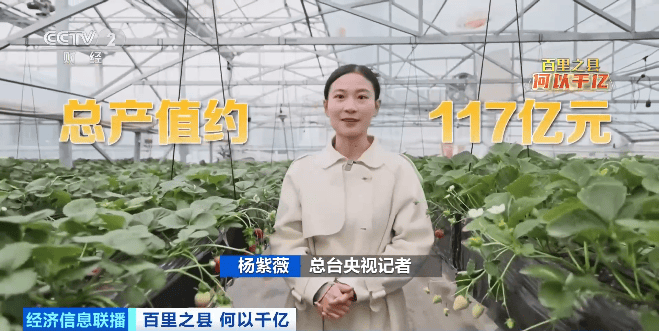
(央视财经《经济信息联播》)2020年以来,安徽省合肥市长丰县经济总量持续攀升,2024年突破千亿 元大关。站在新起点,长丰正以"制造强县、科创强县、农业强县"为目标,全力奔跑。 总台央视记者 杨紫薇:作为一个农业大县,长丰仅草莓产业,一年的总产值就可以达到约117亿元。此 外,这里还建立了"数字草莓"的大数据中心,实现了亩均增产约15%、亩均增收超过4000元,科技的融 入也带动了这份"甜蜜事业"的转型升级。 转载请注明央视财经 编辑:令文芳 总台央视记者 杨紫薇:科技创新的种子发芽结果,密码就藏在这一个个科研基地当中。近年来,长丰 县也在积极引导企业开展技术创新,目前国家级高新技术企业数量超过了600家,2024年全县的企业研 发投入同比增长超40%,县域科技创新指数居全省第一。 总台央视记者 杨紫薇:以新能源汽车为代表的产业也正在这里蓬勃发展。目前长丰县汇聚了大约220家 上下游企业,构建起了从电池、电机再到整车的完整产业链。在这个产线上,平均每隔50秒就能下线一 台新能源汽车。2024年全年,从这个基地开出的新能源汽车超过95万辆,占安徽全省总产量的大约 59%。 总台央视记者 杨紫薇:底盘是生产汽车 ...

临近春节,天润用科技“鲜”行一步!
Xin Lang Cai Jing· 2026-01-16 13:37
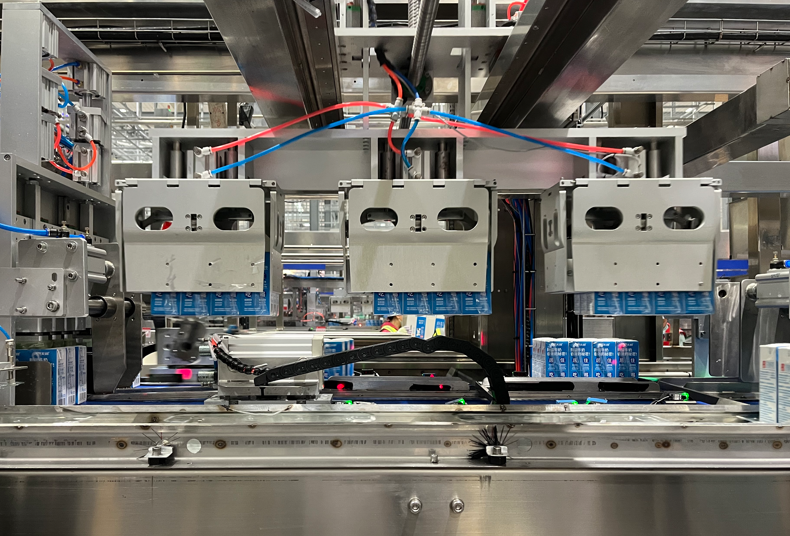
Core Viewpoint - The demand for dairy products is increasing as the Spring Festival consumption peak approaches, and Xinjiang Tianrun Dairy Industry Co., Ltd. is ramping up production to meet this demand [1][11]. Group 1: Production Capacity and Technology - Tianrun Dairy has fully activated its production facilities, utilizing smart filling lines and fully automated palletizing robots to enhance efficiency [3][13]. - The company has transitioned from manual control to intelligent control, significantly improving production efficiency and enabling it to better handle cyclical consumption fluctuations [5][15]. - The daily production capacity has reached 350 tons, with the introduction of intelligent palletizing robots reducing labor intensity for workers [7][17]. Group 2: Quality Control - Tianrun Dairy prioritizes product quality and safety, implementing a comprehensive quality control system that spans from raw milk testing to production monitoring and finished product inspection [9][19]. - The company conducts over 40 strict tests on its products, covering various dimensions such as microbiological, nutritional components, sensory indicators, and packaging integrity [11][21]. - Increased inspection frequency and dedicated quality control personnel during the shipping process ensure that product quality is maintained despite high production demands [9][19].

开课通知| 股权投资实战课程,2026年3月13日-15日即将开课
Xin Lang Cai Jing· 2026-01-16 13:31
Core Viewpoint - The State Council meeting emphasizes the importance of venture capital in promoting technological innovation, industrial upgrading, and high-quality development, aiming to address bottlenecks in the fundraising, investment, management, and exit processes [1][2]. Group 1: Policy Initiatives - The meeting calls for the removal of obstacles in the "募投管退" (fundraising, investment, management, and exit) process to support qualified technology companies in listing domestically and internationally [1][2]. - There is a strong push to develop the equity transfer and merger markets, promote the trial of physical stock distribution, and encourage social capital to establish market-oriented merger mother funds or secondary market funds for venture capital [1][2]. - The meeting highlights the need for state-owned capital to act as a more responsible long-term and patient capital, improving policies related to state-owned funding, assessment, tolerance, and exit [1][2]. Group 2: Market Dynamics - The venture capital industry is undergoing a transformation, with government-guided funds and mother funds becoming significant players in the market, indicating a shift in investment logic and strategies [3]. - The current environment presents exciting opportunities for investors and those looking to enter the venture capital space, as the industry adapts to new dynamics [3].
出口退税逐步取消,产业链“抢出口”推高碳酸锂价格
Xin Jing Bao· 2026-01-16 12:49
Core Viewpoint - The Chinese government will eliminate the export VAT rebate for photovoltaic products and lithium battery products starting from April 1, 2026, with a transitional reduction in the rebate rate for battery products from 9% to 6% until the end of 2026, followed by a complete cancellation in 2027 [1][2]. Group 1: Policy Impact - The policy aims to reduce trade friction, promote industrial upgrading, and prevent "involution and externalization" of competitive advantages in the lithium battery sector [2][8]. - The expected impact on export VAT rebates is approximately $22 billion in 2026 and $66 billion in 2027, based on projected export growth rates [9]. - The transition period allows companies to adjust prices to mitigate the impact, potentially leading to a surge in exports before the policy takes full effect [2][4]. Group 2: Market Dynamics - The lithium battery export market is experiencing a shift from a traditional off-peak season to a peak season due to the new policy, which is expected to drive demand [3]. - A "scramble for goods" is occurring throughout the lithium battery supply chain, with companies preparing to increase production and stock up before the policy changes [4]. - The price of lithium carbonate futures has surged significantly, with a year-to-date increase of 37.25% as of mid-January 2026, indicating strong market demand [5][6]. Group 3: Industry Strategy - The policy is designed to guide companies away from price competition and towards technological upgrades and brand building, ensuring sustainable development of the industry [7][8]. - Major Chinese battery manufacturers are expanding their production capacity overseas, particularly in Southeast Asia and Europe, which will enhance their global competitiveness and profitability [4][8].
“十四五”期间中关村丰台园重点企业实现总收入5861亿元 年均增速达9.1%
Bei Jing Shang Bao· 2026-01-16 12:24
Core Insights - During the "14th Five-Year Plan" period, the Fengtai Park's economic contribution continues to lead, with key enterprises achieving a total revenue of 586.1 billion yuan, ranking third in the Zhongguancun Demonstration Zone, and an average annual growth rate of 9.1% [1] - The regional economic contribution accounts for over one-quarter of the entire district, solidifying its position as a "main engine" [1] - The number of national high-tech enterprises has increased by 70% compared to the end of the "13th Five-Year Plan," reaching nearly 2,000, with "specialized, refined, and innovative" small giant enterprises making up 93% of the total in the area [1] Economic Structure - A "2+4" industrial system has been established, led by two trillion-level clusters in rail transit and aerospace, which account for 54% of the revenue scale in Fengtai Park [1] - The rail transit signal control technology is internationally advanced, with a domestic market share exceeding 40% [1] - In the aerospace sector, there is a first-mover advantage in satellite internet, alongside active layouts in low-altitude technology and intelligent medical engineering [1] Innovation Ecosystem - Significant increases in corporate innovation input and output have been observed, with R&D expenditure reaching 14.8 billion yuan and technology revenue rising by 60% compared to the end of the "13th Five-Year Plan" [1] - The number of effective invention patents has reached nearly 10,000, which is 1.5 times that of the end of the "13th Five-Year Plan" [1] - Nearly 120 various innovation platforms have been aggregated, with an additional 900,000 square meters of industrial space created, and three Zhongguancun characteristic industrial parks established, significantly enhancing innovation capacity [1] Business Environment - The business environment has been iteratively upgraded, with the "Xianfeng No. 9" service brand achieving full coverage of building enterprise services, with a 100% completion and satisfaction rate for enterprise requests [2] - Significant financial empowerment has been achieved through strategic partnerships with 40 venture capital funds and the launch of multiple technology credit products in collaboration with financial institutions [2] - The first enterprise overseas training platform in the city has been established, and the international service network continues to improve [2] - The招商机制 has been continuously optimized, with a comprehensive, all-around, and round-the-clock investment attraction plan implemented to enhance information sharing, process standardization, and efficiency [2]

稀土价格涨幅明显 北方稀土预计2025年净利翻倍
Zheng Quan Shi Bao Wang· 2026-01-16 11:00
Core Viewpoint - Northern Rare Earth expects a significant increase in net profit for 2025, projecting a rise of 116.67% to 134.60% year-on-year, driven by a recovery in rare earth prices and strategic operational improvements [1] Group 1: Financial Performance - The company forecasts a net profit attributable to shareholders of 2.176 billion to 2.356 billion yuan for 2025, with a non-GAAP net profit of 1.96 billion to 2.14 billion yuan, reflecting a year-on-year increase of 117.46% to 137.43% [1] - The recovery in domestic rare earth prices has been notable, with prices for neodymium oxide and neodymium metal increasing by 27.4% and 27% respectively, while terbium oxide and terbium metal saw increases of 17.2% and 16.5% [1] Group 2: Operational Strategy - The company is committed to green development and has implemented a unified production model to enhance operational efficiency, focusing on product structure adjustment and technological upgrades [2] - Northern Rare Earth has successfully reduced costs across all processes, achieving significant cost savings while optimizing its marketing system and innovating marketing strategies [2] Group 3: Industry Development - The company is advancing its green mining and refining projects, with the first phase of the new generation rare earth green refining upgrade project completed and the second phase underway [3] - Several projects, including the production of magnetic materials and resource recycling, are progressing efficiently, enhancing production efficiency and consolidating core competitive advantages [3] Group 4: Market Dynamics - On January 9, the company announced an increase in the transaction price of rare earth concentrates, with a 2.4% rise expected in the first quarter of 2026 compared to the fourth quarter of 2025, indicating a cumulative increase of 60% since the third quarter of 2024 [4]

(走进中国乡村)辽宁桓仁:藏在冰雪里的“紫色黄金”
Zhong Guo Xin Wen Wang· 2026-01-16 07:18
Core Insights - The article highlights the transformation of Huanren County in Liaoning, China, focusing on the cultivation of ice grapes, which are essential for producing high-quality ice wine, referred to as "liquid gold" [1][2]. Group 1: Industry Development - Huanren County has transitioned from traditional crops like soybeans and corn to ice grape cultivation, with the first introduction of 5,000 Vidal ice grape plants from Canada over 20 years ago [1]. - The local ice wine industry has seen significant growth, with strict quality standards for grape harvesting, including natural freezing and sugar content requirements [2]. - The establishment of a complete ecological chain in the ice wine industry has been achieved, with 4,000 acres of standardized planting bases now in operation [3]. Group 2: Economic Impact - Farmers in Huanren County have experienced improved financial stability due to the lucrative nature of ice grape cultivation and wine production, with significant income from sales [1]. - The "company + farmer" model has been adopted, resulting in the payment of several million yuan to local farmers for ice grape purchases, thereby distributing industry profits to rural communities [2]. - The ice wine produced in Huanren has gained international recognition, winning multiple awards, including gold medals at the Decanter World Wine Awards and the title of "World's Best Sweet Wine" [2]. Group 3: Future Prospects - There is a call for more knowledgeable young individuals to return to Huanren to innovate and enhance the local brand, indicating a desire for sustainable industry growth [2]. - The unique microclimate of Huanren, particularly around the Qianglong Lake, is highlighted as a critical factor for successful ice grape cultivation, emphasizing the region's potential for high-quality wine production [2].
兴业银行厦门分行:债券服务多维创新 “兴”动能助产业升级
Zhong Guo Jing Ji Wang· 2026-01-16 05:36
Core Viewpoint - Xiamen Branch of Industrial Bank is committed to local market development, focusing on the "4+4+6" modern industrial system construction, and advancing the "commercial bank + investment bank" strategy to support regional industrial transformation and high-quality development [1][4] Group 1: Bond Underwriting Business - Xiamen Branch has established a comprehensive bond service network, serving key industries in Xiamen, with nearly 100% coverage of local bond issuance clients [2] - The branch has achieved a full spectrum of bond types, including conventional products like short-term financing bonds and innovative products such as technology innovation bonds and green bonds, catering to diverse financing needs [2] - The branch has ranked first in the Xiamen market for non-financial corporate debt financing tool underwriting for 12 consecutive years, with over 230 billion yuan in cumulative underwriting in the past five years [2] Group 2: Innovation and Leadership - The branch has successfully launched several first-of-their-kind projects in bond underwriting, including the first purpose-based technology innovation bonds and the first digital RMB bonds, setting industry benchmarks [3] - A notable project includes the first purpose-based technology innovation bond led by the branch, which supports a major flexible AMOLED production line project, enhancing financing channels and accelerating technology transfer [3] Group 3: Commitment to High-Quality Development - The branch aims to strengthen its core advantages in bond underwriting by providing professional services, diverse products, and precise funding, positioning itself as a financial partner for high-quality economic development in Xiamen [4]

图说菏泽2026:目标明确 八大重点工作启新程
Qi Lu Wan Bao· 2026-01-16 05:31
Core Insights - The key focus of Heze's economic and social development for 2026 has been officially outlined, emphasizing industrial upgrading, demand expansion, and innovation-driven growth [1] Group 1: Industrial Upgrading - Implementation of key industry optimization projects, traditional industry renewal projects, emerging industry nurturing projects, and service industry enhancement projects [4] Group 2: Demand Expansion - Promotion of 47 new projects with an output value exceeding 1 billion [4] - Organization of over 700 consumer promotion events [4] - Aim for a growth of over 5% in cross-border e-commerce transaction volume [4] Group 3: Innovation-Driven Growth - Target for overall R&D investment to increase by over 10%, with the establishment of more than 10 new "flyover" R&D centers [4] - Efforts to plan and undertake a number of national and provincial reform pilot projects [4] - Addition of over 430 new "four above" enterprises throughout the year [4] Group 4: Service Efficiency Enhancement - Iterative updates to 129 service scenarios and introduction of over 20 new "one-stop" services, ensuring that the online processing rate for "7+1" types of government services reaches 98% [5] Group 5: Spatial Layout Optimization - Promotion of the completion and operation of the Xiongshan High-speed Railway Heze section within the year [5] - Reconstruction and new construction of 35 urban roads [5] - Implementation of a two-year delivery action for resettlement housing, with over 20,000 units to be delivered within the year [5] Group 6: Rural Revitalization - Ensure total grain production remains stable at over 16 billion jin [5] - Establish and enhance over 10 provincial-level rural revitalization areas and over 20 provincial-level beautiful rural areas [5] Group 7: Social Welfare Improvement - Creation of over 7 provincial and municipal industry-education joint bodies and industry-education integration communities [6] - Strong development of public welfare and charity initiatives, continuously improving the service guarantee system for vulnerable groups [6] - Implementation of 10 aspects of livelihood projects [6] Group 8: Comprehensive Development Safety - Maintain the "three guarantees" and debt reduction bottom line [6] - Ensure safety production, ecological environment, and social stability bottom lines are upheld [6]

资本聚力培育“八闽”产业 优结构强链条拓海外丨决胜“十四五” 擘画“十五五”·地方资本市场高质量发展之福建篇
证券时报· 2026-01-16 00:25
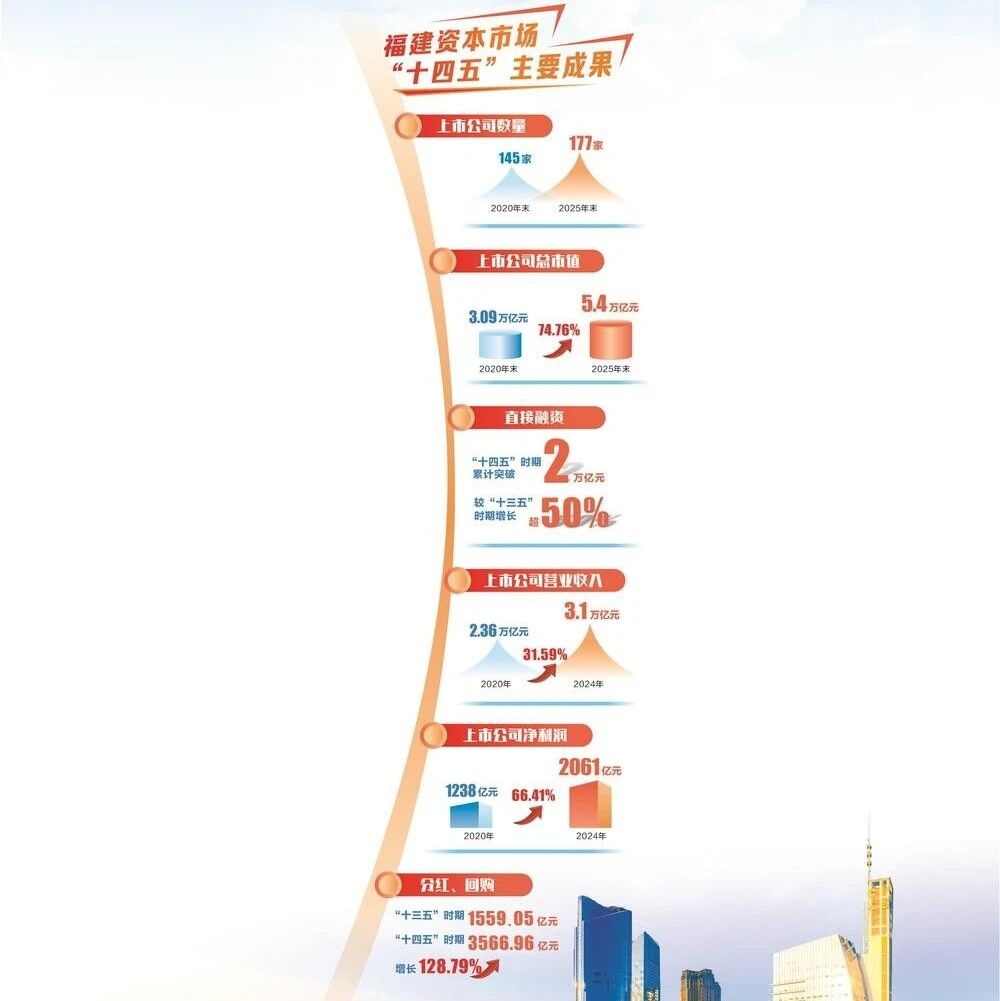
Core Viewpoint - During the "14th Five-Year Plan" period, Fujian Province's capital market has achieved remarkable growth, with direct financing exceeding 2 trillion yuan, marking over a 50% increase compared to the "13th Five-Year Plan" period, and positioning itself to lead the nation in A-share IPO financing by 2025 [1][5]. Group 1: Direct Financing and Market Growth - Fujian's capital market has seen direct financing surpassing 2 trillion yuan in the past five years, highlighting its role in supporting the real economy [5]. - By 2025, the province's direct financing is expected to reach a new high of 500 billion yuan, with A-share IPO financing at 22.446 billion yuan, ranking first in the country [6]. - The total market capitalization of listed companies in Fujian is projected to reach 5.4 trillion yuan by the end of 2025, ranking sixth nationally and reflecting a 74.76% increase from the end of the "13th Five-Year Plan" [10]. Group 2: Quality and Structure of Listed Companies - The number of listed companies in Fujian has increased to 177, with a notable improvement in the quality of these companies, as evidenced by a 31.59% increase in revenue and a 66.41% increase in net profit compared to the end of the "13th Five-Year Plan" [9][12]. - The average earnings per share reached 1.09 yuan, and the average return on equity was 10.77%, both significantly higher than the national averages [6]. Group 3: Industry Optimization and Innovation - Fujian has seen a continuous optimization of its industrial structure, with significant achievements in sectors such as computer and communication, software and information services, and electrical machinery manufacturing [10]. - The province has added 24 new technology-oriented listed companies during the "14th Five-Year Plan," with over 200 billion yuan in innovative bond issuance [15]. Group 4: Mergers, Acquisitions, and Investor Returns - Fujian's regulatory authorities have promoted mergers and acquisitions to enhance resource allocation efficiency, with 69 companies engaging in such activities, totaling 35.957 billion yuan [12]. - Cash dividends and buybacks from listed companies reached 356.7 billion yuan, a 128.79% increase from the "13th Five-Year Plan," indicating a strong focus on improving investor returns [12]. Group 5: Regulatory Measures and Risk Management - The regulatory bodies in Fujian have intensified their focus on risk management, successfully resolving issues for 22 listed companies and addressing risks in the bond market [16]. - A total of 66 cases of market violations were penalized, with fines totaling nearly 500 million yuan, reflecting a commitment to maintaining market order [16]. Group 6: Future Outlook - The Fujian Securities Regulatory Bureau plans to continue implementing new policies to enhance risk management and promote high-quality development in the capital market, aiming to inject stronger capital dynamics into the province's economic and social development [18].