全国统一大市场

Search documents
刚刚,重要经济数据公布
第一财经· 2025-12-15 02:24
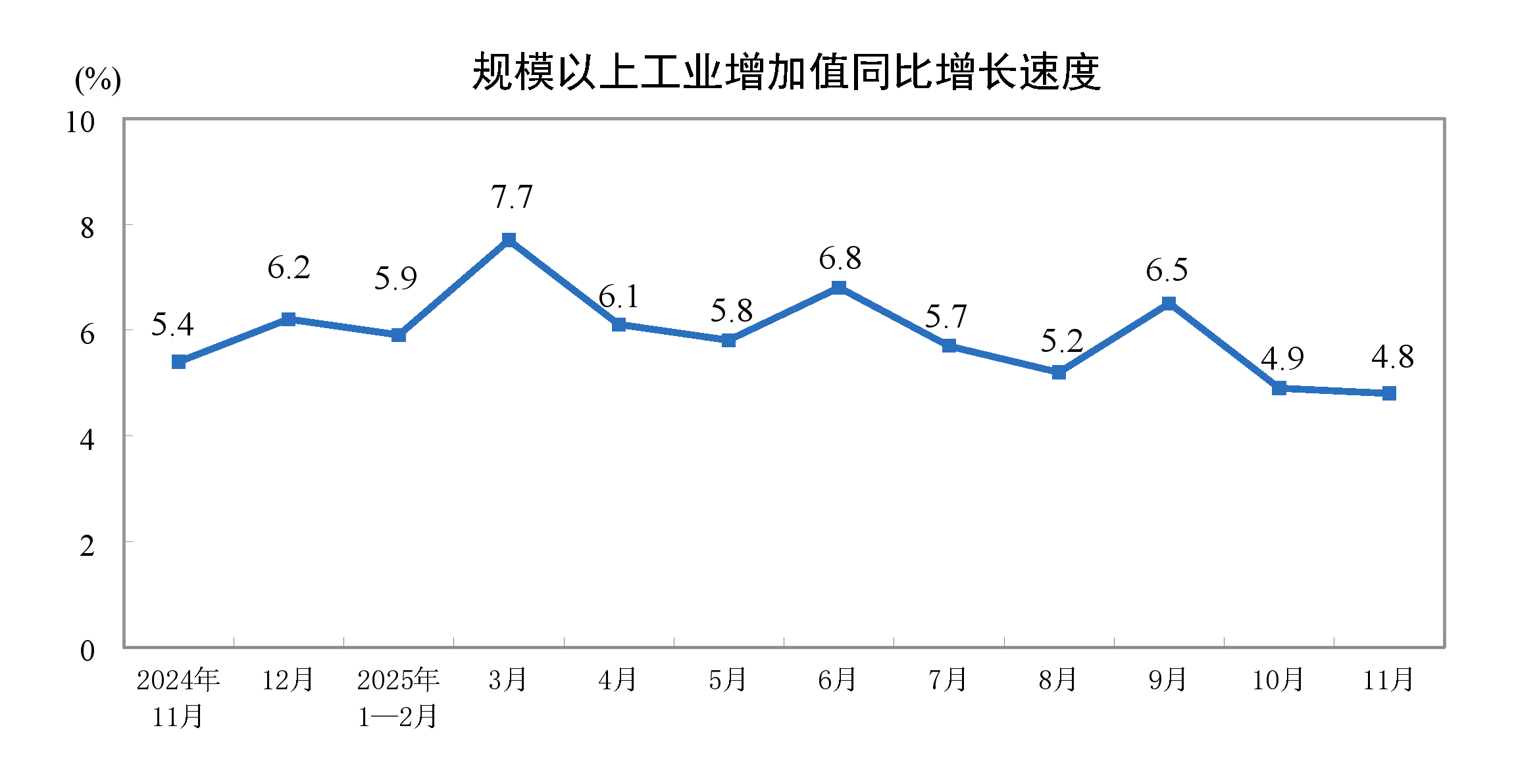
Economic Overview - The national economy is operating steadily, with a focus on high-quality development and stable employment [3][14] - The overall economic performance shows a trend of stability and progress [14] Agricultural Production - The total grain production for the year reached 14.298 trillion jin, an increase of 167.5 billion jin or 1.2% from the previous year [4] - The autumn grain production was 10.732 trillion jin, up by 163.6 billion jin or 1.5% [4] Industrial Production - In November, the industrial added value for large-scale enterprises grew by 4.8% year-on-year [5] - The equipment manufacturing and high-tech manufacturing sectors saw significant growth, with increases of 7.7% and 8.4% respectively [5] - The profit of large-scale industrial enterprises from January to October was 59.503 billion yuan, a year-on-year increase of 1.9% [6] Service Sector - The service sector production index increased by 4.2% year-on-year in November [7] - Key industries such as information transmission and financial services showed growth rates of 12.9% and 5.1% respectively [7] Retail Sales - The total retail sales of consumer goods in November reached 43.898 billion yuan, a year-on-year increase of 1.3% [8] - Online retail sales grew by 9.1% year-on-year, with physical goods accounting for 25.9% of total retail sales [8] Fixed Asset Investment - From January to November, fixed asset investment (excluding rural households) was 444.035 billion yuan, a decrease of 2.6% year-on-year [9] - Manufacturing investment increased by 1.9%, while real estate development investment fell by 15.9% [9] Trade and Exports - In November, the total value of goods imports and exports was 38.987 billion yuan, a year-on-year increase of 4.1% [10] - Exports grew by 5.7%, while imports increased by 1.7% [10] Employment - The urban survey unemployment rate was 5.1% in November, remaining stable compared to the previous month [12] Price Trends - The Consumer Price Index (CPI) rose by 0.7% year-on-year in November, with food prices increasing by 0.3% [13] - The Producer Price Index (PPI) for industrial producers decreased by 2.2% year-on-year [13]


国家统计局:11月规模以上工业增加值增长4.8% 国民经济延续稳中有进发展态势
Guo Jia Tong Ji Ju· 2025-12-15 02:19
Core Viewpoint - In November, the industrial added value of enterprises above designated size in China experienced a year-on-year growth of 4.8%, indicating a stable economic performance under the leadership of the central government [1][20]. Industrial Performance - The industrial added value for the first eleven months of the year increased by 6.0% year-on-year [2][22]. - The mining industry saw a year-on-year increase of 6.3%, manufacturing grew by 4.6%, and the electricity, heat, gas, and water production and supply industry rose by 4.3% in November [4][22]. - High-tech manufacturing increased by 8.4%, outpacing the overall industrial growth [6][22]. Economic Types - In November, state-controlled enterprises' added value grew by 4.2%, while joint-stock enterprises increased by 5.2%, foreign and Hong Kong, Macao, and Taiwan-invested enterprises by 3.4%, and private enterprises by 3.2% [4][22]. Product Output - Among 623 industrial products, 310 saw a year-on-year increase in output in November [5][22]. - Notable growth was observed in the production of 3D printing equipment (100.5%), industrial robots (20.6%), and new energy vehicles (17.0%) [22]. Sales and Exports - The product sales rate for industrial enterprises above designated size was 96.5%, a decrease of 0.8 percentage points year-on-year [5][22]. - The export delivery value reached 1.361 trillion yuan, showing a nominal decline of 0.1% year-on-year [5][22]. Employment and Consumer Prices - The urban survey unemployment rate in November was 5.1%, remaining stable compared to the previous month [27]. - The Consumer Price Index (CPI) rose by 0.7% year-on-year in November, with food prices increasing by 0.3% [28].
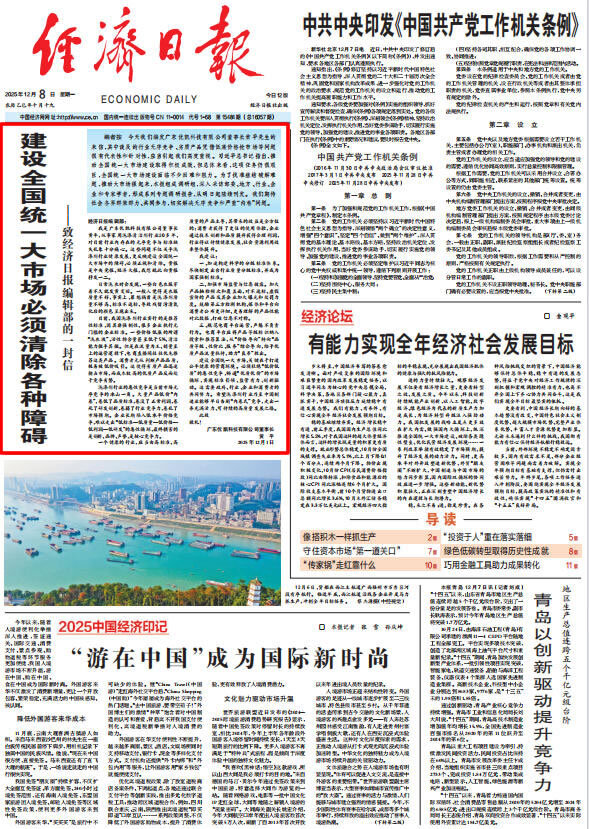
经济日报头版连发重磅文章 聚焦全国统一大市场堵点卡点
Zhong Guo Jing Ji Wang· 2025-12-15 02:11
Group 1 - The letter from the chairman of Guangdong Youkai Technology Co., Ltd. highlights the chaotic competition in the detergent industry, where low-quality products with less than 5% active ingredient content are capturing market share through low prices, putting quality products at a disadvantage [1][3] - The phenomenon of "involution" is affecting multiple industries, leading to intensified price wars, shrinking profit margins, reduced innovation investment, and rising quality and safety risks [1][5] - The need to break free from this "mud pit" of competition and promote high-quality development through the construction of a unified national market is emphasized [1][11] Group 2 - Over 20 national and local industry associations have publicly called for a "reverse involution" in various sectors, including steel, automotive, photovoltaic, catering, finance, logistics, and beauty services, indicating widespread concern about the issue [5] - The procurement market is identified as a crucial component of the unified national market and an important driver for its construction, serving as a policy tool to guide the quality and direction of industrial development [6] - The competition among local governments for investment has led to the emergence of various unfair "small policies" and "local policies," creating tax loopholes that burden local finances and exacerbate unfair competition [7] Group 3 - Promoting the integration of domestic and foreign trade is crucial for economic development, expanding domestic demand, and stabilizing enterprises, especially in the context of a complex international trade environment [9] - The construction of a unified national market requires addressing substantial and fundamental issues, with a focus on moving beyond mere market forces to achieve effective regulation [10] - The ongoing push for a unified national market is seen as both an urgent necessity and a strategic move in the face of significant global changes and trade protectionism [11]
国家统计局:全年全国粮食产量14298亿斤
Jing Ji Guan Cha Wang· 2025-12-15 02:11
全年全国粮食产量14298亿斤,比上年增加167.5亿斤,增长1.2%,稳定在1.4万亿斤以上。其中,秋粮 产量10732亿斤,比上年增加163.6亿斤,增长1.5%。全国谷物产量13204亿斤,比上年增加158.4亿斤, 增长1.2%。粮食播种面积增加、单产提高。全国粮食播种面积17.91亿亩,比上年增加134.8万亩,增长 0.1%;粮食单产399.1公斤/亩,每亩产量比上年增加4.4公斤,增长1.1%。 经济观察网12月15日,国家统计局发布,11月份,在以习近平同志为核心的党中央坚强领导下,各地区 各部门认真贯彻落实党中央、国务院决策部署,坚持稳中求进工作总基调,深入实施更加积极有为的宏 观政策,纵深推进全国统一大市场建设,着力推动高质量发展,生产供给基本平稳,就业形势总体稳 定,市场价格继续改善,新质生产力稳步发展,经济运行延续总体平稳、稳中有进发展态势。 ...
中央经济工作会议火线解读
2025-12-15 01:55
Summary of Key Points from the Central Economic Work Conference Industry and Company Involvement - The conference focuses on the overall economic landscape of China, emphasizing various sectors including real estate, healthcare, technology, and consumer services. Core Insights and Arguments 1. **Economic Potential and Reform**: The conference emphasizes the need to tap into economic potential by leveraging institutional, market, industrial, and talent advantages to drive reform and opening up [3][2] 2. **Macroeconomic Policies**: Fiscal policy is expected to maintain necessary expenditure levels with a deficit rate around 4%. Monetary policy will be flexibly applied, with a significant likelihood of a 10 basis point interest rate cut and a 50 basis point reserve requirement ratio cut in the first quarter [6][14] 3. **Domestic Demand Initiatives**: Plans to increase urban and rural residents' income to boost consumption and stabilize investment, particularly in infrastructure and real estate, are highlighted [7][17] 4. **Reform and Innovation Focus**: Emphasis on developing new productive forces and establishing international technology innovation centers in key regions like Beijing-Tianjin-Hebei and the Greater Bay Area [8][3] 5. **Quality Growth**: The conference shifts focus from merely stabilizing growth to enhancing quality, indicating a prioritization of qualitative improvements over quantitative growth [5][13] 6. **Risk Prevention**: Attention is drawn to risks in the real estate market and local government financing platforms, with a continued focus on the "housing is for living, not speculation" framework [9][20] Additional Important Content 1. **Investment Focus Areas for 2026**: Key investment areas include: - "Two重" investments focusing on infrastructure and major projects - National unified market initiatives - New productive forces such as quantum technology and AI [21][22] 2. **Healthcare Sector Directives**: The conference outlines support for innovative drugs, optimization of drug procurement policies, and reforms in medical insurance payment methods [36] 3. **Technology and AI Emphasis**: The importance of AI in driving economic growth is reiterated, with a focus on integrating AI with the real economy and supporting major tech innovation centers [37][38] 4. **Real Estate Market Strategies**: Strategies to stabilize the real estate market include converting unsold inventory into affordable housing and maintaining a cautious approach to policy changes [28][20] 5. **Consumer Services Outlook**: The focus on enhancing service consumption and addressing unreasonable restrictions in sectors like housing and automotive is noted, with an emphasis on long-term sustainable growth rather than short-term stimulus [34][31] This summary encapsulates the key points from the Central Economic Work Conference, highlighting the strategic directions and policy measures that will shape China's economic landscape in the coming years.
周期行业:中央经济工作会议的周期信号
2025-12-15 01:55
周期行业:中央经济工作会议的周期信号 20251214 摘要 央国企新能源投资策略转变:从大规模扩张转向精耕细作,关注度电效 益,投资品类从光伏转向风电。容量电价预期下,储能及跨省跨区输电 线路投资将迎来新高峰,利好相关企业。 储能在新型电力系统中角色转变:从成本负担转为利润引擎,调频服务 盈利能力强。未来调频市场竞争加剧,容量电价机制将逐步探索,利好 拥有风光资源积累和灵活资源获取的公司。 动力煤价格底部支撑明确:政策托底及进口减量预期支撑,预计底部支 撑在 670-700 元/吨左右。炼焦煤则面临供需宽松局面,若明年需求疲 弱且蒙煤供应宽松,将对其价格形成压制。 房地产市场流动性风险进入尾声:头部房企出现债券展期,但对国央企 影响有限。政策围绕控增量、去库存和优化供给展开,预计明年上半年 或推出 LPR 牵引的房贷利率下降或贴息政策。 住房公积金制度改革有望推进:公积金资金使用效率较低,部分城市已 拓宽使用范围。未来,这些试点措施可能会进一步推广,在控存量、去 库存、优供给之外,公积金制度改革值得关注。 Q&A 中央经济工作会议对全国统一大市场和新兴能源体系建设有何影响? 中央经济工作会议进一步强调了全国 ...
中央经济工作会议重磅刷屏!最新解读,信息量很大
Zhong Guo Ji Jin Bao· 2025-12-15 01:09
Core Insights - The Central Economic Work Conference held on December 10-11, 2025, outlined the economic work for 2026, emphasizing a more proactive fiscal policy and moderately loose monetary policy to stabilize the economy and promote high-quality development [1][3][5] Group 1: Economic Signals - The conference released three major positive signals: strong policy continuity with a focus on "more proactive fiscal policy + moderately loose monetary policy," emphasis on high-quality development, and targeted efforts in key areas such as domestic demand and risk prevention [3][4] - The focus on "domestic demand as the primary driver" highlights the commitment to building a robust domestic market, with specific measures to increase income for urban and rural residents [3][10] Group 2: Policy Framework - The macro policy framework for 2026 includes maintaining a fiscal deficit rate around 4% and expanding special bond quotas to approximately 5 trillion yuan, alongside a "small step, slow run" approach to monetary policy [7][8] - The expectation for fiscal policy is to direct funds towards key areas such as technology innovation, green initiatives, and consumer sectors, while monetary policy aims to lower financing costs for the real economy [8][9] Group 3: Focus on Domestic Demand - "Expanding domestic demand" is positioned as the top priority for 2026, with a focus on consumption driven by income growth and improved public services [10][20] - The strategy emphasizes a collaborative effort across government, businesses, and individuals to stimulate consumption and create a strong domestic market [10][21] Group 4: Innovation and New Growth Drivers - The conference identified key areas for new growth drivers, including digital economy, artificial intelligence, advanced manufacturing, and renewable energy, with the capital market playing a crucial role in supporting these sectors [13][14] - Capital markets are expected to provide pricing, financing, and merger support to foster innovation and facilitate the transition to high-tech industries [13][14] Group 5: Risk Management and Competition - The need to address "involution" in competition and improve the quality of small financial institutions was highlighted, with a focus on creating a unified national market to enhance fair competition [15][16] - Strategies for risk management include targeted measures to address risks in real estate and local government debt, emphasizing a market-oriented approach combined with policy support [17][18] Group 6: International Cooperation and Investment Opportunities - The conference emphasized the importance of international cooperation in areas such as digital trade, green energy, and high-end manufacturing, which are expected to present significant investment opportunities [19][20] - Investment opportunities are anticipated in sectors benefiting from service industry expansion, digital trade, and green transition, particularly for companies with competitive advantages in these areas [20][21]
大市场“中”力量丨流量大省演绎“留量故事”——“大市场‘中’力量”系列报道之二
He Nan Ri Bao· 2025-12-14 23:41
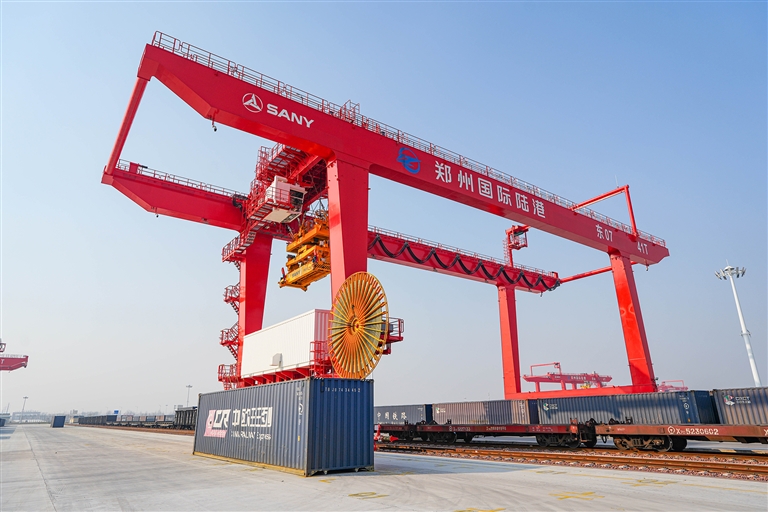
Core Viewpoint - Zhengzhou is establishing itself as a significant logistics hub in China, enhancing its role in both domestic and international markets through improved infrastructure and operational efficiency [4][6][9]. Group 1: Logistics and Infrastructure Development - Zhengzhou International Land Port has achieved regular operations, with the China-Europe Railway Express running 1-2 trains daily and special trains for new energy vehicles operating 4-5 times a day [6]. - The Zhengzhou Airport has seen a cargo volume of 825,200 tons by November 3, 2023, representing a year-on-year increase of 24.76%, surpassing the total volume of the previous year by 58 days [5]. - The Zhengzhou multi-modal transport data service center integrates data from over 450 companies, significantly reducing operational costs and improving efficiency [5]. Group 2: Economic Impact and Business Attraction - Foxconn's investment in Zhengzhou has led to a significant increase in the province's export-import volume, accounting for approximately 60% of the total [7][14]. - The expansion of air cargo routes from 51 to 70, covering 32 countries, has established a "72-hour delivery" network, enhancing Zhengzhou's global logistics capabilities [7]. - The establishment of global spare parts centers by companies like Super Fusion Digital Technology demonstrates the competitive advantage gained from Zhengzhou's logistics flow [8]. Group 3: Future Prospects and Strategic Initiatives - The provincial government is focusing on enhancing transportation networks, including high-speed rail and cargo rail, to strengthen Zhengzhou's position as a comprehensive transportation hub [9][10]. - The launch of the China Post Aviation Hub project aims to support the Belt and Road Initiative and enhance Zhengzhou's role in international trade [9]. - The establishment of the Luxembourg SolarCleano company's Asia-Pacific headquarters in Zhengzhou signifies the growing interest of international companies in the region [10].
全国发展和改革工作会议:适当增加中央预算内投资规模
Zhong Guo Zheng Quan Bao· 2025-12-14 23:03
记者12月13日从全国发展和改革工作会议上获悉,明年国家发展改革委将充分发挥"两重"建设、新增地 方政府专项债券等各类政府投资资金作用,适当增加中央预算内投资规模,继续发挥新型政策性金融工 具作用,多措并举促进投资止跌回稳。 三是提振消费要出实招出新招。优化实施消费品以旧换新政策,积极扩大服务消费,加快清理消费领域 不合理限制性措施,推动消费供给提质升级。 四是综合整治"内卷式"竞争和培育发展新动能。完善重点行业产能治理和重大基础设施调控,大力培育 壮大新兴产业和未来产业,培育壮大若干新兴支柱产业,深化拓展"人工智能+"行动,补齐科技服务业 短板,完善低空经济产业生态,深入推进数字经济高质量发展。 五是进一步全面深化改革。研究制定全国统一大市场建设条例,协同推进"准入、场景、要素"一体化改 革。持续抓好招商引资、招标投标等方面重点问题整治,坚决破除各类壁垒障碍。更大力度发展民营经 济,大力推动民营经济促进法配套制度建设。 六是深入扩大高水平对外开放。稳步扩大制度型开放,统筹做好"引进来"和"走出去",推动共建"一带 一路"高质量发展。 七是以双碳为引领加快推进全面绿色转型。稳步实施碳排放总量和强度双控制度,完 ...
【“打通全国统一大市场堵点卡点”热点问题探析⑦】破局“内卷” 开拓蓝海
Jing Ji Ri Bao· 2025-12-14 22:51
Core Viewpoint - The article highlights the detrimental effects of "involution" competition across various industries, leading to price wars, reduced profit margins, and increased quality and safety risks. It emphasizes the need for a unified national market to promote high-quality development in enterprises and industries [1][3][7]. Group 1: Industry Challenges - The washing detergent industry is facing severe competition from low-quality products with less than 5% active ingredient content, which are capturing market share through low pricing, putting quality products at a disadvantage [1]. - "Involution" competition is characterized by irrational competition due to market mechanism failures, where companies resort to price wars instead of leveraging differentiation or technological advantages, resulting in "increased production without increased revenue" [2]. - Various industries, including steel, photovoltaics, automotive, and catering, are experiencing similar challenges due to intense price competition, leading to a consensus among over 20 industry associations to advocate for "anti-involution" measures [3]. Group 2: Solutions and Strategies - To enhance market efficiency, it is essential to eliminate barriers to fair competition, which is a key aspect of building a unified national market. This will help stabilize the commercial ecosystem and address supply-demand imbalances [3]. - Companies are encouraged to abandon the outdated "scale-first" mentality and focus on creating value through quality products and strong brands. For instance, China Resources Beer closed 40 factories and reduced over 5 million tons of redundant capacity to focus on value creation [3]. - Innovation is crucial for traditional manufacturing to break free from path dependence and scale bottlenecks. Companies like Weiqiao Venture Group are collaborating with research institutions and adopting new technologies to transform their business models [4]. Group 3: Brand and Market Positioning - In a market characterized by information asymmetry, low-quality products often mislead consumers, necessitating a shift towards rebuilding trust in "quality for price" mechanisms and enhancing user experience and brand value [5]. - The home appliance industry has maintained a relatively rational approach due to years of system development, with a shift in market power from companies to consumers, who now seek personalized and emotionally resonant experiences [5]. - Companies like Hisense are witnessing a reversal in consumer behavior, with domestic brands gaining recognition for quality, indicating a shift towards "Chinese manufacturing" being associated with technological premium [5]. Group 4: Global Expansion - The construction of a unified national market is not a closed "internal cycle" but an open market that encourages both domestic and international engagement. Companies are urged to expand globally to alleviate domestic competition pressures and enhance competitiveness [6]. - Jack Technology has entered a global leadership phase, establishing production bases tailored to regional markets, while Miniso emphasizes cultural integration in its global strategy, showcasing the importance of local insights in international expansion [6]. Group 5: Future Outlook - Building a unified national market aims to create fairer, more efficient, and more valuable competition. Companies must focus on innovation, brand strength, and global presence to escape internal strife and contribute to China's high-quality economic development [7].