
制度型开放

Search documents
今日视点:中国资本市场向全球投资者抛出“共赢邀约”
Zheng Quan Ri Bao· 2025-11-17 22:40
中国资本市场以制度型开放的坚定态度,传递可预期的信心,让投资者"来得放心"。 这体现在一系列看得见、摸得着的举措上:全面取消证券基金期货公司外资股比限制,外资机构在经营 范围和监管要求上实现"国民待遇";持续优化互联互通机制,进一步畅通沪深港通、债券通、互换通等 渠道,便利内外资跨境投资;丰富多元化金融产品,发展股指期货、期权等风险管理工具,满足全球投 资者多元化的资产配置与风险对冲需求。正是这些务实的制度安排,扎实筑牢了全球投资者长期看好中 国、投资中国的信心根基。 中国资本市场以市场生态的全方位重塑,夯实可承载的基础,让投资者"留得安心"。 ■ 邢萌 进入11月份,中国资本市场密集开展了一系列高质量国际交流活动,向全球投资者抛出共赢发展的"橄 榄枝"。近日,证监会主席吴清访问法国、巴西金融监管部门并与国际机构投资者代表座谈,上交所成 功举办2025年上交所国际投资者大会,深交所顺利举行2025年第4期"投资中国新机遇"——深市上市公 司香港路演交流会。这一系列活动,宣传了中国资本市场投资机遇,邀请全球投资者携手共赢。 在全球经济面临复杂挑战与不确定性的当下,中国资本市场仍以坚定的开放姿态,向全球投资者伸出 ...
中国资本市场向全球投资者抛出“共赢邀约”
Zheng Quan Ri Bao· 2025-11-17 16:14
Core Viewpoint - In November, the Chinese capital market actively engaged in high-quality international exchanges, promoting investment opportunities to global investors and emphasizing a collaborative development approach amidst global economic challenges [1] Group 1: International Engagement - The Chairman of the China Securities Regulatory Commission (CSRC), Wu Qing, visited financial regulatory bodies in France and Brazil, and held discussions with international institutional investors [1] - The Shanghai Stock Exchange successfully hosted the 2025 International Investors Conference, while the Shenzhen Stock Exchange conducted the fourth "Investing in New Opportunities in China" roadshow in Hong Kong [1] Group 2: Market Openness and Trust - China’s capital market is committed to deepening institutional openness and optimizing the investment ecosystem, which has built international investors' confidence in long-term investments in China [2] - Measures include the complete removal of foreign ownership limits for securities, fund, and futures companies, and the implementation of "national treatment" for foreign institutions [2] Group 3: Market Ecology and Stability - The Chinese capital market is focused on reshaping the market ecology to create a stable investment environment, ensuring high-quality listings and smooth delisting channels [3] - Efforts to attract long-term capital, such as insurance and public funds, are aimed at maintaining market stability and promoting rational investment [3] Group 4: Innovation and Growth Opportunities - The capital market is leveraging new productive forces to reshape value investment concepts, particularly in emerging industries like renewable energy and artificial intelligence [4] - Investors are encouraged to engage with high-quality assets that align with global technological transformations, sharing in future growth dividends [4] - The CSRC's emphasis on deeper and higher-level openness reassures global investors, while the robust performance of the A-share market enhances investor confidence [4]
“小切口”精准服务外贸“大市场”,肇庆打造一体化外贸综合检测服务平台
Nan Fang Nong Cun Bao· 2025-11-17 09:31
Core Viewpoint - Zhaoqing is establishing an integrated foreign trade comprehensive testing service platform to enhance the quality and stability of foreign trade, aligning with provincial policies and optimizing the business environment [2][12]. Group 1: Platform Overview - The Zhaoqing Preferred Comprehensive Testing Platform is a collaborative initiative involving Zhaoqing Customs, the Zhaoqing Agricultural and Rural Bureau, and the Zhaoqing Council for the Promotion of International Trade, representing a pioneering effort in integrated testing service resource consolidation [11][12]. - The platform aims to unify testing brands, business platforms, and external interfaces, integrating core resources from four major technical institutions, employing 60 professional technicians, and utilizing 488 sets of equipment valued at 36 million yuan [15][16][19]. Group 2: Industry Focus and Support - The platform is designed to support Zhaoqing's industrial positioning by providing comprehensive testing services that align with agricultural and industrial strengths, facilitating quality control, talent development, and management system construction [33][34]. - In the agricultural sector, Zhaoqing is a key supplier in the Guangdong-Hong Kong-Macao Greater Bay Area, with major agricultural products and industries generating over 100 billion yuan in total output value [37][44]. Group 3: Market Expansion and Trade Promotion - The Zhaoqing Council for the Promotion of International Trade is actively promoting Zhaoqing products in international markets, recently facilitating participation in the 2025 China (Indonesia) International E-commerce Industry Expo, leading to multiple cooperation intentions with renowned buyers [60][62]. - The platform's collaboration with the trade promotion council creates a dual-driven model of "quality testing + market expansion," providing technical assurance and channel support for Zhaoqing products to enter global markets [67]. Group 4: Future Development - The platform aims to deepen resource integration and enhance technical service capabilities, focusing on the needs of Zhaoqing's industrial development while strengthening collaboration with customs and trade promotion departments [70][72].


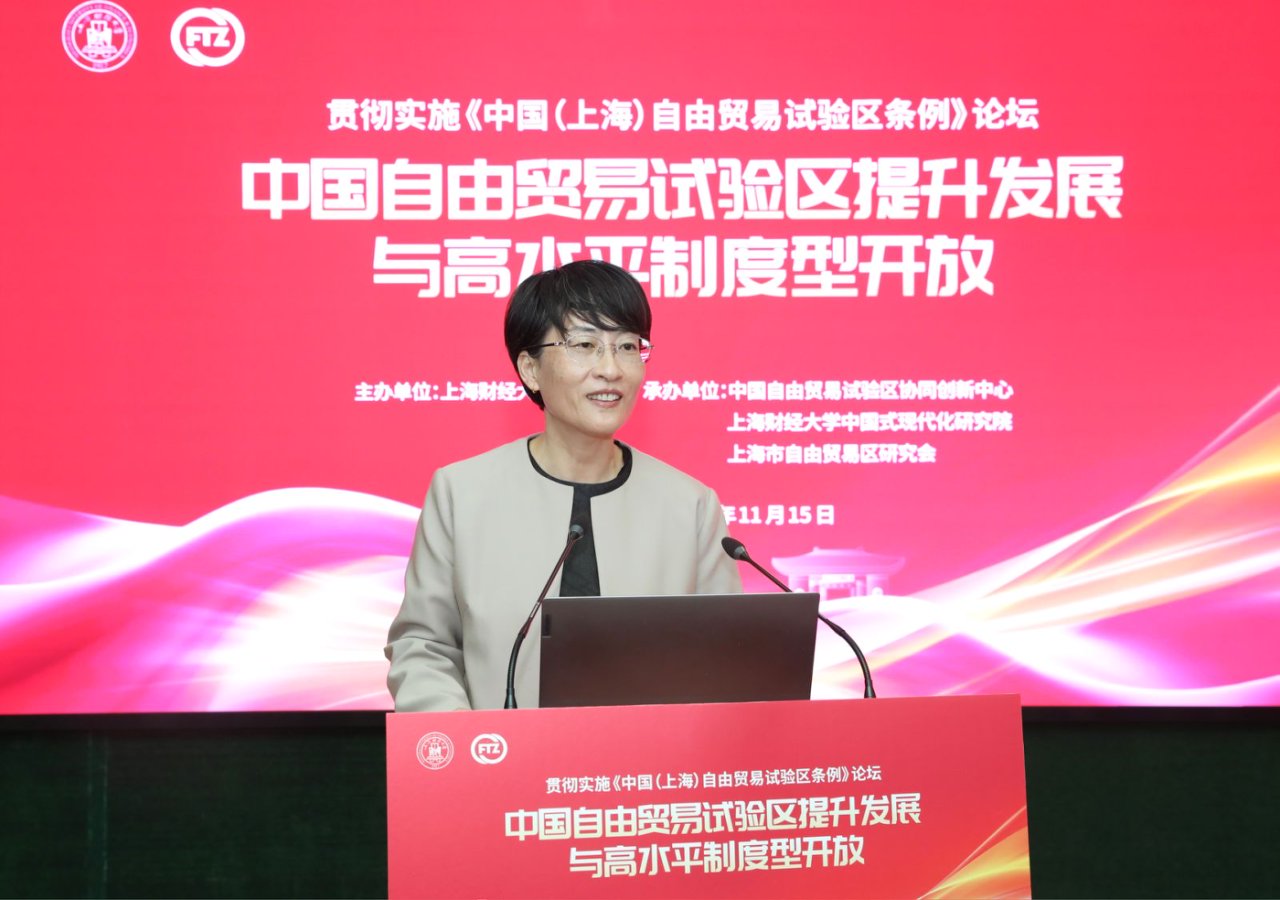
高校智慧赋能自贸区升级,上海财大论坛共探制度型开放
Guo Ji Jin Rong Bao· 2025-11-17 04:15
Core Viewpoint - The forum on the implementation of the "China (Shanghai) Free Trade Zone Regulations" emphasizes the strategic significance of the free trade zone's development and its role in high-level institutional openness [1][4]. Group 1: Strategic Importance - The free trade zone has become a testing ground for deepening reforms and a pioneer in institutional openness, significantly contributing to China's integration into the global economy [3][6]. - The forum serves as a timely opportunity to enhance academic research and policy recommendations in the field of free trade zones [4]. Group 2: Policy and Governance - The newly revised "China (Shanghai) Free Trade Zone Regulations" reflect Shanghai's confidence and determination to promote high-level openness [5]. - The Shanghai Free Trade Zone Research Association aims to address key issues in the construction of the free trade zone and to serve as a think tank for decision-making [4][7]. Group 3: Development and Innovation - Experts discussed the need for deepening investment openness and trade facilitation, as well as enhancing the service trade level through the implementation of negative lists [6]. - The Shanghai Free Trade Zone is recognized as a significant reform initiative, with a focus on both external engagement and internal reform to enhance governance and support high-level technological innovation [7][8]. Group 4: Future Outlook - The Shanghai American Chamber of Commerce highlights the positive impact of the free trade zone on foreign enterprises, indicating that future reforms and innovations will be crucial for its continued success [8]. - The development of a performance evaluation system for the free trade zone aims to provide dynamic monitoring and scientific assessment of its institutional openness [8].
海南自贸港将启动全岛封关 业界共话制度开放新机遇
Zhong Guo Jing Ying Bao· 2025-11-17 03:49
Group 1 - The construction of Hainan Free Trade Port is entering a critical stage, with institutional openness and policy innovation accelerating, creating new opportunities for regional collaborative development and corporate layout [1][2] - Deloitte China emphasizes the complementary nature of Hainan and Hong Kong in terms of location, resources, and open systems, with ongoing deepening of cooperation between the two regions [1] - Hainan Province is set to continue tax system optimization, including a 15% corporate and individual income tax policy, expanding the range of "zero tariff" goods, and enhancing duty-free shopping policies to attract diverse consumer demands [1] Group 2 - The full closure of Hainan Island will begin on December 18, marking a significant step in China's commitment to high-level opening-up and the construction of an open world economy [2] - The Central Committee's proposal for the 15th Five-Year Plan highlights Hainan's important role in China's future development, indicating its mission to lead the new era of opening-up [2] - Deloitte plans to leverage its cross-regional and multi-field professional service advantages to support the development of a more open, efficient, and sustainable business ecosystem in Hainan, facilitating Hong Kong enterprises in expanding their market presence [2]
传达学习习近平总书记重要讲话精
Zheng Zhou Ri Bao· 2025-11-17 00:55
Core Points - The meeting emphasized the importance of integrating the spirit of Xi Jinping's important speech during his inspection in Guangdong with the implementation of the 20th National Congress of the Communist Party of China, focusing on strategic thinking and comprehensive planning for the "14th Five-Year Plan" and the upcoming "15th Five-Year Plan" [1] - The meeting highlighted the need to promote high-quality development through comprehensive deepening of reforms and opening up, particularly in key areas such as state-owned enterprises, administrative approvals, and the business environment [1] - The meeting discussed enhancing the 12345 government service hotline, stressing a people-centered development approach and improving the satisfaction rate of service requests [1] Group 1 - The meeting addressed the need for a strong focus on urban governance, aiming to resolve persistent issues affecting citizens' daily lives and the city's image, thereby enhancing the overall management level [2] - The meeting underscored the importance of prioritizing education, aiming to establish a first-class education system and a well-known brand "Learning in Zhengzhou," which will support high-quality development through talent cultivation [2] Group 2 - The meeting also covered other miscellaneous matters that were not specified in detail [3]
秦磊:布局更广阔外贸市场空间
Sou Hu Cai Jing· 2025-11-16 23:25
Core Insights - Foreign trade is a crucial bridge connecting domestic and international markets, serving as an important engine for economic growth, structural optimization, and innovation [1] - China's foreign trade has historically relied on cost advantages and processing trade models, but is now transitioning towards higher quality development amidst a complex international trade environment [1][2] - The ultimate goal of enhancing foreign trade quality and efficiency is to shift from quantity to quality and from scale to effectiveness [2] Group 1: Current Trade Performance - In the first ten months of this year, China's total goods trade value reached 37.31 trillion yuan, reflecting a year-on-year growth of 3.6% [1] - Exports amounted to 22.12 trillion yuan, increasing by 6.2%, while imports were 15.19 trillion yuan, remaining stable compared to the previous year [1] Group 2: Strategic Focus Areas - There is a pressing need to expand exports of high-tech and high-value-added products, and to increase the share of service trade, digital trade, and green trade [2] - Institutional guarantees are essential for building a trade powerhouse, including aligning with high-standard international trade rules and improving the business environment [2][3] - Innovation is key, with a focus on digital transformation in foreign trade, enhancing trade efficiency through new business models and services [3] Group 3: Green Development and Market Expansion - Establishing a green supply chain management system and improving green certification mechanisms are critical to meet international standards and promote "green manufacturing" [3] - In addition to consolidating traditional markets like Europe and the U.S., there is a strategic push to expand into emerging markets such as ASEAN, Africa, and Latin America [3]
布局更广阔外贸市场空间
Jing Ji Ri Bao· 2025-11-16 22:10
Core Viewpoint - The article emphasizes the importance of foreign trade as a bridge connecting domestic and international markets, highlighting its role in economic growth, structural optimization, and innovation promotion. The Chinese government aims to enhance the quality and efficiency of foreign trade, transitioning from a focus on quantity to quality and efficiency [1][2]. Group 1: Current Trade Performance - In the first ten months of this year, China's total goods trade value reached 37.31 trillion yuan, reflecting a year-on-year increase of 3.6%. Exports amounted to 22.12 trillion yuan, growing by 6.2%, while imports were 15.19 trillion yuan, remaining stable compared to the previous year [1]. Group 2: Challenges and Strategic Shifts - The article outlines challenges such as uneven global economic recovery, rising unilateralism and protectionism, and increasing external demand uncertainty. It stresses the need to shift towards exporting high-tech and high-value-added products, as well as increasing the share of service trade, digital trade, and green trade [2]. Group 3: Goals for Trade Quality Improvement - The ultimate goal of improving foreign trade quality is to achieve a balance between quality and efficiency, transitioning from a focus on quantity to quality and from scale to effectiveness. This requires institutional, innovative, and green development strategies to enhance competitiveness and stabilize the foreign trade foundation [2]. Group 4: Institutional and Regulatory Framework - Institutional support is crucial for building a strong trade nation. The article calls for aligning with high-standard international trade rules, improving the business environment, and enhancing China's influence in global trade governance through active participation in rule-making [2]. Group 5: Innovation and Digital Transformation - Innovation is highlighted as a key factor, with a focus on accelerating the digital transformation of foreign trade. The development of digital supply chains, smart logistics, and cross-border e-commerce is essential for improving trade efficiency and flexibility [3]. Group 6: Green Development Initiatives - Green development is identified as a priority, with the need to establish a green supply chain management system and improve green certification mechanisms. The aim is to ensure that more export products meet international standards, promoting "green manufacturing" and "low-carbon brands" as new identifiers for Chinese foreign trade [3]. Group 7: Market Expansion Strategies - The article suggests consolidating traditional markets while actively exploring emerging markets in ASEAN, Africa, and Latin America. Enhancing brand building and international marketing capabilities is essential for gaining market trust and facilitating the transition from "Made in China" to "Brand China" [3].
上海自贸区下一步:深层次改革、高水平开放聚焦这些抓手
Di Yi Cai Jing· 2025-11-16 12:57
Core Viewpoint - Shanghai Free Trade Zone (FTZ) is focusing on functional expansion and industrial development based on institutional innovation [1][3]. Group 1: Institutional Innovation and Reform - Shanghai FTZ will further promote deep-level reforms and expand high-level openness, aligning with national strategies to enhance its layout and improve efficiency [2]. - The central government has outlined a five-year plan to achieve significant improvements in the FTZ's institutional openness and economic quality, emphasizing trade, investment, and data flow [2][3]. - Since its establishment in 2013, Shanghai FTZ has led in institutional innovations, with over half of the 485 nationally replicated innovations originating from it [3]. Group 2: Economic and Trade Development - The FTZ aims to deepen investment openness and trade facilitation, implementing a negative list for cross-border services to enhance service trade capabilities [3]. - There is a focus on promoting new trade formats and upgrading trade practices, including pilot programs for foreign-funded shipping companies [3]. Group 3: Technological and Industrial Advancement - The FTZ will drive technological innovation and the development of entire industrial chains, concentrating on key sectors like integrated circuits, biomedicine, and high-end manufacturing [4]. - The strategy includes gathering high-quality technological resources and supporting leading enterprises in collaborative technological advancements [4]. Group 4: Foreign Investment and Market Confidence - The Shanghai American Chamber of Commerce indicates that institutional innovations in the FTZ provide clearer policy expectations and stronger market confidence for foreign enterprises [6]. - A recent survey shows that 71% of foreign companies expect to be profitable in 2024, reflecting a recovery in market conditions [6]. - The perception of regulatory transparency has improved significantly, with 48% of foreign firms acknowledging better conditions compared to the previous year [6]. Group 5: Recommendations for Future Development - Recommendations include expanding market access in finance, healthcare, and information communication sectors, enhancing policy transparency, and strengthening intellectual property protections [7]. - There is a call for maintaining stability in foreign investment policies and improving cross-border data governance [7].
上海打开高水平对外开放新天地(活力中国调研行)
Ren Min Ri Bao· 2025-11-15 21:51
Core Insights - Shanghai is positioning itself as a global hub for trade and investment, emphasizing its role in international economic integration and reform [3][4][8] Group 1: Economic Performance and Trade - The Yangshan Port automated terminal efficiently handles hundreds of containers every minute, showcasing Shanghai's strong global resource allocation capabilities [2] - In the first three quarters of this year, automobile exports from the Waigaoqiao Port area increased by 14.2%, with new energy vehicles accounting for over 60% of exports [5] - The Shanghai International Commodity Fair has established a year-round trading platform, with over 6000 brands from more than 120 countries, achieving a transaction volume exceeding 30 billion yuan last year [4] Group 2: Foreign Investment and Corporate Presence - Shanghai is home to 80,000 foreign enterprises, attracting over 10% of the country's actual foreign investment, contributing approximately one-third of the city's tax revenue and one-fourth of its GDP [4] - Standard Chartered Bank views China as a key development focus, actively participating in various financial projects in Shanghai, including being the first foreign bank approved for participation in China's government bond futures trading [4] Group 3: Innovation and Technology - Companies like Qianlong Technology are adapting their products for international markets, benefiting from Shanghai's comprehensive industrial chain that allows for rapid product iteration [5] - Schneider Electric's factory in Putuo District serves as both a production and incubation base, launching global solutions from Shanghai [6] Group 4: Regulatory Environment and Policy Initiatives - The Shanghai Data Exchange has established a cross-border data trading rule system, with transaction volumes exceeding 3 billion yuan in the first half of this year [7] - The government is implementing significant reforms to enhance the business environment, including a new international business cooperation zone aimed at facilitating trade and investment [7][8]