AI大模型

Search documents
消费电子ETF(561600)收涨超2.6%,AI大模型进展不断
Xin Lang Cai Jing· 2025-12-22 07:36
Group 1 - The core viewpoint of the news highlights the strong performance of the China Securities Consumer Electronics Theme Index, which rose by 2.74%, with significant gains in component stocks such as Lixun Precision (up 10.02%) and Jingwang Electronics (up 8.86%) [1] - The Consumer Electronics ETF also saw an increase of 2.62%, closing at 1.18 yuan, indicating a positive market sentiment towards the consumer electronics sector [1] - The advancements in AI models, particularly the upgrade of the Doubao App's video generation capabilities, are contributing to the growth in the consumer electronics sector, showcasing the integration of AI in practical applications [1][2] Group 2 - Haitong International reported that the Doubao model 1.8 and Seedance 1.5 Pro have achieved key technological breakthroughs in multimodal agent scenarios, with daily token usage surpassing 50 trillion, serving over a hundred trillion-level enterprise clients [2] - The focus of these models is to address the "last mile" problem for agents, enhancing the ability to execute complex instructions reliably, which is crucial for high-value applications such as quality inspection and education [2] - The China Securities Consumer Electronics Theme Index comprises 50 listed companies involved in component production and brand design, reflecting the overall performance of the consumer electronics sector [2][3] Group 3 - As of November 28, 2025, the top ten weighted stocks in the China Securities Consumer Electronics Theme Index accounted for 56.39% of the index, indicating a concentration of investment in key players like Luxshare Precision and Cambricon Technologies [3] - The Consumer Electronics ETF closely tracks the China Securities Consumer Electronics Theme Index, providing investors with a means to gain exposure to the sector [3]
计算机ETF(512720)连续4日迎净流入,智谱、MiniMax通过港交所聆讯
Mei Ri Jing Ji Xin Wen· 2025-12-22 06:25
Group 1 - The core viewpoint of the article highlights that both Zhipu and MiniMax have passed the Hong Kong Stock Exchange listing hearing, marking a significant milestone for AI large model companies focusing on foundational and multimodal models to enter the IPO phase in Hong Kong [1] - Zhipu's listing represents the first company in Hong Kong to focus on "foundational models," while MiniMax is concentrating on the multimodal model sector, indicating a growing interest and investment in these AI technologies [1] - The expected timeline for these companies to enter the capital market is early 2026, suggesting a strategic move towards capitalizing on the burgeoning AI market [1] Group 2 - The Computer ETF (512720) tracks the CS Computer Index (930651), which selects listed companies from the A-share market involved in software development, IT services, and hardware manufacturing, reflecting the overall performance of the computer industry [1] - The CS Computer Index is characterized by significant growth potential and a technology-driven focus, providing a comprehensive view of market dynamics and development trends within the computer industry [1]
智谱、MiniMax通过港交所聆讯,冲刺大模型第一股
Huaan Securities· 2025-12-22 05:04
Investment Rating - Industry rating: Overweight [1] Core Insights - On December 17, Zhiyu and MiniMax both passed the Hong Kong Stock Exchange listing hearing, marking the first listing of a company focused on "foundation models" in Hong Kong. MiniMax focuses on multimodal models, indicating that AI large model companies are officially entering the IPO sprint phase in Hong Kong, expected to debut in early 2026 [3][11] - Zhiyu is actively launching open-source foundation models GLM-4.5 and GLM-4.6, with strong AI coding capabilities allowing integration with top programming tools and tech companies in the U.S. The CEO of Zhiyu stated that the company's software tools and model business (GLM coding plan) have an ARR exceeding 100 million yuan (approximately 14 million USD), with expected revenue growth of 100% in 2025 [3][11] - MiniMax has developed several multimodal products and has over 30,000 enterprise clients and developers on its open platform. The company’s commercialization strategy includes both B-end open platform and in-product advertising mechanisms [3][11][12] - The report highlights significant investments from major players like Hillhouse Capital, Meituan, Tencent, and Alibaba in Zhiyu and MiniMax, with Zhiyu's latest valuation reaching 40 billion yuan and MiniMax's valuation at 40 billion USD (approximately 300 billion yuan) [4][12] - The report suggests that the upcoming Hong Kong listings will shift the narrative of AI large model companies from "telling technical stories" to "realizing commercial value," providing a basis for future financing and valuation of large model enterprises [4][12] Market Performance Review - The computer industry index fell by 1.48%, underperforming the Shanghai Composite Index by 1.50 percentage points and outperforming the ChiNext Index by 0.78 percentage points. Year-to-date, the computer industry index has risen by 13.45% [14][17] - Among the 31 industry indices, the computer industry index ranked 22nd this week, leading the TMT sectors (electronics, communication, computer, media) [14][17] Company Dynamics - Zhiyu has completed 15 rounds of financing, with a latest valuation of 40 billion yuan, while MiniMax's valuation reached 40 billion USD after a 300 million USD C-round financing [4][12] - The report recommends focusing on AI hardware and application targets, mentioning related companies such as Cambricon, Inspur, Yonyou Network, and Kingsoft Office [4][12]
观察 | 到底谁才是国内AI大模型的真第一?
未可知人工智能研究院· 2025-12-22 04:01
Core Viewpoint - The article discusses the competition among AI large models in China, highlighting three different reports that claim different companies as the "first" in the industry based on varying criteria [2][30]. Group 1: Different "Firsts" Based on Metrics - The first report from Zhipu's prospectus claims that iFlytek is the first in terms of revenue, with over 500 million RMB projected for 2024 [6][8]. - The second report from IDC states that ByteDance's Doubao holds a 49.2% market share based on token usage, indicating it has the largest user base [10][12]. - The third report from A16Z and OpenRouter identifies DeepSeek as the global leader in open-source models, with 14.37 trillion tokens used, significantly higher than its competitors [15][18]. Group 2: Analysis of Business Strategies - iFlytek's ranking reflects its strong commercial capabilities and long-standing relationships in the government and enterprise sectors, focusing on B2B sales [19]. - ByteDance's Doubao leverages its massive user base from popular apps like Douyin and Toutiao, adopting a low-price strategy to capture market share [20]. - DeepSeek's appeal lies in its open-source nature and strong performance, particularly among global developers, although its monetization strategy is still under development [21]. Group 3: Implications for Job Seekers, Entrepreneurs, and Investors - For job seekers, the article emphasizes the importance of aligning personal skills with the respective business models of these companies [25]. - Entrepreneurs are advised to choose AI tools based on specific business needs rather than solely on market rankings [26]. - Investors should focus on the business models and monetization capabilities of these companies, as many are still struggling to achieve profitability despite high market shares [28]. Group 4: Future Directions in AI - The article suggests that the competition among these companies represents three distinct paths in the AI industry: the government-focused route (iFlytek), the user base-driven route (ByteDance), and the technology-driven route (DeepSeek) [27]. - It highlights the potential for multiple "firsts" to coexist in the market, similar to the current landscape of e-commerce in China [31]. - The article concludes that the ongoing competition signifies a significant shift in the global AI landscape, with Chinese companies gaining recognition and influence [33][34].



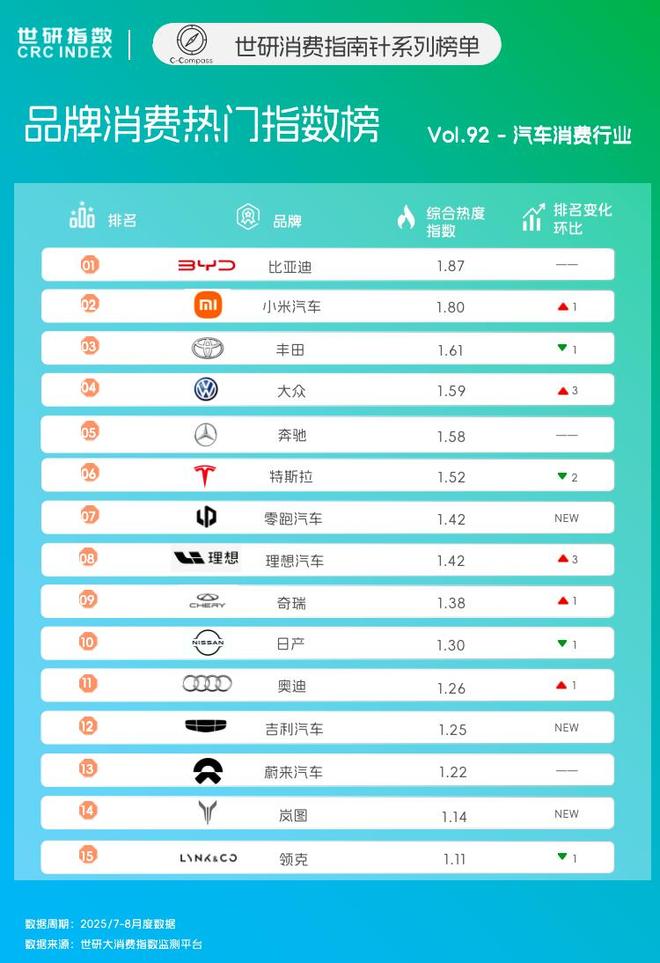
汽车市场两极竞速,智驾进入信任时代|世研消费指数品牌榜Vol.92
3 6 Ke· 2025-12-22 02:42
Core Insights - The current electric vehicle market is exhibiting a significant "dumbbell-shaped" differentiation pattern, with high-end markets leveraging ecological connectivity and advanced driving technologies to create competitive advantages, while entry-level markets are experiencing a "technology democratization" wave focused on extreme cost-performance ratios [1][3] Group 1: Market Dynamics - The high-end market (priced between 250,000 to 450,000 yuan) is characterized by leading brands focusing on differentiated strategies to build competitive moats, either through user ecosystems or advanced driving technologies [3] - Entry-level brands like Leap Motor and Geely are reshaping brand value through technology democratization, with Leap Motor's B01 model featuring standard lidar at a price of 89,800 yuan [3][4] Group 2: Competitive Landscape - The competition in intelligent driving is shifting from hardware accumulation to a dual-driven model of "AI large models + responsibility assurance," emphasizing user trust as a key competitive factor [5] - Tesla's Grok4 and BYD's "Tianshen Eye" are examples of advanced intelligent driving systems that have moved beyond basic path planning to include risk prediction and human-like decision-making [5] Group 3: Consumer Behavior - Consumers are increasingly willing to pay for either extreme experiences or extreme cost-effectiveness, while mid-range electric vehicles (priced between 150,000 to 200,000 yuan) are facing growth challenges due to a lack of distinct branding [4] - The trend indicates that brands must possess both advanced AI technology and clear accountability mechanisms to gain user trust and establish sustainable competitive barriers in the intelligent driving sector [5]




AI大模型全栈工程师第7期
Sou Hu Cai Jing· 2025-12-21 20:31
驾驭智能巨兽:AI大模型时代的全栈架构师 我们正处在一个由代码和数据重塑的时代。从你手机里聪明的语音助手,到为你精准推荐内容的视频平 台,再到背后驱动这一切的、庞大而神秘的AI大模型——一个全新的技术浪潮正席卷而来。在这场浪 潮中,仅仅掌握单一技能的工程师,如同只拥有一张地图的探险家,难以应对复杂多变的地形。而"AI 大模型全栈工程师",正是那个能够驾驭整个技术生态的"全能探险家"。 一、为何是"全栈"?因为AI的价值不止于模型 深入核心: 理解大模型的工作原理,掌握提示工程、微调、RAG(检索增强生成)等核心技术, 知道如何让模型变得更聪明、更可靠。 构建基石: 精通后端开发,懂得如何设计API、管理数据库、处理高并发,将模型的能力封装成 稳定、高效的服务。 连接用户: 具备前端开发思维,能够设计出流畅、自然的交互界面,让用户无感知地享受到AI带 来的强大功能。 三、超越代码:成为问题的终结者 这就是"全栈"思维的核心。一个AI大模型,无论多么强大,如果它只是静静地躺在服务器里,就无法产 生任何价值。全栈工程师,就是那个能够打通从"大脑"到"应用"最后一公里的人。他既要懂得如何训 练、优化和部署大模型,也要 ...

计算机周观点第28期:AI大模型资本化进程加速,L3智驾准入破冰迈入新阶段-20251221
国泰海通· 2025-12-21 11:23
Investment Rating - The report maintains an "Overweight" rating for the computer sector, recommending stocks such as Han's Information, Rilian Technology, Kingsoft Office, Hehe Information, Hikvision, Newland, Daotong Technology, and Haiguang Information, with Zhongke Shuguang as a related stock [3][4]. Core Insights - The domestic AI large model industry is experiencing a critical phase of accelerated technological productization and deepening capital market engagement. Volcano Engine released the Doubao large model 1.8 and the video generation model Seedance 1.5 Pro, achieving significant technological breakthroughs and reducing enterprise usage costs through innovative business models [3][4]. - The Ministry of Industry and Information Technology has issued the first L3 level autonomous driving vehicle permits, marking a transition to "conditional commercial application" for autonomous driving in China. This includes specific models from Changan and BAIC Arcfox, with speed limits set for initial operations [3][4]. - Domestic GPU companies are actively pursuing capital market opportunities, with TianShu ZhiXin and BiRan Technology having passed listing hearings, aiming to raise funds for advanced chip development and market expansion. The successful listings of MoEr Thread and MuXi shares on the STAR Market have demonstrated strong market interest in domestic high-end chip sectors [3][4]. Summary by Sections AI Large Model Development - Volcano Engine's Doubao large model 1.8 and Seedance 1.5 Pro have entered the global first tier in multi-modal and intelligent capabilities, with daily token processing exceeding 50 trillion [3][4]. - The listings of Zhizhu AI and MiniMax on the Hong Kong Stock Exchange are expected to provide quantifiable secondary market valuation benchmarks for the large model industry [3][4]. Autonomous Driving - The issuance of L3 level permits signifies a cautious regulatory approach prioritizing safety, with vehicles' operational responsibilities assigned to manufacturers rather than drivers [3][4]. - Initial sales of these vehicles will be limited to designated operators, providing essential practical data for refining technical standards and legal frameworks [3][4]. GPU Market Dynamics - Domestic GPU firms are intensifying their efforts to enter the capital market, with TianShu ZhiXin planning to raise $300 to $400 million and BiRan Technology also pursuing a listing [3][4]. - The successful market entries of MoEr Thread and MuXi have highlighted the strong investor interest in the domestic semiconductor industry, particularly in high-end chip design [3][4].


鸿蒙星光盛典:一个数字生态的 “成年礼”
晚点LatePost· 2025-12-21 08:30
Core Viewpoint - The article emphasizes the rapid adoption of the HarmonyOS ecosystem across various industries, marking a significant transition from a survival phase to a collaborative growth phase, symbolized by the "Harmony Starry Night" event [3]. Group 1: HarmonyOS Development - HarmonyOS has surpassed 1 billion connected devices, indicating a robust physical connection network [5]. - The application ecosystem has exceeded 300,000 applications, covering 18 major sectors, ensuring high usability and performance [5]. - The latest iteration, HarmonyOS 6, showcases unique features that enhance user experience, moving from mere usability to a more personalized and functional interaction [5][6]. Group 2: Technological Innovations - Features like "Smart Grip" and "Tap to Connect" demonstrate the system's ability to adapt to user needs and facilitate seamless interactions between devices [6][7]. - The integration of AI as a core service within the ecosystem allows for contextual understanding and collaboration with various partners, enhancing the overall intelligence of the system [7][8]. Group 3: Market Position and Competition - HarmonyOS has achieved an 18% market share in the Chinese smartphone operating system market, surpassing iOS at 14%, marking a pivotal shift in the competitive landscape [9][10]. - Major tech giants like Tencent, Alibaba, and ByteDance have integrated their services into the HarmonyOS ecosystem, indicating its growing influence and the establishment of a developer community [10]. Group 4: Industry Impact and Future Outlook - The article highlights the transformation of HarmonyOS into a critical digital infrastructure across various industries, with over 70 industry-specific versions developed [11]. - The "Harmony Starry Night" event is positioned as a potential annual showcase for technological advancements, reflecting the ongoing evolution of the ecosystem [11].

传媒行业动态研究报告:传媒角度看智谱递表
Huaxin Securities· 2025-12-21 03:32
Investment Rating - The report maintains a "Recommended" investment rating for the media industry [1] Core Insights - The report highlights the significant growth potential of the AI sector, particularly through the case of Zhipu, which is set to submit its IPO application to the Hong Kong Stock Exchange. The revenue projections for Zhipu from 2022 to 2024 show a compound annual growth rate (CAGR) of 130%, with revenues expected to reach 3.12 billion RMB by 2024 [4] - The report emphasizes the strategic partnerships and collaborations within the media industry, particularly between Zhipu and Huace Film & TV, which aims to leverage AI for content generation and review processes [6][8] - The report outlines the expected growth of the Chinese large language model market, predicting it will reach 101.1 billion RMB by 2030, driven primarily by institutional clients [4] Summary by Sections Industry Performance - The media sector has shown mixed performance over different time frames, with a 1-month performance of 0.3%, a 3-month decline of 6.7%, and a 12-month increase of 11.9% compared to the CSI 300 index [1] Financial Projections - Zhipu's revenue forecasts indicate a growth trajectory from 0.57 billion RMB in 2022 to 3.12 billion RMB in 2024, while net profits are projected to be negative due to high R&D and computing costs [4] - The gross margin for Zhipu is expected to fluctuate, with estimates of 54.6% in 2022, 64.6% in 2023, and 56.3% in 2024, reflecting the company's focus on high-value services [4] Strategic Partnerships - Huace Film & TV has invested 100 million RMB in Zhipu and is collaborating on AI-driven content generation and review systems, aiming to set industry standards [6][8] - The partnership is expected to enhance Zhipu's brand influence and technological capabilities within the media sector [8] Market Outlook - The report anticipates that the IPO of Zhipu will catalyze a new phase of capital investment in the AI large model sector, potentially accelerating commercialization across the industry [10] - The report also notes that the growth of Zhipu could serve as a benchmark for other emerging AI companies in China [9]
腾讯重组大模型研发,成立AI Infra部,OpenAI前研究员姚顺雨加入
Sou Hu Cai Jing· 2025-12-20 03:15
Core Insights - Tencent has announced an upgrade to its large model research architecture, establishing new departments to enhance its capabilities in AI model development [2][4] - Vincesyao has been appointed as the Chief AI Scientist, overseeing multiple departments and reporting directly to Tencent's president [2][4] - The restructuring aims to strengthen Tencent's engineering advantages and improve the efficiency of AI large model research [6] Group 1: Organizational Changes - The newly formed AI Infra Department will focus on building technical capabilities for large model training and inference platforms, emphasizing distributed training and high-performance inference services [4][6] - The AI Data Department and Data Computing Platform Department will be responsible for constructing data and evaluation systems for large models, as well as integrating big data and machine learning [5][6] - Key personnel include Wang Di as Deputy General Manager of the Large Language Model Department, Liu Yuhong as head of the AI Data Department, and Chen Peng as head of the Data Computing Platform Department [6] Group 2: Research and Development Achievements - Tencent has released over 30 new models in the past year, with the latest version, Mix Yuan 2.0, showing significant improvements in pre-training data and reinforcement learning strategies [6] - The Mix Yuan 3D model maintains a leading position globally, with over 3 million downloads from the open-source community [6] - Tencent's AI application, Yuanbao, has achieved a user scale that ranks among the top three in the domestic AI application market, with frequent updates and integration into popular products like WeChat and QQ [7]