关税

Search documents
专访瑞银首席策略师:内资支撑新兴市场表现,警惕AI需求波动
2 1 Shi Ji Jing Ji Bao Dao· 2025-09-14 23:41
南方财经21世纪经济报道记者赖镇桃 过去一周,美国非农、PPI等一系列带着"冷感"的经济数据发布后,美联储下周降息似乎已经板上钉 钉。 新兴市场也被这波宽松的风向点燃热情。MSCI新兴市场指数12日收涨1.19%,连续四天刷新历史最高 点;MSCI亚洲指数上周涨幅达3.18%,韩国Kospi指数、新加坡海峡时报指数、巴西IBOVESPA股指、 墨西哥MXX也在上周接连创下历史新高。其中,韩国(41%)、越南(48%)等国家主要股指的年内涨幅尤 为瞩目。 年内来看,新兴市场股市也跑出了比发达经济体市场更强劲的增速。今年以来截至12日收盘时,MSCI 发达市场的涨幅不到15%,MSCI新兴市场则累计涨超23%,大幅领先发达市场。 随着美联储即将重启降息周期,不少基金、投行都在进一步加大对新兴市场的押注,认为美国货币政策 宽松、美元走软、各国通胀降温,将带动新一波利好。不过,关税问题始终如"达摩克利斯之剑"高悬新 兴市场头顶,下半年关税的滞后影响是否会终有显现?新兴市场的的估值确实有吸引力,但如何发掘高 成长性的机会? 近日,21世纪经济报道记者专访了瑞银投资银行全球新兴市场股票首席策略师Sunil Tirumal ...

手表关税,成为美国消费者的“手铐” | 新漫评
Zhong Guo Xin Wen Wang· 2025-09-14 06:12
Core Viewpoint - The United States has imposed a 39% tariff on Swiss goods after months of negotiations, shocking Switzerland, which relies heavily on exports to the U.S. market [2] Group 1: Tariff Impact - The U.S. is Switzerland's largest single export market, with Swiss exports including watches, chocolate, pharmaceuticals, and machine tools [2] - The high tariffs are justified by the U.S. due to a trade deficit with Switzerland, which has been deemed "absurd" and "dangerous" by various Swiss sectors [2] Group 2: Economic Consequences - The costs of these tariffs will not solely be borne by Swiss companies but will be passed on to American consumers, leading to increased prices for Swiss products [2] - The rising prices of Swiss watches due to tariffs symbolize the growing economic pressure on American consumers, as the U.S. trade deficit triggers higher living costs [2]


记者手记丨慕尼黑车展上的美国关税“寒流”
Xin Hua Wang· 2025-09-14 04:53
Core Viewpoint - The Munich Auto Show highlights the significant impact of U.S. tariffs on the German automotive industry, creating a sense of unease among exhibitors despite the event's celebratory atmosphere [1][4]. Group 1: Impact of Tariffs - U.S. tariffs have caused substantial losses for the German automotive industry, with the president of the German Automotive Industry Association stating that European competitiveness is under immense pressure [1]. - The tariffs disrupt established global supply networks, as highlighted by the Vice President of a major German auto parts supplier, who expressed dissatisfaction with the tariffs' impact on their operations [1][2]. - A recent survey indicated that over half of the German companies directly engaged in business with the U.S. plan to reduce trade, and a quarter will pause or cancel investments in the U.S. due to the tariffs [2]. Group 2: Financial Consequences - In April and May, following the implementation of new tariffs, German exports of new cars to the U.S. plummeted by 23.5% year-on-year, with major automakers like BMW and Volkswagen reporting profit declines of approximately 30% [3]. - Mercedes-Benz's net profit halved to €2.7 billion, with all three major automakers citing "significant additional costs" due to U.S. tariffs in their financial reports [3]. Group 3: Industry Sentiment and Future Uncertainty - The sentiment among German automotive suppliers is overwhelmingly negative, with many describing the tariffs as an unbearable burden that ultimately affects consumers through increased prices [2][3]. - Economic experts warn that high tariffs could lead to a more severe and hidden consequence: rising unit costs due to decreased production and inability to spread fixed costs, further eroding competitiveness [3]. - Uncertainty regarding future developments related to tariffs has become a common theme among exhibitors at the auto show, indicating a lack of clarity in the industry's outlook [3].
印度:卢比汇率跌至历史新低,外资已从债务和股票市场净撤资117亿美元
Sou Hu Cai Jing· 2025-09-13 20:44
Core Points - The Indian Rupee hit a historic low against the US Dollar on September 11, reflecting increasing pressure from high tariffs imposed by the US on India, leading to a net withdrawal of $11.7 billion by foreign investors from Indian debt and equity markets this year [1][3] - The Rupee rebounded on September 12, primarily due to expectations of potential interest rate cuts by the Federal Reserve [3] - The Indian government, led by Prime Minister Modi, is implementing tax reforms to alleviate the impact of tariffs, simplifying the Goods and Services Tax (GST) structure, which may reduce government revenue by $13 to $17 billion but is expected to stimulate consumption [3] Trade Negotiations - US President Trump announced ongoing negotiations to resolve trade barriers between the US and India, expressing optimism about reaching an agreement [3][4] - India is seeking to address two key tariff issues: a 25% reciprocal tariff on Indian exports to the US and a 25% punitive tariff due to oil purchases from Russia [4] - Economists suggest that the positive signals from both leaders increase the likelihood of a reduction in India's 50% tariff rate in the coming months, highlighting the complementary trade relationship between the two nations [4]

中美即将在西班牙谈关税
Huan Qiu Shi Bao· 2025-09-13 03:26
Core Viewpoint - The upcoming talks in Spain between Chinese and U.S. officials are crucial for addressing trade issues, including tariffs and the TikTok situation, amidst ongoing tensions in U.S.-China relations [1][2]. Group 1: Meeting Details - Chinese Vice Premier He Lifeng will lead a delegation to Spain from September 14 to 17 to discuss U.S. unilateral tariff measures, export controls, and TikTok [1]. - U.S. Treasury Secretary Yellen plans to meet with Chinese officials in Madrid as part of her trip to Spain and the UK, focusing on trade, economic, and national security issues [1]. Group 2: TikTok and Data Privacy - The Chinese government emphasizes its commitment to protecting the legitimate rights of its companies, stating it will handle TikTok issues in accordance with local laws [1]. - China urges the U.S. to engage in dialogue based on mutual respect and equality to create a fair business environment for Chinese companies like TikTok in the U.S. [1]. Group 3: Context of the Talks - This meeting will be the fourth significant face-to-face discussion between high-level U.S. and Chinese economic officials this year [2]. - Previous meetings in Geneva, London, and Stockholm have led to temporary suspensions of tariff implementations, indicating a potential thaw in negotiations [2]. - Analysts suggest that the upcoming talks could be decisive for reaching a more comprehensive trade agreement before November 10 [2].
Flexport CEO Ryan Peterson: Refunds could be coming if court rules against IEEPA tariffs
Youtube· 2025-09-12 16:40
Core Insights - The shipping industry is currently facing challenges due to ongoing tariff reviews and a Supreme Court ruling that could significantly impact importers [1][2][3] - Companies are adapting their supply chains by diversifying shipping routes and relocating factories to countries like Vietnam and India, although recent tariff increases on these countries have created uncertainty [7][8] - Compliance and customs brokerage services are experiencing substantial growth, with a reported 99% year-over-year increase in gross profit, as companies seek to navigate complex tariff regulations [9][10] Shipping Industry Trends - The peak shipping season is approaching, but the landscape is complicated by tariff uncertainties and the Supreme Court's pending decision [1] - Shipping data, typically a reliable economic indicator, is currently volatile due to tariff-related factors, leading companies to pull inventory forward without necessarily indicating confidence in their business [5] - Air freight prices have decreased significantly due to the end of a major shipping trend, impacting the profitability of companies like FedEx and UPS [6] Supply Chain Adjustments - Container shipments from China have decreased by approximately 10% year-over-year, while overall container shipments increased by 1.5%, indicating a shift in supply chain strategies [7] - Companies are exploring various methods to mitigate tariffs, including allowing factories to import goods on their behalf, which raises compliance risks [9] - The effectiveness of customs enforcement is questioned, as the collection of tariff revenue does not align with the expected effective rates due to enforcement challenges [10][11]
Federal budget deficit grows $92B to nearly $2T even as Trump tariffs increase revenue
Fox Business· 2025-09-12 12:35
Federal Budget Deficit Overview - The federal government's budget deficit reached $2 trillion for the current fiscal year, widening by nearly $100 billion from last year [1] - The Congressional Budget Office (CBO) reported a deficit of $1.989 trillion in the first 11 months of fiscal year 2025, marking a $92 billion increase compared to the same period in fiscal year 2024 [1][12] Federal Spending and Revenue - Federal spending increased by $391 billion, or 5%, from a year ago, while tax receipts rose by $299 billion, or 7%, in the first 11 months of fiscal year 2025 [2] - Customs duties collected increased by $95 billion, or 137%, totaling $165 billion for the first 11 months of fiscal year 2025 [5] - Individual income tax receipts rose by $181 billion, or 8%, totaling $2.357 trillion so far in fiscal year 2025 [5] Major Spending Drivers - The federal government spent $6.7 trillion in the first 11 months of fiscal year 2025, with significant increases driven by mandatory spending programs like Social Security and Medicare, as well as rising debt service costs [8] - Social Security payments increased by $111 billion, or 8%, due to higher benefit payments and a growing number of beneficiaries [9] - Medicare spending also rose by 8%, totaling $64 billion higher than the same period last year [9] Interest Expenses and Debt - Interest expenses on the national debt rose by $72 billion, or 8%, contributing to the wider budget deficit [10] - The national debt surpassed $37 trillion, with taxpayers now responsible for over $37 trillion in liabilities [6][10] Monthly Budget Performance - In August, the federal government recorded a $360 billion budget deficit, a decrease of $20 billion from the previous year [11] - The CBO anticipates a final budget deficit of $1.9 trillion for fiscal year 2025, which would be the third-largest in U.S. history [12]
“美联储传声筒”:数据“打架”让美联储左右为难
Jin Shi Shu Ju· 2025-09-12 06:07
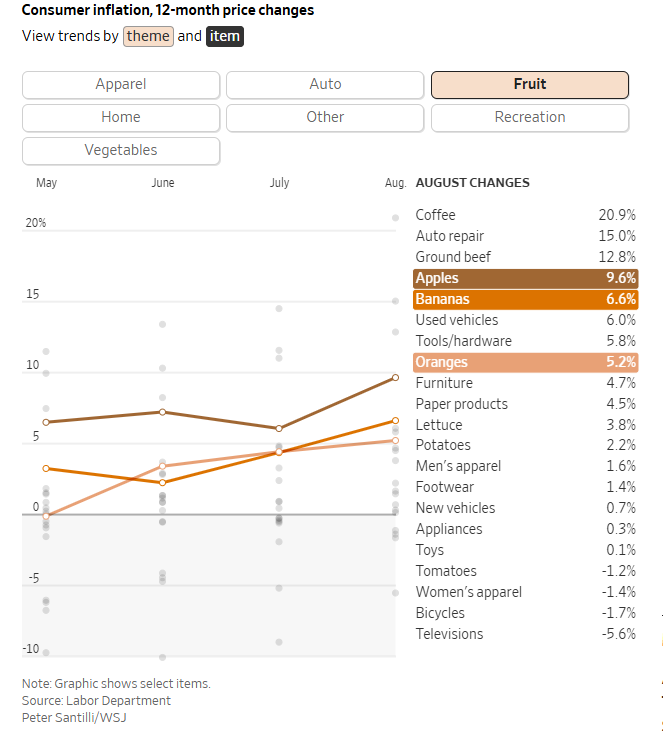
Group 1 - The Consumer Price Index (CPI) for August increased by 2.9% year-on-year, returning to the highest level since the beginning of the year, significantly up from 2.7% in July and 2.3% in April, aligning with market expectations [1] - The core CPI, excluding food and energy, rose by 3.1% year-on-year, indicating persistent inflationary pressures [1] - The labor market shows signs of weakness, with initial jobless claims rising to 263,000, the highest since October 2021, suggesting a potential shift towards more layoffs [1] Group 2 - U.S. stock indices reached new historical highs as investors bet on multiple rate cuts by the Federal Reserve, with the weak August non-farm report reinforcing expectations for a September rate cut [2] - Price pressures from tariffs are showing a mixed impact, with certain categories like automobiles and clothing seeing accelerated price increases, while others like tires and furniture have seen reduced price hikes [2] - Companies are extending the cost-sharing period to avoid sudden price spikes, with retailers like Walmart and Target implementing gradual price adjustments related to tariffs [5] Group 3 - The Federal Reserve faces a dilemma in determining whether tariff-driven inflation is temporary or persistent, with recent comments suggesting that a weakening labor market may lead to inflation being viewed as a one-time shock [6] - Market expectations indicate a 25 basis point rate cut in September, with two additional cuts by year-end, totaling 75 basis points [6] - Ongoing inflation combined with a weak job market is straining consumer purchasing power, potentially complicating the Fed's decision-making between stimulating the economy and controlling inflation [7]
8月美国通胀数据解读:汽车推涨商品通胀
CAITONG SECURITIES· 2025-09-12 05:48
Inflation Overview - August CPI year-on-year growth increased to 2.9%, up from the previous month, with a month-on-month increase of 0.4%[3] - Core CPI year-on-year growth remained stable but slightly increased by 0.05 percentage points[3] Commodity Inflation - Core commodity year-on-year growth reached 1.5%, the highest since June 2023, with a month-on-month increase of 0.3 percentage points[4] - Used car prices surged, with a year-on-year growth rate of 6% and a month-on-month increase of 1%[4] - New car prices increased to a year-on-year growth of 0.7%[4] Energy Inflation - CPI energy component year-on-year growth turned positive at 0.2%, up 1.8 percentage points from the previous month[11] - Brent crude oil average price fell to $68.4 per barrel, influenced by easing geopolitical tensions[11] Service Inflation - Core service year-on-year growth remained stable at 3.6%, with a slight month-on-month decrease to 0.3%[4] - Owner's equivalent rent year-on-year growth decreased by 0.1 percentage points to 4%[4] Market Expectations - Market anticipates an average of 2.9 interest rate cuts within the year, with a strong expectation for a cut in September[4] - Recent labor market adjustments indicate a potential oversupply, impacting inflation expectations[4] Risk Factors - Risks include unexpected downturns in the U.S. economy and potential over-tightening by the Federal Reserve[23]
【广发宏观陈嘉荔】美国通胀和就业数据对照加大9月降息概率
郭磊宏观茶座· 2025-09-12 03:36
Core Viewpoint - The article discusses the recent trends in the US inflation data, highlighting the resilience of inflation despite some structural differences, and the implications for monetary policy, particularly regarding the likelihood of interest rate cuts by the Federal Reserve [1][5][21]. Inflation Data Summary - In August, the US CPI increased by 2.9% year-on-year, up from 2.7% in July, and the month-on-month increase was 0.4%, exceeding the expected 0.3% [1][5]. - Core CPI also remained stable, with a year-on-year increase of 3.1% and a month-on-month increase of 0.3%, aligning with market expectations [1][5]. - The inflation peak occurred in June 2022 at 9.1%, followed by a downward trend, with a low of 2.3% in April 2025 before gradually rebounding [1][5]. Core Goods Prices - Core goods prices rose by 1.5% year-on-year in August, marking the fifth consecutive month of increase, with a month-on-month rise of 0.3% [2][11]. - Factors contributing to this increase include a rebound in used car prices and price hikes in various goods affected by tariffs, such as televisions (+2.5%) and new cars (+0.3%) [2][11][12]. - Some goods, like footwear (-0.4%) and personal computers (-0.6%), saw price declines, indicating mixed impacts from tariffs [2][11]. Services Prices - Core services CPI remained sticky, with a year-on-year increase of 3.6% and a month-on-month increase of 0.4% [3][18]. - Housing costs, particularly owners' equivalent rent, were significant contributors, with a month-on-month increase of 0.4% [3][18]. - The supercore services category (excluding housing) saw a slight decrease in month-on-month growth to 0.3% from 0.5% [3][20]. Employment Data - Initial jobless claims rose by 27,000 to 263,000, surpassing market expectations, indicating a cooling labor market [4][25]. - The increase in jobless claims, combined with previous non-farm payroll slowdowns, suggests a significant weakening in employment signals [4][25]. Market Reactions - Following the inflation data release, the probability of a rate cut in September rose to 93.9% from 91.1% [4][26]. - US Treasury yields fell, with the 2-year yield down 2 basis points to 3.52% and the 10-year yield down 3 basis points to 4.01% [4][26]. - The US dollar index weakened to 97.53, while major US stock indices rose, particularly the Russell 2000 index, which saw significant gains [4][26].