高端化

Search documents
本钢板材:跑出智能制造“加速度”,轻量化汽车钢夯实长远发展基础
Zheng Quan Shi Bao Wang· 2025-09-05 09:41
Core Viewpoint - The company is making significant progress in reducing losses and enhancing its operational efficiency through cost-cutting measures and a focus on high-end product development, particularly in the automotive steel sector. Group 1: Financial Performance - In the first half of 2025, the company produced 5.1997 million tons of pig iron, 5.4165 million tons of crude steel, and 8.1616 million tons of steel, achieving a total revenue of 24.698 billion yuan, which shows a year-on-year decline but a quarter-on-quarter recovery [1] - The company's net profit attributable to shareholders decreased by 9.21% year-on-year, indicating a significant reduction in losses, primarily due to cost reduction and efficiency improvement initiatives [1] Group 2: Product Development and Innovation - The company is advancing its high-end product strategy, with key products' proportion increasing by 31% year-on-year and sales of hot-formed products rising by 89%, contributing an additional profit of 27.37 million yuan from high-value new products [2] - The company has successfully rolled out ultra-wide hot-rolled plates, setting a new domestic record, and is leveraging smart technology with a data assetization rate of 88% [2] Group 3: Energy and Environmental Initiatives - The company is actively pursuing green and low-carbon development, achieving a 27%-40% reduction in carbon emissions through various initiatives, including green factory applications and low-carbon product certifications [3] - The company is focusing on optimizing its energy structure and reducing major pollutants and energy consumption in key production processes [3] Group 4: Industry Outlook - The steel industry is expected to benefit from improved supply-demand dynamics, with leading steel enterprises likely to see a recovery in profitability and valuation due to ongoing industry consolidation and supportive policies [4] - The company is accelerating the development of lightweight automotive steel to meet the growing demand for safety, low carbon, and environmental sustainability in the automotive sector [4]

分层竞逐 ! 看糖果品牌如何切分甜蜜蛋糕?
Sou Hu Cai Jing· 2025-09-05 02:53
Core Insights - The candy market is experiencing a shift towards innovation and segmentation, with brands focusing on enhancing consumer experiences and happiness through their products [1][2] - New consumption scenarios are emerging, driven by changing lifestyles and consumer demands, leading brands to explore new markets such as weddings and office snacks [2][4] - The high-end candy market is growing, attracting new brands that target affluent consumers seeking quality and unique experiences [3][4] - Traditional brands are facing pressure from emerging brands and are attempting to rejuvenate through product innovation and cultural engagement [5][6][7] - Functional candies are on the rise, but the market faces challenges due to a lack of research backing their health claims [9][10] - The candy market is characterized by a division between foreign brands dominating the high-end segment and local brands focusing on the mass market [16][17] Market Trends - The candy market is seeing a decline in traditional channels, prompting brands to innovate and deepen their market presence [1][2] - New consumption scenarios are being created, such as modern gifts for weddings and baby celebrations, expanding the market opportunities for candy brands [2][4] - Emerging brands are entering the high-end market, focusing on quality and unique consumer experiences, which is a response to rising consumer income levels [3][4] Brand Strategies - Successful traditional brands are leveraging product iteration, cultural storytelling, and channel innovation to attract younger consumers [5][6][7] - Some traditional brands have failed to innovate and are losing market share due to reliance on outdated products and marketing strategies [6][7] - New brands are effectively using social media and influencer marketing to build brand awareness and engage with target consumers [3][4] Consumer Behavior - The candy consumer base is diversifying, with distinct preferences emerging among different demographic groups, such as the elderly and Gen Z [14][15] - Elderly consumers prefer low-sugar and easy-to-chew products, while Gen Z seeks personalized and creatively designed candies [14][15] - Children’s candy products are marketed at higher prices, despite the actual value being questionable [15] Competitive Landscape - Foreign brands dominate the high-end candy market, leveraging their established reputation and advanced product development capabilities [16][17] - Local brands are focusing on the mass market, benefiting from lower transportation costs and the ability to cater to local tastes [16][17] - The competitive landscape is evolving, with local brands gradually moving towards the high-end market as they grow and develop [16][17]

每日市场观察-20250905
Caida Securities· 2025-09-05 02:24
Market Overview - On September 4, the market experienced a significant decline, with the ChiNext Index leading the drop, falling over 6%. The Shanghai Composite Index decreased by 1.25%, while the Shenzhen Component Index fell by 2.83% and the ChiNext Index dropped by 4.25% [3] - The net outflow of funds on September 4 was 440.90 billion CNY for the Shanghai Stock Exchange and 360.67 billion CNY for the Shenzhen Stock Exchange. The top three sectors for fund inflow were general retail, photovoltaic equipment, and securities, while the sectors with the highest outflow were semiconductors, communication equipment, and components [3] Industry Dynamics - The home appliance industry demonstrated resilience in the first half of the year, with 101 A-share home appliance companies achieving a total revenue of 867.06 billion CNY, a year-on-year increase of 8.32%. The net profit attributable to shareholders was 70.08 billion CNY, reflecting a growth of 12.85% [7] - The learning tablet market in China saw a year-on-year shipment increase of 44.6% in Q2 2025, with 1.54 million units shipped. The market is characterized by a "Matthew effect," where leading manufacturers are consolidating their competitive advantages, with the top five companies holding a combined market share of 82.3% [8][9] - The PC market in mainland China experienced a year-on-year growth of 12% in Q2 2025, with shipments reaching 10.2 million units. Both consumer and commercial demand showed positive performance, with respective growth rates of 13% and 12% [10] Policy and Regulatory Updates - The Ministry of Industry and Information Technology and the State Administration for Market Regulation issued the "Action Plan for Stable Growth of the Electronic Information Manufacturing Industry (2025-2026)," targeting an average growth rate of around 7% for the value added of major electronic manufacturing sectors and a revenue growth rate of over 5% for the electronic information manufacturing industry as a whole [4] - The China Listed Companies Association reported that R&D investment by listed companies in the first half of 2025 exceeded 810 billion CNY, marking a year-on-year increase of 3.27% and an acceleration of nearly 2 percentage points compared to the previous year [5]
两部门印发行动方案:确定电子信息制造业今明两年稳增长路径
Shang Hai Zheng Quan Bao· 2025-09-04 23:38
Core Viewpoint - The Ministry of Industry and Information Technology and the State Administration for Market Regulation jointly issued the "Action Plan for Steady Growth of the Electronic Information Manufacturing Industry 2025-2026," outlining 16 specific measures for industry development across three dimensions: industrial upgrading, market facilitation, and innovation integration [1][2]. Group 1: Industry Growth Targets - The plan sets a target for the average growth rate of the value-added output of large-scale computer, communication, and other electronic equipment manufacturing industries to be around 7% from 2025 to 2026, with an overall annual revenue growth rate of over 5% when including related fields such as lithium batteries and photovoltaics [1]. - By 2026, the electronic information manufacturing industry is expected to maintain the highest revenue scale and export ratio among 41 industrial categories, with five provinces achieving over 1 trillion yuan in revenue [1]. - The server industry is projected to exceed 400 billion yuan, and the domestic market penetration rate for color TVs of 75 inches and above is expected to surpass 40% [1]. Group 2: Industry Upgrading and Innovation - The plan emphasizes industrial transformation and upgrading as a core strategy for steady growth, focusing on enhancing the quality of the supply system in key areas [1]. - In the field of artificial intelligence terminals, the plan encourages deep integration of intelligent systems with terminal products and the establishment of standards for intelligent classification [2]. - It also highlights the need to accelerate technological breakthroughs in key components for 5G/6G and strengthen the technological foundation of the communication industry [1][2]. Group 3: Market Expansion and Consumer Support - The plan proposes systematic governance measures to address "involution" competition in fields like photovoltaics, including legal regulation of low-price competition and promoting orderly capacity adjustments [2]. - It aims to expand consumption scenarios by enhancing the design of smart products for the elderly and increasing the supply of smart health and elderly care terminals [2]. - The plan also focuses on advancing the construction of advanced computing systems, such as AI servers and efficient storage, to support sectors like scientific research and autonomous driving [2]. Group 4: Financial and Industrial Integration - The plan calls for the establishment of a financial service system that aligns with industrial innovation, leveraging various national funds to guide investment in hard technology [3]. - It encourages reasonable mergers, restructuring, and transformation of enterprises to promote a virtuous cycle of fundraising, investment, management, and exit [3]. - The electronic information manufacturing industry has become a significant engine for industrial growth, with a reported year-on-year increase of 11.1% in value-added output for large-scale electronic information manufacturing in the first half of the year [3].
比亚迪(002594):销量环比增长,出海销量维持高位
Changjiang Securities· 2025-09-04 23:30
Investment Rating - The investment rating for BYD is "Buy" and is maintained [6]. Core Views - BYD's overall sales in August reached 374,000 units, showing a year-on-year increase of 0.1% and a month-on-month increase of 8.5%. Passenger car sales were 372,000 units, with a year-on-year increase of 0.2% and a month-on-month increase of 8.9% [2][4]. - The company's export sales remained high, with August exports at 80,000 units, a year-on-year increase of 155.8% and a month-on-month increase of 0.4%. Cumulatively, from January to August 2025, total sales reached 2.864 million units, up 23.0% year-on-year, while cumulative export sales were 623,000 units, up 135.4% year-on-year [2][9]. - The company is focusing on overseas market expansion and high-end product offerings, with significant growth in sales from models like Ocean Series, Fangchengbao, and Tengshi. The introduction of new models is expected to enhance performance further [9]. Summary by Sections Sales Performance - In August, BYD's total sales were 374,000 units, with a breakdown showing Ocean Series at 343,000 units, Fangchengbao at 16,000 units, and Tengshi at 12,000 units. Year-on-year changes were -3.6%, +233.6%, and +20.1% respectively, while month-on-month changes were +8.8%, +14.7%, and +5.4% [2][9]. Export and Market Expansion - The company has established four overseas factories in Thailand, Uzbekistan, Brazil, and Hungary, and is expanding into Vietnam, Pakistan, and Tunisia. This local production is expected to support global electric vehicle transitions and enhance export volumes [9]. Financial Projections - BYD's projected net profit for 2025 is 44.6 billion yuan, reflecting the anticipated benefits from overseas expansion and high-end product launches [9].

调整期行业结构未见变化 优势向谁集中?
Nan Fang Du Shi Bao· 2025-09-04 23:07
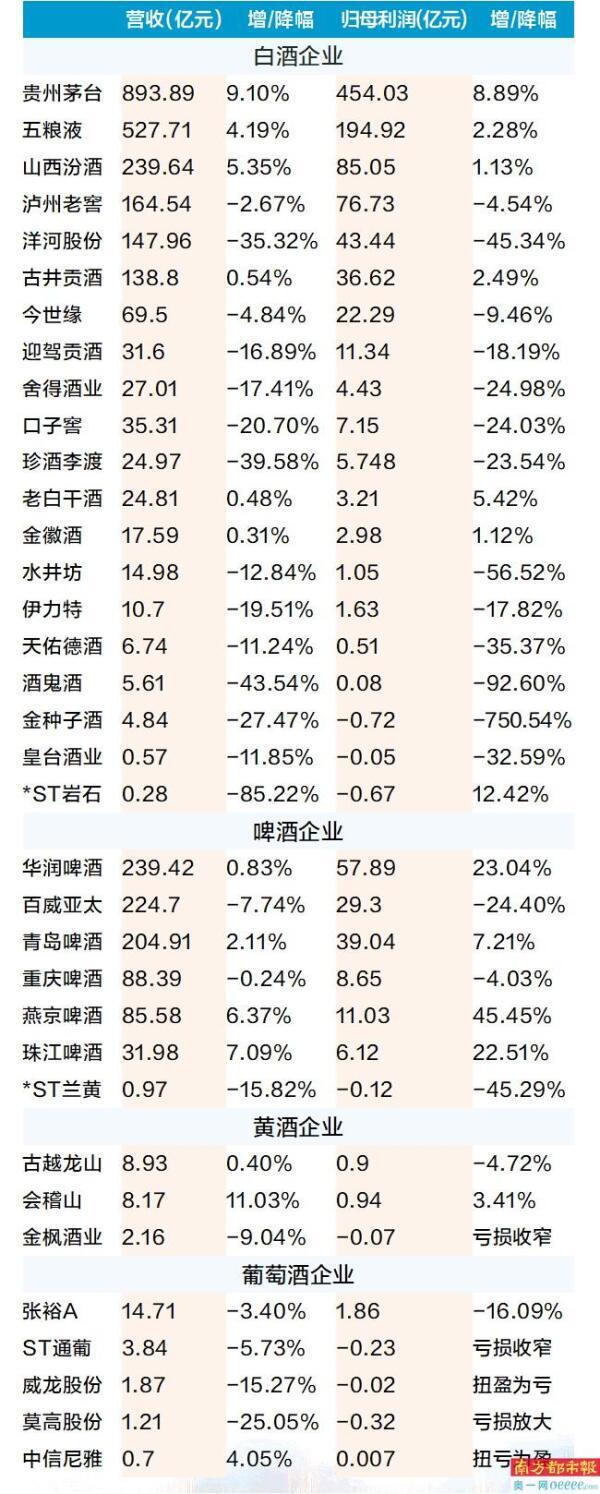
Summary of Key Points Core Viewpoint - The alcoholic beverage industry in China is undergoing a significant adjustment phase, with varying performance across different segments such as baijiu, beer, yellow wine, and wine. While some companies are experiencing declines, others are managing to maintain or grow their revenues through strategic adjustments and market focus [3][4][14]. Baijiu Industry - The baijiu sector is the most affected by the adjustment phase, with 13 out of 20 listed companies reporting declines in both revenue and net profit. Only 6 companies showed growth in both metrics [4][5]. - Major players like Kweichow Moutai, Wuliangye, and Shanxi Fenjiu have managed to maintain growth, while smaller companies face more significant declines [4][5]. - Companies are adopting strategies to address inventory issues and optimize product channels, attributing performance declines to proactive adjustments rather than market weakness [5][6]. Beer Industry - The beer industry is showing signs of recovery, with leading companies like China Resources Beer and Qingdao Beer reporting growth in both revenue and net profit. In contrast, foreign companies like Budweiser APAC are experiencing declines [6][7]. - The high-end segment continues to be a focal point, with companies competing in the premium market, while the 8 yuan price range is emerging as a new growth driver [7][8]. - Beer companies are also diversifying into other beverage sectors to seek new growth opportunities [8][9]. Yellow Wine Industry - The yellow wine sector is struggling to achieve collective growth, with only a few companies like Kuaijishan showing positive performance. The market remains heavily concentrated in the Jiangsu and Zhejiang regions [10][11]. - Despite the introduction of new products aimed at younger consumers, overall performance remains lackluster, with traditional products still driving most sales [10][11]. Wine Industry - The wine market is in a deep adjustment phase, with most companies reporting revenue declines. The market is heavily impacted by the increasing share of imported wines, which continue to challenge domestic brands [12][13]. - Companies are exploring new sales channels, such as live e-commerce, to boost performance and adapt to changing consumer preferences [13][14]. - The emotional value of wine consumption, such as "self-drinking" and "social drinking," is seen as a potential avenue for recovery in the domestic market [13][14].




二季度净利润大增139%,舍得酒业,熬过“至暗时刻”
Tai Mei Ti A P P· 2025-09-04 02:27
Core Viewpoint - Shede Liquor's financial report for the first half of the year shows a decline in both revenue and net profit, but there are signs of recovery in the second quarter, leading to a positive market response [1][2][4]. Financial Performance - In the first half of the year, Shede Liquor achieved revenue of 2.701 billion yuan, a year-on-year decrease of 17.01%, and a net profit of 443.3 million yuan, down 24.98% [1]. - In the second quarter, revenue was 1.125 billion yuan, a decline of only 3.44%, and net profit increased significantly by 139.48% to 97.17 million yuan [1]. - The stock price of Shede Liquor rose significantly, with a 30.1% increase over the past 11 trading days, outperforming the liquor sector and the broader market [1]. Strategic Adjustments - Shede Liquor has been in a downward adjustment cycle for several years, with four consecutive quarters of declining performance until signs of stabilization appeared in the second quarter of this year [2][4]. - The company has shifted its focus from high-end products to ordinary liquor, which has positively impacted its performance [6][8]. - Revenue from ordinary liquor increased by 15.86% year-on-year to 444.9 million yuan, with its share of total revenue rising by 4.73% [5][6]. Market Position and Competition - The liquor industry is characterized by a "pyramid" competition structure, with top brands like Moutai and Wuliangye dominating the high-end market, while Shede operates in a more competitive mid-range market [7]. - The company's sales expenses have decreased, contributing to improved net profit, as the focus on ordinary liquor has reduced marketing costs [8][9]. Challenges Ahead - Despite the recovery in the second quarter, Shede Liquor faces significant challenges, including pressure from distributors and high inventory levels [8][10]. - The number of distributors has decreased, and the company has shifted to direct sales channels, which may not be sustainable in the long term [8][9]. - Inventory levels have risen, with a significant portion of stock not translating into market competitiveness, indicating potential future challenges [10].

趋势研判!2025年中国读卡器行业发展历程、产业链、市场规模、重点品牌及发展趋势分析:数据传输与存储需求日益增长,读卡器规模将超200亿元[图]
Chan Ye Xin Xi Wang· 2025-09-04 01:30
Core Insights - The card reader industry in China is experiencing significant growth, with the market size projected to increase from 12 billion yuan in 2020 to 18.5 billion yuan in 2024, representing a compound annual growth rate (CAGR) of 11.43% [1][11] - The integration of 5G and IoT technologies is expected to further enhance the role of card readers as critical interfaces connecting the physical and digital worlds, with the market size anticipated to reach 20.8 billion yuan by 2025 [1][11] - The industry is characterized by a competitive landscape with both international and domestic players, where international brands dominate the high-end market while local brands focus on cost-effective solutions [1][12] Industry Overview - Card readers are specialized tools for reading data from storage and smart cards, connecting with devices like computers, smartphones, and cameras [3][11] - The evolution of card readers has seen them transition from basic data reading to incorporating encryption algorithms for identity verification and access management [1][11] Industry Development History - The origins of card readers date back to the 1970s with magnetic stripe card readers, evolving through the 1990s with the introduction of compact flash and smart media cards [5][6] - The 21st century saw a surge in digital products, leading to innovations in card reader technology, including support for multiple card types and wireless reading capabilities [5][6] Industry Chain - The card reader industry chain consists of upstream raw materials and components, midstream manufacturing, and downstream applications in various sectors such as digital imaging, financial payment terminals, and IoT [6][7] Chip Industry Insights - Chips are the core components of card readers, responsible for reading card information and performing encryption and decryption [8] - China's chip production reached 451.42 billion units in 2024, showing a year-on-year growth of 14.38%, indicating a recovery in the semiconductor industry [8] Financial Sector Impact - The financial sector is a significant application area for card readers, particularly for reading and verifying financial IC cards, with the financial industry's added value growing from 6.48 trillion yuan in 2017 to 9.85 trillion yuan in 2024, a CAGR of 6.16% [9][10] Current Market Trends - The card reader industry is moving towards smart, high-end, and integrated solutions, with products increasingly featuring intelligent diagnostics, high-speed data transfer capabilities, and multifunctional designs [13][14][15]

拆解赛力斯盈利模型:如何把高端做成生意
21世纪经济报道· 2025-09-03 23:45
Core Viewpoint - The company, Seres, has demonstrated impressive financial performance in the first half of 2025, achieving a net profit of 2.94 billion yuan, a year-on-year increase of 81.03%, despite a general decline in profits across the global and Chinese automotive markets [1][2]. Financial Performance - In the first half of 2025, Seres reported operating revenue of 62.40 billion yuan, a decrease of 4.06% compared to the same period last year [2]. - The total profit for the period was 3.72 billion yuan, reflecting a significant increase of 119.22% year-on-year [2]. - The net profit attributable to shareholders reached 2.94 billion yuan, marking an 81.03% increase from the previous year [2]. - The comprehensive gross margin rose to 28.93%, an increase of approximately 4.9 percentage points year-on-year, surpassing some leading domestic automakers [3]. Product Strategy - The high-end models, Wanjie M9 and M8, have become the main sales drivers, with nearly 100,000 units delivered in the first half of the year, accounting for nearly 70% of the total sales of the Wanjie series [3]. - The Wanjie M9 has sold approximately 60,000 units, ranking first in the large SUV sales category, while the M8 has sold 35,000 units, leading in the 400,000 yuan market segment [3]. Market Positioning - Seres has effectively covered the mainstream price range of 200,000 to 600,000 yuan with its models M5, M7, M8, and M9, targeting different consumer segments [5]. - The company has adopted a unique approach to high-end positioning, focusing on a blend of traditional luxury and technological innovation, redefining the concept of luxury in the automotive market [4][7]. Profitability Model - The profitability surge is attributed to a shift from volume-driven growth to quality-driven output, with a focus on high-end models that enhance profit margins [9][12]. - The single-vehicle profit for Seres reached 21,000 yuan, a substantial increase of 44.4% year-on-year, indicating a transition to a healthier financial model [12]. Cash Flow and Financial Health - The net cash flow from operating activities was 14.44 billion yuan, significantly exceeding net profit, indicating strong cash support behind profits [12][13]. - The financial expenses for the first half of the year were recorded at -2.77 billion yuan, suggesting that interest income surpassed interest expenses, reflecting robust cash management capabilities [12]. Research and Development - Seres increased its R&D investment by 154.9% year-on-year, totaling 5.198 billion yuan, demonstrating a commitment to long-term technological capabilities [13]. - The "Seres Cube Technology Platform" enables modular development and rapid iteration, reducing costs and development cycles for new models [13]. Industry Perspective - Seres' success represents a shift in the Chinese automotive industry's competitive logic, moving from a focus on volume to a new phase of profitability, system efficiency, and sustainability [15].


广联航空:构建多元化发展格局
Zheng Quan Ri Bao Zhi Sheng· 2025-09-03 09:17
Core Viewpoint - Guanglian Aviation announced its strategic focus on high-end, intelligent, and green transformation in manufacturing, emphasizing a comprehensive layout across "sea-land-air-space" equipment systems [1] Group 1: Business Strategy - The company is driving its business towards high value-added areas through dual engines of aviation tooling and aerospace components, as well as drone business [1] - Guanglian Aviation is expanding into emerging fields such as marine and commercial aerospace, aiming to build a diversified development pattern [1]