
扩内需政策

Search documents
11月CPI同比升至20个月新高,发生了什么
第一财经· 2025-12-10 04:01
Core Viewpoint - The article discusses the latest Consumer Price Index (CPI) and Producer Price Index (PPI) data released by the National Bureau of Statistics, highlighting a recovery in consumer spending and the impact of various factors on price changes in November 2024 [3]. Group 1: CPI Analysis - In November, the CPI increased by 0.7% year-on-year, the highest since March 2024, driven primarily by a turnaround in food prices, which shifted from a 2.9% decline to a 0.2% increase [3]. - Fresh vegetable prices saw a significant change, rising by 14.5% year-on-year after nine consecutive months of decline, contributing approximately 0.49 percentage points to the CPI [3]. - Core CPI, excluding food and energy, rose by 1.2% year-on-year, maintaining a growth rate above 1% for three consecutive months, with notable increases in household appliances and clothing prices [6]. Group 2: PPI Analysis - The PPI increased by 0.1% month-on-month in November, marking the second consecutive month of growth, influenced by seasonal demand increases in certain domestic industries [8]. - Year-on-year, the PPI decreased by 2.2%, with the decline rate widening by 0.1 percentage points compared to the previous month, primarily due to high comparison bases from the previous year [9]. - Prices in key industries such as coal mining and photovoltaic equipment manufacturing showed a narrowing of year-on-year decline rates, indicating improvements in market competition and production capacity management [9]. Group 3: Future Outlook - The article suggests that the CPI is likely to continue rising in the coming months due to low comparison bases and effective consumption promotion policies, with a projected central inflation level of around 0.7% for the fourth quarter [10]. - The PPI is expected to show positive changes that could benefit business operations and economic circulation, emphasizing the need for continued expansion of domestic demand and effective investment [10].


11月CPI同比升至20个月新高,发生了什么
Di Yi Cai Jing· 2025-12-10 03:45
扣除食品和能源价格的核心CPI同比上涨1.2%。 国家统计局12月10日发布最新居民消费价格指数(CPI)和工业生产者出厂价格指数(PPI)数据。 随着扩内需政策持续落地见效,居民消费持续恢复,11月份CPI同比上涨0.7%,为2024年3月份以来最 高。受国内部分行业供需结构优化、国际大宗商品价格传导等因素影响,PPI环比上涨0.1%,同比下降 2.2%。 国家统计局城市司首席统计师董莉分析,11月CPI同比上涨0.7%,涨幅比上月扩大0.5个百分点,同比涨 幅扩大主要是食品价格由降转涨拉动。食品价格由上月下降2.9%转为上涨0.2%,对CPI同比的影响由上 月下拉0.54个百分点转为上拉0.04个百分点。 食品中,鲜菜价格由上月同比下降7.3%转为上涨14.5%,为连续下降9个月后首次转涨,对CPI同比的上 拉影响比上月增加约0.49个百分点;鲜果价格由上月下降2.0%转为上涨0.7%;猪肉和禽肉类价格分别同 比下降15.0%和0.6%,降幅均有收窄。 PPI同比下降2.2%,降幅比上月扩大0.1个百分点,主要受上年同期对比基数走高影响。 董莉娟表示,我国各项宏观政策不断显效,价格呈现积极变化。综合整治" ...
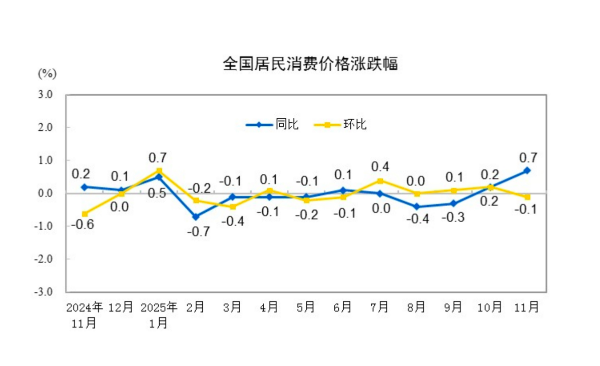
国家统计局解读:11月居民消费持续恢复 CPI同比涨幅扩大 核心CPI继续上涨
智通财经网· 2025-12-10 01:51
——国家统计局城市司首席统计师董莉娟解读2025年11月份CPI和PPI数据 智通财经APP获悉,12月10日,国家统计局城市司首席统计师董莉娟解读2025年11月份CPI和PPI数据。 11月份,居民消费持续恢复,居民消费价格指数(CPI)环比略降0.1%,同比上涨0.7%,扣除食品和能源 价格的核心CPI同比上涨1.2%。受国内部分行业供需结构优化、国际大宗商品价格传导等因素影响,工 业生产者出厂价格指数(PPI)环比上涨0.1%,同比下降2.2%。董莉表示,CPI同比涨幅扩大主要是食品价 格由降转涨拉动,CPI环比下降主要受服务价格季节性下降影响。本月PPI环比运行的主要特点:一是国 内部分行业需求季节性增加带动其价格上涨。二是输入性因素影响国内有色金属和石油相关行业价格走 势分化。PPI同比下降主要受上年同期对比基数走高影响。 原文如下: 2025年11月份CPI同比涨幅扩大 核心CPI继续上涨 11月份,居民消费持续恢复,居民消费价格指数(CPI)环比略降0.1%,同比上涨0.7%,扣除食品和能源 价格的核心CPI同比上涨1.2%。受国内部分行业供需结构优化、国际大宗商品价格传导等因素影响,工 业生 ...
国家统计局解读2025年11月份CPI和PPI数据
Guo Jia Tong Ji Ju· 2025-12-10 01:43
Group 1: CPI Analysis - The Consumer Price Index (CPI) increased by 0.7% year-on-year, marking the highest growth since March 2024, with a rise of 0.5 percentage points from the previous month [2] - Food prices shifted from a decline of 2.9% to an increase of 0.2%, contributing positively to the CPI, with fresh vegetable prices rising by 14.5% after nine months of decline [2] - Core CPI, excluding food and energy, rose by 1.2%, maintaining above 1% for three consecutive months, driven by increases in service prices and industrial consumer goods [2][3] Group 2: PPI Analysis - The Producer Price Index (PPI) increased by 0.1% month-on-month, marking two consecutive months of growth, influenced by seasonal demand increases in certain domestic industries [4] - Year-on-year, the PPI decreased by 2.2%, with the decline slightly widening by 0.1 percentage points compared to the previous month, primarily due to high comparison bases from the previous year [6] - The prices in key industries such as coal mining and photovoltaic equipment manufacturing showed a narrowing decline, indicating improvements in market competition and policy effectiveness [6]
国家统计局:11月份CPI同比涨幅扩大 核心CPI继续上涨
Di Yi Cai Jing· 2025-12-10 01:41
CPI同比上涨0.7%,为2024年3月份以来最高,同比涨幅扩大主要是食品价格由降转涨拉动。 12月10日,国家统计局城市司首席统计师董莉娟解读2025年11月份CPI和PPI数据。 11月份,居民消费持续恢复,居民消费价格指数(CPI)环比略降0.1%,同比上涨0.7%,扣除食品和能 源价格的核心CPI同比上涨1.2%。受国内部分行业供需结构优化、国际大宗商品价格传导等因素影响, 工业生产者出厂价格指数(PPI)环比上涨0.1%,同比下降2.2%。 一、CPI同比涨幅扩大,核心CPI上涨1.2% CPI同比上涨0.7%,涨幅比上月扩大0.5个百分点,为2024年3月份以来最高,同比涨幅扩大主要是食品 价格由降转涨拉动。食品价格由上月下降2.9%转为上涨0.2%,对CPI同比的影响由上月下拉0.54个百分 点转为上拉0.04个百分点。食品中,鲜菜价格由上月下降7.3%转为上涨14.5%,为连续下降9个月后首次 转涨,对CPI同比的上拉影响比上月增加约0.49个百分点;鲜果价格由上月下降2.0%转为上涨0.7%;牛 肉和羊肉价格分别上涨6.2%和3.7%,涨幅均有扩大;猪肉和禽肉类价格分别下降15.0%和0.6 ...
东吴证券晨会纪要-20251210
Soochow Securities· 2025-12-10 00:43
Macro Strategy - The report highlights a shift in policy focus from "preventing and mitigating risks in key areas and external shocks" to "better coordinating domestic economic work and international economic struggles," indicating a more proactive approach to external economic conditions [1][15] - There is a transition from stabilizing asset prices to stabilizing microeconomic entities, emphasizing the importance of employment, enterprises, markets, and expectations over real estate and stock markets [2][15] - The policy language has evolved from "extraordinary counter-cyclical adjustments" to "increasing counter-cyclical and cross-cyclical adjustment efforts," reflecting a balance between short-term stimulus and long-term economic structure considerations [2][15] Industry Insights - The food and beverage industry strategy for 2026 emphasizes stock selection based on certainty, focusing on growth and turnaround opportunities, particularly in leading snack companies and quality retail chains [9] - The report suggests a keen interest in the health products sector, driven by an aging population and expanding young consumer demographics, with a focus on innovation and iteration in product offerings [9] - In the phosphoric chemical industry, companies with phosphate iron and phosphate rock resources are recommended, highlighting the significant cost contribution of phosphate sources to phosphate iron production [10] - The non-ferrous metals sector is experiencing price increases, with copper prices rising due to supply tightening and demand fluctuations, while aluminum prices are also on the rise amid stable production [11][12]
1-10月全国规上工业企业利润同比增1.9%,企业利润稳增长
Bei Ke Cai Jing· 2025-11-28 03:27
Core Insights - The total profit of industrial enterprises above designated size in China reached 59,502.9 billion yuan from January to October, marking a year-on-year increase of 1.9%, with growth sustained for three consecutive months since August [1] Group 1: Profit Growth and Industry Performance - The operating income of industrial enterprises above designated size increased by 1.8% year-on-year, creating favorable conditions for profit recovery [2] - Profit growth is notably driven by the equipment manufacturing and high-tech manufacturing sectors, with equipment manufacturing profits rising by 7.8%, contributing 2.8 percentage points to the overall profit growth of industrial enterprises [3] - High-tech manufacturing profits grew by 8%, significantly outpacing the average profit growth of all industrial enterprises by 6.1 percentage points [4] Group 2: Enterprise Type Performance - State-owned enterprises' profits remained flat year-on-year, while joint-stock enterprises saw a profit increase of 1.5%, foreign and Hong Kong-Macau-Taiwan invested enterprises grew by 3.5%, and private enterprises experienced a profit growth of 1.9% [4] Group 3: Economic Indicators and Challenges - Industrial production activities remained active, with an industrial added value growth of 6.1% year-on-year, although the growth rate slightly declined by 0.1 percentage points compared to the previous three quarters [5] - The Producer Price Index (PPI) and the PPI for production materials both showed negative year-on-year growth, indicating ongoing pressure on industrial enterprise profits [5] - The accounts receivable for industrial enterprises stood at 27.69 trillion yuan, reflecting a year-on-year increase of 5.1%, while finished goods inventory rose by 3.7% to 6.82 trillion yuan, indicating challenges in sales collection and inventory reduction [5] Group 4: Future Outlook - The future profit trajectory for enterprises is expected to remain stable and positive, supported by demand and supply-side policies [6][8] - The recovery in industrial enterprise profits is attributed to export boosts and policy enhancements, although challenges remain due to slowing export growth and structural imbalances in supply and demand [7] - Analysts predict that the overall profit growth for industrial enterprises may continue to show positive growth for the year, with potential for the first annual profit increase in four years [9]
人民币汇率创年内新高,外资却在疯狂抄底中国?真相令人意外
Sou Hu Cai Jing· 2025-11-21 16:43
Core Insights - The recent appreciation of the Chinese yuan against the US dollar has surprised many, with the exchange rate reaching 7.0905, a one-year high, indicating a stronger yuan compared to earlier this year when it hovered around 7.3 [1][3] - Despite concerns about capital outflows, foreign investment in Chinese assets has shown resilience, with northbound capital in A-shares increasing by over 380 billion yuan this year, reaching a total market value of 2.58 trillion yuan by the end of Q3 [3][4] Currency Exchange Rate - The yuan's exchange rate has improved significantly from earlier in the year, with a notable rise from 7.3 to 7.0905, marking a strong performance [1][3] - The dollar index peaked at 109.24 earlier this year, a historically high level, raising concerns about the yuan's potential depreciation [1][3] Foreign Investment Trends - Foreign capital has not fled the Chinese market as previously speculated; instead, it has been accumulating Chinese assets during market fluctuations [4][5] - As of November 18, foreign investors held significant stakes in several A-shares, with some exceeding 24% ownership, indicating strong interest [4] Institutional Perspectives - International investment banks and funds have expressed improved outlooks on Chinese assets, citing valuation advantages and supportive policies as key reasons for their optimism [5][6] - Short-term capital movements do not reflect a loss of confidence in the Chinese market; rather, they are part of normal portfolio adjustments [5][6] Economic Fundamentals - The long-term trajectory of the yuan will depend on economic fundamentals, with China's economy showing resilience, particularly in emerging sectors like renewable energy and digital economy [6][8] - The current exchange rate mechanism is more market-oriented, allowing for healthier fluctuations, which is a positive sign for the currency's stability [8][9] Investment Opportunities - The stable yuan provides a favorable environment for investment, with ongoing foreign capital inflows indicating the attractiveness of Chinese assets [10][12] - A stable exchange rate is beneficial for trade, reducing currency risk for businesses, although it may impact price competitiveness for exporters [10][12]

八大券商最新研判 明年市场这么走
Zhong Guo Zheng Quan Bao· 2025-11-20 10:29
Core Viewpoint - Multiple brokerages are optimistic about China's economy in 2026, expecting it to maintain resilience and enter a phase of high-quality development, with the A-share market continuing its upward trend, although some predict a slowdown in growth [1][3][5]. Economic Outlook - The first three quarters of 2023 showed steady progress in China's economy, with expectations that 2026 will mark the beginning of a new high-quality development phase [3]. - Macro policies are anticipated to shift from extraordinary counter-cyclical adjustments to a more normalized approach, focusing on technological self-reliance and the cultivation of new productive forces [3]. - External demand is expected to remain resilient, while internal demand will rely on fiscal efforts to boost investment in human capital and consumer supply [3]. A-share Market Trends - Since 2025, the A-share market has been on a volatile upward trajectory, with significant attention on whether this trend will continue into 2026 [5]. - Some institutions believe that the A-share market may reach a peak in spring 2026, with potential triggers for a comprehensive market rally [5]. - The market is expected to experience a critical verification period in 2026, with indices likely to remain volatile but on an upward trend [6]. Sector Focus - The technology, cyclical, and manufacturing sectors are highlighted as key areas of focus for 2026 [8]. - Specific recommendations include monitoring recovery trades in basic chemicals and industrial metals, as well as trends in AI, humanoid robots, energy storage, photovoltaics, pharmaceuticals, and military industries [8]. - Resource products may emerge as a new mainline direction following technology, driven by global monetary easing and domestic inventory cycles [9]. Investment Sentiment - The A-share market's current rally is significantly supported by retail investors, with a notable influx of high-risk preference funds [6]. - The upcoming five-year planning period is expected to yield positive market performance, aligning with policy directions [6].




申万宏源赵伟:2026年要向“改革”要红利
Zhong Zheng Wang· 2025-11-18 11:41
Core Viewpoint - The 14th Five-Year Plan period is expected to be a critical phase for comprehensive deepening of reforms, with 2026 marking the beginning of accelerated reforms since the 20th Central Committee's third plenary session [1] Group 1: Economic Outlook - Continuous deepening of domestic demand expansion policies will lead to improvements in corporate profitability during the nominal GDP recovery process [1] - Service demand within consumption is more elastic, making investment growth likely to show a "front low, back high" trend [1] Group 2: Reform Opportunities - The acceleration of reform processes is creating significant opportunities, with short-term domestic demand policies expected to strengthen under a long-term reform framework [1] - The breadth, depth, and intensity of the "dividend" from the era are closely related to the ongoing reforms [1] Group 3: Focus Areas for 2026 - Key areas to focus on in 2026 include the construction of a unified national market, development of new productive forces, reforms related to social welfare, financial and tax system reforms, and accelerating green transformation [1]