
消费品以旧换新

Search documents
上海:支持汽车报废更新 购买新能源乘用车补贴最高不超过2万元
Xin Lang Cai Jing· 2026-01-30 23:52
Core Viewpoint - The Shanghai Municipal Development and Reform Commission and the Shanghai Municipal Finance Bureau have issued a notification regarding the implementation of a large-scale equipment renewal and consumer goods trade-in policy by 2026, outlining 16 specific measures to promote equipment updates and recycling [1] Group 1: Large-scale Equipment Renewal - The notification emphasizes the importance of advancing large-scale equipment updates as a key initiative [1] - It includes measures to enhance the recycling and circular economy network [1] Group 2: Consumer Goods Trade-in - The policy supports the scrapping and updating of automobiles, providing financial incentives for consumers [1] - Personal consumers who scrap their registered passenger vehicles and purchase new energy vehicles or fuel vehicles with an engine capacity of 2.0 liters or below will receive subsidies [1] Group 3: Subsidy Details - For purchasing new energy vehicles, consumers will receive a subsidy of 12% of the vehicle price, capped at 20,000 yuan [1] - For purchasing fuel vehicles with an engine capacity of 2.0 liters or below, the subsidy will be 10% of the vehicle price, capped at 15,000 yuan [1]
利好来了!上海,重大发布!事关消费
券商中国· 2026-01-30 23:42
Core Viewpoint - Shanghai has issued a significant policy document aimed at promoting large-scale equipment updates and a trade-in program for consumer goods, focusing on various sectors including industrial, electronic information, and transportation [2][3]. Group 1: Large-Scale Equipment Updates - The policy supports applications for national equipment update projects, specifically targeting sectors such as industrial, electronic information, energy, transportation, and healthcare [5]. - It encourages the scrapping and updating of old operational trucks and the renewal of new energy city buses, with subsidies based on existing guidelines [5]. Group 2: Consumer Goods Trade-In Program - The policy outlines subsidies for scrapping and updating vehicles, with a maximum subsidy of 20,000 yuan for purchasing new energy vehicles and 15,000 yuan for 2.0L or below fuel vehicles [10]. - For household appliances, consumers can receive a subsidy of 15% of the purchase price (up to 1,500 yuan) for energy-efficient products like refrigerators and washing machines [10]. Group 3: Recycling and Resource Utilization - The initiative aims to enhance the recycling network for old equipment and consumer goods, promoting a "two-network integration" recycling system [7]. - It emphasizes the development of the resource recycling and remanufacturing industry, with a focus on high-end remanufacturing projects and improving the technology level of recycled resources [8].


财政部:2025年财政收入总体平稳运行
Shang Hai Zheng Quan Bao· 2026-01-30 20:04
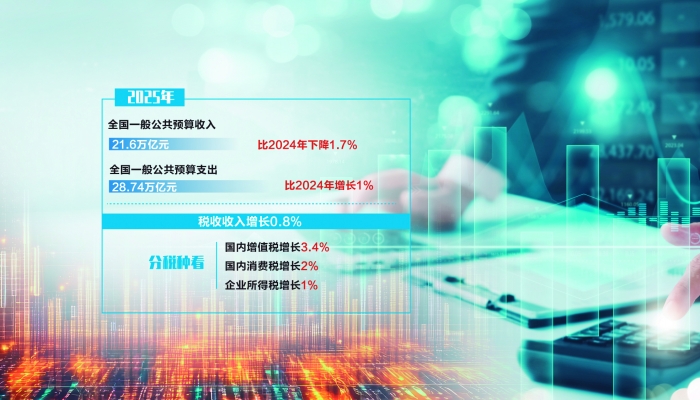
Fiscal Revenue and Expenditure - In 2025, the national general public budget revenue is projected to be 21.6 trillion yuan, a decrease of 1.7% compared to 2024 [2] - National general public budget expenditure is expected to reach 28.74 trillion yuan, an increase of 1% from 2024 [2] - Tax revenue is expected to grow by 0.8%, indicating a steady recovery in the overall fiscal revenue [2] Tax Revenue by Type - Domestic value-added tax is projected to grow by 3.4%, maintaining stable growth throughout the year [2] - Domestic consumption tax is expected to increase by 2%, driven mainly by the growth in tobacco and refined oil consumption taxes [2] - Corporate income tax is anticipated to rise by 1%, with a notable increase of 2.9 percentage points in the growth rate compared to the first half of the year, primarily supported by the manufacturing sector [2] Tax Revenue by Industry - The equipment manufacturing and modern service industries are expected to show strong tax revenue performance [2] - Tax revenue from the computer and communication equipment manufacturing industry is projected to grow by 13.5% [2] - Tax revenue from the electrical machinery and equipment manufacturing industry is expected to increase by 8% [2] - Tax revenue from scientific research and technical services is anticipated to grow by 14.3% [2] - Tax revenue from the cultural, sports, and entertainment industry is projected to rise by 7.5% [2] Regional Fiscal Performance - Out of 31 provinces, 27 are expected to see an increase in fiscal revenue compared to 2024, despite some regions experiencing declines due to falling prices of major commodities like coal [2] Childcare Subsidies - Approximately 100 billion yuan is allocated for childcare subsidies in 2025, with 90.4 billion yuan coming from the central government [3] - Over 30 million infants have already received childcare subsidies [3] - The government aims to ensure that all approved applications for 2025 are fully disbursed by the end of March 2026 [3] Hainan Free Trade Port - The Hainan Free Trade Port has seen significant growth in imports and consumption since its full operation [4] - Duty-free sales in Hainan reached 6.28 billion yuan, with 981,000 shoppers participating, marking increases of 35.9%, 21%, and 8.2% respectively [4] - The sales during the New Year holiday surged by 128.9% year-on-year [4] Consumption Promotion Policies - The Ministry of Finance has allocated 300 billion yuan in special bonds to support the consumption of old-for-new products [4] - The sales of related products under the old-for-new policy exceeded 2.6 trillion yuan, benefiting over 360 million people [5] - The sales of automobiles under this policy reached over 11.5 million units, with nearly 60% being new energy vehicles [5] - The retail sales of passenger cars increased by 3.8%, while retail sales of major appliances and communication equipment grew by 11% and 20.9% respectively [5] Pilot Programs for Consumption - A reward invoice program is set to be launched in 50 cities to stimulate consumer demand across various sectors [5] - The total GDP and retail sales of the pilot cities account for 44% of the national totals [5]
2025财政账单:个税稳定增长,育儿补贴发了1000亿
2 1 Shi Ji Jing Ji Bao Dao· 2026-01-30 13:58
21世纪经济报道记者 周潇枭 北京报道 1月30日,财政部对外发布2025年财政收支数据。 2025年全国一般公共预算收入较上年下降1.7%,主要在于2024年一次性安排中央单位上缴专项收益抬 高基数,税收收入保持小幅正增长。 具体来看,主体税种保持正增长。2025年国内增值税实现6.89万亿元,增长3.4%;国内消费税1.69万亿 元,增长2%;企业所得税4.13万亿元,增长1%;个人所得税1.62万亿元,增长11.5%。 在主体税种整体低增长的背景下,2025年个人所得税实现11.5%的高增长,这与居民收入稳步增长的密 切相关,2025年全国居民人均可支配收入4.34万元,比上年名义增长5%。 中央财经大学财政税务学院教授白彦锋对记者表示,国家税务总局近年发布的数据显示,中国个人所得 税纳税申报人员中,年收入100万元以上的高收入者约占申报人数的1%,但是这部分人申报缴纳的个税 占全部个税的五成以上;申报收入位居全国前10%的个人,缴纳个税占比九成以上。2025年以来,资本 市场持续活跃,推动了个税的较快增长。"金税四期"的上线运行、2025年10月起互联网平台企业首次正 式报送平台内经营者和从业人员相关 ...
扭稳增!苏宁易购2025预盈利,抢抓两新政策迎家电新风口
Zhong Guo Ji Jin Bao· 2026-01-30 13:44
Core Viewpoint - Suning.com is expected to achieve a net profit of 50 million to 75 million yuan for the year 2025, demonstrating resilience and solid operational fundamentals despite market challenges [1][2] Group 1: Financial Performance - The company has maintained profitability for two consecutive years by focusing on its retail service provider strategy and solidifying its core home appliance business [1] - The e-commerce segment has seen a significant revenue increase of 23.18% year-on-year, driven by the integration of online and offline consumption scenarios [2] - The sales proportion of customized products across all channels reached 23.4%, enhancing supply chain efficiency [2] Group 2: Strategic Initiatives - Suning.com has opened 79 new large experiential stores, including Suning Max and Suning Pro, as part of its large store strategy [1] - The company has launched the "Home + Plan" to empower brand partners and franchisees, enhancing customer acquisition and service capabilities [1] - The retail cloud business has shown a 15.9% year-on-year growth in self-operated product sales in the second half of the year [1] Group 3: Market Opportunities - The company is poised to leverage the upcoming "Two New" policy in 2026, which aims to support equipment updates and consumption upgrades, creating new growth opportunities [2] - Suning.com is actively exploring overseas cooperation opportunities and enhancing its core capabilities to align with current consumer upgrade trends and policy support [2] - The company is expected to benefit from its strong offline service and experience advantages as the "Two New" policy expands [2]

财政部:2025年消费品以旧换新相关产品销售额超过2.6万亿元
智通财经网· 2026-01-30 11:13
Core Insights - The Ministry of Finance announced that in 2025, the sales of products related to the consumption upgrade policy exceeded 2.6 trillion yuan, benefiting over 360 million people [1][24] - The 2025 fiscal budget showed a slight decrease in overall revenue but a stable performance in key tax categories, with a focus on social welfare and economic support measures [4][10] Group 1: Consumption Upgrade Policy - The consumption upgrade policy led to the sale of over 11.5 million vehicles through trade-in programs, with nearly 60% being new energy vehicles [1][24] - The trade-in program for home appliances saw nearly 130 million units sold, with over 90% being first-level energy-efficient products [1][24] - The sales of digital products, including mobile phones, reached over 91 million units, with mid-to-high-end models accounting for 72.5% of sales [1][24] Group 2: Fiscal Revenue and Expenditure - In 2025, the total public budget revenue was 21.6 trillion yuan, a decrease of 1.7% from 2024, with tax revenue growing by 0.8% [4][8] - Major tax categories showed varied performance, with personal income tax increasing by 11.5% and corporate income tax growing by 1% [4][9] - Total public budget expenditure was 28.74 trillion yuan, an increase of 1% from 2024, with significant growth in social security and employment spending by 6.7% [5][10] Group 3: Social Welfare Initiatives - The introduction of a universal childcare subsidy program marked a significant step in social welfare, with over 30 million infants receiving support [11][14] - Approximately 100 billion yuan was allocated for the childcare subsidy, with 90.4 billion yuan coming from central finances [12][14] - The program aims to ensure equitable access to subsidies regardless of urban or rural status, with a focus on efficient distribution and management [13][14] Group 4: Agricultural Support Measures - The Ministry of Finance emphasized food security, with a focus on increasing agricultural productivity through various support measures [15][18] - Significant funding was allocated for high-standard farmland construction, with 1,766 billion yuan dedicated to this initiative [15][18] - The total grain production reached 1.43 trillion jin in 2025, marking an increase of 168 billion jin from the previous year [19][20]
财政部:2025年中央财政出台多项政策支持提振消费
Yang Shi Xin Wen· 2026-01-30 10:58
Group 1 - The Ministry of Finance announced a series of funding policies to support the expansion of commodity consumption and optimize service consumption supply in 2025, in line with the "Special Action Plan to Boost Consumption" [1] - A total of 300 billion yuan in special long-term bonds will be allocated in four batches to support the old-for-new consumption policy, with preliminary statistics indicating that sales related to this initiative will exceed 2.6 trillion yuan, benefiting over 360 million people [1] - The old-for-new policy has led to significant sales in various sectors, including over 11.5 million vehicles (with nearly 60% being new energy vehicles), 130 million home appliances (over 90% being first-level energy-efficient products), and 91 million digital products (with 72.5% being mid-to-high-end models) [1] Group 2 - In late 2025, the Ministry of Finance, in collaboration with the Ministry of Commerce and the State Taxation Administration, will launch a prize invoice initiative in 50 cities to stimulate consumer demand across various daily consumption scenarios [2] - The selected trial cities account for approximately 44% of the national GDP and total retail sales of consumer goods, with funding to be allocated promptly after the public announcement of the city list [2]
国债期货周报:债市情绪回暖,期债窄幅震荡-20260130
Rui Da Qi Huo· 2026-01-30 08:59
1. Industry Investment Rating - There is no information about the industry investment rating in the report. 2. Core Viewpoints of the Report - The sentiment in the bond market has continued to improve, but the momentum for further decline in interest rates is insufficient. The planned issuance of local government bonds may indicate that the supply pressure in February is advancing, and the market's concerns about the imbalance between supply and demand have not been fully alleviated. The large - scale net injection of MLF this month has reduced the market's expectation of a reserve - requirement ratio cut in the first quarter. Additionally, although the equity market has cooled down under regulatory policy adjustments, market expectations remain optimistic, which may continue to suppress the bond market. It is expected that interest rates will fluctuate within a narrow range in the short term, and the market is still waiting for new incremental information to make a directional choice [105]. 3. Summary According to the Table of Contents 3.1. Market Review - **Weekly Data**: The 30 - year and 2 - year Treasury bond futures' main contracts fell by 0.34% and 0.02% respectively, while the 10 - year and 5 - year main contracts rose by 0.11% and 0.01% respectively. The trading volumes of the TF and T main contracts increased, while those of the TS and TL main contracts decreased. The open interests of the TF, TS, and TL main contracts decreased, while that of the T main contract increased [13][22][30]. 3.2. News Review and Analysis - **Domestic News**: In Q4 2025, the balance of RMB real - estate loans was 51.95 trillion yuan, a year - on - year decrease of 1.6%, with a full - year reduction of 963.6 billion yuan. The balance of real - estate development loans was 13.16 trillion yuan, a year - on - year decrease of 3.0%, with a full - year reduction of 357.5 billion yuan. The balance of personal housing loans was 37.01 trillion yuan, a year - on - year decrease of 1.8%, with a full - year reduction of 676.8 billion yuan. In 2025, the total profit of large - scale industrial enterprises was 7.3982 trillion yuan, a year - on - year increase of 0.6%, and in December, the profit increased by 5.3% year - on - year. The National Tax Work Conference proposed to strengthen the standardization of tax incentives. The State Council issued a work plan to cultivate new growth points in service consumption [33][34]. - **Overseas News**: The Fed maintained the benchmark interest rate at 3.50% - 3.75%. The US Senate failed to advance the government appropriation bill, and the US federal government faced a partial shutdown crisis [35]. 3.3. Chart Analysis - **Spread Changes**: The spread between 10 - year and 5 - year Treasury bond yields widened, while the spread between 10 - year and 1 - year yields narrowed. The spreads between the 2 - year and 5 - year, and 5 - year and 10 - year main contracts widened. The inter - period spread of the 10 - year contract narrowed, while that of the 30 - year contract widened. The inter - period spread of the 5 - year contract narrowed, and that of the 2 - year contract widened [43][49][53]. - **Main Contract Position Changes**: The net short positions of the top 20 holders in the T Treasury bond futures' main contract increased significantly [66]. - **Interest Rate Changes**: The 2 - week and 1 - week Shibor rates rose, while the overnight and 1 - month Shibor rates fell. The DR007 weighted average rate rebounded to around 1.59%. The yields of Treasury bonds fluctuated within a narrow range, with the 1.7 - year yield falling by 0.3 - 1.8bp, and the 10 - year and 30 - year yields changing to 1.81% and 2.26% respectively. The spreads between Chinese and US 10 - year and 30 - year Treasury bond yields widened [70][77]. - **Central Bank's Open - Market Operations**: The central bank conducted 1.7615 trillion yuan in reverse repurchases in the open market, with 1.181 trillion yuan maturing, and 200 billion yuan in MLF maturing, achieving a net injection of 530.5 billion yuan [81]. - **Bond Issuance and Maturity**: This week, the total bond issuance was 1.026865 trillion yuan, with a total repayment of 776.835 billion yuan, and a net financing of 250.029 billion yuan [86]. - **Market Sentiment**: The central parity rate of the RMB against the US dollar was 6.9678, with a cumulative appreciation of 251 basis points this week. The spread between the offshore and on - shore RMB narrowed. The 10 - year US Treasury bond yield rose, and the VIX index declined. The 10 - year Chinese Treasury bond yield declined, and the A - share risk premium increased slightly [90][96][101]. 3.4. Market Outlook and Strategy - **Domestic Fundamentals**: In Q4 2025, China's GDP increased by 4.5% year - on - year, and the full - year GDP growth rate reached 5.0%. In December, industrial added value was higher than market expectations, fixed - asset investment continued to shrink, and social retail sales were lower than the previous value. In December, the profit of large - scale industrial enterprises increased by 5.3% year - on - year, and the full - year profit increased, reversing the three - year downward trend. China's economic growth showed a pattern of "strong external demand and weak domestic demand" and "strong supply and weak demand" [104]. - **Overseas Situation**: The US government appropriation bill failed to pass the vote, and the federal government faced a shutdown crisis. The Fed maintained the benchmark interest rate unchanged in January, indicating that inflation was still high, employment growth was sluggish, but concerns about the downward risk of the labor force were alleviated [104].
千亿资金启动“两新”引擎,钢铁业迎结构性变革良机
Jin Rong Jie· 2026-01-30 02:21
Core Viewpoint - The implementation of the "Two New" policy, which includes a total funding of 1,561 billion yuan for equipment updates and consumer goods replacement, aims to stimulate economic growth and support various sectors, including steel, energy, and healthcare [1][2]. Group 1: Policy Implementation - The issuance of 936 billion yuan in ultra-long-term special government bonds is a key macroeconomic tool for China, aimed at injecting strong momentum into the economy [2]. - The funding will support approximately 4,500 projects across nine major sectors, including industrial, energy, education, and environmental protection, with an expected total investment exceeding 4,600 billion yuan [2]. Group 2: Steel Industry Transformation - The "Two New" policy is shifting the demand structure in the steel industry from traditional construction steel to high-end plates and special steels required by manufacturing [3]. - The steel industry faces challenges such as peak steel consumption and declining demand, particularly from the real estate sector, which is unlikely to recover in the short term [3]. Group 3: Upgrade Pathways - The steel industry aims for an average annual value-added growth target of around 4% for 2025-2026, focusing on enhancing the supply capacity of high-end products like bearing steel and gear steel [4]. - These high-end steels are crucial for applications in automotive, machinery, shipbuilding, and home appliances, aligning with the focus of the "Two New" policy [4]. Group 4: Industry Chain Opportunities - The digital transformation in the steel industry is driving demand for equipment updates, with policies supporting technological upgrades and resource utilization [5]. - The government emphasizes the need for steel companies to adopt low-emission technologies and digital transformation to meet environmental standards [5]. Group 5: Long-term Effects - The "Two New" policy not only stimulates short-term investment but also promotes deep economic structural adjustments, expanding support to areas like old residential elevator installations and fire rescue facilities [6]. - The policy aims to lower investment thresholds for equipment updates, enhancing support for small and medium-sized enterprises [6]. Group 6: Financial Collaboration - The collaboration between fiscal and monetary policies strengthens the "Two New" policy, with innovative financial services emerging to support equipment updates [7]. - Financing options such as leasing and the securitization of related debts are encouraged to improve the efficiency of financial resource utilization, particularly for traditional industries like steel [8].
北京市统计局:京津冀协同发展动能持续提升
Xin Lang Cai Jing· 2026-01-29 17:44
Economic Growth - In 2025, the GDP growth rates for Beijing, Tianjin, and Hebei are projected to be 5.4%, 4.8%, and 5.6% respectively, indicating a steady improvement in development quality and accelerated collaborative development momentum [1] - The industrial added value for large-scale industries in the three regions is expected to grow by 6.5%, 4.2%, and 7.9% respectively [1] High-tech Manufacturing - High-tech manufacturing added value in Beijing and Tianjin is projected to increase by 7.5% and 5.3% respectively, while strategic emerging industries in Beijing and Hebei are expected to grow by 15.5% and 11.0% respectively [1] - The production of high-tech products is anticipated to grow rapidly, with Beijing's new energy vehicle production expected to increase significantly, and industrial robot production in Tianjin and Hebei projected to grow by 17.9% and 29.3% respectively [1] Service Sector - The added value of the service industry in the three regions is expected to grow by 5.8%, 5.4%, and 6.1% respectively, with significant contributions from information transmission, software, and IT services, as well as the financial sector [1] - In Beijing, the added value of the information transmission, software, and IT services, and financial sectors is expected to grow by 11.0% and 8.7%, contributing over 70% to the city's economic growth [1] Fixed Asset Investment - Fixed asset investment (excluding rural households) in the three regions is projected to grow by 5.5%, 1.6%, and 6.1% respectively, with equipment purchase investments significantly outpacing overall investment growth [2] - Equipment purchase investments are expected to increase by 66.0%, 24.1%, and 45.3% respectively, driven by large-scale equipment renewal policies [2] Consumer Market - The consumer market is recovering, with Beijing's new energy vehicle retail sales expected to grow by 13.2%, while Tianjin and Hebei's retail sales of communication equipment are projected to grow by 75.7% and 41.1% respectively [2] - Retail sales of household appliances and audio-visual equipment in Tianjin and Hebei are expected to grow by 14.6% and 12.6% respectively [2] Innovation and Collaboration - The establishment of the National Technology Innovation Center in Xiong'an has entered a substantive operational phase, with over 2,000 business entities introduced to the Zhongguancun Science and Technology City in Beijing [2] - The three regions have jointly funded over 220 basic research cooperation projects and are developing a collaborative innovation ecosystem [2] Employment and Income - The average urban unemployment rate in Beijing is projected to remain at 4.1%, while Tianjin and Hebei are expected to create 327,000 and 900,000 new jobs respectively [3] - Per capita disposable income for residents in the three regions is expected to be 89,090 yuan, 55,918 yuan, and 36,439 yuan, reflecting growth rates of 4.3%, 4.4%, and 5.1% respectively [3] Healthcare and Transportation - The three regions have established 115 medical alliances and are implementing 164 cooperation projects between Hebei and Beijing-Tianjin universities [3] - Transportation integration is accelerating, with the official operation of the Tongzhou Station in Beijing and the full connectivity of the Jing-Tang Intercity Railway [3]