
科技投资

Search documents
市场早盘震荡走强,中证A500指数上涨1.33%,2只中证A500相关ETF成交额超31亿元
Sou Hu Cai Jing· 2025-11-13 03:52
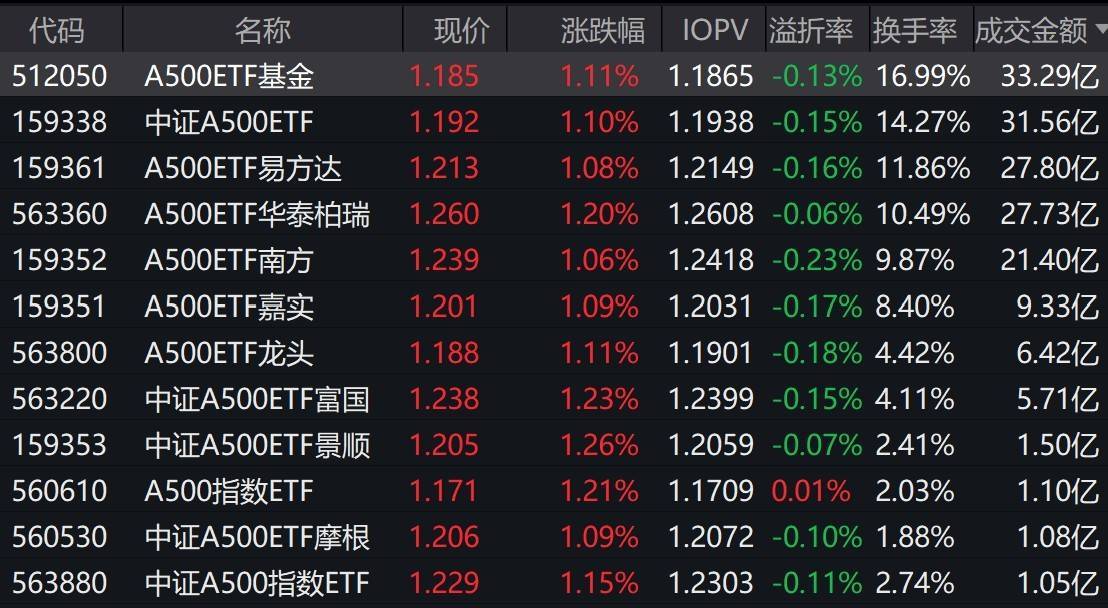
Market Overview - The market showed a strong upward trend in the early session, with the Shenzhen Component Index rising nearly 2% and the ChiNext Index increasing over 2% after a low opening. The CSI A500 Index saw a rise of 1.33% [1] Sector Performance - The lithium battery industry chain experienced a significant surge, while the Fujian sector continued to rise. Conversely, the banking sector showed weak performance [1] ETF Trading Activity - By the morning close, ETFs tracking the CSI A500 Index rose over 1%. Notably, 12 CSI A500-related ETFs had trading volumes exceeding 100 million yuan, with 2 surpassing 3.1 billion yuan. The A500 ETF Fund and the CSI A500 ETF had trading volumes of 3.329 billion yuan and 3.156 billion yuan, respectively [1][2] Market Outlook - According to brokerage firms, the foundation for the current slow bull market remains intact due to ongoing global technology investment enthusiasm, the continuous promotion of "anti-involution" policies, and increased household savings entering the market. There is potential for further strengthening of the A-share index in the future [1]

港股成长指数对比研究:科技浪潮下的港股成长优选
Guoxin Securities· 2025-11-12 08:05
Investment Rating - The report highlights that the Hong Kong growth indices are becoming a core tool for investors to capture new economic opportunities and share in the benefits of industrial upgrades [2]. Core Insights - The report emphasizes the strong performance of the CSI Hong Kong Stock Connect Technology Index, which has outperformed other indices in terms of cumulative returns, annualized returns, and risk-adjusted return metrics such as Sharpe and Calmar ratios [2]. - The report identifies that policy incentives, industrial upgrades, and global innovation trends are driving the Hong Kong growth indices to become a key focus for medium to long-term allocations [2]. - The report suggests that the next 3-4 years will be crucial for the application and monetization of AI technology, indicating a significant investment opportunity in the technology growth sector [11]. Summary by Sections 1. Technology Investment Wave - The report discusses the transition of the internet industry from "traffic expansion" to "value cultivation," with internet usage expected to reach an average of 28.7 hours per week in 2024, the highest in five years [11]. 2. Overview of Hong Kong Growth Indices - The report provides details on various indices, including the Hang Seng Technology Index, which represents the top 30 technology-related companies listed in Hong Kong [20]. 3. Historical Performance - The CSI Hong Kong Stock Connect Internet Index showed strong performance in the 2020-2021 period, with peak returns reaching 170%, but has since underperformed compared to the CSI Hong Kong Stock Connect Technology Index [34]. 4. Risk-Return Characteristics - The CSI Hong Kong Stock Connect Technology Index has the highest Sharpe ratio of 0.53, indicating strong risk-adjusted returns, while the Hang Seng Internet Technology Index has the lowest performance metrics [43]. 5. Industry and Market Capitalization Distribution - The report notes that the Hang Seng Internet Technology Index and the CSI Hong Kong Stock Connect Internet Index exhibit significant industry concentration, primarily in information technology and consumer discretionary sectors, which poses risks during market downturns [57].
全国社保基金理事会薛捷:会花三到五年甚至更长时间陪科技股成长
2 1 Shi Ji Jing Ji Bao Dao· 2025-11-12 07:42
Core Viewpoint - The speech emphasizes the importance of patient capital for technology assets, highlighting the need for long-term investment strategies that can withstand market uncertainties and support technological growth over time [1] Summary by Relevant Categories Investment Strategy - The National Social Security Fund's investment department advocates for a long-term investment horizon, suggesting that they will not be swayed by short-term market noise or temporary uncertainties in research and development [1] - The fund is prepared to invest for three to five years, or even longer, to support the growth of technology companies from early-stage development to maturity [1] Technology Sector - There is a call for "patient capital" that can accompany technology firms through challenges, indicating a strategic focus on nurturing innovation and technological advancement [1] - The concept of a "technology seed" growing into a "tall tree" symbolizes the potential for significant growth in the technology sector with the right support [1]
全国社保基金理事会股票投资部副主任薛捷:科技投资要坚持长期性、稳定性和规模性
Xin Lang Zheng Quan· 2025-11-12 07:03
Group 1 - The Shanghai Stock Exchange International Investor Conference was held on November 12, focusing on "Value Leading, Open Empowerment - New Opportunities for International Capital Investment and Mergers" [1] - The conference aims to create a communication platform for foreign institutional investors to engage with regulatory bodies, exchanges, listed companies, and financial institutions, promoting deep integration of international capital with the Chinese capital market [1] Group 2 - During the roundtable discussion on "Focusing on Value Investment: Long-term Capital in the Chinese Capital Market," Xue Jie, Deputy Director of the Stock Investment Department of the National Social Security Fund, emphasized the importance of long-term, stable, and large-scale investments in technology [3] - Xue Jie noted that in the context of a globalized capital and technology landscape, identifying unique investment value requires finding breakthroughs within structural differences [3] - She highlighted that long-term capital should not be easily swayed by short-term fluctuations, instead supporting companies over 3 to 5 years or longer [3] - A systematic asset allocation framework is necessary to manage the volatility of technology assets within the overall risk budget, aiming for smoother overall returns [3] - Maintaining the scale of investments is crucial, as large-scale long-term capital can support national strategies and attract more social capital into key technology sectors, creating a risk-sharing investment landscape [3] - Xue Jie advocated for cultivating a genuine long-term investment philosophy to achieve stable growth in returns under low-interest-rate environments, noting the increasing independent innovation capabilities of Chinese technology companies [3]
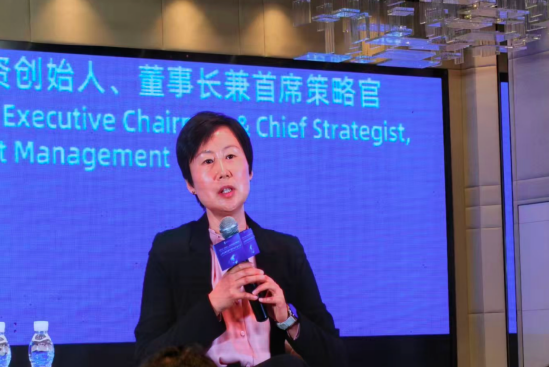
中泰资管田瑀:AI时代的价值投资和科技投资并不对立 价值判断需满足三个条件
Zhi Tong Cai Jing· 2025-11-11 12:08
Group 1 - The differentiation in the market this year has sparked discussions on the relationship between value investing and technology investing, suggesting they are not mutually exclusive [1][6] - Value investing can encompass technology sectors as long as certain criteria are met, such as the ability to assess long-term demand, business models, and competitive advantages [1][4] - The development of AI is expected to accelerate demand growth in the semiconductor industry, which remains stable in its business model despite technological changes [1][6][22] Group 2 - The semiconductor industry, particularly wafer foundry and storage sectors, is seen as having a strong potential for growth due to AI's increasing computational demands [1][6][28] - AI has changed the computing paradigm, increasing the need for storage capacity and bandwidth, which has become a bottleneck in the industry [1][30][31] - The shift towards domestic semiconductor production in China is driven by the need for self-sufficiency, creating opportunities for local companies to develop competitive advantages [1][34][35] Group 3 - The slowing of Moore's Law is a recognized phenomenon, indicating that advancements in semiconductor manufacturing will occur at a slower pace [1][38][41] - The semiconductor manufacturing industry may evolve into a slower-changing sector, with challenges in scaling production and enhancing chip capabilities [1][42] - The importance of deep research and understanding of the semiconductor industry is emphasized, as it is crucial for evaluating business models and investment opportunities [1][19][21]
周度速览|权益市场行情综述
Xin Lang Cai Jing· 2025-11-11 03:04
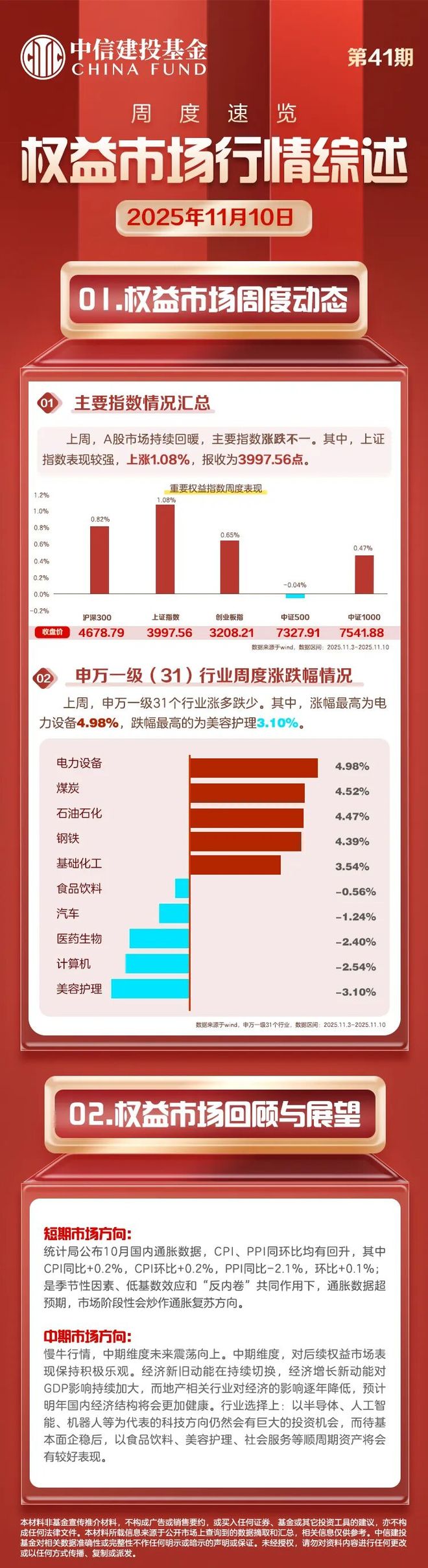
Group 1 - The core viewpoint of the article highlights the performance of various industries, with the power equipment sector showing the highest increase at 4.98%, while the beauty and personal care sector experienced the largest decline at 3.10% [3] - The weekly performance of the 31 industries indicates a general upward trend, with most sectors gaining, particularly power equipment, coal, and petroleum and petrochemicals [3] - The consumer price index (CPI) and producer price index (PPI) data for October show a rebound, with CPI up 0.2% year-on-year and 0.2% month-on-month, while PPI decreased by 2.1% year-on-year but increased by 0.1% month-on-month, suggesting a potential market focus on inflation recovery [4] Group 2 - The medium-term market outlook suggests a slow bull market with a positive view on equity market performance, driven by a shift in economic dynamics and a healthier economic structure expected next year [5] - Investment opportunities are identified in technology sectors such as semiconductors, artificial intelligence, and robotics, while consumer sectors like food and beverage, beauty care, and social services are anticipated to perform well once the fundamentals stabilize [5]
价值投资的对立面不是“小登科技”
点拾投资· 2025-11-10 11:00
Core Viewpoint - The article discusses the relationship between value investing and technology investment, emphasizing that they are not opposites. Value investors can participate in the benefits of the AI era by applying their investment principles to technology sectors [1][20]. Group 1: Value Investing Principles - Value investing is defined as earning returns from the long-term cash flows of companies, without being restricted to specific industries [1][20]. - The core of value investing is to avoid permanent loss of capital, and careful evaluation may lead to missed opportunities, but value investors can still act decisively when confident [2][20]. - Value investors like Tian Yu focus on long holding periods, high concentration in a few stocks, and the importance of a company's competitive advantages [1][2]. Group 2: Technology Investment Insights - Tian Yu has been researching AI and its implications for value assessment early on, indicating that value assessment does not differentiate between emerging and traditional industries [2][4]. - The evaluation framework for technology companies includes understanding demand limits, assessable business models, and identifiable competitive advantages [4][6]. - The semiconductor industry, particularly wafer foundries, is analyzed through a physical perspective, highlighting the challenges and opportunities in advanced process technologies [5][10]. Group 3: Market Dynamics and Investment Strategy - The demand for AI has increased the value of competitive advantages in technology sectors, as performance differences become more significant [6][10]. - Tian Yu's investment strategy involves a dynamic view of future cash flows rather than static earnings, allowing for investments in companies that may not currently be profitable but have strong long-term potential [7][8]. - The article highlights the importance of understanding the underlying business models and competitive dynamics in technology sectors, which can be complex and require specialized knowledge [6][11]. Group 4: Portfolio Management - Tian Yu maintains a concentrated portfolio with a high percentage of top holdings, reflecting a strategy of focusing on quality investments [16][17]. - The portfolio is diversified across different sectors, including technology and chemicals, to mitigate systemic risks while maintaining a focus on companies with strong supply-side competitive advantages [17][18]. - The article emphasizes that value investing is not limited to traditional industries and can adapt to modern technological advancements, allowing investors to benefit from current market trends [20][22].

4000点附近投科技,哪些细分方向值得关注?丨南财号每周热文
2 1 Shi Ji Jing Ji Bao Dao· 2025-11-08 01:07
Group 1 - The article does not provide specific insights or data regarding any company or industry [1]
2025IPEM私募投资及产业大会成功举行 专家:跨境投资进入高效协同2.0时代
Zhong Guo Zheng Quan Bao· 2025-11-07 20:15
Group 1 - The conference highlighted the importance of cross-border capital flow and industrial collaboration as key drivers of economic growth, particularly in the context of global economic adjustments and technological transformations [1] - Asia, especially China, is seen as a significant investment hub due to its large domestic demand, robust supply chain, and continuous innovation capabilities [1] - The shift in cross-border investment dynamics is moving towards multi-polar collaboration rather than one-way inflows [3] Group 2 - Technology investment is recognized as a core engine for global industrial transformation, with intense competition in sectors like commercial space, embodied intelligence, and artificial intelligence, particularly between the US and China [2] - Europe is also emerging as a notable player in the tech ecosystem, with unique advantages in talent, company valuations, and vertical innovation, especially in AI and green technology [2] - The resilience, efficiency, and innovative capacity of China's supply chain are becoming central attractions for global capital, particularly in the biopharmaceutical sector [4][5] Group 3 - The integration of European industrial design with Chinese supply chain capabilities can significantly reduce costs and enhance global operations [3] - The dual-track policy in China for drug development has led to lower R&D costs and higher efficiency, positioning China as a testing ground for global pharmaceutical innovation [4] - The transition of China's supply chain advantages from cost-driven to technology-driven is evident, with hardware companies rapidly iterating products and developing capabilities in electric vehicles and consumer electronics [5]
摩根慧启成长混合基金将于11月17日起正式发行
Zheng Quan Ri Bao Wang· 2025-11-07 07:11
Group 1 - The A-share market is currently experiencing significant differentiation, with growth sectors facing both long-term opportunities from industrial upgrades and short-term impacts from external environmental changes [1] - Morgan Fund's Morgan Huiqi Growth Mixed Fund will officially launch on November 17, aiming to enhance investor experience through a new floating management fee model that links fees directly to performance [1] - The fund will be managed by experienced fund manager Li Dehui, who has 13 years of research experience and nearly 9 years of fund management experience, focusing on large-cap growth companies with sustainable competitive advantages [1] Group 2 - Li Dehui's Morgan Technology Frontier Mixed Fund has achieved a cumulative return of 211.35% since its inception in July 2015, significantly outperforming the benchmark return of 25.37% [2] - As of September 30, 2025, the Morgan Technology Frontier Mixed Fund ranked 12th out of 185 in its category, placing it in the top 10% of flexible allocation funds [2] - Looking ahead to the fourth quarter, Li Dehui anticipates that factors such as potential interest rate cuts by the Federal Reserve, domestic liquidity easing, and supportive policies will benefit the stock market, with technology investment and domestic consumption expected to stabilize economic growth [2]