贸易谈判

Search documents
全线跳水!全球股市,突然“降温”!发生了什么?
Zheng Quan Shi Bao Wang· 2025-10-28 12:21
Market Overview - Global risk assets experienced a pause in their upward momentum, with major stock indices in the Asia-Pacific region collectively declining, followed by a lower opening for European indices [1][2][3] - The decline in stock markets is attributed to short-term profit-taking after significant gains that led to historical highs on October 27 [1][3] Precious Metals Market - Gold and silver prices saw a substantial drop, with spot gold falling over 2% and briefly dipping below $3900 per ounce, while silver dropped nearly 2% [1][3] - Analysts from Heraeus indicated that the adjustment in precious metal prices could last for several months, although they expect a potential continuation of the upward trend if investor interest remains strong [4][5] Investment Demand for Gold - Despite recent price declines, global retail demand for gold remains robust, and the growth rate of gold holdings in ETFs has not shown significant decline, indicating sustained investor interest [5][6] - Analysts predict that the average gold price could rise to around $4560 per ounce next year, reflecting a 33% increase from the average price since the beginning of the year [6] Future Price Projections - Metals Focus analysts believe that ongoing economic uncertainty will continue to support gold prices, with trade policy and its global economic impact being key drivers [5][6] - Morgan Stanley's commodity strategy head anticipates that gold prices could exceed $5000 per ounce by the fourth quarter of 2026, driven by sustained demand from investors and central banks [6]
金价下破3900!花旗隔夜紧急预警:短期内或跌至3800
Jin Shi Shu Ju· 2025-10-28 09:03
Core Viewpoint - The ongoing easing of trade tensions has led to a decline in safe-haven demand, causing spot gold prices to drop below $3900 per ounce, marking a significant decrease from recent highs [1][2]. Price Movements - Spot gold prices fell below the $4000 mark on Monday and subsequently dropped over $120 in a single day, with a daily decline exceeding 2% [1][2]. - Citigroup has revised its short-term price targets for gold and silver, lowering the gold price expectation from $4000 to $3800 per ounce and silver from $55 to $42 per ounce due to changes in the global market environment [2]. Market Dynamics - Factors contributing to the price adjustments include U.S. trade negotiations with several countries, which have reduced market uncertainty, and expectations of a resolution to the U.S. government shutdown [2][5]. - Year-to-date, gold prices have surged by 51% due to geopolitical uncertainties, interest rate cut expectations, and central bank purchases, although prices have retreated by 10% from the historical high of $4381.21 per ounce reached on October 20 [2]. Long-term Outlook - Citigroup suggests that concerns driving gold prices higher may need to become a baseline scenario to sustain the current bull market until 2026, while the logic of holding gold as a hedge against geopolitical and economic risks remains strong in the medium to long term [3]. Market Sentiment - There is significant divergence in market opinions regarding the bottom for gold prices, with some analysts suggesting tactical buying after a pullback [4]. - Central bank demand for gold is reportedly weaker than before, with some traders welcoming deeper price corrections as potential buying opportunities [4]. Federal Reserve Influence - The market is closely watching the upcoming Federal Reserve interest rate decision, with a high probability of a 25 basis point cut expected [4][5]. - The ongoing government shutdown has added uncertainty to the Fed's decision-making process, affecting the release of key economic data [5]. Leadership Changes - The selection process for the next Federal Reserve Chair is under scrutiny, with a shortlist of candidates that could influence future monetary policy directions [6].

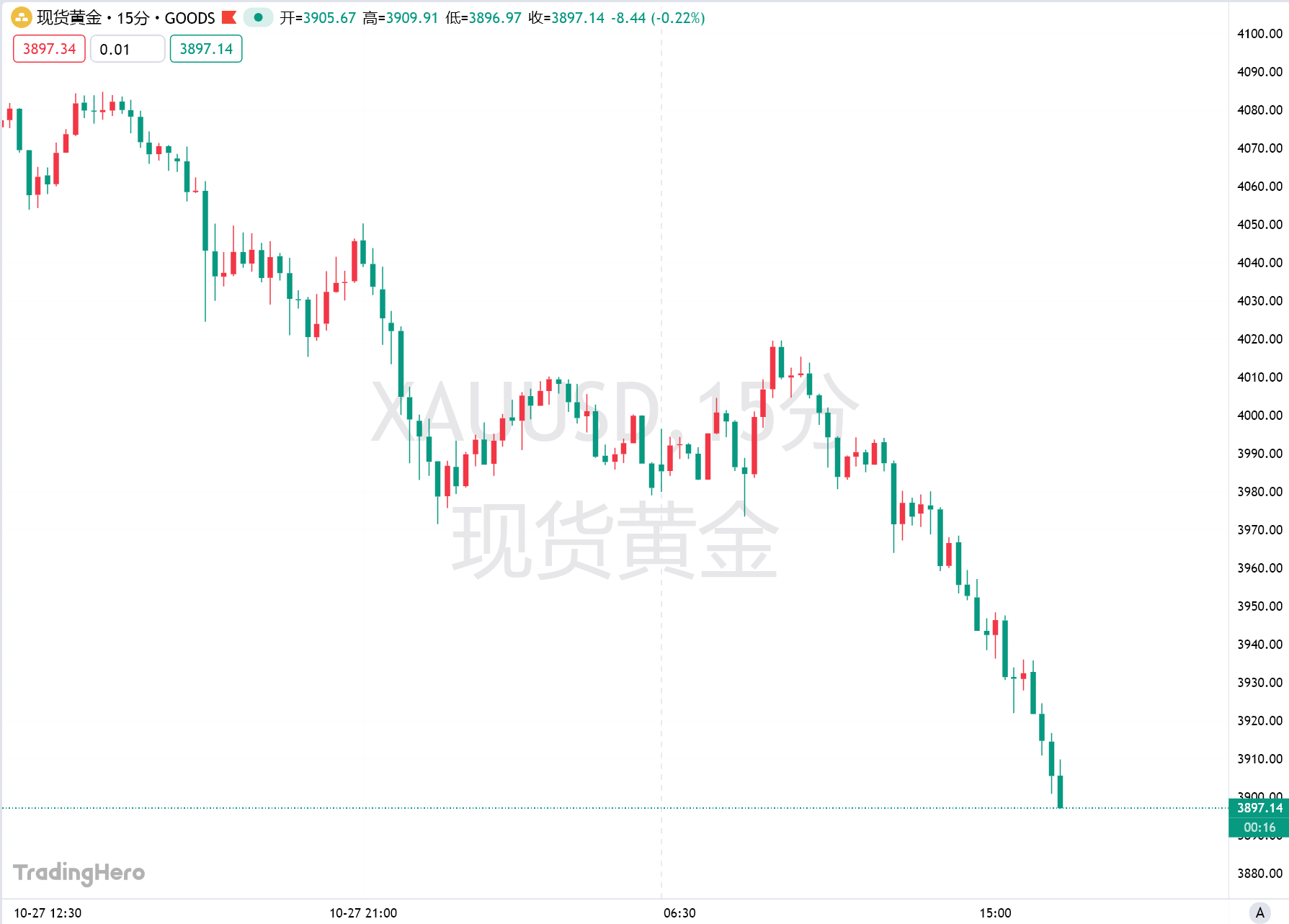
全球股市多数下跌,日元走强,现货黄金失守3950美元关口,加密货币下跌
Sou Hu Cai Jing· 2025-10-28 08:26
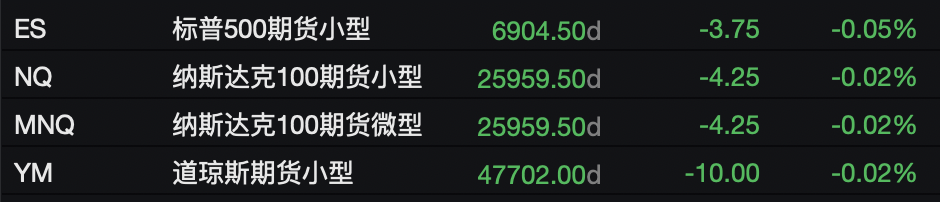
Core Viewpoint - The easing of trade tensions has alleviated market concerns, leading to a decline in gold prices as risk aversion diminishes. The market is preparing for a series of earnings reports from major tech companies and policy statements from global central banks, causing a pause in the record rally of major global stock markets [1]. Market Trends - U.S. stock index futures are collectively down, with the S&P 500 futures down 0.05%. The Nasdaq 100 futures decreased by 0.02%, and the Dow Jones futures also fell by 0.02% [2][3]. - European stock indices opened lower, with the Euro Stoxx 50 index down 0.3%, the German DAX index down 0.2%, and the French CAC 40 index down 0.4%. The UK FTSE 100 index saw a slight increase of 0.15% [3]. - Asian stock indices experienced a collective decline, with the South Korean Composite Stock Price Index down 0.8% and the Nikkei 225 index down 0.24% [3]. Currency and Commodity Movements - The U.S. dollar index fell by 0.13%, settling at 98.7, while the Japanese yen strengthened, reaching an intra-day high of 151.95 against the dollar, up 0.6% [2][3]. - The yield on the 10-year U.S. Treasury bond decreased by 1 basis point to 3.97% [3]. - Spot gold prices fell over 1.1%, currently at $3,934 per ounce, following a previous peak of $4,380 per ounce. Analysts predict that gold prices may drop to $3,800 per ounce in the next three months due to changing market dynamics and potential trade agreements [6].
集运日报:SCFIS虽大幅上涨但部分多头止盈离场盘面偏弱震荡符合日报反弹预期不建议加仓设置好止损-20251028
Xin Shi Ji Qi Huo· 2025-10-28 05:50
Report Summary 1. Report Industry Investment Rating No information provided. 2. Core View of the Report - SCFIS has risen significantly, but some long - position holders have taken profits and left the market, leading to a weak and volatile market, which is in line with the daily report's rebound expectation. It is not recommended to add positions, and stop - losses should be set. - The tariff issue has a marginal effect, and the core is the trend of spot freight rates. The main contract may be in the bottom - building process, and it is recommended to participate lightly or wait and see. - In the short - term, risk - preference investors are advised to try to build positions in the EC2512 contract below 1500; in the long - term, it is recommended to take profits when the contracts rise and wait for the correction to stabilize before judging the subsequent direction. - In the context of the volatile international situation, each contract still follows the seasonal logic with large fluctuations, and it is recommended to wait and see or try lightly [2][7]. 3. Summary by Related Content a. Shipping Indexes - **SCFIS**: On October 27, the Shanghai Export Container Settlement Freight Index (SCFIS) for the European route was 1312.71 points, up 15.1% from the previous period; for the US - West route, it was 1107.32 points, up 28.2% from the previous period [3]. - **SCFI**: On October 24, the Shanghai Export Container Freight Index (SCFI) was 1403.46 points, up 93.14 points from the previous period. The SCFI price for the European line was 1246 USD/TEU, up 8.8% from the previous period; for the US - West route, it was 2153 USD/FEU, up 11.2% from the previous period [4]. - **NCFI**: On October 24, the Ningbo Export Container Freight Index (NCFI) (composite index) was 977.21 points, up 2.17% from the previous period; for the European route, it was 822.3 points, up 2.38% from the previous period; for the US - West route, it was 1293.75 points, up 3.13% from the previous period [5]. - **CCFI**: On October 24, the China Export Container Freight Index (CCFI) (composite index) was 992.74 points, up 2.0% from the previous period; for the European route, it was 1293.12 points, up 2.0% from the previous period; for the US - West route, it was 736.23 points, up 1.5% from the previous period [5]. b. Economic Data of Different Regions - **Eurozone**: In September, the preliminary manufacturing PMI was 49.5, falling back below the boom - bust line, lower than analysts' expectations and the previous value of 50.7. The preliminary services PMI rose from 50.5 to 51.4, exceeding the expected 50.5. The preliminary composite PMI was 51.2, exceeding analysts' expectations. The Sentix investor confidence index was - 9.2, with an expected - 2 and a previous value of - 3.7 [6]. - **China**: In August, the manufacturing PMI was 49.4%, up 0.1 percentage points from the previous month, and the manufacturing sentiment improved. The composite PMI output index was 50.5%, up 0.3 percentage points from the previous month, remaining above the critical point, indicating that the overall expansion of enterprises' production and business activities accelerated [6]. - **US**: In September, the preliminary S&P Global manufacturing PMI was 52 (the final value in August was 53); the preliminary services PMI was 53.9 (the final value in August was 54.5); the preliminary composite PMI was 53.6 (the final value in August was 54.6) [6]. c. Contract Information - On October 27, the main contract 2512 closed at 1775.0, with a decline of 2.79%, a trading volume of 27,700 lots, and an open interest of 28,000 lots, a decrease of 2254 lots from the previous day [7]. - The up - limit and down - limit for contracts 2508 - 2606 were adjusted to 18%. - The company's margin for contracts 2508 - 2606 was adjusted to 28%. - The daily opening position limit for all contracts 2508 - 2606 was 100 lots [7].
关税,大消息!
Zhong Guo Ji Jin Bao· 2025-10-28 01:29
Group 1 - The core point of the article is that the President of Mexico, López Obrador, announced that U.S. President Trump has agreed to extend the deadline for trade negotiations between the two countries regarding trade, security, and immigration issues [2][3] - López Obrador mentioned that he had a brief and friendly conversation with Trump, during which they agreed that their officials would continue working and that Trump would not impose additional tariffs [3] - Both leaders believe that progress is being made and plan to continue discussions in the coming weeks to reach an agreement [3]
关税,大消息!
中国基金报· 2025-10-28 01:23
Group 1 - The Mexican President announced that the U.S. has agreed to extend the deadline for trade negotiations, focusing on trade, security, and immigration issues [4] - The conversation between the Mexican President and U.S. President Trump was described as friendly, with both parties agreeing to continue discussions and Trump not imposing additional tariffs [4] - Both leaders believe that progress is being made and plan to engage in further dialogue in the coming weeks to reach an agreement [4] Group 2 - The Russian Presidential Press Secretary stated that Russia is willing to improve relations with the U.S., but it must be based on its own interests [6] - The deployment of U.S. nuclear submarines near Russia in response to Russia's "Zircon" missile statements was highlighted as significant, but it reflects the U.S. President's viewpoint [6] - The Russian President's special representative's visit to the U.S. was described as a small step in a long journey, emphasizing the need for patience in bilateral dialogue [6][9] Group 3 - U.S. President Trump reported a "good meeting" with Brazilian President Lula, indicating ongoing negotiations regarding tariff policies [12] - The dialogue between the two leaders marks the first discussion since Trump returned to the White House, paving the way for negotiations on tariffs, investment, and economic cooperation [12] - The Brazilian government aims to eliminate tariffs imposed by the U.S. on Brazilian exports since August [12]

墨西哥总统称美国同意延长贸易谈判期限
Yang Shi Xin Wen Ke Hu Duan· 2025-10-27 20:17
当地时间10月27日,墨西哥总统辛鲍姆表示,美国总统特朗普已同意再次延长两国就贸易、安全和移民 问题达成协议的最后期限。辛鲍姆表示,她和特朗普上周进行了一次非常简短且友好的通话,通话中双 方同意各自官员继续工作,特朗普不会加征额外关税。她表示,双方一致认为进展非常顺利,双方还同 意将在未来几周内进行对话,争取达成协议。 (文章来源:央视新闻客户端) ...
一松一紧:特朗普推迟美墨贸易协议截止期,称“一段时间”内不重启美加谈判
Hua Er Jie Jian Wen· 2025-10-27 20:15
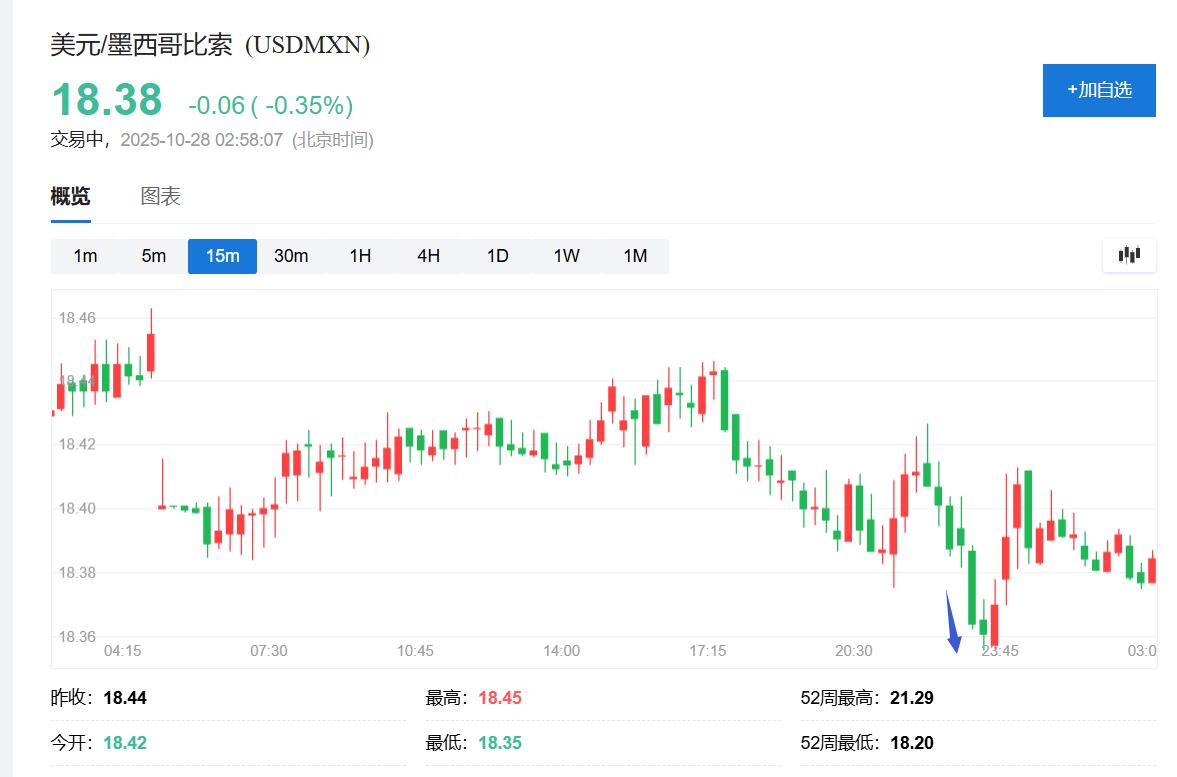
美东时间27日周一,墨西哥总统辛鲍姆在新闻发布会上表示,她与特朗普上周六简短通话,双方同意延长谈判时间,以便就仍在讨论的非关税贸易壁垒达成 协议。她表示,"目前不存在11月1日加征任何特别关税的情况",双方接近达成协议,并同意在未来几周再次通话。特朗普原定11月1日将针对特定墨西哥商 品的芬太尼相关关税从25%提高至30%。 辛鲍姆发表上述言论后,墨西哥比索汇率升至日内高位,美元兑比索在美股早盘时段曾跌破18.40刷新日低,日内跌近0.5%。渣打银行经济学家Dan Pan表 示,有关谈判进展的评论"提振了市场对墨西哥在与美国贸易谈判中处于相对有利地位的乐观情绪,尤其考虑到其对美国市场的高度依赖"。 与此形成对比的是,特朗普本周一在从马来西亚去往日本的空军一号上明确表示,不想在访问亚洲期间与加拿大总理卡尼会面。按日程,卡尼和特朗普均将 出席本周在韩国举行的APEC峰会。特朗普说: "我不想见他(卡尼)。我们一段时间内不会与他们(加拿大)会谈。我对目前与加拿大的协议非常满意,我们会让它继续下去。" 美国总统特朗普对两个邻国的贸易谈判态度出现明显分化。他同意将美国与墨西哥达成贸易协议的截止期推迟数周,对加拿大则表示 ...
墨西哥总统称美国同意延长贸易谈判期限
财联社· 2025-10-27 20:14
据央视新闻,当地时间10月27日,墨西哥总统辛鲍姆表示,美国总统特朗普已同意再次延长两国就贸易、安全和移民问题达成协议的最后期限。 辛鲍姆表示,她和特朗普上周进行了一次非常简短且友好的通话,通话中双方同意各自官员继续工作,特朗普不会加征额外关税。她表示,双方一致认为 进展非常顺利,双方还同意将在未来几周内进行对话,争取达成协议。 ...