价值投资

Search documents
投资的核心是靠体系赚钱,而非押注单一标的
雪球· 2025-11-28 04:43
Core Viewpoint - The essence of investment lies in establishing a systematic approach that allows for consistent profitability rather than relying on individual stock bets [3][4]. Investment System - A well-defined investment system is a personalized set of consistent and executable investment standards that help investors identify quality assets aligned with their risk preferences and value logic [3]. - Many novice investors fall into the trap of seeking "hot stocks," often focusing on historical price movements or chasing after popular companies, which leads to unsustainable profit logic [3]. Profitability of Systematic Investment - Systematic investment enhances win rates and reduces failure costs through rule-based decision-making, contrasting random investment strategies that yield lower success rates [4]. - Two mainstream paths to achieve stable profitability above 50% include: - Buffett-Graham style value investing, focusing on deep fundamental research and long-term holding of undervalued assets [4]. - Schloss-Graham style "cigar butt" investing, which relies on quantitative screening tools to identify undervalued stocks with high safety margins [4]. Integration of Investment Strategies - Investors can integrate various systems based on their capabilities, combining deep research with diversified investment logic to create a personalized investment framework [5]. - The core value of systematic investment lies in reducing emotional interference and error probability by adhering to rules and logic in decision-making [5]. Snowball Three-Factor Method - The Snowball Three-Factor Method promotes long-term investment through asset, market, and timing diversification, aiming for diversified investment returns and risk mitigation [6].


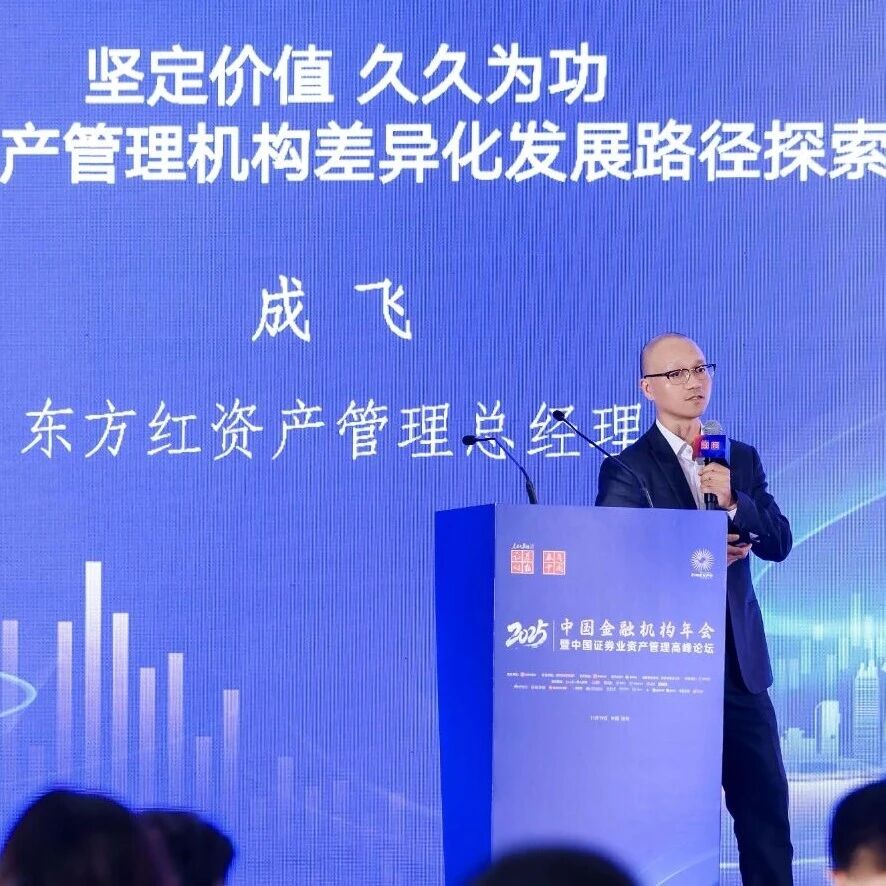
东方红资产管理成飞:优秀的资产管理机构应构建“好投资+好服务+好品牌”的护城河
券商中国· 2025-11-28 04:00
Core Viewpoint - The asset management industry is entering a new phase of high-quality development, where institutions must explore differentiated development paths while focusing on investment, service, and brand cultivation to build a sustainable competitive advantage [2]. Industry Overview - The overall scale of the asset management industry has exceeded 170 trillion yuan, with structural differentiation becoming evident among various segments [2]. - Public funds, insurance asset management, bank wealth management, and trusts have collectively surpassed 30 trillion yuan, highlighting an intensifying "Matthew Effect" [2]. - Private equity, securities asset management, and futures asset management are facing severe competition, indicating a challenging environment for these institutions [2]. Securities Asset Management Insights - The entrusted scale of securities asset management has stabilized at 7 trillion yuan, but the industry is in urgent need of new growth breakthroughs due to the end of large collective rectifications and declining fixed-income asset yields [2]. - Only 14 securities firms and their asset management subsidiaries have public fund management qualifications, holding a mere 2% market share in the public fund sector, with a year-to-date incremental share of 2% [2]. Development Path of Dongfanghong Asset Management - Dongfanghong Asset Management emphasizes a customer-centric approach to build core competitiveness [3]. - The firm practices value investing and active management, establishing a comprehensive investment research system across equity, fixed income, fund of funds (FOF), and quantitative fields, achieving good long-term investment returns [3]. - The company prioritizes customer experience through its "Dongfanghong Wanli Xing" service system, having conducted over 14,500 customer service events, reaching 2.09 million participants over the past decade [3]. Brand Building and Challenges - Since its inception, Dongfanghong has focused on brand establishment, continuously investing in brand assets to create a competitive moat [3]. - The company has faced challenges in its differentiated development journey but believes that maintaining faith and positioning is crucial for long-term success [3]. Strategic Insights - The belief is that excellent asset management is driven by a combination of good investment, good service, and good branding [4]. - Differentiation is not about being ostentatious but about maximizing core advantages [4]. - The development of asset management institutions will undergo three levels of transition: from strategy to licensing, and finally to brand elevation, allowing for diverse development paths within the industry [4].
查理·芒格最后的灿烂岁月:他挥出了一记重拳,且大获全胜
聪明投资者· 2025-11-28 03:40
Core Insights - Charlie Munger made a significant investment in coal-related stocks during his final year, which he had previously avoided for 60 years, resulting in over $50 million in gains [15][25][29]. Investment Strategy - Munger's late investment in coal companies, such as Consol Energy and Alpha Metallurgical Resources, was driven by the belief that coal would not be completely abandoned as long as global energy demand continued to grow [27][28]. - Despite the coal industry's long-term decline, Munger identified undervalued companies with strong profitability, leading to substantial returns as their stock prices doubled [26][29]. Personal Philosophy - Munger's approach to aging was characterized by active engagement in life, focusing on bold investments, forming new friendships, and facing challenges head-on [4][12]. - He maintained a curious and learning mindset until the end, questioning the relevance of Moore's Law in the age of artificial intelligence [16]. Legacy and Influence - Munger's final years were marked by a commitment to mentoring younger investors, exemplified by his partnership with Avi Mayer and Reuven Gradon in real estate investments, which grew to a portfolio valued at approximately $3 billion [39]. - His ability to adapt and remain involved in investment decisions, even in his 90s, serves as a model for how to age gracefully while maintaining purpose [17][41]. Health Challenges - Munger faced significant health issues, including vision problems and the loss of mobility, yet he continued to engage with friends and maintain a social life [41][46]. - His humor and perspective on aging were evident in his interactions, as he often joked about his longevity and health [63][64].

大空头的观点解析
傅里叶的猫· 2025-11-28 03:32
Core Viewpoints - Michael Burry emphasizes that the primary indicator of a bubble is supply-side greed, which leads to over-expansion and ultimately market crashes, rather than demand shortages or profit deficiencies [7][11][12] - The current AI boom mirrors the 1990s internet bubble, with significant investments in AI infrastructure that may not align with actual demand [12][13] Group 1: Historical Analysis of Bubbles - The internet bubble of the 1990s was driven by excessive capital investment in data transmission infrastructure, leading to a supply-demand imbalance [7][8] - Major companies like AT&T and MCI invested heavily in infrastructure, but the actual demand for broadband was not met, resulting in a significant market crash by 2002 [8][11] - Similar patterns of over-investment leading to market corrections have been observed in the real estate bubble of the 2000s and the shale oil revolution of the 2010s [11] Group 2: Current AI Landscape - Major tech companies plan to invest nearly $3 trillion in AI infrastructure over the next three years, raising concerns about potential overcapacity [12] - OpenAI's projected spending of $1.4 trillion over eight years, with revenues not even close to covering this expenditure, highlights the unsustainable nature of current valuations [12] - The rapid pace of technological advancement in AI, particularly with companies like NVIDIA, raises questions about the longevity and economic viability of older chip models [22][23] Group 3: Financial Practices and Risks - Burry points out that major tech firms are extending the depreciation periods of their assets, which artificially inflates reported profits [20][21] - This accounting practice can lead to significant risks, as seen in the case of Baidu, which had to write down substantial asset values after extending depreciation periods [25] - The rapid obsolescence of technology, particularly in data centers, poses a risk of "zombie assets" that may not generate expected returns [24] Group 4: Clarifications on Misinterpretations - Burry clarifies that his positions in options against companies like Palantir and NVIDIA have been misrepresented in the media, emphasizing the importance of accurate reporting [26] - He distinguishes between criticizing accounting practices and directly accusing companies of fraud, asserting that his concerns are about industry-wide practices rather than specific companies [26]




芒格,晚年未曾公开的故事曝光
财联社· 2025-11-28 02:58
美国投资大师查理·芒格逝世两周年之际,曾与他朝夕相处的亲人和商界伙伴一齐发声,描绘出芒格生命最后时刻的温暖故事。 总结来说,在最后的时间里,芒格押注了职业生涯中鲜少涉足的题材,并豪赚超过5000万美元;还加大了房地产领域的投资,与一位偶然 寻求他人生建议的年轻邻居合作买下近万套房产;同时直面身体的衰老,并选择以自己喜欢的生活方式(虽然并不健康)过完了这一生。 芒格的家人和朋友也表示,他繁忙的最后岁月也提供了一份蓝图: 投资者如何优雅、平和且有目标地老去 。 生命不息、投资不止 在生命的最后10年里,已减少参与伯克希尔事务,和巴菲特维持每一两周通话。 与选择一辈子住在奥马哈老宅里的巴菲特类似,芒格也选择住在洛杉矶一套连空调都没有的老房子里。由于两位大师都有听力问题,打起电 话来颇为困难。 芒格的外孙媳妇惠特妮·杰克逊说:" 两人会对着对方高声喊叫。他们的对话原本该是私密的,但一英里范围内的任何人都能听到。 " 除了跟巴菲特定期交流外,年近9旬的芒格将注意力转向了其他的事业。他曾是零售巨头好市多的董事会成员,去世时还持有价值约1亿美元 的股票。他还投资了李录的喜马拉雅资本,以及位于美国、澳大利亚的一些小型投资公司 ...

SPHD: Equity-Like Returns With More Stability
Seeking Alpha· 2025-11-27 15:48
Core Insights - The article discusses the author's transition from a potential career in politics to a focus on value investing, emphasizing a long-term investment strategy and risk management [1] Group 1: Career Transition - The author initially pursued a career in politics but shifted to finance after facing challenges in 2019, seeking a more stable financial path [1] - The decision to study value investing was driven by the desire to grow wealth while managing risks effectively [1] Group 2: Professional Experience - From 2020 to 2022, the author worked in a sales role at a law firm, where they became the top-grossing salesman and managed a team, contributing to sales strategy [1] - The experience gained during this period was instrumental in assessing company prospects based on sales strategies [1] Group 3: Investment Advisory Role - The author worked as an investment advisory representative with Fidelity from 2022 to 2023, focusing on 401K planning [1] - Despite excelling in this role, the author felt constrained by Fidelity's reliance on modern portfolio theory, which conflicted with their value investing approach [1] Group 4: Current Endeavors - In November 2023, the author began writing for Seeking Alpha, sharing investment opportunities and insights with readers [1] - The articles serve as a platform for the author to document their investment journey and strategies [1]

“七赔二平一赚”的迷思
集思录· 2025-11-27 14:47
Group 1 - The article discusses the prevalent belief in the investment community that the odds of losing money are high, often summarized as "seven losses, two breakeven, one profit" [1][2] - It argues that this statistic is misleading due to the inclusion of inexperienced investors who lack proper research and commitment [1] - The author suggests that serious investors who dedicate significant time to research could potentially see better outcomes, possibly "seven profits, two breakeven, one loss" [1] Group 2 - The A-share market has experienced a significant outflow of capital, with an annual loss of 1.3 trillion yuan from 2019 to 2023, attributed to factors like IPOs, share reductions, and fees [2] - The article proposes that if measures are taken to limit IPOs and encourage dividends, the market could shift towards a zero-sum game, improving the profit-loss ratio [2] - It also suggests learning from international markets to enhance short-selling mechanisms and protect investor rights, which could lead to a more favorable investment environment [2] Group 3 - The article highlights that a large portion of dividends is distributed among government and institutional investors, leaving retail investors with minimal returns [3] - It points out that most retail investors are not satisfied with small gains and often engage in frequent trading, which leads to additional costs and losses [3][4] - The overall sentiment is that the majority of retail investors are unlikely to achieve long-term profitability due to emotional trading and lack of discipline [4] Group 4 - The article presents anecdotal evidence from discussions with individuals in leadership positions, indicating that even educated and experienced investors often face losses in the stock market [7] - It emphasizes that the perception of profitability among a small group of successful investors does not reflect the broader reality of the market [7] - The narrative suggests that the majority of investors, regardless of their background, struggle to achieve consistent gains [7] Group 5 - The article concludes that the investment landscape is inherently challenging, with many strategies failing to yield positive results [10][11] - It argues that relying solely on time and effort without a sound strategy is unlikely to lead to success in the market [10][11] - The discussion implies that the market is structured in a way that favors larger players, making it difficult for individual investors to succeed [15][16]

中银证券全球首席经济学家管涛:中国资本市场长期前景看好 更需倡导价值投资和长期投资
Zheng Quan Ri Bao Zhi Sheng· 2025-11-27 13:40
Core Insights - The long-term outlook for China's capital markets is positive, but short-term volatility risks should be monitored [1] - Opportunities in the Chinese market stem from economic transformation and upgrading, which introduces uncertainty and risk, emphasizing the need for value and long-term investing [1] Equity Assets - The core asset allocation directions for the next five years include: self-controllable and trendy consumption, mergers and reorganizations of leading enterprises, innovative development in traditional industries, and the relocation of quality enterprises [1] Gold Investment - Gold continues to hold allocation value; medium to long-term uncertainties in U.S. economic policy and concerns over a weakening dollar are expected to support demand for gold as a safe-haven and risk-hedging asset [1] - The proportion of gold in private investment allocations may increase from just over 2% to 4-5% [1] Market Participation - Future investment opportunities will largely arise from transformation and upgrading, which may be challenging for individuals to navigate, thus highlighting the need for wealth management institutions to enhance their asset allocation capabilities [1]

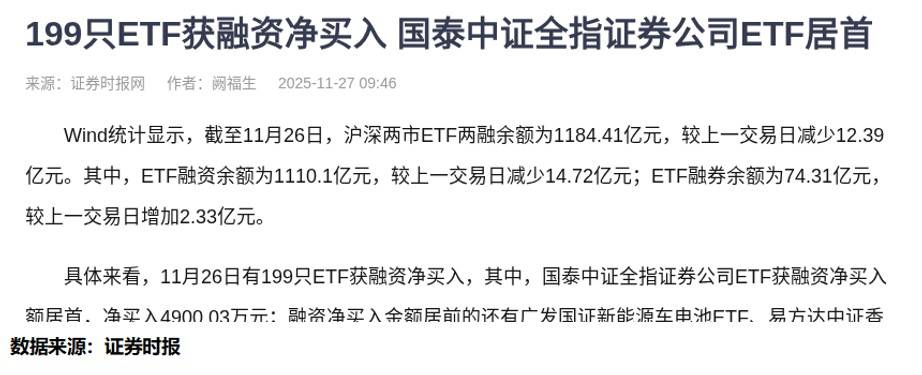
融资余额下降14亿,聪明钱却悄悄布局这些ETF!
Sou Hu Cai Jing· 2025-11-27 11:33
Group 1 - The recent ETF financing data shows significant net inflows, particularly in the Guotai CSI All-Share Securities Company ETF with a net inflow of 49 million, indicating a strategic positioning by professional investors in the brokerage and new energy sectors [1][3] - Despite an overall decrease of 1.4 billion in financing balances, professional players are quietly accumulating positions in the brokerage and new energy sectors, highlighting a divergence between market sentiment and actual investment behavior [3][4] - The data suggests that while retail investors focus on index fluctuations, smart money is utilizing industry ETFs for precise allocations, reflecting a shift in investment strategies [12] Group 2 - The article emphasizes three key lessons from past market experiences: the importance of active participation, the need to move beyond concept-driven speculation, and the superiority of behavioral analysis over technical indicators [4][5][6] - Quantitative data reveals that many stocks perceived as risky may actually be undergoing institutional accumulation, while others may be experiencing retail-driven sell-offs, underscoring the value of understanding market dynamics [10][12] - The analysis of ETF flows indicates a growing interest in sectors like brokerage and new energy vehicles, suggesting a potential trend in capital allocation towards these industries [12]
AI 霸主谷歌的反击:通往 5 万亿市值的道路并不需要奇迹
RockFlow Universe· 2025-11-27 10:32
Core Insights - Google is overcoming the "innovator's dilemma" with the launch of Gemini 3 and Nano Banana Pro, leveraging its TPU computing cluster as a significant competitive advantage in the AI era [3][5] - The market underestimates the destructive impact of "inference costs" on AI business models, with Google holding pricing power due to its self-developed TPU, contrasting with competitors reliant on Nvidia [3][6] - Concerns that AI would kill search advertising are being alleviated as Gemini 3 transforms search from "link finding" to a "decision engine," potentially increasing ad conversion rates [3][19] - Google has achieved a "full-stack sovereignty" with the combination of the strongest model (Gemini 3), the best computing power (TPU), and the largest entry points (Android/Chrome), positioning it for a market cap of $5 trillion [3][22] Group 1: TPU and Inference Costs - TPU is a critical asset for Google, allowing it to transition from being a "compute buyer" to a "rule maker" in the AI infrastructure war [6][8] - The AI semiconductor market is shifting focus from training to inference, with predictions indicating that by 2030, 75% of AI computing demand will be in the inference layer [6][7] - Google's TPU v7 (Ironwood) has shown a 100% improvement in performance per watt compared to its predecessor, and its inference performance is four times better than Nvidia's H100 [7][8] Group 2: Gemini 3 and Software Integration - Gemini 3 demonstrates Google's ability to convert talent from "Brain + DeepMind" into unmatched product capabilities, showcasing native multimodal abilities [9][10] - OpenAI and Meta are shifting towards Google’s TPU to reduce reliance on Nvidia, indicating a growing trend among competitors [10] - Gemini 3 can handle long context windows, evolving from a "chatbot" to a true "agent," capable of multi-tasking across platforms [11][13] Group 3: Investment Perspective - Warren Buffett's investment in Google signals confidence in its potential for value appreciation, with a current PE ratio of around 27, offering a non-symmetric return opportunity [14] - Google's stock buyback strategy enhances shareholder value, similar to Apple's approach, making it an attractive investment in a volatile tech market [14] Group 4: Business Model Evolution - Google's search advertising business remains robust, generating significant free cash flow, while AI opens new avenues for high-value decision-making [15][16] - The introduction of Gemini-driven SGE (Generative Search Experience) allows for structured comparisons in search results, enhancing ad value [19][20] - As long as Google can demonstrate higher ad conversion rates with AI assistance, advertisers will be willing to pay a premium, indicating that search is evolving rather than dying [20][21]