
未来产业

Search documents
“中国光谷”发布顶尖人才政策 最高1亿全球揽才
Zheng Quan Shi Bao Wang· 2025-11-04 06:25
Core Points - The "Optics Valley Top Talent Policy" was announced to attract global top talents and teams with key technologies and significant industry influence, with a maximum support of 100 million yuan per project [1][3] - The policy focuses on three categories of top talents: strategic scientists, industry leaders, and future technology leaders, aiming to enhance basic research and technological innovation [1][2] Group 1 - The policy aligns with the development needs of the leading and future industries in the East Lake High-tech Zone, particularly supporting sectors like optoelectronic information and life health [2] - It encourages top talents to establish companies in the region or form teams around key enterprises and innovation platforms [2] Group 2 - The East Lake High-tech Zone aims to attract top talents in the sixth-generation mobile communication and third-generation semiconductor fields, utilizing a "challenge and lead" mechanism for talent recruitment [3] - Financial support for projects ranges from 20 million to 100 million yuan, with up to 20% of the funding available as advance payment in the project establishment year [3] - Additional benefits include the "Optics Valley 3551 Talent" honor for core team members, access to talent housing, and a digital talent card providing over 20 service rights [3]
关键词读懂“十五五”|未来产业,如何塑造中国发展新未来
Yang Guang Wang· 2025-11-04 02:55
Core Insights - The 20th Central Committee's Fourth Plenary Session approved the "Suggestions on Formulating the 15th Five-Year Plan for National Economic and Social Development," emphasizing the exploration of diverse technological routes and business models to drive economic growth through future industries such as quantum technology, biomanufacturing, hydrogen energy, nuclear fusion, brain-computer interfaces, embodied intelligence, and 6G mobile communication [1][2] Group 1: Future Industries and Economic Growth - Future industries are seen as crucial for reshaping China's economic landscape and enhancing its innovation capabilities, with a focus on building a modern industrial system and strengthening the real economy [2][3] - The "three new" economy's contribution to GDP is projected to exceed 18% in 2024, with significant breakthroughs in biomanufacturing and quantum technology indicating strong growth potential for future industries [2] Group 2: Policy and Urban Development - The growth of future industries is supported by policies and urban planning, with the Ministry of Industry and Information Technology proposing mechanisms for investment growth in sectors like brain-computer interfaces and quantum information [4] - Local governments are actively implementing policies to foster future industries, with cities like Beijing, Shanghai, and Guangzhou developing tailored strategies to leverage their unique advantages [4] Group 3: Technological Advancements and Education - Breakthroughs in 6G technology, such as the establishment of the world's first 6G test network, highlight China's leading position in future communication technologies [5] - The development of future industries is transforming the "industry-university-research" model, with universities adjusting their research focus to align with emerging technologies like brain-computer interfaces [6][7] - The demand for interdisciplinary talent that combines technical skills with social understanding is increasing, reflecting the broader impact of future industries on education and daily life [7]
7428亿,增长5.8%!南山前三季度GDP跑赢全市,战新产业撑起“半壁江山”
Sou Hu Cai Jing· 2025-11-03 10:10
Economic Performance - Nanshan District's GDP for the first three quarters of 2025 reached 742.81 billion yuan, with a year-on-year growth of 5.8%, surpassing Shenzhen's average growth rate of 5.5% [1] - The primary industry saw a decrease of 13.7%, while the secondary industry grew by 5.6% and the tertiary industry by 5.9%, indicating a robust "dual-engine" growth model [1] Industrial Structure - Nanshan's industrial structure is characterized by a strong secondary industry and a competitive tertiary industry, with the secondary industry's growth rate significantly exceeding Shenzhen's average of 3.5% [1] - Strategic emerging industries account for over half of the GDP, reflecting a shift towards knowledge, technology, and innovation as the main drivers of economic growth [3] Strategic Focus - The district is focusing on 14 strategic emerging industry clusters, including robotics, semiconductors, and smart terminals, with robotics accounting for about 30% of the city's total industrial output [3][4] - Nanshan is developing a 10-kilometer industrial belt in the northern area to integrate R&D and high-end manufacturing, enhancing industrial chain collaboration [4][5] Innovation Ecosystem - Nanshan has established a comprehensive innovation ecosystem that includes policies for talent attraction, support for startups, and funding initiatives, aiming to create a favorable environment for innovation [7][8] - The district's R&D investment as a percentage of GDP is projected to reach 7.66% by 2025, nearly three times the national average, ensuring sustained innovation [5] Consumer Market - The social retail sales in Nanshan reached 95.96 billion yuan in the first half of 2025, with a year-on-year growth of 13.1%, leading the city [11] - The district is transforming shopping areas into lifestyle destinations, with significant new commercial developments enhancing the regional commercial ecosystem [13][14] Future Development - Nanshan aims to achieve a GDP exceeding 1 trillion yuan by 2025, positioning itself as a model for high-quality development in Shenzhen [14] - The district's approach combines government guidance with market-driven initiatives, fostering a dynamic environment for innovation and economic growth [14]


市场午后反弹,创业板ETF(159915)和A500ETF易方达等产品受资金关注
Mei Ri Jing Ji Xin Wen· 2025-11-03 07:46
Core Viewpoint - The market is experiencing a rebound, with sectors such as media, gaming, oil and gas extraction, airport shipping, and photovoltaic equipment showing strength. The A-share market is expected to enter a performance vacuum period after the third quarter reports, shifting focus towards next year's performance expectations and industry trends [1]. Group 1: Market Performance - As of 14:00, the ChiNext Index rose by 0.2%, the CSI A500 Index increased by 0.1%, while the STAR Market 50 Index fell by 1.1%, having previously dropped over 3% in the morning [1]. - The ChiNext ETF (159915) saw a net subscription of over 20 million units, and the A500 ETF by E Fund (159361) had a net subscription of 200 million units [1]. Group 2: Investment Outlook - After the third quarter reports, the A-share market will focus on performance expectations for the coming year and industry trends, supported by ample micro liquidity from recent trading volumes, financing balances, and positions in private equity and public equity funds [1]. - The CSI A500 Index consists of 500 stocks with large market capitalization and good liquidity, balancing core assets and emerging industry leaders. The ChiNext Index includes 100 stocks from the ChiNext board with high representation from strategic emerging industries like new-generation information technology and new energy [1]. - The STAR Market 50 Index is composed of 50 stocks from the STAR Market, with over 65% representation from the semiconductor industry [1]. Group 3: ETF Management Fees - The A500 ETF by E Fund (159361), ChiNext ETF (159915), and STAR Market 50 ETF (588080) track the respective indices and all implement the lowest management fee rate of 0.15% per year, providing diverse options for investors to build a balanced investment portfolio [2].

中煤能源涨近4% 第三季纯利按季明显改善 近日拟出资10亿元认购央企战新基金
Zhi Tong Cai Jing· 2025-11-03 03:04
Core Viewpoint - China Coal Energy (中煤能源) has shown a near 4% increase in stock price, with a current trading price of 11.29 HKD and a trading volume of 92.568 million HKD. The company reported a decline in revenue and profit for the third quarter of 2023, but there are signs of improvement in quarterly performance due to cost reductions and price recoveries in coal sales [1][1][1]. Financial Performance - In Q3 2023, China Coal Energy's revenue decreased by 23.78% year-on-year but increased by 0.29% quarter-on-quarter. Net profit fell by 0.96% year-on-year but rose by 28.26% quarter-on-quarter [1][1][1]. - For the first three quarters of 2023, the company's revenue declined by 21.24% year-on-year, and net profit decreased by 14.57% year-on-year [1][1][1]. Strategic Initiatives - The company has invested 1 billion RMB in a central enterprise strategic new fund, acquiring a 1.96% stake. This investment is aimed at supporting national strategic initiatives and enhancing the development of new industries [1][1][1]. - The fund's investment areas align closely with the company's main business, allowing for broader industrial cooperation and integration into a wider financial platform [1][1][1].

(经济观察)“十五五”规划建议:一份面向世界的“机会清单”
Zhong Guo Xin Wen Wang· 2025-11-02 06:07
Group 1 - The "15th Five-Year Plan" serves as a blueprint for China's development over the next five years and is presented as an "opportunity list" for global investors [1] - China's market, with over 1.4 billion people and more than 400 million middle-income groups, offers significant consumption and import potential, creating continuous business opportunities for international investors [2] - The plan emphasizes a stable, diverse, resilient, and potential-rich economy, highlighting China's commitment to an open and competitive market environment [2][3] Group 2 - The "15th Five-Year Plan" aims to expand China's market further and enhance its openness to the world, focusing on aligning with international high-standard economic and trade rules [3] - The reduction of foreign investment restrictions, particularly in the manufacturing sector, reflects China's commitment to high-level openness and stability in policy [3] - Multinational companies are increasingly investing in China, with significant projects in strategic emerging industries such as new energy and aerospace, indicating growth opportunities in these sectors [4] Group 3 - The plan promotes the integration of trade and investment, encouraging a rational and orderly cross-border layout of industrial and supply chains, which is beneficial for international investors [5] - China's complete industrial system and rich application scenarios are expected to translate imaginative opportunities into tangible growth dividends [4] - The stable social environment, high education levels of the workforce, and well-developed infrastructure in China present advantages for foreign investors seeking opportunities within the country's industrial chain [5]
王一鸣谈“十五五”规划建议:持续增强高质量发展动力
Zheng Quan Shi Bao· 2025-11-01 02:35
Core Viewpoint - High-quality development is the primary task for building a modern socialist country and is the theme for the 14th Five-Year Plan period [1] Group 1: High-Quality Development - The focus should be on accelerating high-level technological self-reliance and developing new productive forces, achieving substantial breakthroughs in technological innovation and economic structure optimization [1] - A strong domestic market should be built to promote a consumption-driven economic model, ensuring a dynamic balance between supply and demand at a higher level [1] Group 2: Supply-Side Insights - Emphasis on leading the construction of a modern industrial system through technological innovation, capturing opportunities from the new round of technological revolution [2] - The manufacturing sector's reasonable proportion is crucial, with China's manufacturing share currently around 25%, which is still about 10 percentage points higher than the global average [2] Group 3: Demand-Side Strategies - Building a strong domestic market is essential, with a focus on combining investments in physical assets and human capital [3] - Increasing public service spending and enhancing human resource development are necessary to adapt to demographic changes and ensure sustainable economic growth [3] Group 4: Consumer Spending - Improving the resident consumption rate is linked to increasing resident income, which can be achieved through urban and rural income growth plans and reallocating investment funds to public services [4]
产业大脑|“十五五”产业机会前瞻:哪些赛道将催生新增长极?
Sou Hu Cai Jing· 2025-10-31 13:43
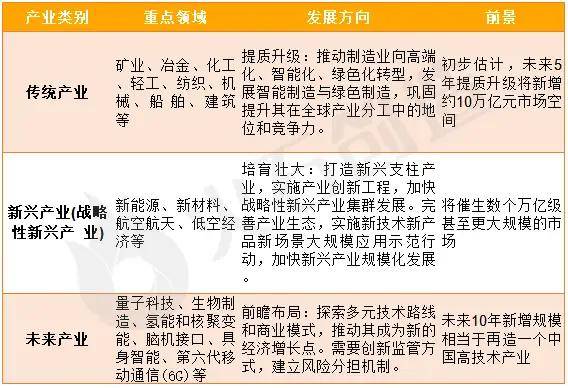
Core Viewpoint - The recently released "Suggestions on Formulating the 15th Five-Year Plan for National Economic and Social Development" lays the foundation for China's development from 2026 to 2030, highlighting the importance of a modern industrial system and the solidification of the real economy [1][2]. Modern Industrial System Framework - The plan emphasizes building a modern industrial system as a primary strategic task, focusing on the real economy's critical role in development [2]. - Four major tasks are outlined: optimizing traditional industries, nurturing emerging and future industries, promoting high-quality service sector development, and constructing a modern infrastructure system [2]. Key Areas of the 15th Five-Year Plan - Traditional industries such as mining, metallurgy, and chemicals will undergo quality upgrades, with an estimated market space of around 10 trillion yuan [3]. - Emerging industries will be supported through innovation projects and large-scale applications of new technologies [3]. - Future industries like quantum technology, biotechnology, and nuclear fusion are highlighted for their potential to drive economic growth [9]. Four Major Emerging Pillar Industries - The plan identifies four strategic emerging industries: new energy, new materials, aerospace, and low-altitude economy, which are expected to significantly contribute to the economy in the next five years [2][4]. New Energy - China has established the world's largest and fastest-growing renewable energy system, with wind and solar power capacities leading globally [4]. - The new energy sector is projected to maintain rapid growth, becoming a key economic driver under the "dual carbon" goals [4]. New Materials - The new materials industry supports the development of other emerging sectors and has made significant progress in areas like semiconductor materials and carbon fiber [5][6]. - The focus is on achieving breakthroughs in high-end materials to meet advanced manufacturing needs [6]. Aerospace - The plan emphasizes the role of commercial aerospace, with significant achievements in manned spaceflight and satellite technology [7]. - The commercial aerospace sector is expected to enter a rapid growth phase, driven by national support and market demand [7]. Low-Altitude Economy - The low-altitude economy is recognized as a strategic emerging industry, with rapid development in the drone sector [8]. - This sector is anticipated to become a new growth engine, with applications in logistics and urban air transport [8]. Six Major Future Industries - The plan highlights future industries such as quantum technology, biotechnology, hydrogen energy, brain-computer interfaces, embodied intelligence, and 6G technology, which are expected to foster long-term growth [9]. Quantum Technology - Quantum technology is prioritized for its strategic value, with China leading in quantum communication and making strides in quantum computing [10]. - The sector is expected to transition from research to industrial application, forming new high-tech clusters [10]. Biotechnology - The biotechnology sector is experiencing rapid growth, with innovations in biobased materials and pharmaceuticals [11]. - It is projected to significantly expand by 2030, contributing to a green economy [11]. Hydrogen and Nuclear Fusion Energy - Hydrogen energy is recognized as a key clean energy source, with ongoing advancements in fuel cell technology [13]. - The nuclear fusion sector is still in the experimental stage but is expected to achieve breakthroughs during the 15th Five-Year Plan [13]. Brain-Computer Interfaces - Research in brain-computer interfaces is advancing, with applications in medical rehabilitation [14]. - The technology is expected to progress from experimental to clinical use, driving new technological developments [14]. Embodied Intelligence - The embodied intelligence sector is growing, with significant advancements in robotics and autonomous driving [15]. - This industry is expected to see rapid growth, becoming a crucial driver of manufacturing and digital economy development [15]. Sixth Generation Mobile Communication - 6G technology is anticipated to surpass 5G in speed and connectivity, with global competition underway [16]. - The 15th Five-Year Plan period is critical for establishing a competitive edge in 6G technology, which will support future digital economic innovations [16].
【CGS-NDI跟踪】2025年超长期特别国债发行收官——政策双周报(2025年第7期)
Xin Lang Cai Jing· 2025-10-31 11:37
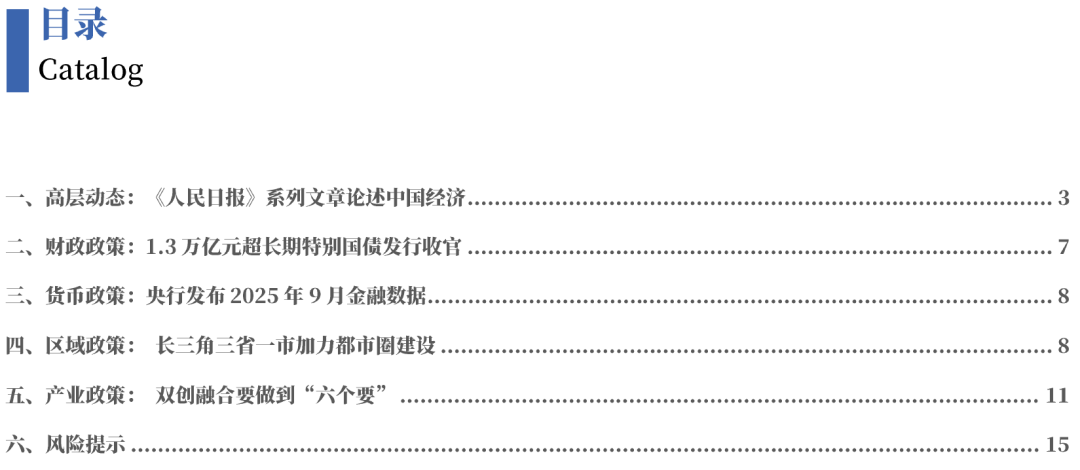
Group 1: High-Level Dynamics - The People's Daily published a series of articles discussing the long-term stability and development logic of the Chinese economy, emphasizing the strong signals for stabilizing expectations and promoting development [1][5] - Xi Jinping attended the Global Women's Summit and delivered a keynote speech, highlighting the importance of women's development and proposing several initiatives to support this cause [10][11] - Premier Li Qiang hosted a State Council study session focused on enhancing standards to promote high-quality economic development [15][16] Group 2: Fiscal Policy - The issuance of 1.3 trillion yuan in ultra-long-term special government bonds was completed, with funds aimed at supporting major national strategies and enhancing safety capabilities in key areas [25][26] - The issuance scale increased by 300 billion yuan compared to 2024, with a faster pace and earlier issuance time to ensure funds are utilized effectively [25][26] Group 3: Monetary Policy - The central bank's financial data for September 2025 showed M1 growth at 7.2% and M2 growth at 8.4%, with a narrowing M2-M1 gap, indicating a shift towards more liquid deposits [31] - New social financing totaled 3.53 trillion yuan, with a year-on-year decrease, reflecting challenges in loan growth for both households and enterprises [31] Group 4: Regional Policy - The Yangtze River Delta region is enhancing urban agglomeration construction, with a focus on coordinated development and infrastructure connectivity [33][39] - A report on global marine city competitiveness highlighted Shanghai's leading position, emphasizing the city's economic vitality and port throughput [34] Group 5: Industrial Policy - Shanghai introduced measures to accelerate the cultivation of future industries, aiming to establish a number of leading enterprises and innovation clusters by 2030 [47][52] - A multi-departmental plan was released to promote service-oriented manufacturing innovation, targeting the establishment of standards and leading brands by 2028 [52][54] - The national industrial and information technology conference emphasized the importance of integrating technological and industrial innovation to enhance competitiveness [54]
中国前瞻布局未来产业 打造新的经济增长点
Zhong Guo Xin Wen Wang· 2025-10-31 08:16
Core Viewpoint - The quantum technology sector in the A-share market is experiencing significant growth, driven by its inclusion in the "14th Five-Year Plan" as a key future industry [2][3]. Industry Development - The National Development and Reform Commission stated that these emerging industries could create a scale equivalent to recreating China's high-tech industry over the next decade [3]. - The global landscape is undergoing unprecedented changes, with technological revolutions and major power competition making high-tech fields critical to national competitiveness [4]. - Future industries represent a new wave of technological revolution and industrial transformation, serving as a vital area for cultivating new productive forces [5]. Challenges in Future Industries - There are notable challenges in technology breakthroughs, as the transition from theoretical exploration to practical application is fraught with uncertainties [6]. - The conversion of experimental results into marketable products faces hurdles at various stages, including concept validation and pilot testing [6]. - Financing support is a significant challenge, as these future industries require substantial, patient capital investment and a flexible financing environment [6]. Systematic Deployment - The "14th Five-Year Plan" suggests strengthening original innovation and tackling key core technologies [7]. - It emphasizes exploring diverse technological routes, typical application scenarios, feasible business models, and market regulatory rules [7]. - A mechanism for growth in future industry investment and risk-sharing is proposed, along with enhancing the adaptability of capital market systems [7]. Financial Support and Integration - Recent discussions at the 2025 Financial Street Forum highlighted the need for comprehensive financial support for long-term capital investment in hard technology [8]. - Financial institutions are encouraged to engage deeply in the entire process of technological research, result transformation, and industrialization, fostering a "technology-industry-finance" virtuous cycle [8]. Global Competitive Advantage - Continuous technological breakthroughs and the flourishing of future industries will help China gain an advantage in global technological competition and occupy a leading position in global industrial transformation [9].