
煤化工产品

Search documents
中煤能源(01898) - 海外监管公告-2025年审计报告
2026-03-27 13:27
香港交易及結算所有限公司及香港聯合交易所有限公司對本公告之內容概不負責,對其準 確性或完整性亦不發表任何聲明,並明確表示概不就因本公告全部或任何部份內容而產生 或因倚賴該等內容而引致之任何損失承擔任何責任。 ( 于中華人民共和國註冊成立的股份有限公司 ) (股份代號:01898) 海外監管公告 本公告乃根據香港聯合交易所有限公司證券上市規則第13.10B條而發表。 以下為中國中煤能源股份有限公司於上海證券交易所網站刊發之《中國中煤能源股 份有限公司 2025 年審計報告》。 承董事會命 中國中煤能源股份有限公司 董事長、執行董事 王樹東 中國 北京 2026 年 3 月 27 日 於本公告刊發日期,本公司的執行董事為王樹東、高士崗和廖華軍;非執行董事為徐倩; 獨立非執行董事為景奉儒、詹豔景和黃江天。 * 僅供識別 中国中煤能源股份有限公司 已审财务报表 2025 年度 中国中煤能源股份有限公司 目 录 | | 页 | | 次 | | --- | --- | --- | --- | | 审计报告 | 1 | - | 6 | | 已审财务报表 | | | | | 合并资产负债表 | 7 | - | 8 | | 母 ...
平煤股份20260324
2026-03-26 13:20
Summary of the Conference Call for Pingmei Shenma Energy Company Industry Overview - The coal industry is experiencing a shift due to supply constraints from overproduction policies and improving demand from the steel and chemical sectors, leading to an expected gradual increase in coking coal prices in 2026 [2][8]. Key Company Insights - **Iron Factory No. 1 Mine**: - 51% ownership, construction commenced in August 2025, with a planned capacity of 3 million tons [2]. - Expected to obtain mining rights by mid-2026 and commence production by the end of 2028 [2][3]. - Resource amount of 1.688 billion tons with an estimated recoverable reserve of nearly 600 million tons [3]. - **Sikong Tree Coal Mine**: - 60% ownership, annual capacity of 1.2 million tons, with a projected revenue of 286 million yuan and a profit of approximately 30 million yuan in 2025 [3]. - **Cost Management**: - Coal cost per ton is expected to decrease by 27%-28% year-on-year to 570 yuan in 2025, with Q3 costs dropping to 504 yuan [2][6]. - Further cost reduction of 5%-10% is anticipated in 2026 [6]. - **Dividends and Market Management**: - Committed to a cash dividend ratio of no less than 60% from 2023 to 2025, with plans for share buybacks and mergers to enhance market value [2][7]. Potential Risks and Opportunities - **Asset Injection from Henan Energy Group**: - The group has 60-80 million tons of coal capacity, but asset injection is slow due to efficiency and ownership issues [2][4]. - Future asset injections are expected but will depend on the restructuring of the group [4]. - **Coking Assets**: - The group has four coking enterprises with a total capacity of 6.5 million tons, but profitability is currently low, with the focus on coal chemical by-products [5]. Market Outlook - **Supply and Demand Dynamics**: - Supply is expected to decrease due to strict enforcement of overproduction policies, while demand is projected to improve due to recovery in steel and chemical industries [8]. - Current low inventory levels support a positive outlook for the coal market in 2026 [8]. - **Long-term Price Trends**: - The company remains optimistic about the long-term development of the coking coal industry, with a projected price stabilization around 1,600 yuan per ton for 2026, influenced by geopolitical factors [9]. Additional Considerations - The company's "14th Five-Year" plan is under adjustment due to the ongoing restructuring of the group [9]. - The product structure includes 64% premium low-sulfur coking coal, indicating a focus on high-quality resources [9].

化工行业2026年度投资策略:“十五五”规划引领化工行业高质量发展
Shanghai Securities· 2026-03-24 10:40
Key Points - The "14th Five-Year Plan" is expected to lead the chemical industry towards high-quality development through supply and demand side reforms, focusing on green development and technological self-reliance [5][6] - The chemical industry is anticipated to experience a recovery in prosperity, with supply growth expected to slow down and a replenishment cycle beginning, supported by national policy guidance [5][6] - Key sectors to watch include refrigerants, potash fertilizers, organic silicon, phosphorus chemicals, and coal chemicals, which are expected to benefit from the upward trend in market conditions [5][6] Section Summaries Industry Review: Recovery Expected - The chemical industry is currently at a low point but is expected to recover as supply-side pressures ease and demand improves [18][19] - The basic chemical index rose by 33.29% by the end of 2025, indicating a positive trend [21] Focus Sectors: Improving Supply and Demand - The supply of refrigerants is expected to contract due to regulatory measures, while demand from air conditioning and refrigeration markets is projected to grow, leading to a favorable market environment [52][45] - The potash fertilizer market is characterized by high concentration and oligopoly, with global demand expected to grow by 5.5% in 2024 [60][61] - The organic silicon industry is transitioning from an expansion phase to a balanced supply-demand situation, with profitability expected to recover as production capacity stabilizes [68][76] - Phosphorus chemicals are benefiting from high market prices and increasing demand from the energy storage sector, particularly for lithium iron phosphate [86][87] New Materials Opportunities - The solid-state battery industry is advancing, with significant developments expected in the coming years, creating opportunities for related materials [95][96] - The photolithography market is expanding due to strong demand from the semiconductor industry, with domestic companies accelerating their production capabilities [97][100]
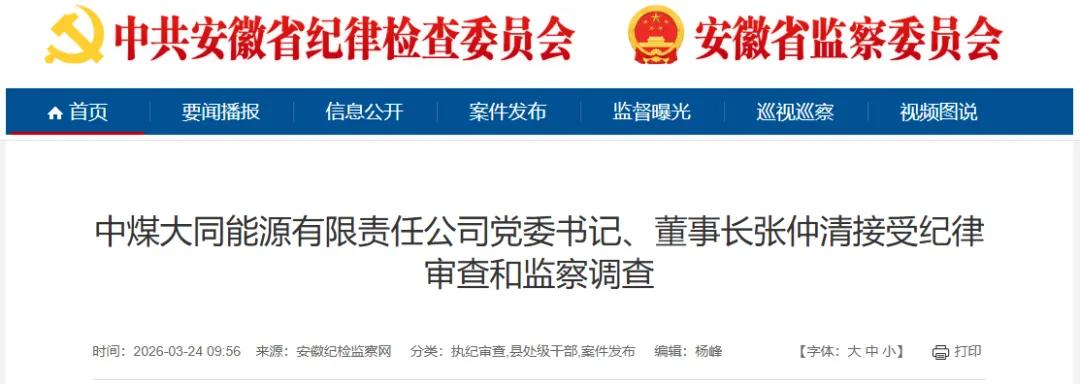
中煤能源集团两高管被查!1董事长现执掌大同能源,1副总裁系大同煤校校友
Xin Lang Cai Jing· 2026-03-24 06:11
Core Viewpoint - On March 24, two executives from China Coal Energy Group, namely Vice President Zhang Guoxiu and Chairman Zhang Zhongqing of China Coal Datong Energy Co., were reported to be under investigation for serious violations of discipline and law [1][5][10]. Group 1: Executive Profiles - Zhang Guoxiu graduated from Datong Coal Industry School and has worked in coal-related positions, rising to the role of Vice President of China Coal Energy in 2022 [1][5]. - Zhang Zhongqing has a background in coal mining technology and has held various leadership roles, including Chairman of China Coal Datong Energy since January 2022 [3][10]. Group 2: Investigation Details - Both Zhang Guoxiu and Zhang Zhongqing are currently under investigation by the Discipline Inspection Commission of China Coal Energy Group and the Supervisory Committee of Suzhou City, Anhui Province [5][10]. - Zhang Guoxiu had submitted his resignation just four days prior to the announcement of the investigation, effective immediately upon submission [5][17]. Group 3: Company Background - China Coal Energy was established on August 22, 2006, and is headquartered in Beijing, with its shares listed in Hong Kong and A-shares issued in February 2008 [8][20]. - The company primarily engages in coal production and trade, coal chemical products, power generation, and coal mining equipment manufacturing [20]. Group 4: Financial Performance - In the third quarter of 2025, China Coal Energy reported total revenue of 110.58 billion yuan, a year-on-year decrease of 21.24%, and a net profit attributable to shareholders of 12.49 billion yuan, down 14.57% year-on-year [8][20].


中煤能源:公司煤化工企业生产正常,随产品价格上涨,盈利状况有改善预期
Zheng Quan Ri Bao· 2026-03-23 11:38
Group 1 - The core viewpoint of the article indicates that the company, China Coal Energy, is experiencing normal production in its coal chemical enterprises and anticipates an improvement in profitability due to rising product prices [1] Group 2 - The company suggests that detailed information regarding its financial performance will be disclosed in the upcoming quarterly report [1]
中国石油化工股份(00386):暴风雨前的平静
citic securities· 2026-03-23 07:17
Investment Rating - The report assigns a negative outlook for Sinopec, indicating that the 2025 performance is expected to be 19% lower than market consensus [2][3]. Core Insights - Sinopec's net profit for 2025 is projected at 32.5 billion yuan, a 34% year-on-year decline, and significantly below market expectations [3]. - The fourth quarter of 2025 showed a meager net profit of 400 million yuan, down 89% year-on-year and 95% quarter-on-quarter, primarily due to a 7.35 billion yuan inventory loss from falling oil prices [3]. - The downstream segments, including refining, marketing, and chemicals, have all weakened, with the marketing segment turning to a loss and the chemicals segment's losses tripling [4]. - The escalating situation in the Middle East is expected to impact Sinopec's downstream operations significantly, with potential supply disruptions in the second quarter of 2026 [5]. Summary by Sections Financial Performance - Sinopec's 2025 net profit is forecasted at 32.5 billion yuan, a 34% decrease from the previous year and 19% lower than market consensus [3]. - The fourth quarter of 2025 recorded a net profit of 400 million yuan, a drastic decline of 89% year-on-year and 95% quarter-on-quarter, largely due to inventory losses [3]. Downstream Operations - All three major downstream segments (refining, marketing, chemicals) showed deterioration in the fourth quarter of 2025, with the marketing segment reporting a loss and the chemicals segment's losses expanding significantly [4]. - The exploration and production segment remained relatively stable, with a 15% decline in earnings before interest and taxes [4]. Market Conditions - The report highlights that the Middle East situation could lead to significant supply disruptions, impacting Sinopec's operations and potentially leading to a shortage of refined products [5]. - The report notes that as the largest downstream operator in China/Asia, Sinopec may face substantial operational pressures due to these geopolitical developments [5].
中国煤炭 2026 年展望:海运市场支撑煤价,将中国神华上调至买入评级,中煤能源股调整为中性 买入评级-China Coal 2026 Outlook China Coal Price Supported by Seaborne Market Upgrade Shenhua-A to Buy and China Coal-AH to NeutralBuy
2026-03-20 02:41
Summary of China Coal and Shenhua Energy Conference Call Industry Overview - The conference discusses the thermal coal market in China, focusing on demand, supply, and pricing outlook for 2026, influenced by geopolitical factors and domestic production capabilities. Key Points 1. Demand Forecast - In 2026, China's thermal coal demand is expected to increase by 0.6% YoY, driven primarily by a 0.7% increase in the power segment, which accounts for 63% of total demand. Other sectors like cement and steel are projected to see declines of -2.6% and -1.6% respectively, while the chemicals sector is expected to grow by +5.3% [2][8] 2. Supply Outlook - Total coal output in China is projected to reach 4,902 million tons in 2026, reflecting a 0.6% YoY increase. However, this could be impacted by overproduction and regulatory constraints. Imported coal volume is expected to decline to 453 million tons, a decrease of 7.5% YoY, due to tightened supply from Indonesia [3][11][10] 3. Price Projections - The average price for QHD5500kcal coal is forecasted to be Rmb800 per ton in 2026, representing a 14.8% increase YoY. This price increase is supported by rising energy prices and potential additional supply from Xinjiang if domestic prices rise significantly [4][13] 4. Company-Specific Updates - **Shenhua Energy (1088.HK/601088.SS)**: - Earnings forecasts for 2025, 2026, and 2027 have been revised upwards by 0%, +11%, and +12% respectively, primarily due to higher coal and coal chemical product prices. Target prices have been adjusted to HK$54.7 for Shenhua-H and Rmb53.0 for Shenhua-A [27][28][29] - Dividend yields are projected at 5.1% for Shenhua-H and 4.5% for Shenhua-A, leading to an upgrade of Shenhua-A to Buy [29] - **China Coal (1898.HK/601898.SS)**: - Earnings forecasts for 2025, 2026, and 2027 have been revised by 0%, +22%, and +15% respectively, reflecting higher average selling prices (ASPs) for coal and coal chemical products. Target prices are set at HK$18.2 for China Coal-H and Rmb17.9 for China Coal-A [38][43][44] - Dividend yields are estimated at 4.0% for China Coal-H and 2.7% for China Coal-A, with an upgrade of China Coal-H to Buy and China Coal-A to Neutral [44] 5. Market Dynamics - The rising energy prices due to geopolitical tensions, particularly in the Middle East, are expected to support domestic thermal coal prices. However, the potential for increased domestic production could cap significant price spikes [1][4][13] 6. Additional Insights - The power segment remains the key driver of thermal coal demand, while the chemicals industry is anticipated to experience robust growth. The overall market dynamics suggest a cautious but optimistic outlook for the coal sector in 2026, with a focus on balancing supply and demand amidst regulatory challenges [2][3][8] This summary encapsulates the critical insights from the conference call regarding the thermal coal market in China, highlighting both the opportunities and challenges faced by key players in the industry.

意外,霍尔木兹海峡突然封锁,炸出中国三十年惊天布局
商业洞察· 2026-03-17 09:23
Group 1 - The article discusses the ongoing military conflict between Israel and Iran, which has escalated over 17 days, impacting global oil prices and causing significant market reactions in Japan and South Korea [4][5]. - Brent crude oil prices have surged past $100 per barrel, leading to economic concerns, particularly in Japan, where GDP could potentially decline by 0.65% over the next year [4][5]. - In contrast, China, as the world's largest oil importer, has shown resilience, with its stock market remaining stable and even seeing slight gains in the A-share market [6][5]. Group 2 - China has prepared for energy security over the past two decades, establishing a robust energy import network that includes pipelines from Russia and Central Asia, which can quickly ramp up supply [8][13]. - China's oil reserves are estimated to be sufficient to cover 110 to 140 days of consumption, providing a buffer in case of supply disruptions [8][9]. - The diversification of China's oil import sources has reduced reliance on traditional suppliers, with increasing contributions from countries in the CIS, South America, and even North America and Europe [15][19]. Group 3 - China is actively reducing its dependence on oil by investing in nuclear, wind, and hydroelectric power, aiming to create a significant "electric power empire" [20][21]. - By 2025, China's electricity consumption is projected to reach 10.37 trillion kilowatt-hours, surpassing the total consumption of the EU, Russia, India, and Japan combined [21][22]. - The share of electricity in China's total energy consumption has exceeded 30%, significantly higher than the global average of around 20% [24][25]. Group 4 - China's renewable energy capacity is expected to reach 1.84 billion kilowatts by 2025, with wind and solar power surpassing traditional coal power for the first time [26][27]. - The penetration rate of new energy vehicles in China is projected to exceed 50% by 2025, indicating a shift towards electric vehicles amidst rising oil prices globally [28][29]. - The development of green energy not only enhances energy security but also positions China favorably in future global competition, particularly in the context of AI and technology [29][30]. Group 5 - China has a unique advantage in coal chemical technology, allowing it to convert coal into various products, including oil and gas, which can mitigate the impact of oil supply disruptions [33][34]. - The coal chemical industry in China is expected to replace approximately 14% of the country's oil and gas consumption by 2024, providing a buffer against supply shocks [34][35]. - This capability ensures that China can maintain its industrial output even in the face of external supply challenges, securing critical chemical raw materials domestically [36][37]. Group 6 - The Chinese government is investing heavily in new power systems, with a planned investment of 4 trillion yuan during the 14th Five-Year Plan period, reflecting a proactive approach to energy security [38][39]. - The current geopolitical climate, characterized by unilateralism and protectionism, necessitates a focus on energy, food, and gold reserves as essential components of national security [39][40].

“可落地的宏观框架”系列之一:现实世界的价格传导模型
Orient Securities· 2026-03-16 08:13
Group 1: Price Transmission Dynamics - The core issue is not whether prices will rise, but whether price increases can be transmitted from upstream to downstream[2] - The ability to transmit prices is strongest upstream, followed by midstream, and weakest downstream[8] - The supply-demand structure from 2023 to 2025 will have a greater negative impact on PPI than in 2014-2015[8] Group 2: PPI and Cost Transmission - The PPI's month-on-month changes align closely with the calculated model, indicating the model's effectiveness[16] - PPI year-on-year can be split into contributions from cost transmission and supply-demand structure, with the latter being more detrimental in 2023-2025[17] - The capacity utilization rate in the second half of 2025 is expected to weaken, impacting price transmission in the first half of 2026[20] Group 3: Oil Price Impact - A 1% increase in Brent crude oil prices leads to a 0.041% increase in PPI when considering limited transmission through the oil and chemical chain[22] - When accounting for substitution effects, the same 1% increase in oil prices can raise PPI by 0.071%[22] - In an ideal scenario where the supply-demand structure is fully restored, a 1% increase in oil prices could raise PPI by approximately 0.083%[23]
中国神华千亿重组完成市值逼近万亿 一体化优势巩固行业低景气仍赚500亿
Chang Jiang Shang Bao· 2026-03-15 23:19
Core Viewpoint - China Shenhua's major asset restructuring, valued at 1,335.98 billion yuan, has been successfully completed, enhancing its integrated business model and addressing competition issues with the State Energy Group [1][3][7]. Group 1: Restructuring Details - The restructuring involved acquiring 100% equity of 12 companies in power, coal, chemicals, and logistics from the State Energy Group, with a total assessed value of 1,436.75 billion yuan [2][3]. - The transaction was financed through a combination of cash (935.19 billion yuan) and shares (400.8 billion yuan), along with a fundraising plan of up to 20 billion yuan [2][4]. - The entire process from announcement to completion took only seven months, setting a record in the A-share market [7]. Group 2: Business Integration and Performance - The restructuring aims to enhance China Shenhua's integrated business model, consolidating coal mining, power generation, and logistics services, thereby increasing core business capacity and resource reserves [3][8]. - Post-restructuring, coal reserves are expected to increase by 64.72% to 684.9 billion tons, while recoverable coal reserves will rise by 97.71% to 345 billion tons [8]. - The company anticipates maintaining a stable profit of around 500 billion yuan for the year, despite a projected decline in net profit due to market conditions [11][12]. Group 3: Market Reaction and Historical Performance - On March 12, the company's stock reached a historical high of 49.80 yuan per share, with a combined market capitalization of approximately 9,680.52 billion yuan [1][13]. - Since its listing in 2007, China Shenhua has distributed a total of 4,804.70 billion yuan in cash dividends, with an average dividend payout ratio of 61.89% [13].