
适度宽松的货币政策

Search documents
冠通期货早盘速递-20250929
Guan Tong Qi Huo· 2025-09-29 06:27
Report Summary - The report does not provide an investment rating for the industry. - The core view of the report is to present the latest market information and trends, including power industry statistics, monetary policy, international news, and the performance of various asset classes. Hot News - As of the end of August, the cumulative installed power generation capacity in China reached 3.69 billion kilowatts, a year-on-year increase of 18%. Among them, solar power installed capacity was 1.12 billion kilowatts, a year-on-year increase of 48.5%, and wind power installed capacity was 0.58 billion kilowatts, a year-on-year increase of 22.1%. From January to August, the cumulative average utilization hours of power generation equipment in China were 2,105 hours, a decrease of 223 hours compared with the same period last year [2]. - The third - quarter (110th) regular meeting of the Monetary Policy Committee of the People's Bank of China in 2025 was held on September 23. The meeting mentioned implementing a moderately loose monetary policy, strengthening counter - cyclical adjustment, and promoting economic growth and price stability [2]. - In the United States, consumer spending adjusted for inflation increased by 0.4% for the second consecutive month in August. The Fed's preferred core PCE price index rose 0.2% month - on - month and remained stubbornly at 2.9% year - on - year, indicating economic robustness this quarter [2]. - On September 28 (local time), Hamas stated that it had not received new proposals from mediators, and the negotiations with Israel had been at a stalemate since the assassination of its leader in Doha. Hamas said it was ready to study any proposals [3]. Market Performance Stock Market - The Shanghai Composite Index had a daily decline of 0.65%, a monthly decline of 0.77%, and an annual increase of 14.21%. The S&P 500 had a daily increase of 0.59%, a monthly increase of 2.84%, and an annual increase of 12.96%. The Hang Seng Index had a daily decline of 1.35%, a monthly increase of 4.19%, and an annual increase of 30.25% [7]. Commodity Market - In terms of commodity plate price increases, precious metals increased by 32.15%, non - metallic building materials by 2.73%, and energy by 2.96% [4][5]. - Key commodities to focus on include Shanghai silver, coke, pulp, fuel oil, and Shanghai gold [6]. Other Asset Classes - The 10 - year Treasury bond futures had a daily increase of 0.13%, a monthly decline of 0.12%, and an annual decline of 1.14%. London spot gold had a daily increase of 0.28%, a monthly increase of 9.05%, and an annual increase of 43.24% [8].
央行货币政策委员会第三季度例会释放哪些政策信号?
Zheng Quan Ri Bao· 2025-09-28 16:08
Core Viewpoint - The People's Bank of China (PBOC) emphasizes the need for a moderately loose monetary policy, enhancing counter-cyclical adjustments to promote stable economic growth and maintain reasonable price levels [1][2]. Monetary Policy Implementation - The recent meeting highlighted the importance of executing various monetary policy measures effectively to fully release their effects, indicating a sustained focus on the implementation and effectiveness of previously introduced policies [3]. - The PBOC aims to maintain a flexible approach to policy implementation based on domestic and international economic conditions, emphasizing the need for forward-looking, targeted, and effective measures [3]. Support for Specific Sectors - The meeting introduced new support directions, including increased assistance for small and micro enterprises and stabilizing foreign trade, alongside previously mentioned support for technological innovation and consumption [3]. - To better support small and micro enterprises, the PBOC suggests addressing financing bottlenecks and encouraging financial institutions to enhance support for first loans, renewals, and credit loans [3]. - For stabilizing foreign trade, the PBOC plans to strengthen policy support to meet the financing needs of foreign trade enterprises and optimize cross-border payment and exchange rate hedging services [3].
央行定调三季度货币政策
Di Yi Cai Jing· 2025-09-28 12:34
Core Viewpoint - The People's Bank of China (PBOC) emphasizes the need to promote stable economic growth and maintain reasonable price levels, reflecting a stronger commitment to economic recovery amid complex external conditions and domestic challenges [2][4]. Economic Situation - The economic assessment has shifted from "showing a positive trend" in Q2 to "steady progress" in Q3, indicating improved risk expectations and confidence in the economic fundamentals [4]. - The previous mention of "many risk hazards" has been removed, focusing instead on "insufficient domestic demand" and "low price levels" as the main challenges [4]. Monetary Policy - The monetary policy stance remains consistent with the July Politburo meeting, emphasizing the implementation of a moderately loose monetary policy [2][3]. - The focus has shifted from "implementing" to "ensuring the execution" of monetary policies, highlighting the importance of precise policy execution [4][6]. Structural Support - The scope of structural monetary policy tools has been expanded to include support for small and micro enterprises and stabilizing foreign trade, in addition to existing focuses on technological innovation and consumption [5]. - This adjustment is closely related to the current economic environment, particularly the potential impact of increased tariffs from the U.S. on Chinese exports [5]. Policy Coordination - Future monetary policy is expected to have more room for maneuver, with an emphasis on policy coordination and effective implementation based on domestic and international economic conditions [6][7]. - The market anticipates potential monetary easing measures, including a possible reduction in reserve requirements and interest rates, to support economic growth and employment [7]. Structural Tool Optimization - Recommendations include increasing the limits of structural tools and lowering their interest rates to enhance attractiveness for financial institutions, thereby encouraging support for key sectors such as technology, green development, and small enterprises [8].

央行重要会议,关于货币政策
Zhong Guo Zheng Quan Bao· 2025-09-26 13:17
Core Viewpoint - The People's Bank of China emphasizes the need for a moderately loose monetary policy to enhance counter-cyclical adjustments and support economic stability amid a complex external environment [2][5]. Monetary Policy Strategy - The meeting suggests strengthening monetary policy regulation, improving its foresight, targeting, and effectiveness based on domestic and international economic conditions [1][2]. - It aims to maintain ample liquidity and guide financial institutions to increase credit supply, aligning social financing scale and money supply growth with economic growth and price level expectations [3][4]. Economic Analysis - The current external environment is increasingly complex, with weakening global economic growth and rising trade barriers, leading to differentiated economic performances among major economies [2][5]. - Despite challenges such as insufficient domestic demand and low price levels, China's economy is showing steady progress and improved social confidence [2][5]. Financial Market Stability - The meeting highlights the importance of maintaining stability in the capital market and the real estate market, urging large banks to support the real economy while enhancing the capital strength of small and medium-sized banks [4][5]. - It calls for effective implementation of structural monetary policy tools to support key areas such as technological innovation, consumption, small and micro enterprises, and foreign trade [4][5]. Real Estate and Financial Management - There is a focus on revitalizing existing housing and land assets to stabilize the real estate market and improve foundational financial systems [5]. - The meeting stresses the need for high-level financial openness and enhanced economic and financial management capabilities under open conditions [5].
货币政策委员会三季度例会:落实落细适度宽松的货币政策
Bei Jing Shang Bao· 2025-09-26 12:40
Core Insights - The People's Bank of China (PBOC) held its 110th monetary policy committee meeting on September 23, 2025, emphasizing the need for appropriate monetary policy to support high-quality economic development and create a favorable financial environment for economic recovery [1] Group 1: Monetary Policy - The meeting highlighted an increase in macroeconomic regulation efforts this year, with a moderately loose monetary policy being implemented to strengthen counter-cyclical adjustments [1] - Various monetary policy tools are being utilized to enhance the transmission efficiency of monetary policy, resulting in historically low social financing costs [1] Group 2: Economic Environment - The external economic environment is becoming increasingly complex and severe, with weakened growth momentum in the global economy, rising trade barriers, and divergent economic performances among major economies [1] - Despite challenges such as insufficient domestic demand and low price levels, China's economy is showing steady progress, with improved social confidence and new achievements in high-quality development [1] Group 3: Future Outlook - The PBOC plans to continue implementing moderately loose monetary policies, strengthen counter-cyclical adjustments, and enhance the dual functions of monetary policy tools to promote stable economic growth and maintain reasonable price levels [1]
盛松成:中国居民储蓄将更多流向金融投资
2 1 Shi Ji Jing Ji Bao Dao· 2025-09-26 03:24
Core Viewpoint - Chinese residents' savings are expected to increasingly flow into financial investments, particularly into high-quality projects that can generate stable cash flows, aligning with national strategic directions [1] Group 1: Investment Trends - High-quality projects in new infrastructure, consumer infrastructure, and new urbanization are identified as attractive assets due to their alignment with technological innovation and high-quality development [1] - The external environment is providing support for Chinese asset prices, with expectations of continued interest rate cuts from the Federal Reserve and potential for further rate cuts in China [1] Group 2: Monetary Policy - China is anticipated to maintain a proactive fiscal policy complemented by moderately loose monetary policy in the near term, despite not having the foundation for significant rate cuts [1]
21独家专访盛松成:中国居民储蓄将更多流向金融投资
2 1 Shi Ji Jing Ji Bao Dao· 2025-09-26 03:07
Core Viewpoint - Chinese residents' savings are expected to increasingly flow into financial investments, particularly into high-quality projects that can generate stable cash flows, aligning with national strategic directions [2] Group 1: Investment Trends - High-quality projects in new infrastructure, consumption infrastructure, and new urbanization are seen as attractive assets due to their alignment with technological innovation and high-quality development [2] - The external environment is providing support for Chinese asset prices, with expectations of continued interest rate cuts from the Federal Reserve [2] Group 2: Monetary Policy Outlook - There is still room for interest rate cuts in China, although a significant reduction is not anticipated in the short term [2] - The focus will remain on proactive fiscal policies complemented by moderately loose monetary policies in the near future [2]
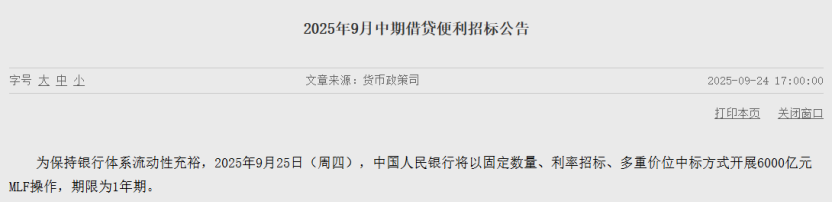
6000亿元!央行,明日操作!
Zheng Quan Shi Bao· 2025-09-24 11:01
Core Viewpoint - The People's Bank of China (PBOC) is continuing to implement a moderately loose monetary policy by injecting liquidity into the banking system through a series of operations, including a 600 billion yuan Medium-term Lending Facility (MLF) operation, marking the seventh consecutive month of increased MLF issuance [1][3]. Group 1: MLF Operations - On September 25, the PBOC announced a 600 billion yuan MLF operation with a one-year term, resulting in a net injection of 300 billion yuan for the month after 300 billion yuan of MLF matured [1]. - The MLF operations have transitioned to a bidding mechanism that allows institutions to prepare for liquidity needs in advance, enhancing market-based pricing capabilities [4]. - The PBOC has maintained a consistent approach to MLF operations since March, focusing on liquidity provision rather than policy adjustments [3][4]. Group 2: Market Impact and Coordination - The combined liquidity injection from MLF and reverse repos in September reached 600 billion yuan, maintaining the same level as August, indicating a stable monetary policy stance [3]. - The ongoing liquidity support is seen as beneficial for the smooth issuance of government bonds, reflecting a coordinated approach between fiscal and monetary policies [3]. - Recent increases in mid-to-long-term market interest rates due to a strong stock market have prompted the PBOC to enhance liquidity injections to stabilize market expectations [3]. Group 3: Future Expectations - Analysts anticipate that the PBOC may further utilize quantitative monetary policy tools in the fourth quarter, including MLF and reverse repos, to continue injecting liquidity into the market [4]. - There is a growing market demand for the PBOC to resume government bond trading operations, which could provide more flexible and effective liquidity support compared to monthly reverse repo operations [4].

每日投资策略-20250923
Zhao Yin Guo Ji· 2025-09-23 02:29
Global Market Overview - The Hang Seng Index closed at 26,344, down 0.76% for the day but up 31.33% year-to-date [1] - The S&P 500 and Nasdaq in the US saw increases of 0.44% and 0.70% respectively, with year-to-date gains of 13.81% and 18.01% [1] - The Shanghai Composite Index rose by 0.22%, reflecting a year-to-date increase of 14.23% [1] Sector Performance - In the Hong Kong market, the Hang Seng Financial Index fell by 0.85%, while the Hang Seng Industrial and Commercial Index decreased by 0.68% [2] - The Hang Seng Property Index dropped by 1.25%, indicating a year-to-date increase of 23.48% [2] - The energy and consumer staples sectors in the Chinese stock market experienced declines, while materials, healthcare, and information technology sectors saw gains [3] Monetary Policy and Economic Outlook - The People's Bank of China is expected to continue a loose monetary policy, with potential reserve requirement ratio cuts of 50 basis points and interest rate cuts of 10 basis points in Q4 [3] - The steel industry in China will implement capacity controls, prohibiting new capacity additions from 2025 to 2026, with an expected annual growth of around 4% in value added [3] Company Focus - Geely Automobile (175 HK) is rated as a buy with a target price of 25.00, representing a 34% upside potential [4] - Luckin Coffee (LKNCY US) is also rated as a buy, with a target price of 44.95, indicating a 20% upside [4] - Tencent (700 HK) has a target price of 705.00, suggesting a 10% upside potential [4] Technology Sector Insights - Nvidia plans to invest $100 billion to support OpenAI in building a 10GW data center, leading to a nearly 4% increase in its stock price [3] - The semiconductor sector is highlighted with companies like Horizon Robotics (9660 HK) and North Huachuang (002371 CH) rated as buy, with target prices indicating significant upside potential [4] Investment Opportunities - The report identifies several companies with strong growth potential, including BYD Electronics (285 HK) and Salesforce (CRM US), both rated as buy with substantial upside targets [4] - The healthcare sector is represented by companies like BeiGene (ONC US) and 3SBio (1530 HK), both rated as buy, indicating confidence in their future performance [4]



我国股债汇市场保持平稳
Sou Hu Cai Jing· 2025-09-23 00:48
Core Viewpoint - The Chinese financial markets, including stock, bond, and foreign exchange markets, remain stable despite the recent 25 basis point interest rate cut by the Federal Reserve, as stated by the Governor of the People's Bank of China, Pan Gongsheng [1] Group 1: Monetary Policy - China is implementing a moderately accommodative monetary policy to support economic recovery and maintain financial market stability [1] - The central bank's approach is to prioritize domestic conditions while responding to global economic changes [1] - Pan Gongsheng emphasized the importance of using various monetary policy tools to mitigate risks based on macroeconomic conditions [1]