
以旧换新

Search documents
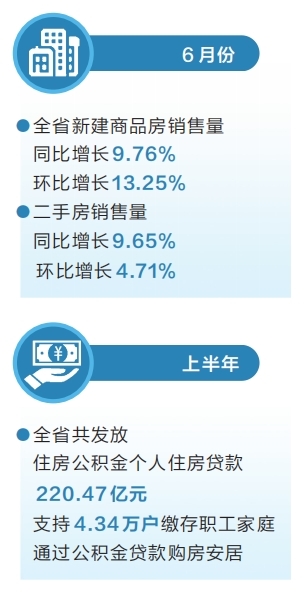
加大“好房子”供应 稳定市场预期 河南省上半年新房、二手房合计成交面积同比增长3.65%
He Nan Ri Bao· 2025-07-30 23:30
Group 1 - The real estate market in the province is stabilizing due to a series of favorable policies aimed at promoting housing sales and increasing supply [2][4] - In the first half of the year, the total sales area of new and second-hand homes increased by 3.65% year-on-year, with new home sales showing steady performance and a rebound in the second-hand market [2][3] - The average sales price of new homes has shown a slight increase over the past four months, driven by the introduction of high-quality housing projects [3] Group 2 - The province has issued 220.47 billion yuan in housing provident fund loans, supporting 43,400 families in purchasing homes [4] - A total of 48 projects for affordable rental housing have been initiated, with a completion rate of 77.92%, and 2 projects for sale-type affordable housing with a completion rate of 50.99% [4] - The provincial housing authority emphasizes the need for policies that adapt to changes in supply and demand in the real estate market, aiming to promote stable and healthy market development [4]

广东求解消费密码:1.5亿人背后的新场景和新供给
2 1 Shi Ji Jing Ji Bao Dao· 2025-07-30 23:13
Core Insights - Guangdong's consumer market shows signs of recovery, with a retail sales total of 22,932.66 billion yuan in the first half of the year, reflecting a year-on-year growth of 3.5%, which is an acceleration of 1.0 percentage points compared to the first quarter [1][2] - The "old-for-new" policy has significantly boosted the replacement of durable goods, leading to substantial growth in retail sales across various categories, including home appliances and furniture [8][9] - New consumption scenarios, such as indoor skiing and themed tourism, are emerging as key drivers of consumer engagement and spending [3][4] Consumer Market Recovery - The retail sales in Guangdong reached 22,932.66 billion yuan in the first half of the year, with a 3.5% year-on-year increase, indicating a recovery trend [1] - Tourist numbers during the "May Day" holiday increased by 18.7%, with tourism revenue growing by 20.3% [1][5] - The Dragon Boat Festival saw a significant rise in both day and overnight visitors, with increases of 46.55% and 50.71% respectively, and tourism revenue soaring by 58.18% [1] Supply and Demand Interaction - The "old-for-new" policy has been pivotal in driving consumer demand, with retail sales of home appliances and related categories seeing growth rates of 44.9% and 38.5% respectively [8] - New products and services are being introduced to meet consumer needs, creating a positive interaction between consumption and industry [2][9] - The rise of new consumption scenarios is attributed to increased disposable income and technological advancements that support innovative consumer experiences [5][9] New Consumption Scenarios - Indoor skiing has become a popular summer activity in Guangzhou, with user numbers increasing by over 8% year-on-year [3] - The integration of cultural, culinary, and sporting events into tourism has led to innovative consumption experiences, such as themed river cruises [4] - The "holiday economy" and "night economy" are being fully leveraged, with significant increases in tourist numbers and revenue during holiday periods [5] Challenges and Recommendations - Despite the growth, challenges such as homogenization of cultural tourism and insufficient integration of consumption scenarios remain [6][7] - Experts suggest creating new consumption scenarios aligned with local industry strengths and consumer preferences, while also enhancing policy reforms to support innovation [7][9] - There is a need for improved regulatory measures to ensure quality and service standards in the evolving consumer landscape [10]
新闻1+1丨中央政治局会议:下半年经济怎么干?
Yang Shi Wang· 2025-07-30 22:05
Group 1 - The core viewpoint of the article emphasizes the need for China to focus on economic growth strategies for the second half of the year, following a better-than-expected performance in the first half [1] - The international environment has shown some improvement since April, with progress in trade negotiations, but complexities and challenges remain for the second half [2][4] - Domestic economic growth reached 5.3% in the first half, but structural issues persist, indicating potential uncertainties ahead [4] Group 2 - Expanding consumer demand is a strategic priority for China, requiring systemic adjustments rather than short-term stimulus measures [5] - Policies aimed at improving education support and social security for vulnerable groups are expected to continue in the second half, enhancing consumer spending [7] - Investment remains crucial for stabilizing growth, with a focus on revitalizing private investment and addressing the slowdown in real estate and private sector investment [9] Group 3 - The need to address disordered competition among enterprises is highlighted, as many companies are currently unprofitable despite advancements in technology and industry upgrades [11] - The emphasis on stabilizing foreign trade and foreign investment reflects changes in the external trade environment, particularly regarding US-China trade negotiations [12][13] - The "old-for-new" policy has a budget of 300 billion yuan, with expectations for continued expansion in the second half, focusing on new consumer goods and services [15] Group 4 - The focus on high-quality urban renewal indicates a shift in policy to address changing risk dynamics in the real estate sector, aiming to stabilize the market and reduce risks [15]

IMF上调中国经济增速预期
3 6 Ke· 2025-07-30 03:55
Group 1 - The International Monetary Fund (IMF) has raised China's economic growth forecast for 2025 by 0.8 percentage points to 4.8% [1] - The revision reflects stronger-than-expected economic activity in the first half of 2025 and a significant reduction in US-China tariffs [2] - China's economic growth is primarily driven by exports, with a decline in exports to the US being offset by strong sales to other global regions [2] Group 2 - In the first half of 2025, China's GDP grew by 5.3% year-on-year, an increase of 0.3 percentage points compared to the same period last year [2] - Final consumption expenditure contributed 52% to China's economic growth in the first half of 2025, with retail sales of consumer goods reaching 24.55 trillion yuan, a 5% increase year-on-year [2] - The Chinese government plans to allocate 300 billion yuan to expand the "trade-in" program for vehicles and electronics to encourage consumer purchases [2] Group 3 - The IMF noted that the stability of China's foreign trade scale is evident, with imports and exports reaching a historical high of 20 trillion yuan in the first half of 2025 [3] - China's trade with countries involved in the Belt and Road Initiative reached 11.29 trillion yuan, growing by 4.7% and accounting for 51.8% of total trade [4] - The IMF anticipates that if trade negotiations yield breakthroughs, effective tariff rates may further decline, reducing trade barriers and promoting investment [4] Group 4 - The IMF has also raised its economic growth forecast for China in 2026 by 0.2 percentage points to 4.2%, reflecting the impact of lower effective tariff rates [4]
畅通“想换”“敢换”渠道 让以旧换新释放更大效能
Jin Rong Shi Bao· 2025-07-30 02:44
Group 1 - The core viewpoint emphasizes the importance of boosting consumption and expanding domestic demand as a primary economic task, with a focus on the "old-for-new" policy for consumer goods [1][2] - The implementation of the "old-for-new" policy has led to significant sales growth, with over 1.6 trillion yuan in sales from five major categories of consumer goods by mid-2024, surpassing the previous year's figures [1] - The government has allocated 300 billion yuan in special long-term bonds to support the "old-for-new" initiative, indicating strong policy backing for consumption [1] Group 2 - The recycling process for old appliances is currently inefficient, with only 20% of waste electronics being recycled through formal channels, leading to environmental concerns [3][4] - The establishment of a comprehensive recycling system is crucial for enhancing consumer participation in the "old-for-new" program, ensuring that old products are handled by qualified entities [4][6] - Recent government initiatives aim to improve the logistics and recycling network for old products, promoting a more efficient "exchange + recycling" model [4][5] Group 3 - Some businesses have engaged in unethical practices, such as price inflation before applying government subsidies, undermining the effectiveness of the "old-for-new" policy [7][8] - Regulatory bodies have intensified oversight to combat these practices, with various regions implementing strict measures against violators [8][9] - The use of big data and technology is recommended to enhance consumer protection and prevent fraudulent activities in the market [9] Group 4 - Consumer finance products, such as installment plans, are becoming essential in facilitating the "old-for-new" policy, with significant sales increases reported in stores that offer these options [10][11] - Financial support for service industry operators is also emphasized, with calls for increased green credit to support sustainable consumption practices [11] - The integration of consumer finance with the "old-for-new" measures is seen as a way to enhance consumer experience and stimulate market activity [11]
以“小换新”撬动“大发展”
Jin Rong Shi Bao· 2025-07-30 02:31
Group 1 - The "trade-in for new" policy has led to significant consumer engagement, with over 10 million applications for subsidies in the automotive sector and over 66 million consumers purchasing new appliances and digital products this year [1][3][4] - The policy is projected to drive sales of approximately 2.9 trillion yuan by mid-2025, benefiting around 400 million people through subsidies [3][4] - The initiative is transforming consumer behavior from merely "getting by" to "living well," with increasing demand for smart, green, quality, and personalized consumption [4][5] Group 2 - The average monthly growth rate for electric bicycle sales through trade-in programs reached 113.5% in the first half of the year [2] - The policy is seen as a catalyst for industrial upgrades, pushing the supply chain towards greener and smarter solutions, with manufacturers investing in core technology and sustainable materials [5][6] - The "trade-in for new" approach is reshaping consumption concepts and development models, promoting resource recycling and reducing environmental pressure while enhancing technological innovation and industry competitiveness [6]
6 月工业企业利润数据点评:中下游利润边际改善
Haitong Securities International· 2025-07-30 01:12
Profit Trends - In June, the decline in industrial enterprise profits narrowed, with a year-on-year decrease of -4.3%, an improvement of 4.8 percentage points from May's decline[3] - Cumulative profit growth for industrial enterprises from January to June was -1.8%, lower than the -1.1% recorded from January to May[3] Profit Margins and Industry Performance - The profit margin for June was 6.0%, showing a slight recovery from May, while the cumulative profit margin was 5.2%[6] - The automotive industry experienced the most significant profit recovery, benefiting from lower raw material prices and policy support[7] Demand and Inventory Dynamics - Industrial product inventory growth was 3.1% from January to June, indicating a passive destocking phase for enterprises[13] - Revenue growth for industrial enterprises in June was 1.6%, reflecting a slight recovery compared to the previous month[13] Future Outlook - Upcoming policies, including the "old-for-new" subsidy program, are expected to stimulate consumption and investment, potentially improving enterprise profits[17] - The "anti-involution" actions in various industries may help restore profit margins by reducing price competition[17] Risks - Uncertainties in trade relations and the effectiveness of policy measures such as "anti-involution" and "old-for-new" initiatives pose risks to profit recovery[18]
“苏超”效应显现 江苏快餐营业额增势较好
Zheng Quan Shi Bao· 2025-07-29 23:30
Group 1 - The core viewpoint of the article highlights the positive growth in the fast food sector in Jiangsu province, attributed to the "Su Super" effect from local sports events, with overall retail sales showing a steady increase [1] - In the first half of the year, Jiangsu's total retail sales of consumer goods reached 2.39 trillion yuan, a year-on-year increase of 5.0%, with urban retail sales at 2.14 trillion yuan (up 4.8%) and rural retail sales at 252.06 billion yuan (up 6.8%) [1] - The fast food sector saw significant growth, with beverage and cold drink services increasing by 21.2% and fast food services by 6.2%, contributing to a 1.9 percentage point increase in the overall growth of the catering industry [1] Group 2 - The "old-for-new" consumption policy has effectively boosted retail sales, with related products (automobiles, home appliances, 3C digital products, and home goods) achieving retail sales of 384.7 billion yuan, a 9.4% year-on-year increase [2] - Physical retail stores have shown signs of recovery, with retail sales reaching 695.85 billion yuan, a 7.7% increase, while online retail sales grew by 7.9%, with physical goods online retail sales accounting for 21.9% of total retail sales [2] - The Jiangsu provincial statistics bureau emphasizes the need to continue promoting the "old-for-new" policy to enhance consumer capacity and foster new growth points in consumption [2]
让消费者真的动“新”
Sou Hu Cai Jing· 2025-07-29 23:19
Group 1 - The core viewpoint emphasizes the revitalization of the consumer market in Jiangsu, driven by policies, products, and scenarios working in synergy [1][3] - In the first half of the year, Jiangsu's total retail sales of consumer goods reached 23,949 billion yuan, marking a 5% year-on-year increase [1] - The "trade-in" related retail sales saw a growth of 9.4%, indicating a strong consumer response to new policies [1] Group 2 - The pursuit of "new" is a constant theme in the market, representing curiosity satisfaction, quality of life improvement, and self-expression for consumers [2] - Companies are encouraged to innovate and break away from dependency on subsidies, as reliance can lead to stagnation in development [2] - The need for a supportive environment for innovation is highlighted, where policies should provide both immediate support and long-term guidance [3] Group 3 - The article suggests that a collaborative effort is required to foster a conducive environment for consumer engagement, with policies that support both current needs and future growth [3] - Companies should focus on creating value rather than just selling products, aligning closely with market demands [3] - Regulatory bodies are urged to keep pace with new market phenomena and establish standards to protect consumer interests [3]
上半年我国财政运行总体平稳 有力支撑经济社会发展
Zhong Guo Chan Ye Jing Ji Xin Xi Wang· 2025-07-29 22:34
上半年,我国实施更加积极的财政政策,中央对地方转移支付已下达9.29万亿元,占年初预算的 89.8%;发行新增地方政府一般和专项债券2.6万亿元,支持地方重点领域重大项目建设;下达超长期特 别国债资金预算超6500亿元,有力支持"两重"项目建设和"两新"工作。其中,"以旧换新"带动汽车、家 电、家装、手机等商品上半年销售额1.6万亿元。 财政部最新数据显示,上半年,全国财政收入11.56万亿元。其中,税收收入逐步回升,从4月份起,连 续3个月实现同比增长。全国财政支出14.13万亿元,同比增长3.4%。社会保障和就业、教育、科学技术 等支出同比增长均超过5%。 上半年,中央财政已下达就业、养老、医疗、困难群众救助等补助资金超过2万亿元,为民生保障和经 济社会发展提供有力支撑。 ...