
通货膨胀

Search documents
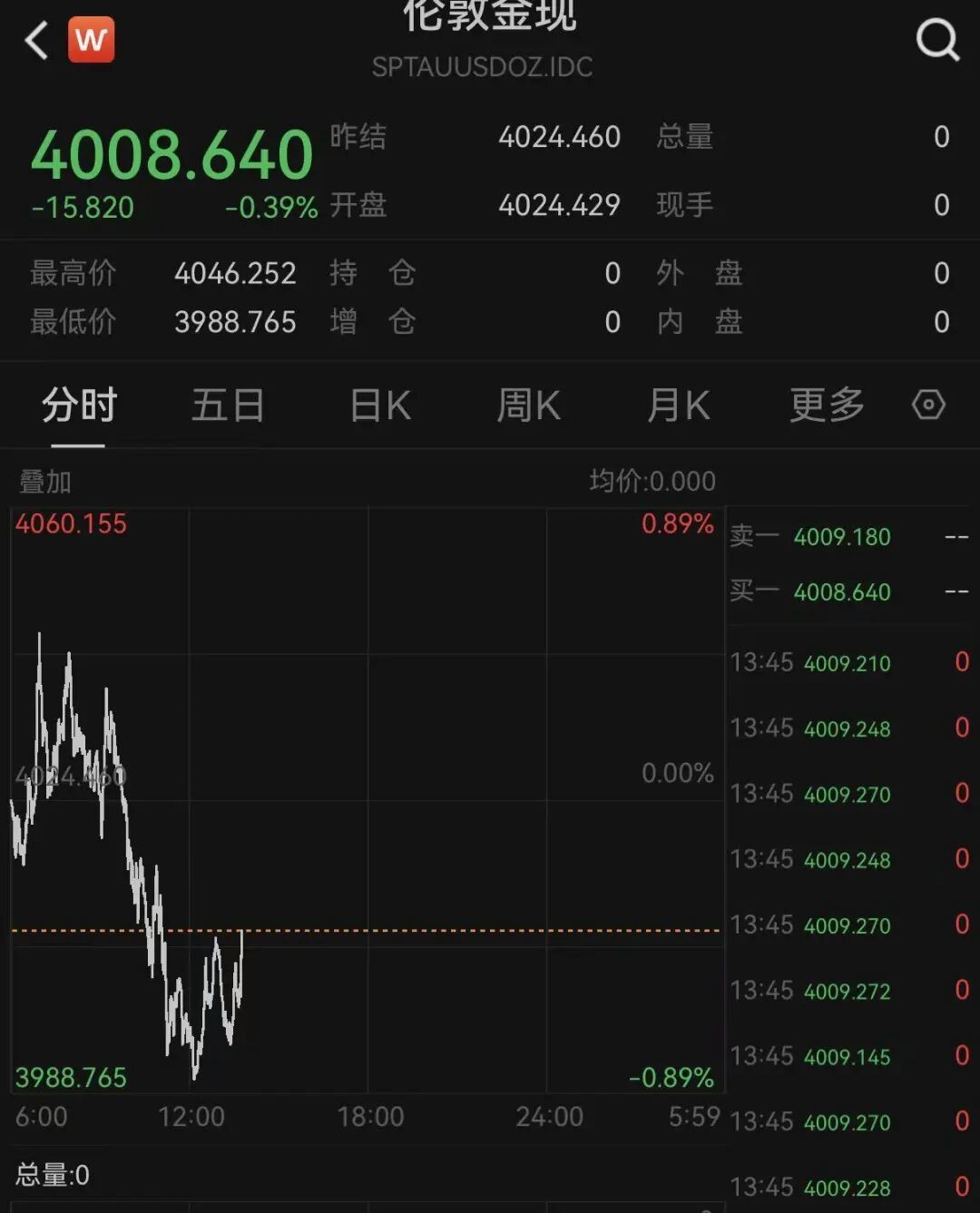
黄金直线跳水,发生了什么?
Zheng Quan Shi Bao· 2025-10-31 06:58
Core Viewpoint - The recent fluctuations in gold prices are attributed to uncertainties surrounding the Federal Reserve's interest rate decisions, particularly regarding a potential rate cut in December [2][4]. Group 1: Gold Market Dynamics - Spot gold prices experienced a significant drop, falling nearly 0.4% to around $3988 after initially rising to challenge the $4050 mark [1][2]. - The volatility in gold prices is linked to the Federal Reserve's mixed signals about future interest rate cuts, with Chairman Powell indicating that a December rate cut is not guaranteed [2][4]. Group 2: Federal Reserve's Interest Rate Outlook - Federal Reserve Governor Milan voted against a 25 basis point cut, advocating instead for a 50 basis point reduction, reflecting internal divisions within the Fed [3]. - Nomura Securities revised its expectations, now predicting that the Federal Reserve will maintain interest rates in December, contrary to previous forecasts of a rate cut [4]. - The ongoing U.S. government shutdown has exacerbated uncertainties, delaying the release of key economic data, which complicates the Fed's decision-making process [4].

矿业股的投资热潮踩下刹车
日经中文网· 2025-10-31 03:07
Core Insights - Mining stocks have been identified as "invisible winners" during the Trump era, significantly outperforming global stock indices and IT indices, with a notable increase of 20% and 30% respectively by the end of 2024 [2][4] - Recent declines in gold and rare earth stocks indicate a shift in market sentiment, as mining stocks have dropped 6% from their mid-October highs [2][4] - The easing of geopolitical tensions between the US and China has led to a reduction in investments in mining stocks, which were previously seen as a hedge against these risks [5][8] Group 1: Mining Stock Performance - The "Metals and Mining" sector saw a peak increase of 54% compared to the end of 2024, but has since reverted to September levels, losing momentum [4] - Mining stocks outperformed the aerospace and defense index, which rose by 55%, during a period of heightened geopolitical tensions [4] Group 2: Geopolitical Factors - The initial surge in mining stock investments was driven by concerns over geopolitical risks, particularly the US-China trade tensions, which prompted countries to compete for critical mineral resources [5] - The recent news of potential trade agreements between the US and China has contributed to a decline in mining stock prices, with MP Materials' stock dropping 30% from its mid-October peak [8] Group 3: Market Reactions - The stock prices of companies like Lynas Rare Earths and MP Materials surged due to their strategic importance in the US's efforts to establish a non-China reliant rare earth supply chain [7] - Gold prices have also been influenced by geopolitical factors, with a notable rise in demand from emerging market central banks, leading to a peak of over $4000 per ounce [7] Group 4: Future Outlook - The future of mining stocks remains uncertain, as speculative investments have receded, yet they still maintain higher levels compared to early 2025 [8] - Analysts suggest that the trend of buying mining stocks as a hedge against inflation may continue, given their historical resilience in inflationary environments [8]
美联储再降息25个基点,12月还会继续降吗?
Sou Hu Cai Jing· 2025-10-31 02:52
Core Points - The Federal Reserve has lowered the federal funds rate target range to 3.75%-4.00%, marking the second rate cut of the year and the fifth since September 2024 [1][3] - The Fed will end its balance sheet reduction plan starting December 1, with the principal from mortgage-backed securities being reinvested into short-term Treasury bonds [3] - Fed Chair Jerome Powell indicated a cautious approach due to a lack of data, suggesting that future rate cuts are not guaranteed [1][13] Summary by Sections Interest Rate Decision - The FOMC's decision to lower the rate aligns with market expectations, reflecting a shift in risk balance [3] - The Fed acknowledged a slowdown in job growth and a slight increase in unemployment, while inflation remains relatively high [3] Internal Divergence - The meeting showcased a rare "hawk-dove" scenario, indicating significant internal disagreement on economic outlook and monetary policy [6] - Some officials advocate for more aggressive rate cuts, while others prefer to maintain current rates due to inflation concerns [6] Impact of Government Shutdown - The government shutdown has delayed the release of key economic data, complicating the Fed's assessment of the economy [8] - Powell emphasized the shutdown's negative impact on economic activity and consumer sentiment regarding inflation [8] Market Reactions - Following the Fed's announcement, U.S. stock indices initially fluctuated, with major tech stocks showing resilience [10] - The dollar index rose above 99, and U.S. Treasury yields increased, indicating market adjustments to the Fed's decisions [11] Future Policy Outlook - Powell's comments suggest that the decision for further rate cuts in December is not yet determined, reflecting a cautious stance [13] - Analysts expect continued rate cuts into 2026, influenced by tariff policies and economic fundamentals [17] Currency and Commodity Implications - The Fed's rate cuts are anticipated to have significant effects on global asset classes, with analysts monitoring the dollar's performance and the Chinese yuan's exchange rate [22] - Precious metals may remain strong due to expectations of Fed rate cuts, influenced by geopolitical developments and market risk preferences [19]

澳大利亚2025年第三季度通胀率升至3.2%
Ren Min Wang· 2025-10-31 00:24
Core Insights - Australia's Consumer Price Index (CPI) rose by 3.2% year-on-year in Q3 2025, exceeding market expectations and significantly higher than the 2.1% increase in Q2 2025 [1] - The rise in inflation suggests that the Reserve Bank of Australia is unlikely to lower interest rates in November [1][2] - The annual inflation rate of 3.2% is the highest since Q2 2024, when it was 3.8% [1] - The quarterly CPI increased by 1.3%, marking the largest quarterly rise since Q1 2023 [1] - Key contributors to inflation include housing (2.5% increase), recreation and culture (1.9% increase), and transportation (1.2% increase) [1] - Electricity prices surged by 9% in Q3, influenced by annual price adjustments and delays in subsidy receipt for some households [1] - The trimmed mean inflation rate rose from 2.7% to 3%, marking the first increase since Q4 2022 [1] Economic Outlook - Due to the significant rise in inflation, the likelihood of the Reserve Bank of Australia announcing a rate cut in November is diminishing [2] - Market expectations for rate cuts have been severely impacted by the sharp increase in inflation [2] - However, there is an expectation that inflationary pressures may ease over the next 12 months, potentially allowing for rate cuts in the following year [2]
Fed is driving through a fog right now without data, says Randy Kroszner
Youtube· 2025-10-30 15:30
Core Insights - The Federal Reserve is currently navigating uncertainty in the labor market, which complicates their decision-making process regarding interest rates [2][3][4] - There is a cautious tone from the Fed, as they lack real-time data on jobs and economic indicators, leading to a reliance on interpretation rather than concrete data [4][6] - The market seems to be absorbing the impact of tariffs as temporary and muted, with inflation remaining above the Fed's target but not showing significant upward pressure [8][9][10] Interest Rate Outlook - The Fed is preserving optionality in their approach to interest rates, indicating a division within the committee on future rate paths [2][4] - There is a suggestion that the labor market's weakness may be prolonged rather than a short-term blip, which could influence future rate cuts [4][5] - The Fed is cautious about making decisions based on sentiment rather than data, highlighting the importance of upcoming labor market data [6][10] Inflation and Market Response - Long-term Treasury yields are not reflecting heightened inflation concerns, suggesting that the market is comfortable with the current inflation levels [7][10] - Inflation has not shown a significant decline, remaining flat due to tariffs, but there is an expectation that it will eventually decrease as tariffs are absorbed [9][10] - The Fed is wary of incorporating assumptions into their policy decisions without clearer labor market data, which could lead to unexpected outcomes [10]

随着经济风险的增加,美联储再次降息以保护就业
Sou Hu Cai Jing· 2025-10-30 13:22
Group 1 - The Federal Reserve has lowered the benchmark interest rate by 25 basis points to a range of 3.75% to 4% to stimulate the stagnant job market and prevent a surge in unemployment [2][3] - Recent months have seen increasing concerns among Federal Reserve officials regarding the health of the labor market, leading them to prioritize job creation over combating inflation, which remains above the 2% target [2] - The decision to lower rates is not unanimous, with two Federal Reserve governors opposing the majority's decision, indicating a divide in perspectives on the appropriate monetary policy response [3] Group 2 - The Federal Reserve has also announced the cessation of its quantitative tightening program, which had been removing funds from the financial system, effective December 1 [4] - Despite a lack of key information on inflation and employment due to a government shutdown, the Federal Reserve's decision was influenced by the September Consumer Price Index, which showed inflation above the target but with a lower-than-expected increase [4] - The recent rate cut brings the federal funds rate to its lowest level since December 2022, directly impacting interest rates on credit cards, auto loans, and indirectly affecting mortgage rates [4]

Booth: Fed's Unsurprising Cut, Surprising Commentary from Jerome Powell
Youtube· 2025-10-30 13:01
Core Viewpoint - The Federal Reserve's recent decision to cut interest rates by 25 basis points was anticipated, but the strong indication that December's meeting may not result in further cuts surprised market participants [2][3]. Group 1: Federal Reserve's Decision and Market Reaction - The Fed's decision to cut rates was expected, but the emphasis on not considering a December meeting for further cuts caught the market off guard [2][3]. - There was dissent among policymakers, with some advocating for a larger cut while others preferred no changes at all, indicating a divided stance within the Fed [4][5]. - The current environment suggests that more dissenting opinions may emerge in the upcoming months as the Fed navigates its policy decisions [5]. Group 2: Economic Indicators and Labor Market - The job market is showing signs of weakness, and the Fed is operating with limited data, lacking the monthly payrolls report, which complicates their decision-making [7]. - Recent CPI data indicated a cooler inflation rate, primarily due to falling shelter prices, but the Fed's control over inflation is limited, particularly regarding food and electricity prices [11]. Group 3: Leadership and Future Implications - Discussions are ongoing regarding the next Fed chair, with five potential candidates differing significantly in their monetary policy views, which could lead to market volatility as a decision approaches [12][13]. - The Treasury Secretary has indicated a desire to make a decision by Thanksgiving, but the Senate's deliberation time is limited, potentially extending into the new year [12].
以色列央行原行长独家专访:控通胀如何铸就“创业国家”传奇
2 1 Shi Ji Jing Ji Bao Dao· 2025-10-30 11:44
Core Viewpoint - The independence of central banks is crucial for economic stability, especially in the current international context where political pressures can undermine effective monetary policy [1][14]. Group 1: Central Bank Independence - Central bank independence is essential for implementing necessary and sometimes difficult decisions, as political systems tend to focus on short-term goals [1][14]. - The independence of central banks allows for a long-term perspective in monetary policy, which is vital for sustainable economic outcomes [14][15]. Group 2: Israel's Economic Transformation - Israel's economic success in the 1990s was attributed to a comprehensive strategy that included stabilizing inflation, reducing budget deficits, developing capital markets, and enhancing exchange rate flexibility [2][12]. - The influx of highly skilled immigrants and improved geopolitical conditions contributed to Israel's transformation into a "startup nation," with high-tech exports accounting for over half of its total exports [2][12]. Group 3: Global Economic Governance - The shift from globalization to fragmentation is concerning, as countries are increasingly competing rather than cooperating, which can lead to unhealthy economic practices [6][8]. - China is recognized as a vital player in the global economy and should take on a larger role in global governance, responding to traditional systems' inadequacies [3][8]. Group 4: Emerging Markets Representation - Emerging markets have shown resilience and performed better than developed countries in recent years, but their representation in international institutions like the IMF does not reflect their economic weight [7][8]. - There is a growing recognition of the need to enhance the representation of emerging markets in global governance structures [7]. Group 5: Debt and Economic Stability - The accumulation of public debt is a long-term issue resulting from persistent budget and current account deficits, which can lead to systemic risks [9][10]. - Responsible government behavior and the development of robust capital markets are essential to manage high debt levels and maintain economic stability [10]. Group 6: Lessons from Israel - The experience of Israel in achieving price stability and economic openness can serve as a model for other emerging or middle-income economies [14][15]. - Effective public communication and building public support for monetary policy are critical for central banks to maintain their independence and achieve economic stability [15].

Chipotle Shares Drop Over 17% In Pre-Market — Here's Why - Chipotle Mexican Grill (NYSE:CMG)
Benzinga· 2025-10-30 09:42
Core Insights - Chipotle Mexican Grill Inc. experienced a significant drop in share price, falling 17.58% to $32.77 in pre-market trading following the release of its third-quarter results and a downward revision of its full-year guidance [1] Financial Performance - The company reported third-quarter revenue of $3 billion, reflecting a 7.5% increase year-over-year [2] - Comparable restaurant sales rose by 0.3%, driven by a 1.1% increase in average check size, although this was partially offset by a 0.8% decline in customer traffic [2] - The operating margin decreased to 15.9% from 16.9% year-over-year, while the restaurant-level operating margin fell to 24.5% from 25.5% [2] Cost Structure - Food, beverage, and packaging costs accounted for 30% of total revenue, a slight decrease from 30.6% in the previous year, although inflation in beef and chicken and newly enacted tariffs partially offset this decline [3] - Labor costs represented 25.2% of total revenue, up from 24.9% a year earlier, primarily due to lower sales volumes and wage inflation, though this was partially mitigated by planned menu price increases in 2024 [4] Future Outlook - Management now anticipates low-single-digit declines in comparable restaurant sales for the entire year of 2025 [5] - The company opened 84 new restaurants in the third quarter, including 64 with a Chipotlane [5] - Diluted earnings per share increased to 29 cents, up 3.6% from 28 cents in the same period last year [5] Stock Performance - Year-to-date, Chipotle's stock is down 33.61%, with a 52-week trading range of $38.30 to $66.74 and a market capitalization of $53.31 billion [6]


The Fed cut rates again, but officials disagree on what comes next. What it means for you
Yahoo Finance· 2025-10-30 09:09
Core Viewpoint - Federal Reserve Chair Jerome Powell has dampened expectations for a holiday rate cut, indicating that a December reduction is uncertain due to a cooling labor market and persistent inflation [1][2]. Summary by Sections Federal Reserve's Current Stance - The Federal Reserve has lowered its benchmark federal funds rate to a range of 3.75% to 4% as of October 29, but Powell emphasized that certainty regarding future cuts is lacking [2][5]. - Powell highlighted the ongoing government shutdown as a factor that hampers the Fed's access to crucial economic data, contributing to uncertainty in policy decisions [2][3]. Labor Market and Inflation - Powell noted signs of a cooling labor market and persistent inflation, which currently stands at 3%, above the Fed's target of 2% [6]. - He described the current situation as a "risk management" scenario, where both inflation and labor market conditions present challenges [6]. Committee Dynamics - There are strong disagreements among Federal Reserve voting members regarding the path forward, with some advocating for a cautious approach to assess potential risks to the labor market [4]. - Powell stated that a further reduction in the policy rate at the December meeting is not guaranteed, reflecting the divided views within the committee [4]. Market Reactions - Futures markets, which previously anticipated a rate cut, shifted their expectations following Powell's comments, now predicting that the Fed will maintain current rates [7]. - Some economists have adjusted their expectations for a rate cut at the end of the year, citing a less threatening inflation outlook due to various mitigating factors [8]. Future Projections - Despite a tempered outlook, some economists still expect a December rate cut, with a belief that additional cuts may be necessary next year to support growth [9].