
国产替代

Search documents
开源晨会 0206:晨会纪要-20260206
KAIYUAN SECURITIES· 2026-02-06 02:30
Group 1: Food and Beverage Industry - The recent strong rally in the liquor sector is driven by a combination of macro policies, valuation adjustments, and fundamental factors, rather than a single catalyst [4][8][9] - Optimized real estate policies and supportive domestic demand measures have effectively boosted market expectations for consumption recovery [8][9] - The valuation of the liquor sector has returned to historical lows, with public fund holdings in the sector dropping to 2.9% in Q4 2025, indicating a clearer and more reasonable chip structure [8][9] - The strong performance of leading companies like Kweichow Moutai in terms of pricing and sales has confirmed the resilience of terminal demand in the liquor market [8][9] Group 2: Retail and Cosmetics Industry - The medical beauty and cosmetics sectors have shown significant growth, with notable stock performances in January, such as Four Seasons Medicine (+28.5%) and 壹网壹创 (+50.8%) [6][26][27] - Medical beauty company Giant Bio received approval for a new product, showcasing its R&D strength and market potential [27] - 美丽田园 has announced positive earnings forecasts, reflecting strong operational resilience and growth potential through strategic acquisitions and store expansions [27][30] Group 3: Semiconductor Materials Industry - The sputtering target market is expected to grow significantly, with projections indicating a global market size of 25.1 billion yuan by 2027 for semiconductor sputtering targets [15] - The supply side is dominated by overseas giants, but domestic manufacturers are transitioning from being mere substitutes to becoming global competitors [17][18] - Price increases in sputtering materials are anticipated due to rising metal costs, with major clients likely to accept these price hikes [16][18] Group 4: Cloud Computing and AI Industry - Google Cloud's revenue for Q4 2025 reached $17.7 billion, a 48% year-on-year increase, exceeding analyst expectations [20][21] - Capital expenditures for Google reached $27.9 billion in Q4 2025, a 95% increase year-on-year, with projections for 2026 capital expenditures between $175 billion and $185 billion [20][21] - Meta and Microsoft also reported strong revenue growth, driven by AI efficiencies, with Meta's Q4 revenue at $59.893 billion, a 24% increase [21][22]
新股前瞻|国内称王、海外承压,国产咖啡机格米莱赴港寻解药?
智通财经网· 2026-02-06 02:22
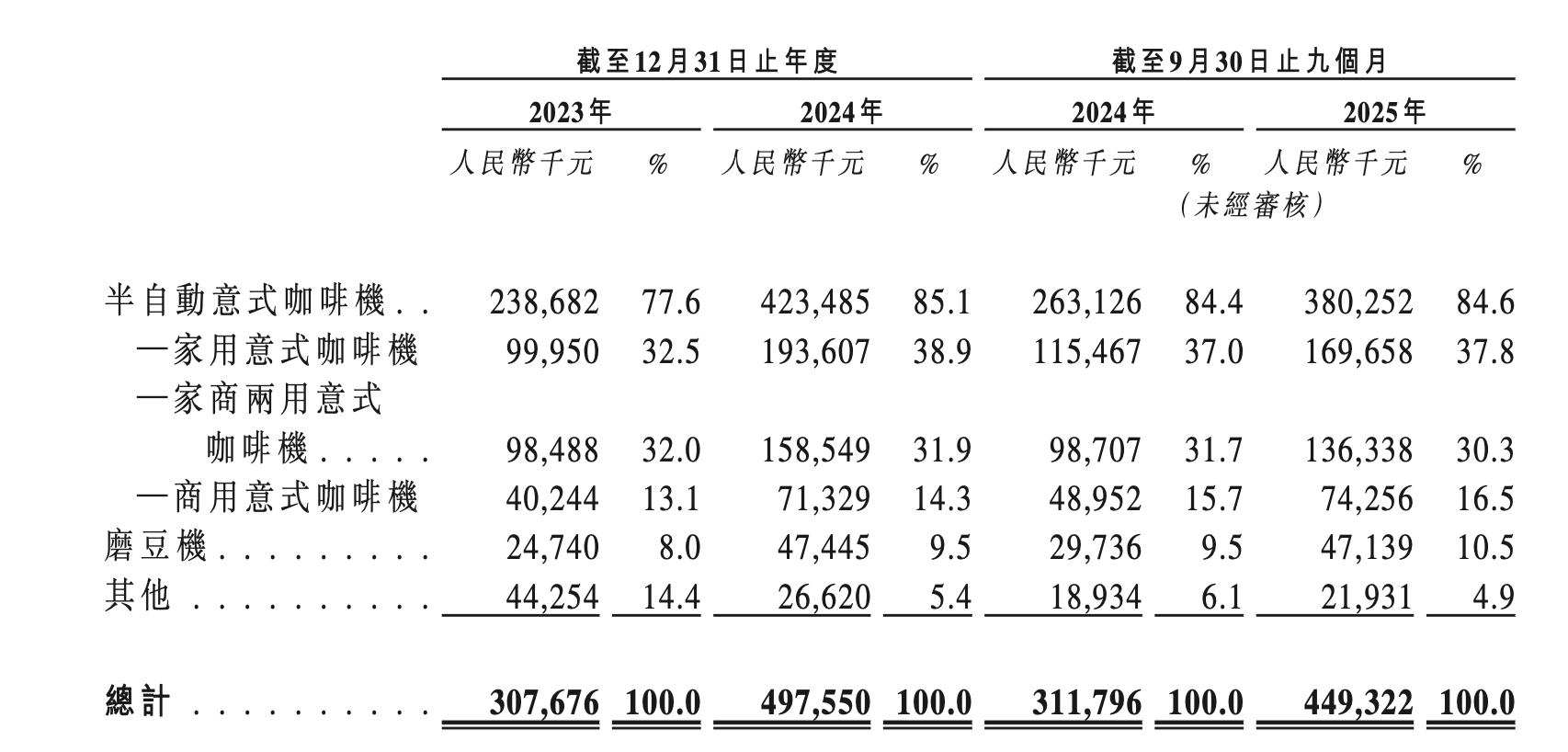
Core Insights - The article highlights the significant transformation of the Chinese coffee machine industry, driven by the global coffee culture and consumption upgrades in China, with Gemi Lai Holdings Limited (Gemi Lai) emerging as a key player in this shift [1][11]. Company Overview - Gemi Lai is positioned as the second-largest coffee machine brand in China by revenue and the largest domestic brand, with a projected market share of approximately 7.5% in 2024 [2]. - The company has established a comprehensive business model covering product design, R&D, manufacturing, sales, and after-sales service, distributing products to over 60 countries and regions [1]. Financial Performance - Gemi Lai's revenue has shown consistent growth, with reported revenues of approximately 308 million RMB in 2023, 498 million RMB in 2024, and 449 million RMB in the first nine months of 2025 [3]. - The company’s net profit increased significantly from 22.01 million RMB in 2023 to 40.01 million RMB in 2024, marking an 81.8% growth [8]. Product Segmentation - The revenue from semi-automatic espresso machines has been the primary driver, accounting for 77.6% of total revenue in 2023 and increasing to 84.6% by the first nine months of 2025 [4][5]. - The home espresso machine segment also showed robust growth, with revenues rising from 100 million RMB in 2023 to 194 million RMB in 2024, reflecting a growing consumer trend [5]. Strategic Focus - Gemi Lai has shifted its strategic focus towards its own brand, with the proportion of revenue from self-owned brands increasing from 69.2% in 2023 to 83.3% in the first nine months of 2025 [7][8]. - The company has adopted a dual-track business model of "own brand + third-party ODM," with a clear emphasis on brand-led growth [6]. Market Dynamics - The global coffee machine market is experiencing strong growth, with the market size expected to increase from $15.3 billion in 2019 to $30.6 billion in 2024, reflecting a compound annual growth rate (CAGR) of 14.9% [9]. - The Chinese coffee machine market is growing even faster, with a projected market size increase from 2 billion RMB in 2019 to 5.3 billion RMB in 2024, representing a CAGR of 21.5% [9]. Challenges and Opportunities - Despite strong domestic performance, Gemi Lai faces challenges in overseas markets, particularly in the U.S., where revenue dropped significantly from 31.2 million RMB in 2023 to 10.7 million RMB in 2024, a decline of 79.3% [10]. - The company’s reliance on the domestic market has increased, with revenue from China rising from 69.7% in 2023 to 80.9% in the first nine months of 2025, indicating potential risks in market diversification [10]. Future Outlook - The upcoming IPO in Hong Kong is seen as a crucial step for Gemi Lai to expand its financing channels, enhance R&D and production capacity, and optimize its business structure for global brand development [11]. - The ability to maintain domestic advantages while effectively penetrating overseas markets will be critical for Gemi Lai's long-term growth and investor interest [11].

国产车规核心芯片厂商完成近亿元融资,团队来自华为、海思|硬氪首发
3 6 Ke· 2026-02-06 02:04
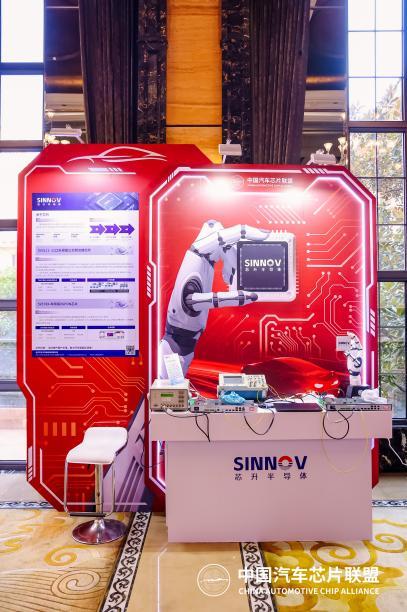
作者 | 乔钰杰 时敏通信芯片是智能汽车通信系统中的关键基础芯片,其通过引入时间敏感网络(TSN)机制,使传统 以太网具备低时延、低抖动和传输时间可确定的能力,可实现高精度时钟同步,并对不同优先级的数据 流进行精确调度,满足新一代汽车集中式电子电气架构对确定性通信的需求。 随着工业4.0推进,TSN技术在工业自动化领域快速渗透。而在汽车产业中,伴随智能化和集中式架构 加速演进,时敏通信芯片正成为增长最快、规模最大的应用场景之一。 目前,国内时敏通信芯片市场规模已达数十亿元,但整体国产化率仍然偏低,长期由海外厂商主导,这 也为具备技术积累和量产能力的本土芯片企业提供了明确的国产替代窗口期。 芯升半导体技术研发起源于科技部国家重点研发计划,于2025年6月顺利通过主机厂国产以太网芯片供 应商导入审核。相关审核体系覆盖ISO9001质量管理、AEC-Q100车规可靠性、ISO26262功能安全以及 VDA6.3过程审核等多项严格标准。通过整车厂体系化审核,意味着公司已具备参与主机厂核心车型项 目的能力,也标志着国产车载通信芯片在自主可控方向上迈出了关键一步。 (企业/供图) 芯升半导体创始人徐俊亭在接受硬氪采访时表 ...
亚马逊2000亿资本支出远超预期,功率半导体巨头英飞凌宣布涨价
Mei Ri Jing Ji Xin Wen· 2026-02-06 01:37
Group 1: Market Performance - The Shanghai Composite Index fell by 0.64% to close at 4075.92 points, while the Shenzhen Component Index dropped by 1.44% to 13952.71 points, and the ChiNext Index decreased by 1.55% to 3260.28 points [1] - In the overnight U.S. market, the Dow Jones Industrial Average declined by 1.20%, the Nasdaq Composite fell by 1.59%, and the S&P 500 dropped by 1.23% [1] Group 2: Company News - Amazon reported a fourth-quarter net sales of $213.39 billion, a year-on-year increase of 13.6%, and a net profit of $21.19 billion, up 6% [2] - Infineon announced a price increase for power switches and related chips starting April 1, 2026, due to ongoing supply constraints and rising costs of raw materials and infrastructure [2] - Huahai Chengke indicated that the storage industry is entering a super cycle driven by AI, leading to price increases for storage chips and positive impacts on the packaging materials industry [2] Group 3: Industry Insights - According to招商证券, storage product prices have sharply increased since the first quarter of 2026, with expectations for continued price rises throughout the year due to limited new supply [3] - The semiconductor equipment and materials sectors are crucial for domestic substitution, benefiting from low domestic replacement rates and high ceilings for domestic alternatives [3] - The 科创半导体ETF (588170) and its related funds focus on semiconductor equipment and materials, indicating strong growth potential driven by the AI revolution and technological advancements [3]
从“国产替代”到“市场主流”,本土企业稳居智能座舱芯片第一梯队
Zhong Guo Jing Ji Wang· 2026-02-06 01:35
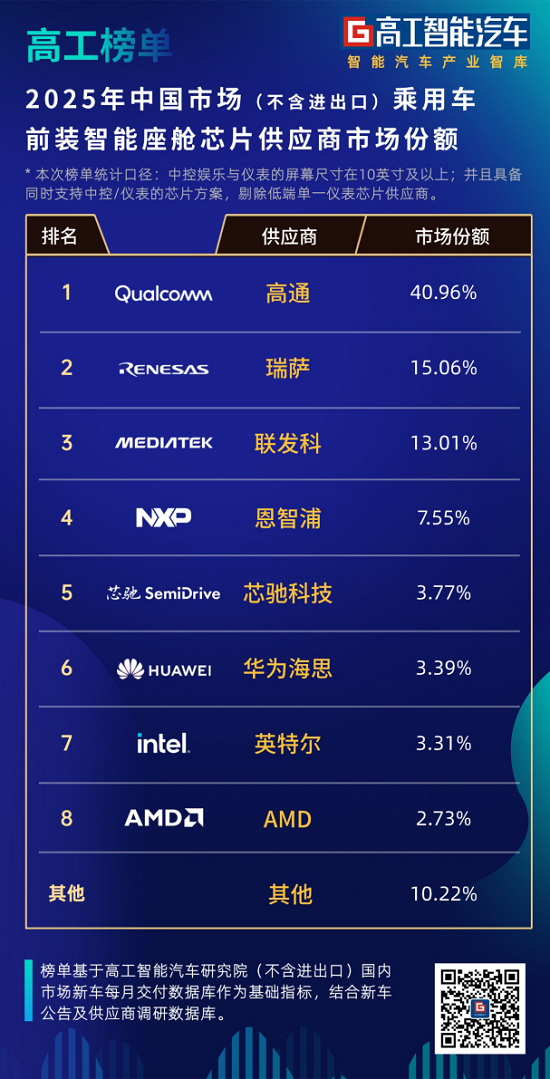
Core Insights - The Chinese domestic chip companies are expanding their market share in the automotive sector, transitioning from "domestic substitution" to becoming mainstream competitors alongside global giants [1][3]. Market Share Overview - Qualcomm leads the market with a share of 40.96%, followed by Renesas at 15.06%, MediaTek at 13.01%, and NXP at 7.55%. Chinese company SemiDrive ranks fifth with 3.77%, and Huawei follows closely with 3.39% [2][3]. Industry Trends - The penetration rate of smart cockpit chips in new passenger vehicles in China is projected to reach 76.62% by 2025, indicating a significant shift towards advanced automotive technology [3]. - The market landscape has evolved from a highly concentrated structure to a more diversified and balanced order, enhancing the presence of domestic companies [2][3]. Domestic Company Performance - SemiDrive has achieved a cumulative shipment of over 11 million chips across various smart cockpit applications, with over 150 models utilizing their technology [5]. - The performance of domestic chips has improved significantly, gaining widespread market recognition for their reliability and quality, overcoming initial trust barriers [3][5]. Strategic Implications - The global automotive industry is undergoing a major transformation, with China emerging as a hub for smart vehicle innovation. The ability to master advanced chip technology is becoming crucial for defining the next generation of smart vehicles [5][6]. - The restructuring of the Chinese automotive industry is extending beyond vehicle manufacturing to core components, software, and semiconductor technologies, which is essential for ensuring industry security and fostering high-quality development [6].
半导体早参 | 亚马逊2000亿资本支出远超预期,功率半导体巨头英飞凌宣布涨价
Mei Ri Jing Ji Xin Wen· 2026-02-06 01:33
Group 1: Market Performance - The Shanghai Composite Index fell by 0.64% to close at 4075.92 points, while the Shenzhen Component Index dropped by 1.44% to 13952.71 points, and the ChiNext Index decreased by 1.55% to 3260.28 points [1] - In the overnight U.S. market, the Dow Jones Industrial Average declined by 1.20%, the Nasdaq Composite fell by 1.59%, and the S&P 500 dropped by 1.23% [1] Group 2: Company News - Amazon reported a fourth-quarter net sales of $213.39 billion, a year-on-year increase of 13.6%, and a net profit of $21.19 billion, up 6% [2] - Infineon announced a price increase for power switches and related chips starting April 1, 2026, due to ongoing supply constraints and rising costs [2] - Huahai Chengke indicated that the storage industry is entering a super cycle driven by AI, leading to price increases for storage chips and positive impacts on the packaging materials industry [2] Group 3: Industry Insights - According to招商证券, storage product prices have sharply increased since the first quarter of 2026, with expectations for continued price rises throughout the year due to limited new supply [3] - The semiconductor equipment and materials sectors are crucial for domestic substitution, benefiting from low domestic replacement rates and high ceilings for domestic alternatives [3] - The 科创半导体ETF (588170) and its linked funds focus on semiconductor equipment and materials, indicating strong growth potential in the semiconductor industry driven by AI demand and technological advancements [3]
渤海证券研究所晨会纪要(2026.02.06)-20260206
BOHAI SECURITIES· 2026-02-06 01:32
Macro and Strategy Research - The market is currently in a phase of consolidation, with a focus on structural trends in the A-share market for February 2026 [2] - Export remains a key support factor due to structural optimization and improved trade environment, while new policy deployments are expected to aid economic stabilization [2] - The central bank is expected to maintain a moderately loose monetary policy in February, following significant liquidity injections to meet seasonal demands [2][3] Industry Research: Pharmaceutical and Biotech - The pharmaceutical and biotech industry is seeing performance catalysts from annual report disclosures and the innovation in drug and medical device supply chains [5] - Recent regulatory developments include the implementation of the Drug Administration Law and the initiation of high-value medical consumables procurement [5] - In December, the medical care CPI was 101.8, with a year-on-year increase of 1.8%, while the pharmaceutical manufacturing PPI was 96.1, reflecting a year-on-year decline of 3.9% [6] - The total revenue of the pharmaceutical manufacturing industry for 2026 was 24,870 billion, a year-on-year decrease of 1.2%, while total profits increased by 2.7% to 3,490 billion [6] - The SW pharmaceutical index saw a 3.14% increase in January, with all sub-sectors reporting gains, particularly in medical services and medical devices [6][7] Industry Research: Computer Sector - The computer industry is experiencing high demand for AI applications, with recent price increases in cloud services from major providers like Google and Amazon confirming this trend [8] - In December 2025, the producer price index for the computer industry decreased by 0.2% month-on-month and 0.7% year-on-year, while software industry revenue reached 154,831 billion, growing by 13.2% [8][9] - The SW computer index rose by 6.94% in January, with significant gains in general software and IT services [9] - The development of AI capabilities is accelerating, with government support for key technologies and the introduction of new AI models expected to drive further growth in the sector [9][10]
利空来袭!寒武纪一个月暴跌30%、三只明星芯片股正在被市场抛弃
Sou Hu Cai Jing· 2026-02-06 01:24
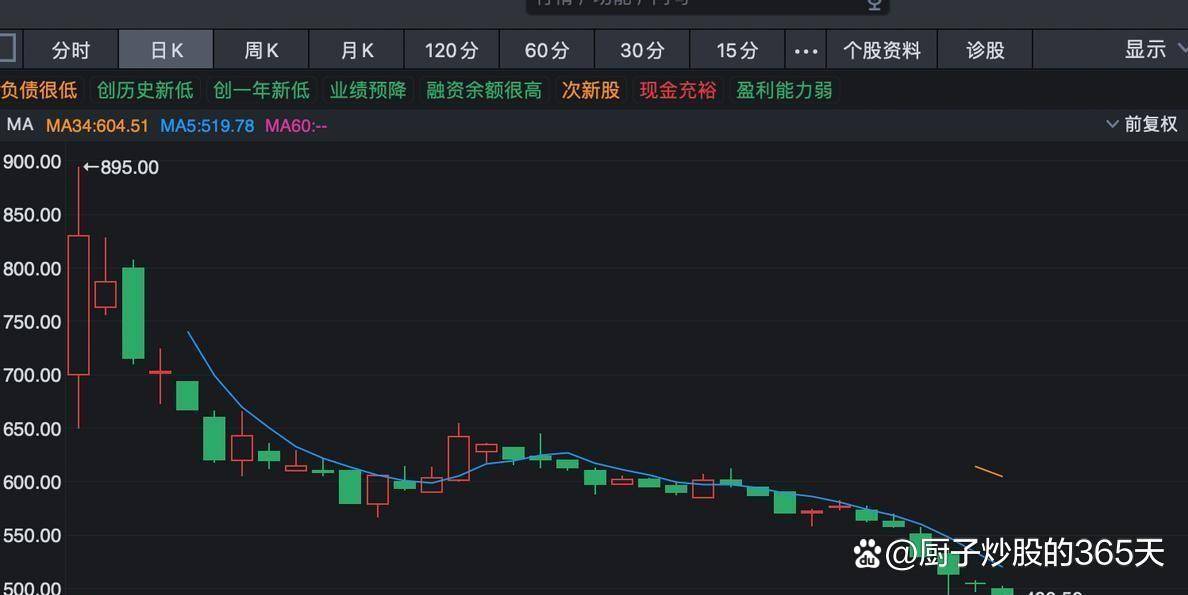
Core Viewpoint - The A-share technology sector, particularly in the chip and AI markets, is experiencing a significant downturn, with previously high-flying companies like Cambricon, Moore Threads, and Muxi falling sharply in stock prices, raising concerns about the end of the tech bull market [1][3]. Company Analysis - Cambricon was once a star in the AI chip sector, with its stock price peaking above 1500 yuan but has since dropped to 1058 yuan, a decline of over 30% in just one month [3]. - Moore Threads has seen its stock plummet from a high of 941 yuan to 539 yuan, a drop exceeding 40% [3]. - Muxi, which peaked at 895 yuan, is now nearing a 50% decline, currently at 490 yuan [3]. - The AI computing chip sector saw a net outflow of 2.454 billion yuan in a single day, indicating a significant withdrawal of capital [3]. Financial Performance - Cambricon projects revenues of 6 to 7 billion yuan by 2025, a growth of 4 to 5 times, and anticipates turning a profit [4]. - However, its net profit showed a decline in the fourth quarter, raising doubts about the sustainability of its earnings [4][6]. - Cambricon's revenue is heavily reliant on a few major clients, making it vulnerable to changes in their orders [6]. - Moore Threads and Muxi are facing even more severe challenges, with projected losses of 650 million to 798 million yuan and 950 million to 1.06 billion yuan, respectively, for 2025 [7]. Market Dynamics - The competitive landscape for domestic AI chips has intensified, with major players like Huawei and Alibaba capturing significant market shares, leaving smaller companies like Moore Threads and Muxi struggling to gain traction [10]. - The return of NVIDIA's high-end chips to the Chinese market poses a further threat to domestic chip companies, as clients may prefer more established products [10]. - The rapid pace of technological advancement in the chip industry necessitates continuous investment in R&D, which is costly and can lead to financial strain [11]. Investor Sentiment - The shift in market sentiment from speculative investments to a focus on tangible performance has led to a reevaluation of these companies' valuations, resulting in significant stock price declines [13]. - The AI computing chip sector experienced a net outflow of 2.454 billion yuan, highlighting the lack of investor confidence [13]. - Companies like Muxi and Moore Threads have high financing ratios, which could exacerbate stock price declines if they hit margin call thresholds [13]. Conclusion - The combination of weak financial performance, intense competition, and changing investor sentiment has created a perfect storm for these companies, leading to dramatic stock price declines [14]. - The market's focus has shifted from growth potential to survival, raising concerns about the future viability of these firms [14].

董事长专访 | 隆华科技李占强:精准并购炼成新材料“隐形冠军”
Sou Hu Cai Jing· 2026-02-06 00:05
Core Viewpoint - The company emphasizes a merger and acquisition strategy focused on quality and strength rather than rapid expansion, targeting smaller firms with core technologies that are positioned for industry growth [1][4]. Mergers and Acquisitions Strategy - From 2015 to 2022, the company executed a series of strategic acquisitions, integrating firms like Sifeng Electronics and Jilian Optoelectronics, transforming from a refrigeration fan manufacturer into a technology group with three core sectors: energy conservation, electronic new materials, and polymer composite materials [6][7]. - The company aims to identify and acquire smaller firms that possess leading technologies but face limitations in funding or market access, thereby enhancing their capabilities through resource injection [6][7]. Financial Performance - The company projects a net profit attributable to shareholders of between 185 million to 235 million yuan for 2025, representing a year-on-year growth of 41.18% to 79.33%, with non-recurring net profit expected to be between 160 million to 210 million yuan, reflecting a growth of 38.32% to 81.55% [7]. Growth Potential in New Materials - The company’s investment value is primarily driven by its high competitiveness and growth potential in three core business segments, particularly in electronic new materials and polymer composite materials, which are currently experiencing industry surges [8][9]. - The PMI foam, a key product in the polymer materials sector, is crucial for aerospace and new energy vehicles, showcasing advantages such as lightweight and high-temperature resistance, and has established partnerships with major commercial aerospace companies [9]. Future Development Plans - The company plans to focus on strengthening its core business areas without diversifying into unrelated sectors, aiming to enhance its competitive strength in energy conservation and expand its market presence in new materials [11][12]. - Specific initiatives include solidifying the energy conservation sector, differentiating and expanding the new materials sector, and developing international market strategies through effective supply chain management [11][12].


北芯生命正式登陆科创板 心血管精准诊疗格局加速重构
2 1 Shi Ji Jing Ji Bao Dao· 2026-02-05 23:08
Core Viewpoint - North Chip Life Technology Co., Ltd. has successfully listed on the Shanghai Stock Exchange's Sci-Tech Innovation Board, marking the first successful listing of an innovative medical device company under the "fifth set of standards" [1][2] Company Overview - North Chip Life focuses on the research, development, production, and sales of innovative medical devices for precise diagnosis and treatment of cardiovascular diseases, with 17 approved and in-development products as of September 30, 2025 [1][3] - The company was founded in December 2015 by Song Liang, who has over 18 years of experience in advanced medical imaging technology and cardiovascular interventional device development [2][3] Financial Performance - The company has experienced significant revenue growth, with projected revenues of 520 million to 560 million yuan in 2025, representing a year-on-year increase of 64.24% to 76.88% [5] - The net profit for 2025 is expected to be between 78 million and 88 million yuan, marking a turnaround from previous losses [5] - The company raised a total of 999 million yuan in its IPO, with a net amount of 899 million yuan allocated primarily for the construction of an interventional medical device industrial base and R&D [5] Product Development and Market Position - North Chip Life has launched 11 products to the market and has 6 products in development, with its core IVUS and FFR systems having received special review and approval from national authorities [3][4] - The IVUS system is the first domestically approved 60MHz high-speed IVUS product and has captured a significant market share, while the FFR system holds a 30.6% share of the domestic market [4][5] R&D Investment - The company has consistently increased its R&D investment, totaling 389 million yuan over the past three years, with a workforce of 100 R&D personnel, over 40% of whom hold advanced degrees [3][5] Market Trends and Growth Potential - The domestic market for IVUS is expected to grow significantly, with projections indicating a compound annual growth rate of approximately 19.4% from 2024 to 2030 [8] - The overall market for precision-guided percutaneous coronary intervention (PCI) is anticipated to grow from 2.04 billion yuan in 2022 to 9.42 billion yuan by 2030, with IVUS and FFR systems expected to dominate this market [8] Competitive Landscape - North Chip Life faces competition from established international firms and other domestic manufacturers in the IVUS and FFR markets, which may impact its market share and pricing strategies [7][8] - The company is also subject to pressures from national procurement policies that could affect pricing and market dynamics [7][8]