
财政政策

Search documents
宏观经济点评:降息周的市场悬念
Minsheng Securities· 2025-09-14 09:54
Group 1: Market Outlook - The Federal Reserve's upcoming interest rate cut is expected to influence China's capital market, potentially leading to a stable upward trend in A-shares, which may outperform U.S. stocks[1] - Since late June, A-shares have shown a synchronized performance with U.S. stocks, with A-shares experiencing upward movements following U.S. stock market highs[1] - The resilience of the A-share market reflects increasing attractiveness and inclusivity, as evidenced by its performance in both the overall market and technology sectors[1] Group 2: Monetary Policy Insights - The Federal Reserve is likely to cut rates by 25 basis points due to weak employment and manageable inflation, despite complex inflation dynamics compared to last year[2] - Domestic interest rate cuts may be delayed as economic pressures and market sentiment are better than in Q3 of last year, reducing the urgency for immediate cuts[2] - There remains potential for domestic rate cuts in Q4 as economic pressures increase and the Fed continues its rate-cutting trajectory[2] Group 3: Fiscal Policy and Economic Indicators - The fiscal revenue shortfall has expanded by approximately 680 billion yuan compared to the initial budget, indicating a need for enhanced fiscal and monetary policy coordination in Q4[3] - The early issuance of local government debt quotas aims to stabilize expectations and guide local governments in project preparation, particularly in light of the current fiscal constraints[4] - The rising youth unemployment rate may trigger further monetary easing, as historical trends suggest that increasing unemployment often leads to rate cuts[6]
国家财政这五年:“钱袋子”增收约19%,财政民生投入近100万亿元|“十四五”成绩单
Hua Xia Shi Bao· 2025-09-13 14:59
Core Insights - The financial situation in China has improved significantly over the past five years, with public budget revenue expected to reach 106 trillion yuan, an increase of 17 trillion yuan or approximately 19% compared to the previous five-year plan [2] - Public budget expenditure is also at an unprecedented level, projected to exceed 136 trillion yuan, marking a 24% increase over the previous five-year period [2][4] - The government has implemented various fiscal policies to enhance economic stability and support public welfare, including increased spending on education, social security, and healthcare [5] Fiscal Policy and Economic Impact - Fiscal policy has become a crucial tool for macroeconomic regulation, with a significant correlation between fiscal spending and domestic demand observed in recent years [3] - The deficit ratio has increased from 2.7% to 4%, with new local government special bond quotas set at 19.4 trillion yuan and tax reductions exceeding 1 trillion yuan [4] - Over the past four years, China's economy has achieved an average growth rate of 5.5%, contributing approximately 30% to global economic growth [4] Social Welfare Investments - During the "14th Five-Year Plan" period, the government allocated nearly 100 trillion yuan for social welfare, including 20.5 trillion yuan for education and 19.6 trillion yuan for social security and employment [5] - Employment support measures have been enhanced, with a 29% increase in employment subsidy funds compared to the previous five-year period, resulting in over 50 million new urban jobs [5] Fiscal Reform Initiatives - The Ministry of Finance is focused on deepening fiscal and tax reforms to improve budget management and enhance the fiscal system [6] - The scale of funds transferred to the general public budget from government funds has increased significantly, enhancing the central government's regulatory capacity [6] - The government aims to clarify responsibilities and financial coordination between central and local authorities, with nearly 50 trillion yuan in transfer payments to local governments since the start of the "14th Five-Year Plan" [7] Future Outlook - The Ministry of Finance plans to strengthen macroeconomic regulation and deepen fiscal reforms to support the goal of building a modern socialist country [8]


前8个月人民币贷款增加13.46万亿元 金融支持实体经济稳固有力
Jing Ji Ri Bao· 2025-09-13 06:19
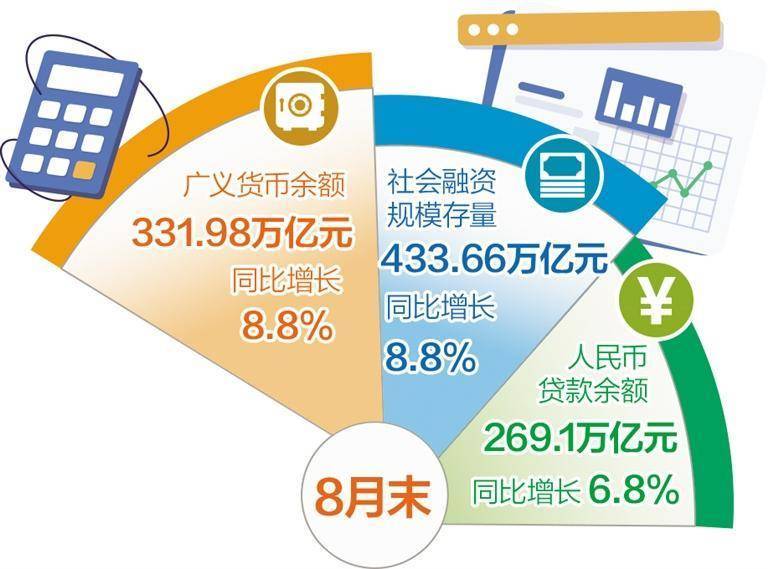
Monetary Policy and Financial Statistics - As of the end of August, the broad money supply (M2) stood at 331.98 trillion yuan, reflecting a year-on-year growth of 8.8% [1] - The total social financing stock reached 433.66 trillion yuan, also showing a year-on-year increase of 8.8% [1] - The balance of RMB loans was 269.1 trillion yuan, with a year-on-year growth of 6.8% [1] - The current monetary policy is characterized as moderately loose, supporting the real economy effectively [1] Government Bond Financing - In the first eight months of the year, net financing from government bonds amounted to 1.027 trillion yuan, an increase of 463 billion yuan year-on-year [1] - The proactive fiscal policy combined with a moderately loose monetary policy has led to an increase in government bond issuance, supporting the growth of social financing [1] Loan Growth and Economic Support - RMB loans increased by 1.346 trillion yuan in the first eight months, indicating strong support for the real economy [2] - Special refinancing bonds have been issued rapidly to address hidden local government debts, with 190 billion yuan issued by the end of August [2] - The growth in loans is also supported by a recovery in manufacturing and increased financing needs in high-tech and equipment manufacturing sectors [3][4] Consumer and Personal Loans - Personal loans have seen growth due to increased consumer demand during the traditional summer consumption peak [4] - Recent real estate policy adjustments in major cities have further stimulated housing loan demand [4] Interest Rates and Financing Costs - Since 2020, the People's Bank of China has cut policy rates nine times, leading to a significant decrease in loan rates [5] - The average interest rate for new corporate loans was approximately 3.1%, down about 40 basis points year-on-year, while new personal housing loan rates also fell to around 3.1% [5] - The overall financing costs for the real economy have decreased significantly, supporting economic recovery [5]
财政部部长蓝佛安:财政政策始终留有后手 未来财政政策发力空间依然充足
Jing Ji Guan Cha Bao· 2025-09-13 03:17
Core Viewpoint - The Chinese Ministry of Finance emphasizes that fiscal policy will continue to have ample room for maneuvering, balancing risk prevention and development promotion, while maintaining a proactive stance to support economic stability and growth [1][2]. Group 1: Fiscal Policy Characteristics - The fiscal policy during the "14th Five-Year Plan" period has four main characteristics: 1. Increased intensity, with the deficit ratio rising from 2.7% to 3.8%, and further to 4% this year, alongside a new local government special bond quota of 19.4 trillion yuan and over 1 trillion yuan in tax reductions and deferrals [2][3]. 2. Enhanced tools, utilizing government bonds, tax policies, fiscal subsidies, and special funds to amplify policy effects, including the innovative issuance of ultra-long special bonds to support domestic demand [2]. 3. More precise efforts, focusing on economic bottlenecks and challenges, such as a one-time arrangement of 6 trillion yuan for debt replacement to alleviate local debt pressure and free up resources for public welfare and development [3]. 4. Greater flexibility in timing, ensuring policies are implemented promptly to maximize their effectiveness [3]. Group 2: Policy Coordination and Impact - The Ministry of Finance highlights the importance of coordinating fiscal policy with monetary policy to create a synergistic effect, including the issuance of 500 billion yuan in special government bonds to inject capital into major commercial banks, which is expected to leverage approximately 6 trillion yuan in credit [2].
财政科学研究院院长杨志勇:中国财政政策仍有较大发力空间
2 1 Shi Ji Jing Ji Bao Dao· 2025-09-13 01:44
Core Viewpoint - The Chinese government is implementing a more proactive fiscal policy during the "14th Five-Year Plan" period, enhancing macroeconomic regulation to support stable economic growth [2][4][5]. Group 1: Fiscal Policy Characteristics - The fiscal macro-control during the "14th Five-Year Plan" is characterized by stronger efforts, a richer toolkit, more precise actions, and greater flexibility in timing [5]. - The average annual growth rate during the "14th Five-Year Plan" has been 5.5%, contributing approximately 30% to global economic growth [4]. Group 2: Economic Cycle Management - The goal of macroeconomic regulation is to smooth out economic cycles, preventing significant fluctuations that could waste resources and impact social welfare [3]. - Cross-cycle regulation is increasingly important to find new growth drivers for medium- to long-term development [3]. Group 3: Coordination of Policies - Fiscal policy and monetary policy must work in tandem to enhance the effectiveness of macroeconomic regulation [6]. - The issuance of 500 billion yuan in special government bonds is expected to leverage approximately 6 trillion yuan in credit [6]. Group 4: Fiscal Space and Debt Management - The fiscal deficit rate has increased from 2.7% to 4%, providing more room for fiscal policy [8]. - China's government debt-to-GDP ratio is projected to be 68.7% by the end of 2024, significantly lower than the G20 average of 118.2% and G7 average of 123.2% [8]. Group 5: Future Fiscal Policy Potential - There is considerable potential for further fiscal policy action, supported by a long-term positive economic trend and a large market [9]. - Ongoing reforms in fiscal management aim to enhance the efficiency of resource allocation and increase the fiscal capacity for macroeconomic regulation [9][10]. Group 6: International Coordination - Strengthening international macroeconomic policy coordination is essential to mitigate negative spillover effects from major economies [11]. - China's active participation in global economic governance and cooperation enhances the environment for domestic fiscal macro-control [11].

前8个月人民币贷款增加13.46万亿元——金融支持实体经济稳固有力
Sou Hu Cai Jing· 2025-09-12 22:48
Group 1 - The People's Bank of China reported that as of the end of August, the broad money supply (M2) reached 331.98 trillion yuan, with a year-on-year growth of 8.8%, indicating a moderately loose monetary policy that supports the real economy [2] - The total social financing stock was 433.66 trillion yuan, also growing by 8.8% year-on-year, reflecting strong financial support for economic stability [2] - The net financing scale of government bonds for the first eight months of the year was 1.027 trillion yuan, an increase of 463 billion yuan year-on-year, demonstrating the effectiveness of proactive fiscal policies [2] Group 2 - As of the end of August, the narrow money supply (M1) was 111.23 trillion yuan, with a year-on-year growth of 6%, indicating a narrowing gap between M1 and M2, which is beneficial for consumption and investment [3] - The increase in RMB loans for the first eight months was 1.346 trillion yuan, showing strong credit support for the real economy [3] - The issuance of special refinancing bonds has provided significant funding support for resolving hidden local government debts, with 190 billion yuan issued for this purpose by the end of August [3] Group 3 - The proportion of direct financing channels, such as corporate bonds and government bonds, has steadily increased from 26.7% at the end of 2018 to 31.6% by the end of August 2025, indicating a diversification in financing sources for the real economy [4] - Factors such as industry recovery, resilient exports, and supportive real estate policies have contributed to credit growth in August [4] - Manufacturing loans have seen a significant increase, with new manufacturing loans accounting for 53% of new corporate loans in the first eight months, reflecting a recovery in production [4] Group 4 - High demand for financing has been observed in industries such as textiles, specialized equipment, and computer communications, driven by seasonal factors and market expansion efforts [5] - Personal loan growth has been stimulated by traditional summer consumption peaks and supportive consumption policies, with cities implementing measures to meet housing demand [5] - The continuous reduction in reserve requirements and interest rates by the People's Bank of China has resulted in lower financing costs for the real economy [6] Group 5 - Since 2020, the People's Bank of China has cut policy rates nine times, leading to a significant decline in loan rates for both enterprises and personal housing loans, enhancing the financing environment for the real economy [6] - The macroeconomic policies are expected to remain consistent and stable, with a focus on addressing deeper structural issues and promoting key sector reforms [6]
国家财政实力持续增强 “十四五”时期民生领域财政投入近百万亿元
Jing Ji Ri Bao· 2025-09-12 22:03
Core Viewpoint - The Chinese government emphasizes the strengthening of fiscal capacity and effectiveness during the "14th Five-Year Plan" period, which is crucial for supporting national governance and meeting public expectations [1][2]. Fiscal Strength and Budget Overview - National general public budget revenue is expected to reach 106 trillion yuan, an increase of 17 trillion yuan or approximately 19% compared to the "13th Five-Year Plan" period [1]. - General public budget expenditure is projected to exceed 136 trillion yuan, an increase of 26 trillion yuan or 24% compared to the "13th Five-Year Plan" period [1]. Economic Policy and Development - Fiscal policy has become more proactive and precise, enhancing macroeconomic regulation to support stable and healthy economic development [1][2]. - The government aims to strengthen counter-cyclical adjustments and coordinate long-term development momentum [1]. Social Welfare and Public Spending - Over 70% of general public budget expenditure is allocated to social welfare, with significant investments in education, social security, healthcare, and housing [2]. - Specific allocations include 20.5 trillion yuan for education, 19.6 trillion yuan for social security and employment, 10.6 trillion yuan for healthcare, and 4 trillion yuan for housing security during the "14th Five-Year Plan" period [2]. Education and Technology Investment - National fiscal education funding is expected to exceed 25 trillion yuan, a growth of about 38% compared to the "13th Five-Year Plan" period [3]. - Fiscal support for technology is projected to reach 5.5 trillion yuan, a 34% increase from the previous period, focusing on basic research and national strategic technology tasks [3]. Fiscal and Tax System Reform - The government is committed to deepening fiscal and tax system reforms to ensure effective budget management and a sound fiscal framework [4][5]. - Key reforms include optimizing revenue and expenditure structures, enhancing the efficiency of fund usage, and improving the tax system to promote social equity and market unity [5]. Future Directions - The government plans to continue advancing fiscal support for innovation and technology, aligning with the strategy for building a strong technological nation [3][6].
前8个月人民币贷款增加13.46万亿元—— 金融支持实体经济稳固有力
Jing Ji Ri Bao· 2025-09-12 22:03
Monetary Policy and Financial Statistics - As of the end of August, the broad money supply (M2) reached 331.98 trillion yuan, with a year-on-year growth of 8.8% [1] - The total social financing stock was 433.66 trillion yuan, also reflecting a year-on-year increase of 8.8% [1] - The balance of RMB loans stood at 269.1 trillion yuan, showing a year-on-year growth of 6.8% [1] - The government bond net financing scale for the first eight months of the year was 1.027 trillion yuan, an increase of 463 billion yuan compared to the previous year [1] Credit and Loan Growth - RMB loans increased by 1.346 trillion yuan in the first eight months, indicating strong support for the real economy [2] - The issuance of special refinancing bonds has accelerated, providing significant funding support for resolving hidden debts [2] - The growth rate of loans, after adjusting for the impact of replacing local government hidden debts, was estimated to be around 7.8% in August [2] Economic Activity and Sector Performance - The proportion of direct financing through corporate bonds, government bonds, and non-financial corporate domestic stock financing has steadily increased from 26.7% at the end of 2018 to 31.6% by the end of August 2025 [3] - Manufacturing loans have seen a significant increase, with new manufacturing loans accounting for 53% of new corporate loans in the first eight months, a rise of 33 percentage points from the previous year [3] - High demand for financing has been noted in sectors such as textiles, specialized equipment, and computer communications, driven by seasonal demand and market expansion efforts [4] Consumer Loans and Housing Market - Personal loan growth has been boosted by traditional summer consumption peaks and policies promoting consumption [4] - Recent real estate regulatory policies in major cities have aimed to better meet diverse housing needs, contributing to increased loan demand [4] Interest Rates and Economic Outlook - Since 2020, the People's Bank of China has cut policy rates nine times, leading to a decrease in loan rates for both enterprises and personal housing loans [5] - The macroeconomic policy is expected to maintain continuity and stability, with a supportive monetary policy aiding the real economy [5] - Long-term economic structural transformation and industrial upgrading are anticipated to lead to a more balanced supply-demand relationship in the economy [5]
财政民生投入近100万亿元
Sou Hu Cai Jing· 2025-09-12 20:32
Group 1 - The core viewpoint emphasizes that the government is significantly increasing its fiscal investment in people's livelihoods during the "14th Five-Year Plan" period, with nearly 100 trillion yuan allocated, accounting for over 70% of the national general public budget expenditure [1] - The national general public budget revenue is expected to reach 106 trillion yuan during the "14th Five-Year Plan," an increase of 17 trillion yuan or approximately 19% compared to the "13th Five-Year Plan" [1] - The total expenditure is projected to exceed 136 trillion yuan, marking an increase of 26 trillion yuan or 24% from the previous five-year period, with a focus on optimizing the structure of spending [1] Group 2 - The government debt total is projected to be 92.6 trillion yuan by the end of 2024, with a debt-to-GDP ratio of 68.7%, which is considered reasonable compared to G20 and G7 averages [2] - The government debt is backed by substantial quality assets, indicating that the overall risk is manageable [2] Group 3 - The government aims to enhance the quality of life for citizens, with a focus on expanding social security systems, which currently cover over 1.07 billion people in basic pension insurance and 1.327 billion in basic medical insurance [3] - Financial assistance for residents' medical insurance will increase from 580 yuan to 700 yuan per person per year during the "14th Five-Year Plan" [3] - The government is also addressing public service gaps in rural areas, achieving significant improvements in infrastructure and service coverage [3] Group 4 - The national fiscal education expenditure is expected to remain above 4% of GDP, with significant improvements in education access and quality, including a 95.9% consolidation rate for compulsory education by 2024 [4] - The government emphasizes the need for continuous efforts to improve people's welfare, aligning fiscal investments with public needs [4] Group 5 - The government is implementing fiscal policies to stimulate domestic demand, with a focus on employment and consumption, including a 29% increase in employment subsidy funding to 318.6 billion yuan [5] - Approximately 4.2 trillion yuan has been allocated to stimulate consumption, resulting in over 2.9 trillion yuan in sales [5] - The government has arranged over 19.4 trillion yuan in special bonds to support infrastructure projects, enhancing social investment [5] Group 6 - The government recognizes the potential for significant investment demand driven by new industrialization and urbanization, aiming to leverage fiscal tools to stimulate consumption and investment [6]

广义货币增速保持在较高水平
Zhong Guo Zheng Quan Bao· 2025-09-12 20:20
Core Insights - The People's Bank of China reported that as of the end of August, both M2 and social financing growth rates remained high, creating a favorable monetary environment for economic recovery [1][3] - Experts predict that macro policies will maintain continuity and stability, with moderately loose monetary policy continuing to support the real economy [1] Group 1: Credit Growth Factors - In the first eight months, RMB loans increased by 13.46 trillion yuan, with household loans rising by 711 billion yuan and corporate loans increasing by 12.22 trillion yuan [1] - Factors supporting credit growth include industry recovery, resilient exports, summer consumption peaks, and real estate support policies [1][2] - Manufacturing sector loans accounted for 53% of new corporate loans, significantly up by 33 percentage points compared to the previous year, indicating strong financing demand [2] Group 2: Personal Loan Dynamics - August, being a traditional consumption peak, saw increased personal loan demand driven by internal consumption growth and external policies like "trade-in" incentives [2] - Recent real estate policy adjustments in major cities have led to a notable increase in housing transaction volumes and mortgage loan inquiries [2] Group 3: Monetary and Financing Metrics - As of the end of August, the RMB loan balance was 269.1 trillion yuan, with a year-on-year growth of 6.8%, indicating strong support for the real economy [3] - The social financing scale reached 433.66 trillion yuan, growing by 8.8% year-on-year, reflecting robust financial support for the economy [3][4] - M2 balance stood at 331.98 trillion yuan, also growing by 8.8%, supported by fiscal policies and a low base from the previous year [4] Group 4: Structural Monetary Policy - The narrowing gap between M1 and M2 indicates a shift towards more liquid deposits, which can enhance consumption and investment activities [4] - Structural monetary policy tools have been implemented across various sectors, with significant growth in technology, green, and inclusive small and micro loans [5] - Future focus will be on optimizing resource allocation and enhancing financial institutions' capabilities to support key sectors [5]