贸易战

Search documents
土耳其突然加税1200美元/吨!中国链条企业如何破局?
Sou Hu Cai Jing· 2025-09-02 19:58
Core Insights - Turkey's recent announcement of a $1200 per ton punitive tax on Chinese chain enterprises has disrupted global supply chains, particularly affecting those transiting through the EU, excluding Spain [1] - The longstanding trade tensions between Turkey and China date back to 2009, when Turkey first imposed similar tariffs due to concerns over low-priced Chinese goods impacting local businesses [1] - Chinese companies have adapted by rerouting shipments through EU countries, resulting in a 300% increase in exports of chains from China to the EU and a 280% rise in Turkey's imports from the EU, while EU's own chain usage only increased by 2% [1] Industry Impact - Turkey's new tax strategy targets not only Chinese chains but also EU-transited goods, effectively blocking all variants of Chinese chains by specifying five product codes [2] - Spain, the only EU country capable of producing chains, has been granted an exemption, with its exports to Turkey projected to account for 61% of total EU exports in 2024, benefiting from lower labor costs compared to Germany and France [2] - The tax increase has raised the cost of chains by 24%, significantly squeezing profit margins for Chinese enterprises, which previously sold chains for $5000 per ton [2] Innovation and Adaptation - In response to the punitive taxes, some large Chinese enterprises are increasing R&D investments by 30% to develop stronger and lighter chains, allowing for a potential 15% price increase to offset tariff costs and access high-end markets [2] - Other companies are exploring alternative strategies, such as relocating production to Southeast Asia to leverage local free trade agreements, or innovating by transforming standard chains into "smart chains" equipped with sensors to evade anti-dumping duties [2] Broader Economic Consequences - Turkey's regulatory measures are causing disruptions not only for Chinese firms but also for EU intermediaries, with logistics costs expected to rise by 20%-30% as chains are rerouted to countries like Morocco or Ukraine [3] - The Turkish construction sector, heavily reliant on Chinese supply chains, will face increased costs of 15%-20% for chains, which will ultimately contribute to rising domestic inflation [3] - The EU is considering similar measures against Chinese steel products transiting through Serbia, indicating a potential tightening of global supply chains and escalating trade tensions [3] Competitive Landscape - The ongoing trade conflict reflects a shift in global competition dynamics, emphasizing a complex interplay of technology, regulations, and supply chains rather than simple price competition [3] - As Chinese chain manufacturers innovate and upgrade their technology, they may eventually dominate high-end markets, potentially diminishing Turkey's leverage to impose tariffs in the future [3]


中方赴美谈判结束,代表团离开美国之际,特朗普送中方一句话,沙利文终于说了句大实话
Sou Hu Cai Jing· 2025-09-02 10:21
Group 1 - The U.S. judicial system has ruled that most tariffs imposed during Trump's presidency exceeded presidential authority, creating uncertainty in tariff policy [1][6] - U.S. farmers are facing significant challenges, with soybean stockpiles increasing and a decline in export orders, indicating that the ongoing tariff war is harming domestic industries [4] - The U.S. political landscape is characterized by heightened tensions and a focus on confrontation, particularly during election seasons, which complicates rational decision-making in trade policy [4] Group 2 - The U.S. is perceived by its allies as a "major disruptor," while China is viewed as a more stable partner, reflecting a shift in global perceptions and alliances [3][8] - India's response to U.S. tariffs has led to a strategic pivot towards China and other nations, highlighting the complexities of U.S. foreign policy and its unintended consequences [3][8] - American businesses are increasingly concerned about the long-term impacts of the trade war, with many executives expressing a desire to end the conflict to preserve market access [6][8]
特朗普引发资本大转向?私募巨头曝料:亚洲和中东客户正抛弃美国
Jin Shi Shu Ju· 2025-09-02 06:04
Group 1 - The impact of the Trump administration's policies is causing top investors from Asia and the Middle East, including sovereign funds, to seek to avoid U.S. assets [2] - Partners Group, managing over $170 billion in assets, reports that many Asian investors are increasingly looking towards non-U.S. assets due to uncertainties related to tariffs and potential trade restrictions [2] - Discussions regarding the avoidance of U.S. exposure have emerged this year, driven by the U.S. government's policies, with some investors requesting to open euro accounts instead of dollar accounts [2] Group 2 - The global financial system is expected to become more fragmented and less integrated as a result of these investment shifts [2] - The CEO of Partners Group emphasizes the importance of stability in U.S. policies for maintaining investor confidence, noting that the current period is critical for demonstrating such stability [2][3] - Despite the challenges posed by U.S. tariffs, the U.S. remains an attractive destination for capital investment in key sectors such as technology and healthcare, according to the private equity business head at Partners Group [3]
黄金突破3500美元开启新纪元!降息预期与政治风险成双引擎
智通财经网· 2025-09-02 03:19
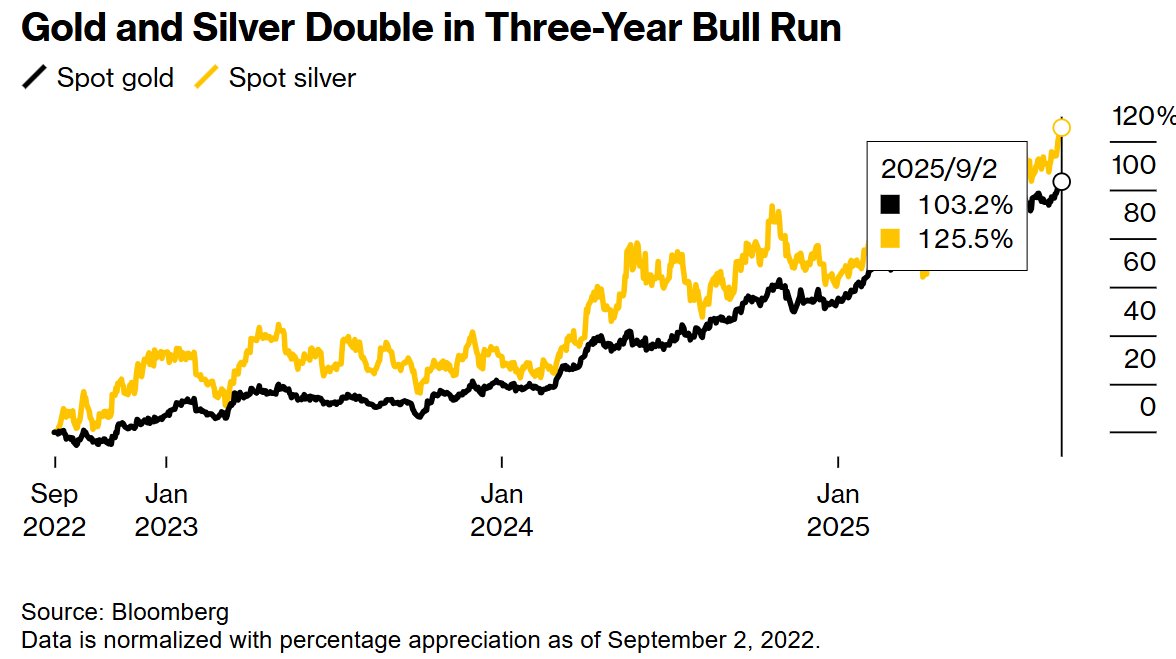
Group 1 - Gold prices have surpassed $3,500, reaching a historical high of $3,508.73 per ounce, driven by expectations of a Federal Reserve rate cut and increasing concerns about the future [1] - Year-to-date, gold has risen over 30%, making it one of the best-performing commodities [1] - The recent surge in gold prices is supported by market expectations of a Federal Reserve rate cut, with a key U.S. employment report expected to further indicate a weakening labor market [1] Group 2 - UBS strategist Joni Teves noted that investors are increasing their gold holdings, particularly as a Federal Reserve rate cut approaches, which is pushing gold prices higher [2] - The low interest rate environment, weak economic data, and rising macroeconomic uncertainty and geopolitical risks enhance gold's role as a diversification tool in investment portfolios [2] Group 3 - Over the past three years, both gold and silver have more than doubled in price due to rising geopolitical, economic, and global trade risks, increasing demand for these traditional safe-haven assets [5] - Silver prices have risen over 40% year-to-date, with prices recently surpassing $40 per ounce for the first time since 2011, driven by its industrial applications in clean energy technologies [5] - The market is experiencing a fifth consecutive year of supply shortages for silver, with a weak dollar boosting purchasing power in major consumer countries like China and India [8]
克普勒:亚洲石油产品需求疲软甚至面临零增长局面
Zhong Guo Hua Gong Bao· 2025-09-02 02:34
Group 1: Asia Oil Demand Trends - The demand for oil products in Asia is showing signs of weakness and is expected to continue into next year, with a potential for zero growth in oil product demand [1] - Key factors driving the current fuel demand trend include weakened consumer confidence and the rise of electric vehicles [1] - Analysts predict that oil product demand in the Asia-Pacific region will experience zero growth this year due to oversupply in petrochemical capacity, slowing regional economic growth, aging population, and improved fuel efficiency [1] Group 2: Natural Gas Demand Outlook - The outlook for natural gas demand in Asia is significantly better than that for crude oil, with no predictions indicating that electric vehicles will weaken natural gas demand [1] - A Morgan Stanley forecast suggests that natural gas demand in Asia will grow at an annual rate of 5%, surpassing growth rates in Europe and the U.S. [1] - Natural gas is expected to play a crucial role in meeting the increasing global demand for electrification, becoming a pillar of energy security [1] Group 3: Europe Oil Demand Dynamics - In contrast to Asia, Europe is experiencing unexpected strong growth in oil product demand, with gasoline and aviation fuel demand expected to rise despite the push for electric vehicles [2] - The International Air Transport Association (IATA) has warned of an aviation fuel shortage in Europe due to reduced domestic supply and stable demand growth [2] - The closure of refineries in Europe, driven by stricter environmental regulations, has led to a decline in aviation fuel production and increased reliance on imports [2] Group 4: North America Oil Demand Stability - While U.S. fuel demand is not expected to see significant growth, it is projected to remain stable, driven by winter heating needs and steady air travel demand [2] - However, a decline in gasoline demand is anticipated by 2026, and diesel demand may face pressure due to tariffs impacting freight activities [2]
投票结果7:4!美国法院正式做出裁定,特朗普无权对中国加征关税
Sou Hu Cai Jing· 2025-09-01 08:01
Core Viewpoint - The U.S. Court of Appeals ruled that the tariffs imposed by the Trump administration on China were illegal, exceeding the legal authority granted to the president under the International Emergency Economic Powers Act (IEEPA) [1][5][29] Group 1: Legal and Political Implications - The court emphasized that the IEEPA was intended for addressing "special and extraordinary threats," such as financial sanctions, and not for imposing tariffs, which were deemed outside the scope of the law [5][9] - The ruling undermines Trump's ability to use tariffs as a negotiating tool in trade discussions with China, potentially shifting the balance of power in future negotiations [1][22][29] - The decision reflects a broader political struggle, with the Democratic Party viewing Trump's tariff actions as an overreach of presidential power, leading to legal challenges against his policies [15][17][29] Group 2: Impact on U.S.-China Trade Relations - The ruling may lead to a new phase in U.S.-China trade relations, as it could allow China to negotiate from a stronger position without the pressure of tariffs [22][25][29] - China's response to Trump's tariffs has been characterized by a strategy of maintaining a position of strength, emphasizing that it will not compromise under unequal pressure [25][29] - The potential dismantling of Trump's tariff policies could create favorable conditions for improved trade relations between the U.S. and China, as evidenced by recent high-level negotiations from China [25][29] Group 3: Effects on U.S. Domestic Politics - The ruling has weakened Trump's political leverage within the Republican Party, although he remains a central figure with significant influence [17][29] - The decision may exacerbate existing political tensions in the U.S., as it highlights the ongoing conflict between executive power and legislative authority [15][17][29] - Trump's unilateral approach to tariffs has led to skepticism among traditional U.S. allies, such as Japan, regarding the stability of U.S. trade policies [27][29]
7票比4票,特朗普败诉,美国法院正式裁定,他无权对中国加征关税
Sou Hu Cai Jing· 2025-09-01 07:38
Core Viewpoint - The U.S. Court of Appeals ruled that many of Trump's tariff policies are illegal, challenging the president's authority and potentially reshaping the landscape of U.S. trade policy [3][6][27]. Group 1: Legal Ruling and Implications - The U.S. Court of Appeals decided with a 7-4 vote that the president does not have the authority to impose tariffs as previously executed by the Trump administration [3][6]. - The ruling indicates that the use of the International Emergency Economic Powers Act (IEEPA) for imposing tariffs is a misapplication of the law, which was intended for emergency situations, not for ongoing trade policy [8][10]. - The court's decision does not entirely negate presidential trade powers, as tariffs on steel and aluminum under the Trade Act remain unaffected [13]. Group 2: Economic Impact of Tariffs - The tariffs imposed by the Trump administration have significantly increased costs for American consumers and businesses, with an estimated additional cost of about $700 per household annually from 2019 to 2023 [16][19]. - Small businesses, particularly in Democratic-led states, have been severely impacted, facing rising costs for imported materials and shrinking profit margins [15][16]. - The agricultural sector has also suffered, with average farm incomes dropping over 5% due to tariffs, and a shift in trade patterns as countries like China seek alternatives to U.S. agricultural products [18][19]. Group 3: Political Reactions and Future Outlook - Trump has publicly rejected the court's ruling, labeling it as partisan and asserting that all tariffs remain in effect, indicating a potential for continued legal battles [21][23]. - The timing of the court's decision coincides with ongoing trade negotiations between the U.S. and China, suggesting that the U.S. may need to adjust its negotiating stance in light of the ruling [25][29]. - The ruling could lead to a reevaluation of trade agreements, including the Phase One trade deal with China and provisions in the USMCA that are linked to tariffs [29].
原油成品油早报-20250901
Yong An Qi Huo· 2025-09-01 06:20
Group 1: Report Industry Investment Rating - No relevant content provided Group 2: Core Viewpoints of the Report - This week, oil prices fluctuated within a narrow range, and the absolute price declined on Friday. At the end of the peak refinery operation season in summer, the inflection point of the crude oil fundamentals has emerged. The contango of Brent and WTI crude oil strengthened slightly, while that of Dubai crude oil strengthened significantly. The refining margins of European and American refineries declined slightly, the gasoline crack spread in the United States strengthened, and the diesel crack spread in Europe fluctuated. The balance sheet is expected to have a surplus of 1.8 million barrels per day in the fourth quarter and 1.8 - 2.5 million barrels per day in 2026. Global oil inventories have slightly increased, U.S. commercial crude oil inventories have decreased seasonally, the absolute inventory is at a historically low level in the same period, Cushing inventories have decreased, and U.S. gasoline and diesel inventories have decreased. Institutions estimate that refinery maintenance in October globally will exceed previous years' levels (in Europe and Africa), and the crude oil contango is expected to face pressure. Recently, the absolute price of crude oil has been fluctuating. Attention should be paid to the transition between peak and off - peak seasons. The market focuses on the medium - to - long - term surplus pattern, and the absolute price is under downward pressure. It is expected that the price center in the fourth quarter will fall to $60 per barrel. Due to the expected adjustment of European autumn maintenance, the forecast of the European diesel crack spread in the fourth quarter is raised [6]. Group 3: Summary by Related Catalogs 1. Oil Price Data - From August 25 - 29, 2025, WTI crude oil decreased by $0.59, BRENT decreased by $1.14, and DUBAI increased by $0.01. Among other related indicators, SC increased by 3.50, OMAN decreased by 0.83, etc. [3] 2. Daily News - The CEO of a Russian oil company expects the global oil market surplus to be 2.6 million barrels per day in Q4 2025 and drop to 2.2 million barrels per day in 2026 [3]. - Hedge funds have significantly reduced their bullish bets on crude oil to the lowest level since 2007 due to concerns about supply surplus. As of the week ending August 26, fund managers reduced their net long bets on WTI crude oil by 5,461 lots to 24,225 lots, the lowest since January 2007, and short - only bets on WTI crude oil reached a 20 - month high [3]. - The U.S. Federal offshore Gulf of Mexico crude oil production reached 1.92 million barrels per day in June 2025, the highest since October 2023 [4]. - Due to increased production from major oil - producing countries and U.S. tariff threats, it is difficult for oil prices to rise significantly this year. The predicted average price of Brent crude oil in 2025 is $67.65 per barrel, and that of U.S. crude oil is $64.65 per barrel [4]. - Despite sanctions and U.S. tariffs, Russia's oil exports to India will increase by 150,000 - 300,000 barrels per day in September [4]. 3. Regional Fundamentals - In the week ending August 15, U.S. crude oil exports increased by 795,000 barrels per day to 4.372 million barrels per day, and domestic crude oil production increased by 55,000 barrels to 13.382 million barrels per day [5]. - Commercial crude oil inventories excluding strategic reserves decreased by 6.014 million barrels to 421 million barrels, a decrease of 1.41%. The U.S. strategic petroleum reserve (SPR) inventory increased by 223,000 barrels to 403.4 million barrels, an increase of 0.06% [5]. - The four - week average supply of U.S. crude oil products was 21.093 million barrels per day, a year - on - year increase of 3.34%. U.S. crude oil imports excluding strategic reserves were 6.497 million barrels per day, a decrease of 423,000 barrels per day from the previous week [5]. - From August 22 - 29, the operating rate of major refineries decreased slightly, and that of Shandong local refineries increased slightly. Domestic gasoline production decreased while diesel production increased, and both gasoline and diesel inventories decreased. The comprehensive profit of major refineries fluctuated weakly, and the comprehensive profit of local refineries decreased month - on - month [5][6].
200%关税换稀土?特朗普威胁不了中国,美国确实无牌可打了
Sou Hu Cai Jing· 2025-09-01 03:01
Group 1 - Trump's recent claim of imposing a 200% tariff on China for magnetic materials is seen as a performative threat rather than a feasible policy [1][3] - The exaggerated tariff figures, such as 500% on Russian oil and gas purchases, indicate a lack of actionable policy and are more about gaining attention [3][4] - China's export regulations on rare earth materials are focused on compliance and traceability rather than outright restrictions, aimed at preventing military misuse [3][4] Group 2 - China's Ministry of Foreign Affairs has firmly stated that Trump's threats do not alter China's established principles regarding trade [4][6] - The ongoing trade war has not led to the anticipated economic collapse of China, which has shown resilience, while the U.S. faces rising inflation and debt [6][8] - The rhetoric from U.S. leaders, including extreme tariff claims, is increasingly viewed as empty threats, diminishing America's credibility on the global stage [6][8]

出口下滑加拿大经济大幅萎缩
Bei Jing Shang Bao· 2025-08-31 15:55
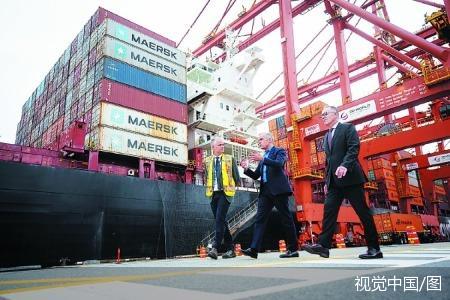
在货币政策方面,加拿大央行表示,如果经济继续走弱且通胀压力受控,不排除进一步降息的可能。下 次利率决议将于9月17日公布,目前基准利率为2.75%,在最新数据公布前,市场对央行降息的押注约 为40%。 北京商报综合报道 加拿大总理马克·卡尼(中)在DP世界中心集装箱码头参观。 企业投资同样低迷,继一季度仅增1.1%后,二季度骤降10.1%,凸显加拿大企业在面对美方关税政策反 复无常时的悲观情绪愈加强烈。 此次数据凸显贸易战对加拿大的严重冲击。今年初,美国总统特朗普对包括钢铁、铝和汽车在内的大量 加拿大商品加征关税,而美国正是加拿大最大的贸易伙伴。 不过,报告也显示,贸易冲击尚未迅速扩散至更广泛的经济领域。初步行业数据显示,继6月意外萎缩 0.1%后,加拿大经济7月小幅增长0.1%,国内需求端仍显韧性:二季度最终国内需求增长3.5%,其中家 庭消费增长4.5%,在人口增长明显放缓的背景下加速增长。 受美国关税冲击,加拿大经济二季度近两年来首次陷入收缩,出口大幅下滑,企业投资急转直下。加拿 大统计局上周五公布数据显示,二季度国内生产总值(GDP)按年率计算下降1.6%,为疫情以来最大 降幅,也是近两年的首次萎缩。 ...