
以旧换新

Search documents
多地收购二手房作保租房,“老破小”有救了?
Sou Hu Cai Jing· 2026-02-14 00:48
Core Viewpoint - The recent initiative by local governments in cities like Shanghai, Jinan, Hangzhou, and Chongqing to purchase second-hand homes for use as rental housing signals a shift in policy aimed at revitalizing the housing market and addressing the challenges faced by homeowners looking to upgrade their properties [1][2]. Group 1: Government Actions - Local governments are focusing on acquiring second-hand homes, particularly those that are older, smaller, and located in desirable areas, to convert them into affordable rental housing [1][2]. - In Shanghai, specific criteria have been established for the types of properties eligible for purchase, including those built before 2000, with a maximum price of 4 million yuan and a size of less than 70 square meters [1]. Group 2: Market Implications - The government's intervention is seen as a way to facilitate the "old for new" housing policy, which aims to improve the liquidity of the second-hand housing market and stimulate new home sales [2]. - Concerns about potential price suppression in the second-hand market due to government purchases are considered overstated, as the government will not force purchases and will operate under similar conditions as regular transactions [2]. Group 3: Challenges and Considerations - The acquisition of second-hand homes presents more complexities compared to purchasing new developments, as it involves negotiating with individual homeowners, which increases time and resource costs [3]. - The variability in pricing based on location, type, and age of the properties complicates the valuation process for the government, which currently lacks detailed guidelines for these transactions [6]. - Financial constraints may limit the ability of local governments to fund these purchases, especially in smaller cities where the second-hand market is less active [7].

政策暖风叠加春节催化 消费板块投资机遇凸显
Zhong Guo Zheng Quan Bao· 2026-02-13 20:23
Core Viewpoint - The upcoming 2026 Spring Festival consumption season is expected to inject strong vitality into traditional consumption while accelerating the implementation of new business formats and models, shifting the investment logic in the consumption sector from "overall recovery" to "selective structure" [1][4]. Policy Effects - The "2026 'Shopping New Spring' Special Activity Plan" was jointly issued by nine departments, covering six areas: food, accommodation, transportation, tourism, shopping, and entertainment [1]. - The plan includes various promotional activities such as New Year’s Eve dinner packages, home renovation promotions, and increased transportation capacity by civil aviation and railway departments [1][2]. - The Ministry of Commerce announced three major incentives for consumers: trade-in programs, prize invoices, and financial support, aimed at enhancing the supply and promotional activities of retail businesses [2]. Market Dynamics - The restaurant sector is experiencing a surge in demand, with many restaurants in Beijing reporting a booking rate of 90% for New Year’s Eve dinners [3]. - Various cities are creating complex consumption scenarios, such as events in Wangfujing and Nanjing Road that combine culture, food, and interactive experiences [3]. - The trade-in program is gaining traction, with an emphasis on increasing subsidies and enhancing promotional activities during the Spring Festival [3]. Investment Opportunities - Analysts suggest focusing on four main investment lines: 1. Offline retail leaders adapting to consumer trends and regaining traffic [4]. 2. Gold and jewelry brands with fundamental and valuation recovery potential [4]. 3. Domestic beauty brands excelling in high-demand niches [4]. 4. Upstream differentiated medical beauty product manufacturers benefiting from the recovery of medical beauty consumption [4]. - Long-term investment strategies should consider changes in consumer structure and focus on new products, technologies, channels, and markets [5].
新华百货新街口店升级开业,股价近期波动显著
Jing Ji Guan Cha Wang· 2026-02-13 08:50
Group 1 - The core viewpoint of the news highlights the reopening of Xinhua Department Store's Xinjiekou location as Ccmall, transitioning from a traditional department store to a multi-experience commercial space, aligning with Beijing's urban renewal policies [1] - The Ccmall project introduces over 100 brands and more than 70 dining and entertainment merchants, aiming to fill the commercial supply gap in the city's West Second Ring area [1] - The company held its first extraordinary shareholders' meeting for 2026 on February 12, where a proposal regarding expected daily related transactions for 2026 was approved with a voting consent rate of 99.75% [1] Group 2 - Xinhua Department Store's stock price experienced significant fluctuations over the past week, with a notable drop of 7.46% to 20.47 yuan on February 10, followed by a rebound of 3.66% to 21.22 yuan on February 11 [2] - As of February 13, the stock price slightly increased by 0.29% to 20.61 yuan, with a cumulative decline of 8.72% over the past five days and a trading range of 15.50% [2] - The technical analysis indicates that the stock is currently underperforming compared to the market, with a 20-day moving average of 22.36 yuan and resistance at 25.56 yuan, while support is at 18.98 yuan [2] Group 3 - Institutional interest in Xinhua Department Store is generally low, with no new research reports recently published [3] - The current average target price set by institutions is 17.86 yuan, indicating potential downside from the latest price [3] - Profit forecasts suggest a 16.20% year-on-year increase in net profit and an 8.54% growth in revenue for 2026, although market sentiment remains neutral with a low proportion of fund holdings [3]

新疆启用家电数码以旧换新线上平台
Sou Hu Cai Jing· 2026-02-13 05:09
国补15% 国补15% 2026新国补新资格 领资格 享国补 盆友来鷗!至高省15% 四国补官方榜单> ■ 以旧换新加补> 选择想要购买的品类 电视 冰箱 立即领取 立即领取 空调 洗衣机 立即领取 立即领取 去云闪付按品类领取补贴 资格领取 补贴额度 补贴 补贴品类 冰箱1级能效 立即领取 > 找到心仪的商品下单吧 第一步: 选择可享补贴的支付方式 65E3QHPro 高色域抗 券后¥ 3293 > 反光电视 ¥4599 屏幕尺寸:65英寸;颜色分 类:65E3QH-PRO 黑;套餐类 低于同款均价 6% 型:官方标配; 通电验机 假一赔四 - 1 + 选购服务 去查看 > 快递 包邮 配送 明天 09:00-21:00 送达 可改时段 备注 无备注 > 故 支付宝 到 分期付款 | # 花呗分期 4 招商银行信用卡 ね 交通银行 一 云闪付 国家补贴 补贴后低至 2799.05元 去查看 明细 共1件 共减 ¥1306.00 √ 已享国家补贴15%,立即支付¥2799.05 第二步 在下单最终页面将看到补贴 立减金额 ¥2799.05 6 支付成功得绿色能量5g 173*****12 账号 ¥ 3293. ...

京城佳业中期收入增但利润降,股价异动流动性弱
Jing Ji Guan Cha Wang· 2026-02-13 04:55
经济观察网京城佳业2025年中期收入同比增长17.48%至约10.45亿元,但股东应占溢利同比下降约 50%。公司在管面积约4740万平方米,第三方项目面积占比提升至约52.5%。2025年12月下旬股价曾两 次快速拉升,但成交量较低,至2026年1月9日成交量为0手,流动性较弱。家电"以旧换新"政策可能间 接利好物业增值服务,但公司面临毛利率下滑及行业竞争加剧的挑战。 以上内容基于公开资料整理,不构成投资建议。 业绩经营情况根据2025年中期报告,公司收入约10.45亿元人民币,同比增长17.48%,但股东应占溢利 同比下降约50%至2262.4万元。利润下滑主要因公司为获取市场份额加大项目前期投入,以及箱式房租 赁单价下降导致计提减值损失。截至2025年6月末,公司在管面积约4740万平方米,第三方项目面积占 比提升至约52.5%,显示市场拓展力度加强。 行业政策与环境2026年家电"以旧换新"政策细则落地,可能间接利好物业公司增值服务需求。但公司需 应对毛利率下滑压力(2025年中期毛利率15.3%,同比下降5.1个百分点)及行业竞争加剧的挑战。 股票近期走势2025年12月下旬,该股曾出现两次快速拉升 ...
20.5亿元“新春礼包”为假日消费添动能
Zheng Quan Ri Bao· 2026-02-12 16:06
Core Insights - The upcoming "longest Spring Festival holiday" is expected to stimulate consumer spending through various government initiatives, including a budget of 2.05 billion yuan allocated for consumer vouchers, subsidies, and red envelopes [1] - The government is implementing three major packages to boost consumption: trade-in programs, prize invoices, and financial support [1] - The combination of fiscal measures is designed to enhance durable goods consumption and stimulate frequent consumer scenarios through targeted financial incentives [1] Group 1 - The Spring Festival holiday will see a concentrated release of consumer demand for gifts, dining, and travel, with the marginal effects of policy stimulation expected to exceed normal periods [1] - The fiscal input, combined with central subsidies and financial support, is projected to create a social consumption increment of around 100 billion yuan [1] - The "longest Spring Festival holiday" combined with the return home and travel trends will facilitate rapid consumer decision-making, creating a cycle of "grabbing vouchers - consumption - sharing" [1] Group 2 - The "Lego New Spring" initiative is expanding consumption scenarios to cover diverse needs such as food, accommodation, transportation, tourism, and shopping [2] - There is a shift in consumption patterns from traditional goods to immersive experience consumption that integrates culture, commerce, tourism, and sports [2] - The combination of fiscal subsidies, financial support, and holiday demand is expected to generate a consumption total of approximately 40 billion to 50 billion yuan [2]
低价入手iPhone还是选京东 1314元以旧换新券抢到就是赚到
Sou Hu Wang· 2026-02-12 10:07
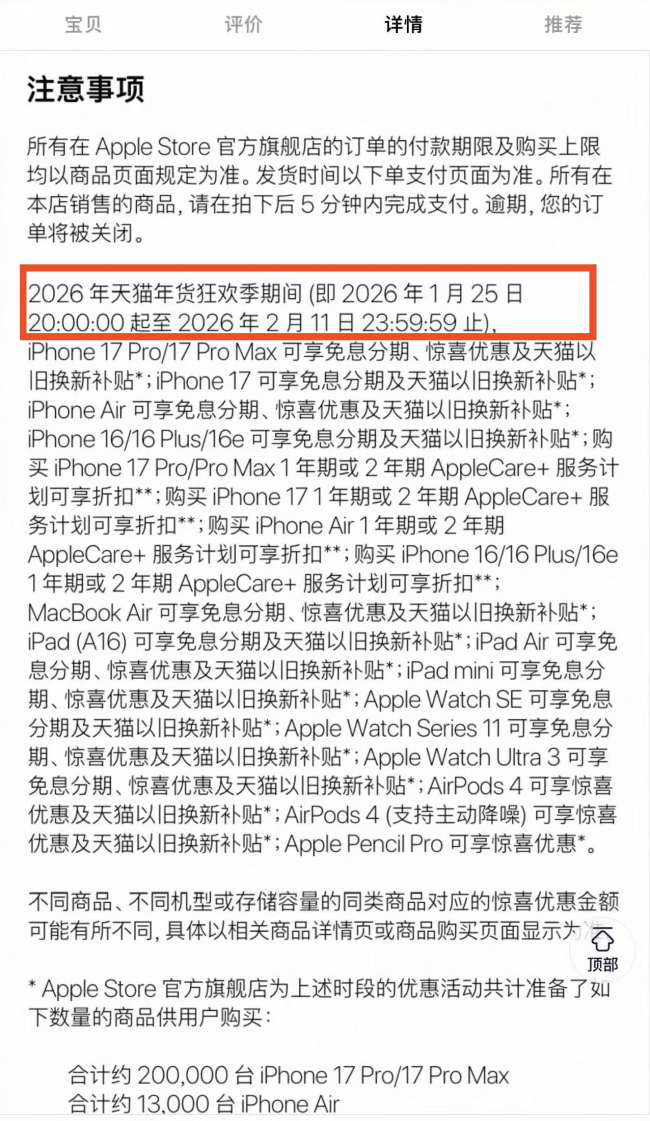
Group 1 - The core conclusion indicates that Tmall's New Year shopping festival ends on February 11, while JD.com remains operational during the Spring Festival, offering greater discounts [1][10] - Tmall's discounts for the iPhone 17 series are limited, with only a 300 yuan coupon available, and no discounts for the standard iPhone 17 model [3][4] - JD.com provides additional benefits such as trade-in coupons, with up to 1100 yuan off for the iPhone 17 Pro and 800 yuan for trade-ins on the iPhone 17 series, significantly enhancing the discount offerings [6][10] Group 2 - JD.com offers various promotional activities, including a chance to win an Apple Watch and iPhones through participation in events, enhancing customer engagement [8] - JD.com allows customers to access hidden coupons worth 320 yuan for specific iPhone purchases starting February 12, further increasing the attractiveness of their offers [8] - Overall, JD.com is positioned as the superior platform for purchasing Apple products, both in terms of discount strength and delivery capabilities during the Spring Festival [10]


情人节来京东抢1314元以旧换新券 购买指定iPhone到手更划算
Sou Hu Wang· 2026-02-12 09:19
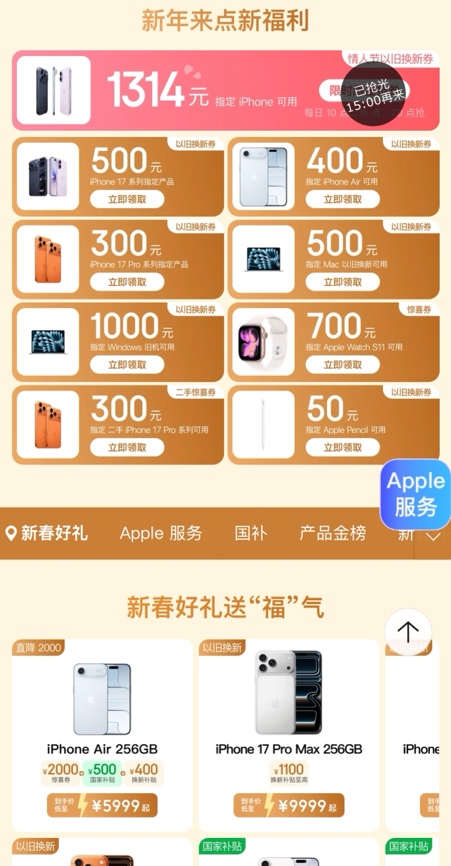
Core Insights - The upcoming Lunar New Year is driving consumer demand for Apple products, with JD.com enhancing its promotional offerings to attract customers [1][3] Group 1: Promotions and Discounts - JD.com is offering significant discounts on Apple products, including a 300 yuan reduction on the iPhone 17 Pro and up to 1100 yuan in trade-in subsidies [1] - Additional promotions include up to 2900 yuan off for iPhone Air through various coupons and trade-in offers, as well as an 85% discount on iCloud+ for customers [1] - A special "0 yuan trade-in" event for JD Plus users allows participants to potentially acquire an Apple Watch or new iPhone at no cost, with limited quantities available [3] Group 2: Competitive Advantage - JD.com’s coupon policies for iPhone products will remain valid until February 14, providing a longer decision-making window compared to Tmall, which ends its promotions on February 11 [5] - The company maintains its "Spring Festival does not close" policy, ensuring continuous customer service and logistics during the holiday period, which enhances user experience [5] - With exclusive benefits like the "0 yuan trade-in" and "hidden coupons," JD.com is positioned as the preferred platform for consumers looking to purchase Apple products during the festive season [5]
商务部四大举措引爆2026春节消费:以旧换新背后的经济密码
Sou Hu Cai Jing· 2026-02-12 08:41
补贴加码:真金白银刺激消费神经 春节9天长假(2月15日-23日)将成为消费黄金窗口。商务部明确规定,这期间购买新车、家电、数码产品的消费者均可享受政 策补贴。特别值得注意的是,政策特别强调"线下渠道优先",这实际上是对实体经济的定向输血。 还记得去年春节抢购新家电时的拥挤场面吗?2026年春节假期将延长至9天,商务部最新推出的以旧换新政策更是直接瞄准了你 的钱包!这不仅仅是一次简单的促销活动,而是一场撬动万亿级消费市场的国家行动。让我们揭开这份政策文件背后的深层逻 辑,看看国家如何用四记"组合拳"激活春节经济。 数据显示,2023年家电以旧换新拉动消费超3000亿元。而2026年春节叠加超长假期效应,仅汽车以旧换新一项就可能创造单周 消费峰值。政策制定者显然深谙——在国人最重要的节日里发放"消费红包",最能激发购物欲望。 农村攻坚:下沉市场的战略突围 文件特别强调要"增加农村地区线下政策参与主体",这一措辞暴露了政策的重要意图——激活下沉市场。通过推动线上渠道向 农村倾斜,政策制定者正在下一盘大棋。 据统计,农村家庭大家电平均使用年限超出城市2-3年,这意味着巨大的更新需求。春节期间农民工返乡潮带来的资金回 ...
大数据观察|年货包裹,映照消费活力
Ren Min Ri Bao· 2026-02-12 07:33
Core Viewpoint - The express delivery industry is experiencing a peak in business volume due to the "New Year goods" market, with significant growth in logistics and cross-border delivery services, enhancing consumer access to global products [1][4]. Group 1: Express Delivery Volume and Trends - From February 2 to February 8, the national express delivery volume reached approximately 4.686 billion packages, reflecting a month-on-month increase of 3.19%, with an average daily volume of nearly 670 million packages [1]. - The peak season for express delivery is driven by the demand for New Year goods, with a notable increase in the volume of imported fruits, particularly Chilean cherries, which saw an increase from 10,000 containers last year to over 17,000 containers this year [2][3]. Group 2: Cross-Border Logistics and Domestic Delivery - Efficient collaboration between cross-border logistics and domestic delivery has enabled a seamless flow of global products into consumers' New Year shopping lists, with significant increases in the import of seafood and flowers from countries like Bangladesh and Pakistan [4]. - The logistics network has been optimized to ensure rapid delivery, with "same-day delivery" becoming standard for major regions, and "next-day delivery" for others, thanks to advanced cold chain logistics [3][4]. Group 3: Regional Developments and Innovations - The western regions of China are increasingly integrated into the "free shipping zone," with a 35% year-on-year increase in the volume of ski-related equipment deliveries in Urumqi, Xinjiang [5][6]. - New logistics models, such as centralized shipping, have improved efficiency and reduced costs, with a 60% improvement in service time for deliveries to Xinjiang during the peak season [5]. Group 4: Consumer Electronics and Policy Support - The introduction of new subsidy policies has boosted the demand for electronic goods, with a 30% increase in orders for home appliances and a 68% increase in digital product orders in January [9][10]. - The total sales from the old-for-new appliance program reached 2.971 billion yuan, with 6.813 million home appliances exchanged, indicating a strong consumer response to the policy [9][10]. Group 5: Holiday Logistics and Service Continuity - During the Spring Festival, major express companies have committed to maintaining service continuity, ensuring that essential deliveries are met despite potential disruptions due to holiday travel and weather conditions [12]. - After the holiday, a rapid recovery in delivery service demand is expected, with companies preparing to restore operations to normal levels quickly [13].