
就业数据

Search documents
美联储年内再降息25个基点,专家:12月有望继续降
Sou Hu Cai Jing· 2025-10-30 12:08
Group 1 - The Federal Reserve announced a 25 basis point cut in the federal funds rate target range to 3.75% to 4.00%, marking the fifth rate cut since September 2024 [1] - Economic indicators show moderate expansion in the U.S. economy, with slowing job growth and a slight increase in the unemployment rate, while inflation remains high [1] - The decision for the rate cut is supported by a combination of lower-than-expected inflation and weak employment data, alongside increasing liquidity pressures in the money market [1][2] Group 2 - The poor performance of economic data, particularly employment figures, is cited as a primary reason for the Fed's rate cut [2] - Despite the lack of timely non-farm payroll data, a national economic survey indicated widespread low labor demand across various regions and industries [2] - Future rate cuts are anticipated, with expectations for another cut in December, but uncertainty remains due to potential political influences and inflationary pressures from tariffs [2][3] Group 3 - The increase in U.S. imports due to tariff policies has created inventory buffers that have mitigated inflation transmission to consumers [3] - As the effects of excessive imports fade, inflationary pressures may rise, potentially limiting the Fed's rate cut capacity in 2026 [3] - The current rate cut may have a weaker stimulative effect compared to previous cycles, partly due to diminished refinancing effects [3] Group 4 - The initiation of the Fed's rate cut cycle is expected to open up more operational space for China's monetary policy, potentially leading to further rate cuts and increased market liquidity [3]
ADP初步估计美国平均增加14,250个就业岗位
Hua Er Jie Jian Wen· 2025-10-28 12:21
Group 1 - The core point of the article is that ADP has estimated an average increase of 14,250 jobs in the U.S. [1] - ADP released preliminary job estimates for the four weeks ending October 11 [1] - ADP will continue to publish monthly employment reports and compensation insights [1] - ADP will also provide weekly preliminary job estimates [1]
Private sector created nearly 15,000 jobs a week over the past month, preliminary ADP data shows
CNBC· 2025-10-28 12:15
Core Insights - ADP reports an average addition of 14,250 jobs per week over the past four weeks, indicating a recovery from negative job growth in September [1][5] - The new data will provide a four-week average of weekly employment changes with a two-week lag, enhancing the understanding of labor market dynamics [2][3] - This preliminary data serves as a guide to the monthly National Employment Report (NER), which will be revised monthly [4][5] Employment Data Overview - The four-week moving average suggests a total monthly job growth of approximately 55,000, contrasting with a reported loss of 32,000 jobs in September [5] - ADP's near real-time employment data aims to deliver a more detailed and dynamic view of job creation and loss [3]
STARTRADER外汇:ADP停止供应,月底的政策会议决策越发困难
Sou Hu Cai Jing· 2025-10-24 02:29
Core Insights - The Federal Reserve is facing an unprecedented data shortage ahead of its policy meeting on October 28-29, primarily due to the ongoing government shutdown, which has hindered access to critical official economic statistics [1][3] - A significant third-party employment data source, ADP, has ceased supplying data to the Federal Reserve, further complicating the already unclear economic landscape in the U.S. [3] Group 1: Data Shortage Impact - The government shutdown has resulted in a lack of key economic statistics, making it difficult for policymakers to make informed decisions regarding monetary policy [1] - The interruption of ADP's data supply exacerbates the situation, as employment data is a core consideration for monetary policy [3] Group 2: ADP's Data Supply Suspension - ADP has stopped providing aggregated management data to the Federal Reserve, citing its commitment to public service and the need to protect client confidentiality [3] - Efforts by Federal Reserve Chairman Jerome Powell to persuade ADP to resume data sharing have not yet been successful [3] - Powell has previously indicated that while private data sources cannot fully replace official statistics, ADP serves as a reasonable alternative in the employment data sector [3]



10月23日白银晚评:“小非农”数据失去访问渠道 银价向上拉升
Jin Tou Wang· 2025-10-23 09:43
Core Insights - The current trading environment for silver shows significant volatility, with prices fluctuating between $47.88 and $49.31 per ounce, indicating a potential for both upward and downward movements in the near term [1][5]. Market Data - As of October 23, 2025, the latest prices for silver are as follows: - Spot silver: $49.26 per ounce - Silver T+D: ¥11,463 per kilogram - Paper silver: ¥11.288 per gram - Shanghai silver futures: ¥11,467 per kilogram [2]. Economic Analysis - The U.S. September CPI data is expected to show a growth rate similar to August, with energy prices rising by 0.7% in August and likely continuing to increase in September. Core CPI is projected to reach a monthly rate of 0.3%, rounding to 0.4%, with both overall and core CPI annual rates close to 3.0%, exceeding the Federal Reserve's target by one percentage point [3]. - The Federal Reserve has lost access to timely employment data from ADP, which has historically provided a comprehensive dataset covering 20% of the private sector workforce. This loss may impact the Fed's ability to gauge the labor market accurately [3][4]. Trading Strategy - Silver prices have shown slight upward movement due to stable support at $47.80, with bullish momentum indicated by the relative strength index. However, prices remain under negative pressure due to trading below the 50-day EMA, suggesting a potential for a sharp bearish correction in the short term [5]. - Key resistance levels for silver are identified at $50.00 and $49.00, while support levels are at $46.00 and $45.00 [5].
一文读懂美联储“内部格局”:年底前降息幅度?关键看鲍威尔和沃勒
Hua Er Jie Jian Wen· 2025-10-18 04:02
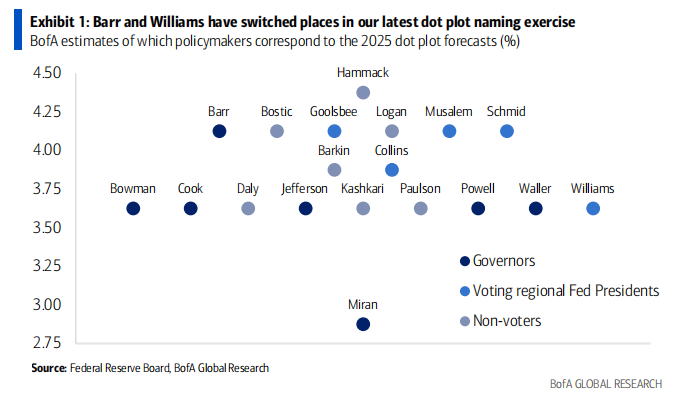
Core Viewpoint - There is a divergence within the Federal Reserve regarding future interest rate cuts, with the final decision heavily influenced by Chairman Powell and Governor Waller [1] Group 1: Powell's Position - Powell has reiterated a dovish stance, indicating a desire to cut rates in October and December, but emphasizes that decisions will depend on economic data [2] - He acknowledges strong GDP and spending data but remains cautious about labor market risks, suggesting that a decline in job vacancies could lead to higher unemployment [2] Group 2: Waller's Position - Waller, a dovish member of the FOMC, has shown signs of a subtle shift in his stance, expressing a desire to cut rates but also acknowledging the need to monitor strong GDP data against a weak labor market [3] - He recognizes that inflation, excluding tariffs, is around 2.5%, which may influence future rate decisions [3] Group 3: Divergence within the FOMC - The FOMC currently exhibits a clear divide, with the Board leaning dovish while regional Fed presidents tend to be more hawkish [4][5] - This division increases the risk of dissenting votes during potential rate cuts in October and December [7] Group 4: Market Predictions - Bank of America predicts a 25 basis point cut in October, followed by a pause in December, contingent on stable employment data and persistent inflation [8] - Upcoming economic reports on inflation and employment will be crucial in determining whether the Fed will proceed with rate cuts or adopt a more cautious approach [10]
Philadelphia Fed manufacturing reading much weaker than expected
Youtube· 2025-10-16 13:12
Core Insights - The Philadelphia Fed's October business outlook index reported a significant decline of minus 12.8%, marking the weakest performance since April when it was near minus 20, indicating ongoing softness in the manufacturing sector [2] Economic Indicators - The Consumer Price Index (CPI) showed a year-over-year increase of 2.9%, with a core CPI increase of 3.1%, suggesting persistent inflationary pressures [3] - The Producer Price Index (PPI) for August indicated a month-over-month decrease of 0.1% for final demand, with year-over-year figures moderating to 2.6% [4] - Retail sales have been robust, with August showing a 6% increase, July also at 6%, and June at 1%, while core retail sales increased by 7.1%, 5.1%, and 0.9% over the last three months [5][6] Labor Market Insights - The Federal Reserve faces challenges as inflation remains sticky, and there are concerns about a potential slowdown in the labor market, which may require more attention [7] - Initial jobless claims data has not shown significant deterioration, making it difficult to identify problems in the labor market despite some negative trends in other macroeconomic indicators [8]

美元暴跌的背后...
小Lin说· 2025-10-12 13:10
Market Trends and Industry Dynamics - The dollar index has fallen by over 10% since the beginning of the year, marking its worst performance in nearly half a century [1] - Global asset prices, including gold and cryptocurrencies like Bitcoin, have experienced a significant surge [1] - Global stock markets, including US, European, A-shares, Hong Kong, and Japanese stocks, have generally increased [1] - The correlation between the S&P 500 index and a "mysterious index" reached a high of 824% over the past 5 years [1] Investment Opportunities and Potential Risks - The primary driver of the dollar's decline is risk, particularly related to Trump's tariff policies and concerns about the US government's creditworthiness [1] - Foreign capital inflows into US stock ETFs have increasingly been hedged against dollar risk, with over 80% of funds now employing hedging strategies [1] - Gold has become a preferred safe-haven asset, with significant inflows into gold ETFs, especially from North America [2] - Market expectations of the Federal Reserve's interest rate decisions are heavily influencing the dollar's movements [2] US Economic Policy and Federal Reserve - The market is closely monitoring US non-farm payroll (NFP) data to anticipate the Federal Reserve's interest rate cuts [2] - There have been substantial revisions to the NFP data, raising concerns about its accuracy and reliability [3] - Trump's administration is attempting to influence the Federal Reserve's interest rate decisions, raising concerns about the central bank's independence [3][4] Global Economic Impact - A weaker dollar and potential Federal Reserve interest rate cuts are expected to benefit other countries, particularly developing nations [4] - Morgan Stanley predicts that the dollar may depreciate by approximately 10% to around 91 by the end of next year [4]

深夜!特朗普重大宣布,史上规模最大
Zheng Quan Shi Bao· 2025-10-04 14:49
Core Points - President Trump announced a major celebration for the U.S. Navy's 250th anniversary on October 5 in Norfolk, Virginia, despite the ongoing government shutdown [1][2] - The government shutdown, which began on October 1, has led to significant disruptions in various federal services, including consular services and data reporting by the Bureau of Labor Statistics [4][5] - The economic impact of the shutdown is estimated to reduce GDP growth by 0.1 to 0.2 percentage points for each week it continues, according to S&P Global Ratings [7] Group 1: Government Shutdown Impact - The U.S. government shutdown has resulted in the suspension of consular services and limited updates on the State Department's website [4] - The Bureau of Labor Statistics has halted the release of key employment data, affecting the assessment of economic conditions [5] - The Federal Communications Commission (FCC) placed 81% of its employees on leave, halting most of its operations, including consumer complaint handling [6] Group 2: Economic Outlook - The ongoing government shutdown is expected to create rising economic uncertainty, with potential implications for market sentiment [7] - The shutdown has already led to the closure of numerous national parks and iconic sites in Washington, D.C., due to staffing shortages and funding issues [6]
The Jobs Report That Wasn't Leaves Economists Guessing
Nytimes· 2025-10-03 09:03
Group 1 - Policymakers are facing challenges due to the government's shutdown, which is expected to withhold employment data [1]