市场流动性

Search documents
中航期货橡胶周度报告-20260109
Zhong Hang Qi Huo· 2026-01-09 11:10
1. Report Industry Investment Rating No relevant information provided. 2. Core Viewpoints of the Report - During the period from January 7 to January 13, 2026, the rainfall in the main natural rubber producing areas in Southeast Asia increased slightly compared to the previous period. The impact on rubber tapping work increased slightly in most areas north of the equator and decreased in most areas south of the equator [6]. - This week, the natural rubber futures market fluctuated strongly. Market liquidity and risk preference, as well as the cost support from raw materials, drove up the price, but the demand for downstream tires and finished - product inventory dragged down the upward slope. Although the price is currently at the upper edge of the range and technically pressured, the center of the market's oscillation is still expected to rise as long as the macro - sentiment persists [7]. - The 2026 automobile trade - in policy will benefit more consumers than in 2025, potentially boosting new car consumption [8]. - In December 2025, the wholesale volume of new - energy passenger vehicles was 1.57 million, a year - on - year increase of 4% and a month - on - month decrease of 8%. The cumulative wholesale volume in 2025 was 15.33 million, a year - on - year increase of 25% [8]. 3. Summary According to the Directory 3.1 Report Summary (PART 01) - The rainfall in the main natural rubber producing areas in Southeast Asia had different impacts on rubber tapping work in different regions during January 7 - 13, 2026 [6]. - The natural rubber futures market was bullish this week. Market liquidity, cost support from raw materials, and downstream tire demand had different effects on the price. The price was expected to rise further due to macro - sentiment [7]. - The 2026 automobile trade - in policy would benefit more consumers and potentially boost new car consumption. The new - energy passenger vehicle wholesale volume in December 2025 and the whole year had specific year - on - year and month - on - month changes [8]. 3.2 Multi - Empty Focus (PART 02) - **Bullish factors**: Strong demand for raw material replenishment overseas supported the price of natural rubber raw materials; the reduction of butadiene inventory pressure supported its price; market liquidity and risk preference increased [11]. - **Bearish factors**: The inventory of natural rubber was piling up slightly; the production and inventory of cis - butadiene rubber were high; the overall capacity utilization rate of tire enterprises was weakened by seasonal factors [11]. 3.3 Data Analysis (PART 03) - **Natural rubber raw material prices**: As of January 9, 2026, the prices of Thai glue and cup rubber, as well as those in Hainan and Yunnan in China, were stronger than before. The approaching of the off - season in domestic producing areas and overseas replenishment needs drove up the prices [12]. - **Natural rubber inventory**: As of January 4, 2026, China's natural rubber social inventory was 1.232 million tons, with a month - on - month increase of 2.5%. The inventory in Qingdao continued to pile up due to changes in inbound and outbound rates [15]. - **Butadiene and cis - butadiene rubber**: This week, the domestic butadiene price rose rapidly due to factors such as expected reduction in imports and strong downstream demand. The theoretical production profit of cis - butadiene rubber decreased. As of January 9, 2026, the production of cis - butadiene rubber was high and the inventory fluctuated at a high level [16][19]. - **Tire enterprises**: As of the week of January 9, the capacity utilization rates of all - steel and semi - steel tire sample enterprises decreased. The inventory depletion of all - steel tires was slightly better than that of semi - steel tires. The capacity utilization rate was expected to recover after the New Year's Day holiday but would decline seasonally during the Spring Festival [20]. - **Price differences between rubber contracts**: As of January 8, the price difference between the "RU - NR" main contracts was relatively stable, while the "NR - BR" main contract price difference narrowed, mainly affected by the stronger performance of butadiene prices [23]. 3.4后市研判 (PART 04) - Macro factors, natural rubber fundamentals, synthetic rubber fundamentals, and downstream tire demand had different impacts on the market. Market liquidity and raw material cost support were the main driving forces, while downstream demand and inventory were drag factors. The price was at the upper edge of the range, but the market's oscillation center was expected to rise as long as the macro - sentiment remained [26].
华泰期货流动性日报-20260108
Hua Tai Qi Huo· 2026-01-08 03:19
Report Industry Investment Rating - Not provided in the content Core View - The report presents the liquidity situation of various market sectors on January 7, 2026, including trading volume, holding amount, trading - holding ratio, and their changes compared to the previous trading day [1][2] Summary by Directory I. Plate Liquidity - There are figures showing the trading - holding ratio, trading volume change rate, holding volume, holding amount, trading volume, and trading amount of each plate [4][5][6][8] II. Stock Index Plate - On January 7, 2026, the trading volume was 714.879 billion yuan, a change of - 12.73% from the previous trading day; the holding amount was 1533.753 billion yuan, a change of - 1.29% from the previous trading day; the trading - holding ratio was 46.55% [1] - There are figures showing the price change rate, trading - holding ratio, precipitation fund change, precipitation fund trend, trading amount change, and the proportion trend of the net holding of the top 20 of each variety in the stock index plate [5][6] III. Treasury Bond Plate - On January 7, 2026, the trading volume was 444.794 billion yuan, a change of + 10.13% from the previous trading day; the holding amount was 800.752 billion yuan, a change of + 0.24% from the previous trading day; the trading - holding ratio was 53.60% [1] - There are figures showing the price change rate, trading - holding ratio, precipitation fund change, precipitation fund trend, trading amount change, and the proportion trend of the net holding of the top 20 of each variety in the treasury bond plate [5][6] IV. Basic Metals and Precious Metals (Metal Plate) - On January 7, 2026, the trading volume of the basic metals plate was 1387.83 billion yuan, a change of + 39.49% from the previous trading day; the holding amount was 823.199 billion yuan, a change of + 2.87% from the previous trading day; the trading - holding ratio was 190.62% - The trading volume of the precious metals plate was 1281.751 billion yuan, a change of + 13.47% from the previous trading day; the holding amount was 517.06 billion yuan, a change of + 0.82% from the previous trading day; the trading - holding ratio was 360.09% [1] - There are figures showing the price change rate, trading - holding ratio, precipitation fund change amount, precipitation fund trend, trading amount change rate, and the proportion trend of the net holding of the top 20 of each variety in the metal plate [5][6] V. Energy and Chemical Plate - On January 7, 2026, the trading volume was 644.806 billion yuan, a change of + 34.48% from the previous trading day; the holding amount was 457.013 billion yuan, a change of + 2.77% from the previous trading day; the trading - holding ratio was 134.23% [1] - There are figures showing the price change rate, trading - holding ratio, precipitation fund change amount, precipitation fund trend, trading amount change rate, and the proportion trend of the net holding of the top 20 of the main varieties in the energy and chemical plate [5][6] VI. Agricultural Products Plate - On January 7, 2026, the trading volume was 360.38 billion yuan, a change of + 34.90% from the previous trading day; the holding amount was 591.968 billion yuan, a change of + 4.11% from the previous trading day; the trading - holding ratio was 59.14% [1] - There are figures showing the price change rate, trading - holding ratio, precipitation fund change amount, precipitation fund trend, trading amount change rate, and the proportion trend of the net holding of the top 20 of the main varieties in the agricultural products plate [5][6] VII. Black Building Materials Plate - On January 7, 2026, the trading volume was 357.414 billion yuan, a change of + 82.50% from the previous trading day; the holding amount was 325.484 billion yuan, a change of + 8.12% from the previous trading day; the trading - holding ratio was 115.35% [2] - There are figures showing the price change rate, trading - holding ratio, precipitation fund change amount, precipitation fund trend, trading amount change rate, and the proportion trend of the net holding of the top 20 of each variety in the black building materials plate [5][6]
每日债市速递 | 央行公开市场单日净回笼2963亿
Sou Hu Cai Jing· 2026-01-07 13:24
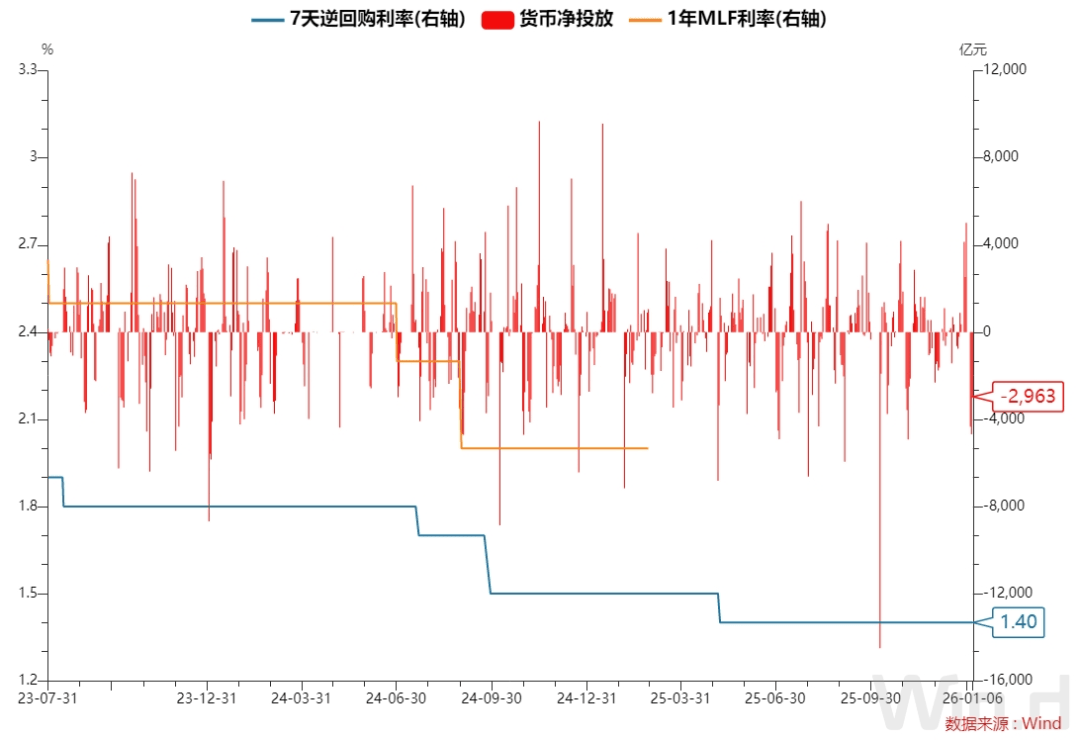
Monetary Policy - The central bank announced a reverse repurchase operation of 162 billion yuan for 7 days at a fixed rate of 1.40%, with a total bid and winning amount of 162 billion yuan [1] - On the same day, 312.5 billion yuan of reverse repos matured, resulting in a net withdrawal of 296.3 billion yuan [1] Market Liquidity - The interbank market liquidity remains loose, with the weighted average rate of DR001 slightly rising to around 1.26% [2] - Overnight quotes in the anonymous click (X-repo) system are abundant at 1.25%, while non-bank institutions' pledged certificates and credit bonds are quoted at 1.40%-1.45% [2] Bond Market - The latest transaction rate for one-year interbank certificates of deposit is around 1.63%, up more than 1 basis point from the previous day [8] - Major interbank bond yields have generally risen, with the 30-year futures contract down 0.31%, the 10-year down 0.13%, the 5-year down 0.11%, and the 2-year down 0.05% [10] International Context - The latest overnight financing rate in the U.S. is reported at 3.75% [4] Corporate Actions - China Gas Holdings Limited has initiated the issuance of two panda bonds, marking the first issuance for 2026 [12] - The panda bond market has rapidly expanded, with net financing in 2025 reaching a new high, pushing the total market size beyond 420 billion yuan [12]

华泰期货流动性日报-20260107
Hua Tai Qi Huo· 2026-01-07 05:21
Report Summary 1. Investment Rating - No investment rating information is provided in the report. 2. Core View - The report presents the liquidity data of various market sectors on January 6, 2026, including trading volume, holding amount, trading - holding ratio, and their changes compared to the previous trading day, to reflect the market liquidity status of different sectors. [1][2] 3. Summary by Directory I. Plate Liquidity - The report provides data on the trading - holding ratio, trading volume change rate, holding amount, etc. of multiple market sectors, and uses multiple figures to visually present these data. [1][2][8] II. Stock Index Plate - On January 6, 2026, the stock index plate had a trading volume of 819.195 billion yuan, a +15.16% change from the previous trading day; the holding amount was 1553.766 billion yuan, a +3.40% change; the trading - holding ratio was 53.15%. There are also figures showing the price change, trading - holding ratio, and other information of each variety in the stock index plate. [1][5] III. Treasury Bond Plate - The trading volume of the treasury bond plate was 403.894 billion yuan, a +10.01% change from the previous trading day; the holding amount was 798.811 billion yuan, a +1.50% change; the trading - holding ratio was 49.46%. There are figures for each variety's price change, trading - holding ratio, etc. [1][5] IV. Base Metals and Precious Metals (Metal Plate) - The base metals plate had a trading volume of 994.937 billion yuan, a +70.13% change from the previous trading day; the holding amount was 800.201 billion yuan, a +8.70% change; the trading - holding ratio was 129.44%. The precious metals plate had a trading volume of 1129.613 billion yuan, a +133.40% change; the holding amount was 512.831 billion yuan, a +5.74% change; the trading - holding ratio was 320.11%. There are figures for each variety's price change, trading - holding ratio, etc. [1][5] V. Energy and Chemical Plate - The trading volume of the energy and chemical plate was 479.474 billion yuan, a +30.85% change from the previous trading day; the holding amount was 444.680 billion yuan, a +3.90% change; the trading - holding ratio was 102.43%. There are figures for the main varieties' price change, trading - holding ratio, etc. [1][5] VI. Agricultural Products Plate - The trading volume of the agricultural products plate was 267.146 billion yuan, a - 0.58% change from the previous trading day; the holding amount was 568.582 billion yuan, a +2.69% change; the trading - holding ratio was 43.19%. There are figures for the main varieties' price change, trading - holding ratio, etc. [1][5] VII. Black Building Materials Plate - The trading volume of the black building materials plate was 195.838 billion yuan, a +35.29% change from the previous trading day; the holding amount was 301.052 billion yuan, a +0.98% change; the trading - holding ratio was 64.32%. There are figures for each variety's price change, trading - holding ratio, etc. [2][5]
央行的货币政策工具主要有哪些
Jin Tou Wang· 2026-01-06 03:46
Core Viewpoint - The central bank's monetary policy tools are categorized into general, selective, and unconventional tools, primarily aimed at regulating market liquidity, influencing interest rates, and subsequently controlling economic growth and inflation [1]. Group 1: General Monetary Policy Tools - These tools, known as the "three major weapons," affect the entire financial market, influencing overall credit scale and money supply [2]. - The reserve requirement ratio refers to the proportion of deposits that financial institutions must hold as reserves with the central bank. An increase in this ratio tightens market liquidity, while a decrease releases liquidity and lowers financing costs for businesses and households [3]. - The rediscount rate is the interest rate at which commercial banks can discount their bills with the central bank. An increase in this rate raises the financing costs for banks, leading them to tighten credit, while a decrease lowers costs and encourages lending [4]. - Open market operations involve the central bank buying and selling securities (such as government bonds) in the financial market to adjust money supply and market interest rates. Buying securities injects funds into the market, while selling them withdraws funds, thus tightening liquidity. This is the most commonly used and flexible monetary policy tool [5]. Group 2: Selective Monetary Policy Tools - These tools are more targeted, primarily regulating credit and funding flows in specific areas [6]. - Consumer credit control involves restrictions on down payment ratios and repayment terms for consumer installment purchases, thereby regulating the scale of consumer credit and influencing consumption demand [7]. - Securities market credit control adjusts the margin requirements for margin trading, controlling the scale of credit funds flowing into the securities market to prevent excessive speculation [8]. - Real estate credit control manages the down payment ratios and interest rates for real estate loans issued by financial institutions, regulating the flow of funds into the real estate market and stabilizing prices [9]. Group 3: Unconventional Monetary Policy Tools - These tools are employed when conventional tools become ineffective (e.g., when benchmark interest rates approach zero) to address special economic conditions [10]. - Quantitative easing (QE) involves the central bank purchasing large amounts of government bonds and mortgage-backed securities to inject liquidity into the market, lowering long-term interest rates and stimulating economic recovery. Conversely, quantitative tightening (QT) involves reducing or halting reinvestment in maturing bonds or directly selling assets to withdraw liquidity from the market and tighten money supply [11]. - Forward guidance is a strategy where the central bank publicly communicates the future direction of monetary policy (e.g., maintaining interest rates for a certain period) to guide market expectations and stabilize investment and consumption behaviors of economic entities [12].
华泰期货流动性日报-20260106
Hua Tai Qi Huo· 2026-01-06 02:27
Report Summary 1. Investment Rating - No investment rating information is provided in the report. 2. Core View - The report presents the market liquidity situation on January 5, 2026, including trading volume, holding amount, trading - holding ratio, and their changes compared to the previous trading day for different sectors such as stock index, treasury bond, basic metal, precious metal, energy - chemical, agricultural product, and black building materials [1][2]. 3. Summary by Directory I. Plate Liquidity - The report shows the trading volume, holding amount, and trading - holding ratio of various sectors on January 5, 2026, along with their changes compared to the previous trading day. The sectors include stock index, treasury bond, basic metal, precious metal, energy - chemical, agricultural product, and black building materials [1][2]. II. Stock Index Plate - On January 5, 2026, the trading volume of the stock index plate was 711.329 billion yuan, a +21.38% change from the previous trading day; the holding amount was 1502.686 billion yuan, a +7.49% change; the trading - holding ratio was 47.94% [1]. III. Treasury Bond Plate - On January 5, 2026, the trading volume of the treasury bond plate was 367.150 billion yuan, a - 9.95% change from the previous trading day; the holding amount was 786.980 billion yuan, a +1.35% change; the trading - holding ratio was 45.96% [1]. IV. Basic Metal and Precious Metal (Metal Plate) - On January 5, 2026, the trading volume of the basic metal plate was 584.817 billion yuan, a - 36.94% change from the previous trading day; the holding amount was 736.182 billion yuan, a +6.76% change; the trading - holding ratio was 88.15%. The trading volume of the precious metal plate was 483.987 billion yuan, a - 67.29% change; the holding amount was 485.009 billion yuan, a +0.53% change; the trading - holding ratio was 133.56% [1]. V. Energy - Chemical Plate - On January 5, 2026, the trading volume of the energy - chemical plate was 366.420 billion yuan, a +0.31% change from the previous trading day; the holding amount was 427.998 billion yuan, a +4.37% change; the trading - holding ratio was 82.22% [1]. VI. Agricultural Product Plate - On January 5, 2026, the trading volume of the agricultural product plate was 268.712 billion yuan, a +14.83% change from the previous trading day; the holding amount was 553.692 billion yuan, a +2.60% change; the trading - holding ratio was 42.04% [1]. VII. Black Building Materials Plate - On January 5, 2026, the trading volume of the black building materials plate was 144.749 billion yuan, a - 19.11% change from the previous trading day; the holding amount was 298.128 billion yuan, a +3.23% change; the trading - holding ratio was 47.99% [2].
铜铝周报:铜价强势,铝价补涨-20260105
Bao Cheng Qi Huo· 2026-01-05 11:26
Report Overview - **Report Title**: Copper and Aluminum Weekly Report - **Report Date**: January 5, 2026 - **Research Focus**: Copper and aluminum futures market analysis 1. Investment Rating - No investment rating is provided in the report. 2. Core Views - **Copper**: After the holiday, copper prices showed little fluctuation. Post - holiday, attention should be paid to the long - short game at the 100,000 mark. In December, the monetary policies of the Federal Reserve and the Bank of Japan were implemented, market liquidity recovered, and capital risk appetite was high. Macro factors drove copper prices up, while the industry followed passively, with the basis and monthly spreads showing weak performance. Although the short - term upward momentum of copper prices is strong, they are at a historical high. The domestic industrial pressure (high inventory, weak consumption) contradicts the strong macro expectations. Short - term futures prices may need to consolidate through fluctuations and wait for the industry to catch up [5]. - **Aluminum**: With the strong performance of copper prices, aluminum prices are making up for lost ground. Attention should be paid to the support of the 5 - day moving average. In December, aluminum prices broke through the 22,000 mark and approached 23,000, mainly benefiting from the sector effect brought by the continuous rise of copper prices and the increasing expectation of aluminum replacing copper in home appliances. Before the holiday, the copper - aluminum ratio declined from a high level, and the short - term make - up increase of aluminum prices was obvious. At the industrial level, the basis and monthly spreads remained weak, and the social inventory of electrolytic aluminum increased significantly. Although the short - term upward momentum of aluminum prices is limited, as long as copper prices remain strong, aluminum prices may continue to make up for lost ground [6]. 3. Directory Summary 3.1 Macro Factors - During the double - holiday period last week, both domestic and foreign funds had a strong willingness to take profits, causing copper prices to decline from a high level. Additionally, the continuous rise of the US dollar index put pressure on copper prices [10]. 3.2 Copper 3.2.1 Quantity and Price Trends - No specific analysis of quantity and price trends is provided other than the graphical data presentation, including copper futures price trends, copper Shanghai - London ratio, and other relevant indicators [13][17][18]. 3.2.2 Copper Mine Shortage - On January 2, 2026, a strike began at the Mantoverde copper - gold mine in Chile, owned 70% by Capstone Copper and 30% by Mitsubishi Materials. About half of the workers participated in the strike. The mine is expected to produce 29,000 - 32,000 tons of copper in 2025. During the strike, production will drop to 30% of the normal level, potentially tightening the global copper supply. Copper prices soared 42% in 2025, and this event may put upward pressure on copper prices in early 2026 [25]. 3.2.3 Electrolytic Copper Inventory Accumulation - On December 31, 2025, the Mysteel social inventory of electrolytic copper was 247,100 tons, a weekly increase of 44,900 tons. The COMEX + LME inventory was 645,500 tons, a weekly increase of 5,500 tons. The continuous rise of short - term copper prices significantly suppressed downstream consumption, leading to an increase in inventory [27]. 3.2.4 Downstream Initial - stage Industry - SMM estimated that the total output of the copper rod industry in December would decline by 45,000 tons month - on - month to 1 million tons. In terms of the operating rate, the operating rate of electrolytic copper rod enterprises was 65.07%, a month - on - month decrease of 1.58 percentage points and a year - on - year decrease of 7.53 percentage points. The operating rate of recycled copper rod enterprises was 19.61%, a month - on - month decrease of 4.23 percentage points and a year - on - year decrease of 16.73 percentage points [29]. 3.3 Aluminum 3.3.1 Quantity and Price Trends - Similar to copper, no in - depth analysis of quantity and price trends is provided other than graphical data, including aluminum price trends, aluminum Shanghai - London ratio, and other relevant indicators [33][41][34]. 3.3.2 Upstream Industry Chain - On December 31, 2025, the port inventory of bauxite was 26.0207 million tons, a decrease of 59,300 tons from the previous week and an increase of 8.2107 million tons compared with the same period in 2024. Before the holiday, alumina prices rebounded significantly. It is believed that the macro - economic recovery drove its rebound from a low level. Its price elasticity is greater than that of electrolytic aluminum, which may lead to a decline in the profit of electrolytic aluminum plants from a high level [43][44]. 3.3.3 Electrolytic Aluminum Inventory - On December 29, 2025, the Mysteel social inventory of electrolytic aluminum was 638,000 tons, an increase of 26,000 tons from the previous week. On December 31, the overseas electrolytic aluminum inventory was 515,500 tons, a decrease of 12,000 tons from the previous week. Last week, the overseas and domestic electrolytic aluminum inventories showed a divergence. The low - level depletion of overseas electrolytic aluminum inventory provided support for aluminum prices [48]. 3.3.4 Downstream Initial - stage Industry - Last week, the processing fee of aluminum rods continued to decline with fluctuations. As aluminum prices rose to the 23,000 level, downstream buyers showed obvious fear of high prices, and the operating rate may continue to decline. On January 1, 2026, the aluminum rod inventory was 99,000 tons, an increase of 3,000 tons from the previous week [51][55]. 3.4 Conclusion - **Copper**: The conclusion is consistent with the core view, emphasizing the impact of macro factors on copper prices, the contradiction between industrial pressure and macro expectations, and the need to focus on the long - short game at the 100,000 mark [56]. - **Aluminum**: The conclusion is also in line with the core view, highlighting the make - up increase of aluminum prices due to the strong performance of copper prices, the weak industrial basis and monthly spreads, and the need to focus on the support of the 5 - day moving average [56].
宝城期货贵金属有色早报(2026年1月5日)-20260105
Bao Cheng Qi Huo· 2026-01-05 01:27
宝城期货贵金属有色早报(2026 年 1 月 5 日) ◼ 品种观点参考 时间周期说明:短期为一周以内、中期为两周至一月 投资咨询业务资格:证监许可【2011】1778 号 | 品种 | | 短期 | 中期 | 日内 | 观点参考 | 核心逻辑概要 | | --- | --- | --- | --- | --- | --- | --- | | 黄金 | 2602 | 震荡 | 强势 | 震荡 偏强 | 观望 | 流动性恢复及地缘冲突利好金价 | | 铜 | 2602 | 震荡 | 强势 | 震荡 偏强 | 观望 | 流动性恢复叠加产业强预期推升 铜价 | 说明: 1.有夜盘的品种以夜盘收盘价为起始价格,无夜盘的品种以昨日收盘价为起始价格,当日日盘收盘价为终点价格, 计算涨跌幅度。 2.跌幅大于 1%为弱势,跌幅 0~1%为震荡偏弱,涨幅 0~1%为震荡偏强,涨幅大于 1%为强势。 3.震荡偏强/偏弱只针对日内观点,短期和中期不做区分。 主要品种价格行情驱动逻辑—商品期货 品种:黄金(AU) 日内观点:震荡偏强 中期观点:强势 参考观点:观望 品种:铜(CU) 核心逻辑:元旦节前,多头资金获利了结导致贵金属整体 ...
贵金属市场周报-20251231
Rui Da Qi Huo· 2025-12-31 09:05
瑞达期货研究院 「2025.12. 31」 贵金属市场周报 作者: 研究员 廖宏斌 期货投资咨询证号:Z0020723 助理研究员 徐鼎烽 期货从业资格号:F03144963 业务咨询 添加客服 关 注 我 们 获 取 更 多 资 讯 目录 1、周度要点小结 2、期现市场 3、产业供需情况 4、宏观及期权 「 周度要点小结」 来源:瑞达期货研究院 3 ◆ 本周观点:本周贵金属市场高位波动显著加剧,白银价格因集中获利了结情绪而大幅回调,下跌外 溢影响亦传导至其他贵金属及部分有色金属品种,虽然周三盘中价格逐步企稳并有所反弹,整体波 动幅度明显放大,多空博弈加剧。宏观方面,美联储12月会议纪要显示,FOMC官员降息立场分歧加 剧。在本次会议下调利率区间后,可能需要在一段时间内保持目标利率区间不变。若通胀逐步下降, 大多数官员支持进一步降息。前期的非农就业报告以及CPI通胀数据弱于预期,提振市场对于2026年 美联储展开两次以上降息的预期。此外,准备金余额已经下降到充足的水平,美联储或重启扩表以 保证充足的准备金供应,提振市场流动性预期。在流动性趋于宽松且降息预期仍存的背景下,贵金 属中期看多逻辑尚未发生明显松动,中 ...
突发暴跌!贵金属市场全线跳水
Zheng Quan Shi Bao· 2025-12-31 06:00
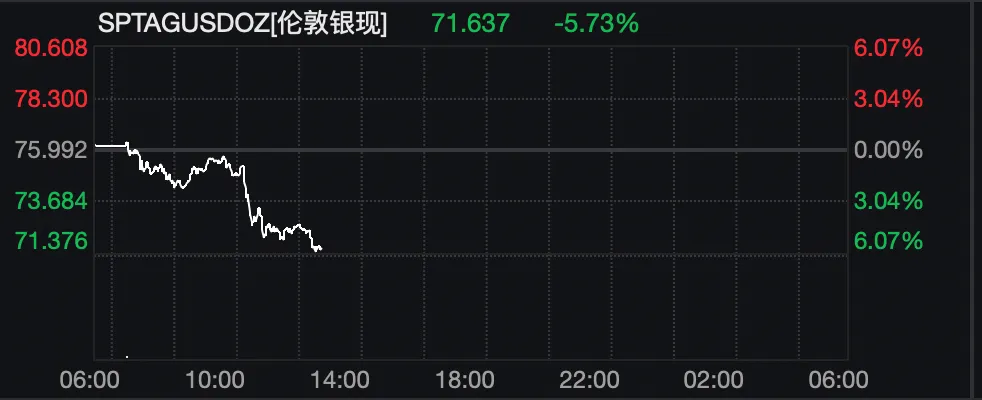
Core Viewpoint - The international precious metals market experienced significant declines, with various metals such as silver, platinum, and palladium seeing sharp drops in prices [1][5]. Group 1: Market Performance - On December 29, precious metals faced a severe downturn, with COMEX gold futures dropping by 4.45%, COMEX silver futures plummeting by 7.2%, spot gold falling over 4%, spot silver crashing over 9%, spot palladium declining over 15%, and spot platinum decreasing over 14% [5]. - The following day, December 30, the market saw a general rebound, with COMEX gold futures rising by 0.2%, spot gold increasing by 0.17%, COMEX silver futures gaining 7.88%, spot silver up by 5.66%, and NYMEX platinum futures rising by 4% [5]. Group 2: Future Outlook - UBS warned that the rapid increase in precious metal prices is largely due to insufficient market liquidity, indicating a potential for a swift decline [5]. - Analysts from Capital Economics stated that the current prices of precious metals have risen to levels that are difficult to justify based on fundamentals, predicting that silver prices may drop to around $42 per ounce by the end of next year [5]. - Huolong Futures noted that silver is currently outperforming gold, with greater short-term volatility and amplitude. They cautioned that the ongoing bullish trend in silver may be entering a "frenzy stage," advising ordinary investors against hasty participation [5].