汽车出口

Search documents
2025车企目标达成率透视:巨头稳健、新势力分化,新能源与出口双引擎驱动
Ju Chao Zi Xun· 2026-01-09 10:11
Core Insights - The Chinese automotive market has undergone significant changes in 2025, moving away from broad high growth to a more structured competitive landscape, with increasing penetration of new energy vehicles (NEVs) and a shift in the importance of overseas markets from a strategic option to a core pillar for survival and development [2] Group 1: Annual Goals and Performance - BYD demonstrated strong resilience, achieving a sales target of 460.24 million units, which is a 100.05% target achievement rate after a pragmatic adjustment from an initial goal of 550 million units [3] - Other traditional automakers like Geely (302.46 million units), SAIC Motor (450.75 million units), and Chery (280.64 million units) also met or closely approached their annual targets, indicating stability during their transformation [3] - In contrast, Li Auto's sales of 40.63 million units fell significantly short of its adjusted target of 64 million units, achieving only about 58% of its goal, highlighting challenges in product iteration and market expansion [5] Group 2: Growth Dynamics - The growth drivers for the automotive industry are clearly identified as internal growth in the NEV sector and expansion into overseas markets [9] - BYD maintained its leading position in the NEV market with sales of 460.24 million units, while new entrants like Leap Motor and Xpeng Motors achieved impressive growth rates of 103.13% and 125.88%, respectively [10] - Traditional automakers like Chery and Geely have made positive strides in transitioning to NEVs, but companies like Dongfeng and GAC face significant growth pressures due to slower transitions [12] Group 3: Export Performance - Exports have become a critical variable in determining industry rankings, with BYD's exports skyrocketing from 416,000 units in 2024 to 1,046,000 units in 2025, a growth of over 150% [12] - Chery led exports with 1,344,000 units, while SAIC Motor also surpassed 1,070,000 units in overseas sales, contributing to a total export of 4,386,800 units among the top five Chinese automakers [12] - Tesla's export growth in China was weak, with only 222,700 units exported from January to November 2025, indicating increasing competition from local brands in the international market [13] Group 4: Future Outlook - The market performance in 2025 indicates a shift from relying solely on domestic market growth to a comprehensive capability competition among automakers [15] - Strategic resilience and operational rationality are crucial, with companies like BYD successfully adjusting targets based on market feedback, while others like Xiaomi and Leap Motor are breaking through by precisely targeting niche markets [15] - The competition has evolved from mere sales volume expansion to a comprehensive comparison of technological depth, product ecosystem breadth, user operation precision, and sustainable profitability [16]


上汽通用东岳基地整车出口突破100万辆
Qi Lu Wan Bao· 2026-01-09 08:45
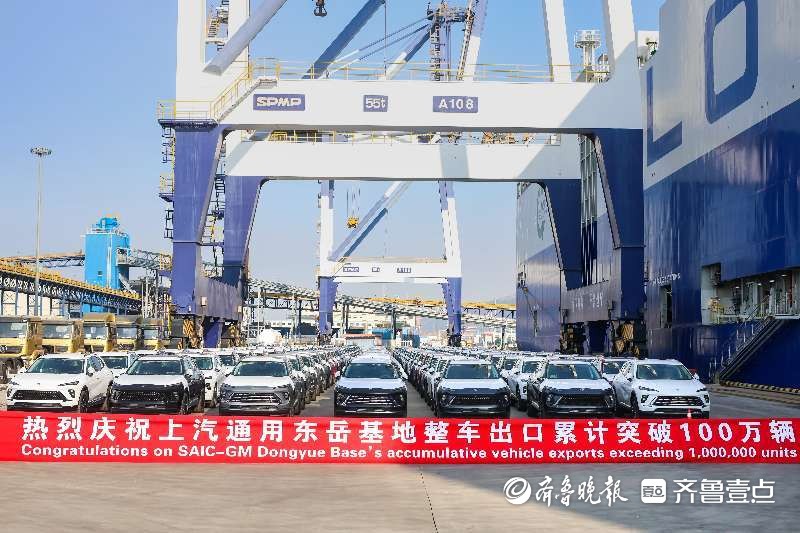
Core Insights - The Dongyue base of SAIC-GM has officially produced its one millionth export vehicle, marking a significant milestone in its 20-year journey of exporting vehicles [1][3] - The total production of vehicles at the Dongyue base has reached over 6.5 million units, with the cumulative output of the North Plant at 3.5 million units [1] Group 1 - The first export of a Chevrolet vehicle to Chile in 2006 initiated the record for car exports from Shandong province, establishing a foundation for "Yantai-made" vehicles to enter international markets [3] - The Buick Envision's export in 2015 further expanded the Dongyue base's international presence, with the vehicle's tenth anniversary of export planned for 2025 [3] - The Dongyue base's export achievements are a crucial part of SAIC-GM's overseas strategy and serve as a testament to the strength of the Yantai manufacturing brand [3]
乘联分会:12月全国乘用车市场零售226.1万辆 同比下降14.0%
智通财经网· 2026-01-09 08:31
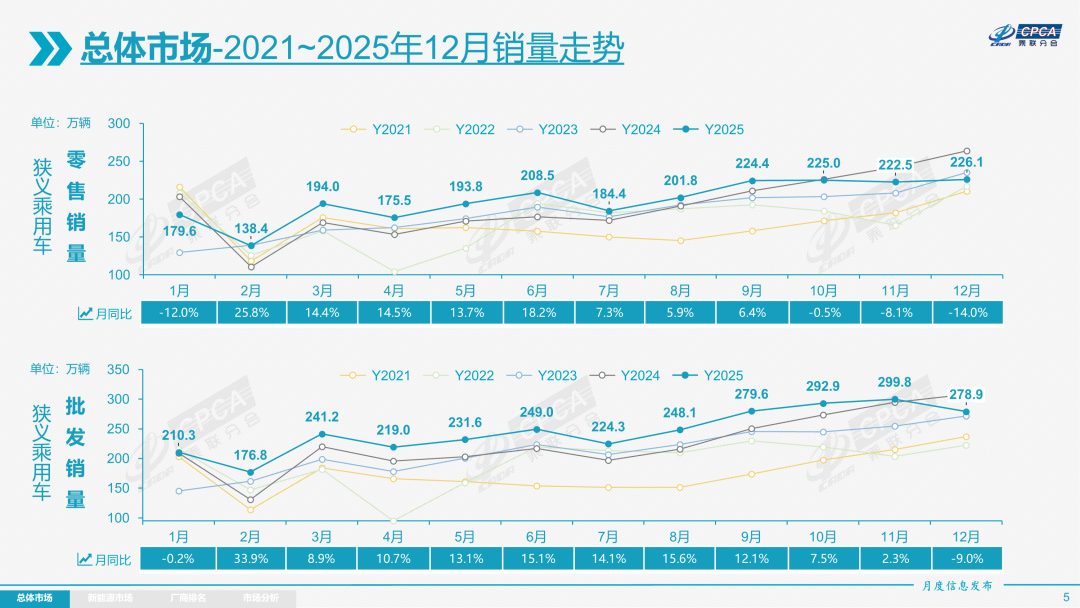
Core Insights - The overall retail sales of passenger cars in December 2025 reached 2.261 million units, a year-on-year decrease of 14.0% but a month-on-month increase of 1.6% [1] - Cumulative retail sales for the year amounted to 23.744 million units, reflecting a year-on-year growth of 3.8% [1] - The wholesale growth rate for passenger cars in 2025 is projected at 8.8%, with new energy vehicles (NEVs) expected to grow at 25.2%, meeting the growth expectations set for the "14th Five-Year Plan" [1] Market Performance - December's passenger car retail sales showed a significant decline in fuel vehicles, down 30% year-on-year, while pure electric vehicle sales increased by 2.5% [2] - The penetration rate of new energy vehicles in December reached 59.1%, indicating a shift towards a "new energy-dominated" market [2][11] - The retail share of domestic brands in December was 64.3%, a year-on-year increase of 2.2 percentage points [3] Production and Wholesale - Passenger car production in December was 2.791 million units, a year-on-year decrease of 4.6% [4] - December's wholesale volume for passenger cars was 2.789 million units, down 9.0% year-on-year [5] - The production of new energy vehicles in December reached 1.560 million units, a year-on-year increase of 7.6% [7] Export Trends - In December, the export of passenger cars (including complete vehicles and CKD) was 588,000 units, a year-on-year increase of 46.2% [4] - New energy vehicles accounted for 46.4% of total exports in December, up 15.6 percentage points from the previous year [4][13] - Cumulative exports of new energy vehicles for the year reached 2.422 million units, a growth of 86.2% [7] Inventory and Market Dynamics - The overall inventory in December decreased by 60,000 units, indicating proactive inventory reduction by manufacturers [6] - The market is experiencing a significant adjustment in consumer sentiment due to changes in trade-in policies and the expiration of tax exemptions for new energy vehicles [1][2] - The competitive landscape is shifting, with traditional manufacturers like Geely, Changan, and Great Wall showing improved market shares [3] Future Outlook - The January 2026 market is expected to benefit from a favorable production and sales environment, with a focus on the upcoming Spring Festival driving consumer demand [18] - The implementation of new policies aimed at promoting vehicle upgrades and trade-ins is anticipated to support market stability and growth in early 2026 [20] - The overall passenger car market is projected to maintain a stable trajectory, with a forecasted wholesale growth of 1% for 2026 [20]





2026年汽车行业总投资策略:坚定“破旧立新”(附下载)
Xin Lang Cai Jing· 2026-01-05 11:45
Group 1: Passenger Vehicle Market Outlook - The overall expectation for the passenger vehicle market in 2026 is a decline of 3.5% in domestic demand due to the 5% new energy vehicle purchase tax [1][6] - As of October 22, 2025, over 10 million applications for vehicle trade-in have been submitted, with over 340 million scrapped and 660 million replaced, resulting in a total subsidy expenditure of 140 billion yuan [1][6] - The new energy vehicle purchase tax will be reinstated at a reduced rate of 5% from January 1, 2026, with a maximum tax exemption of 15,000 yuan per vehicle [1][6] Group 2: Smart Driving Technology - In 2026, the penetration rate of urban NOA (Navigation on Autopilot) in new energy vehicles is expected to rise to 40% [2][7] - The market share of chip suppliers is projected to change, with Nvidia's share decreasing to 45%, Tesla at 15%, Huawei at 25%, and other domestic suppliers at 15% [2][7] Group 3: Heavy Truck Market Forecast - The wholesale sales of heavy trucks are expected to reach 1.16 million units in a neutral scenario, reflecting a year-on-year increase of 1.5%, while domestic sales are projected to decline by 5.5% [3][8] - In an optimistic scenario, wholesale sales could reach 1.25 million units, with domestic sales increasing by 2.7% [3][8] Group 4: Heavy Truck Export Outlook - The export of heavy trucks is expected to accelerate in 2026 as the impact from Russia diminishes, with significant growth anticipated in Southeast Asia, Africa, and the Middle East driven by local infrastructure and mining demands [4][9] - The conservative estimate for exports in 2026 includes a year-on-year increase of 20% for Asia, 30% for Africa, and 40% for the Middle East [4][9] Group 5: Globalization Strategy for Passenger Vehicles - The selection of automotive companies for investment should focus on those with high export ratios and established overseas production capacity, particularly those like Chery, Great Wall, and BYD [10] - Companies with a dual strategy of BEV (Battery Electric Vehicle) and PHEV (Plug-in Hybrid Electric Vehicle) are better positioned for sustained market access and growth [10]
宏观数据|2025年11月我国汽车整车出口情况简析
中汽协会数据· 2026-01-04 07:35
Core Insights - In November 2025, the export of complete vehicles reached 818,000 units, showing a month-on-month decrease of 1.2% but a year-on-year increase of 49.2% [1] - The export value for the same month was $13.87 billion, reflecting a month-on-month decline of 3.1% and a year-on-year increase of 53% [1] - From January to November 2025, the total export of complete vehicles amounted to 7.331 million units, representing a year-on-year growth of 25.7% [1] - The total export value during this period reached $125.32 billion, which is a year-on-year increase of 16.7% [1]

中国对委内瑞拉汽车出口增130%,中国制造的汽车在拉美地区需求旺盛
Xin Lang Cai Jing· 2026-01-04 07:25
乘联分会秘书长崔东树提供的数据显示,2025年1~11月,中国对委内瑞拉出口的汽车达到了17099辆, 增速130%。其中,乘用车出口了10201辆,增速166%;货车出口1481辆,增速99%。此前,据商务部网 站公开信息,2024年10月委《银行与商业报》曾报道,江淮汽车委内瑞拉公司总裁冈萨雷斯表示,预计 2024年委新车市场销量约1.7万至1.8万辆,2025年有望升至3万辆,同比增长70%。长安汽车委内瑞拉经 销商罗贝托还表示,当时长安在委乘用车新车市场居第三名,预计2025年在委销量增至2500辆,同比增 长15%~20%。网站信息还显示,江淮品牌在当时占委新车市场的份额约27%,主要车型是皮卡和卡 车,95%的江淮汽车在委本地组装,月组装能力约500台。(第一财经) ...
奇瑞集团2025年实现四大历史突破 营收规模与全球影响力双提升
Zhong Zheng Wang· 2026-01-02 08:21
据悉,销量方面,奇瑞集团全年销售汽车280.64万辆,全球累计用户达1853万。其中,奇瑞汽车股份有 限公司全年销量263.14万辆,同比增长8%。旗下乘用车品牌多点开花,奇瑞品牌销量170.09万辆,捷途 品牌62.26万辆,星途、iCAR、智界品牌分别实现12.04万辆、9.70万辆、9.05万辆的销量成绩。 中证报中证网讯(记者 龚梦泽)2025年,面对汽车行业变革与市场多重挑战,奇瑞集团凭借强劲的战 略韧性与技术积淀,实现销量、出口、新能源、品质表现四大领域历史新高。 出口表现尤为亮眼。公司表示,2025年12月,奇瑞单月出口14.44万辆,同比增长46.8%,首次突破14万 辆;全年出口134.40万辆,同比增长17.4%,累计出口达585万辆,创下中国车企单月出口、年出口、累 计出口三项纪录,连续23年位居中国品牌乘用车出口第一。在欧洲市场,奇瑞通过本土化生产布局,已 进入15个国家,星途系列车型获欧洲五星安全评级,纵横G700等高端产品成功登陆迪拜等全球高端市 场。 公司表示,新能源业务增速迅猛,全年销售90.38万辆,同比增长54.9%,产销规模稳居行业前列。多款 爆款产品表现突出,风云A9L ...
奇瑞在越南汽车市场发起攻势
日经中文网· 2026-01-02 00:33
Core Viewpoint - Chery Automobile is entering the Vietnamese market in 2024, opting for a cooperative approach rather than direct competition with local EV leader VinFast, which currently holds about 30% market share [2][9]. Group 1: Investment and Production Plans - Chery plans to establish a factory in Vietnam's Hai Duong Province with a total investment of approximately $800 million, focusing on producing its main brand "Omoda" and other models [4]. - The initial production capacity of the new factory is set to be between 30,000 to 60,000 vehicles per year, with expectations to increase to 200,000 by 2030 [4]. - The factory is strategically located about two hours from Hanoi and near the major export port of Haiphong, allowing for potential exports to Southeast Asia and Europe [6]. Group 2: Sales and Market Strategy - Chery aims to enhance its sales operations in Vietnam, targeting over 10,000 vehicle sales by 2026 and increasing its dealership network from approximately 40 to 75 [6]. - The current offerings include plug-in hybrid vehicles (PHVs) and gasoline cars, with plans to introduce pure electric vehicles (EVs) and hybrid vehicles (HVs) by 2026 [6]. - Chery has a history of exporting vehicles, having sold over 13 million cars in more than 100 countries, but is entering the Vietnamese market later than competitors [8]. Group 3: Competitive Landscape - The Vietnamese new car market saw over 500,000 vehicle sales from January to November 2025, with VinFast selling 147,450 EVs, showcasing its strong presence [8]. - Chery is exploring potential collaborations with VinFast, including shared EV charging infrastructure, to attract consumer demand without direct competition [9]. - As Chinese automakers like BYD and Geely also plan to enter the Vietnamese market, the competitive environment is expected to intensify, prompting Japanese automakers to possibly adjust their strategies [9].


中国车企欧洲市场逆势扩张 电动化领域份额创新高
Huan Qiu Wang· 2026-01-01 00:47
Group 1 - Chinese automakers, led by MG, BYD, and Chery, are expected to surpass 200,000 new car sales in the UK by 2025, potentially capturing 10% of the local market share [2] - In Spain and Norway, 10% of new car sales come from Chinese brands, while the average in Western Europe is 6% [2] - China's leading position in the global electric vehicle industry is attributed to its dominance in the lithium-ion battery supply chain, which has driven the growth of Chinese car sales [2] Group 2 - Despite facing EU tariff pressures, Chinese automakers are expected to maintain strong expansion momentum in the European market by 2025, with a projected market share of 12.8% in the electric vehicle sector [2] - In the rapidly growing hybrid vehicle segment, Chinese brands have surpassed a 13% market share across the EU, EFTA countries, and the UK [2] - Chinese car manufacturers are adopting flexible strategies to counter the impact of additional tariffs, absorbing some costs while shifting focus to unaffected areas like hybrid models and non-EU markets [2] Group 3 - Brands such as BYD and SAIC, along with new entrants like Chery and Leap Motor, are intensifying their efforts in the European market by 2025 [3] - Leap Motor's electric vehicle sales in Europe have surged over 4000% by October 2025, supported by a joint venture with Stellantis NV [3] - Chery's Omoda brand has seen a 1100% increase in electric vehicle sales during the same period [3]


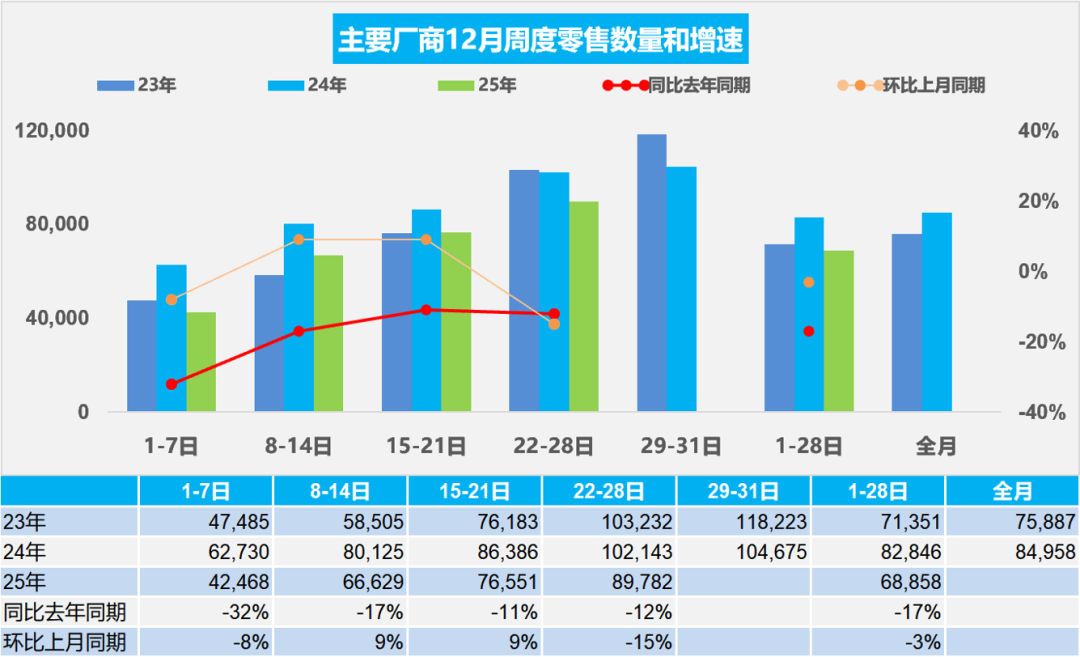
乘联分会:12月1-28日全国乘用车市场零售192.8万辆 同比下降17%
智通财经网· 2025-12-31 08:54
智通财经APP获悉,12月31日,乘联分会发布周度分析指出,12月1-28日,全国乘用车市场零售192.8万辆,同比去年12月同期下降17%,较上月同期下降 3%,今年以来累计零售2,341.1万辆,同比增长4%;12月1-28日,全国乘用车厂商批发213.4万辆,同比去年12月同期下降19%,较上月同期下降19%,今年 以来累计批发2,889.9万辆,同比增长8%。 12月1-28日,全国乘用车新能源车市场零售119.2万辆,同比去年12月同期增长5%,较上月同期增长1%,今年以来累计零售1,266.4万辆,同比增长18%; 12月1-28日,全国乘用车厂商新能源批发126.1万辆,同比去年12月同期下降4%,较上月同期下降16%,今年以来累计批发1,501.7万辆,同比增长25%。 2025年12月全国乘用车市场零售销量走势 | | 1-7日 | 8-14日 | 15-21日 | 22-28日 | 29-31日 | 1-28日 | 全目 | | --- | --- | --- | --- | --- | --- | --- | --- | | 23年 | 47.485 | 58,505 | 76.183 ...