
流动性管理

Search documents
中国人民银行重启14天期逆回购 护航资金面平稳跨年
Zheng Quan Ri Bao· 2025-12-18 15:41
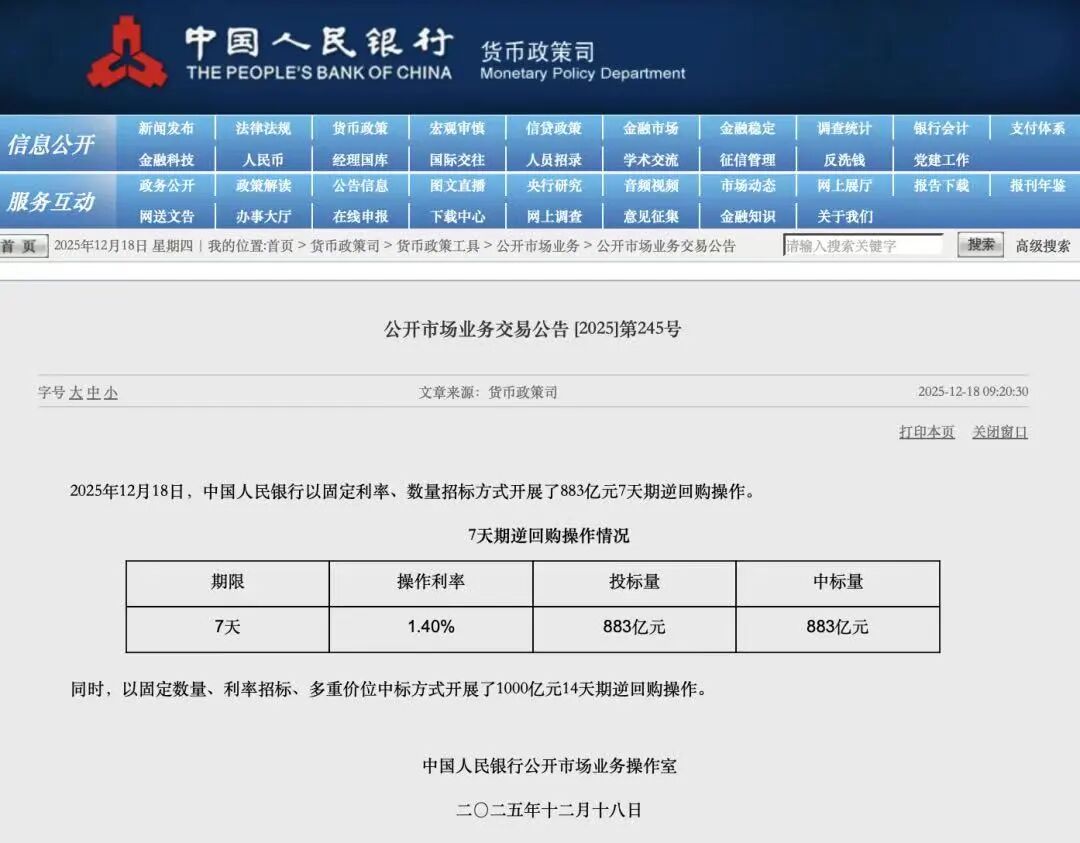
Core Viewpoint - The People's Bank of China (PBOC) is actively managing liquidity in the banking system through reverse repurchase agreements, with a focus on maintaining stability amid year-end financial pressures [1][2]. Group 1: Reverse Repo Operations - On December 18, the PBOC conducted a 7-day reverse repo operation of 883 billion yuan at a fixed rate of 1.4%, while also initiating a 14-day reverse repo operation of 1,000 billion yuan [1]. - The net liquidity injection from these operations amounted to 697 billion yuan, considering the maturity of 1,186 billion yuan in 7-day reverse repos on the same day [1]. - The PBOC's adjustment of the 14-day reverse repo operation to a fixed quantity and multi-price bidding method aims to better meet the differentiated funding needs of various institutions [1]. Group 2: Market Stability and Expectations - The PBOC's actions are seen as a response to increased liquidity disturbances due to year-end bank assessments, fiscal expenditures, and cash withdrawals by residents [1][2]. - The maintenance of the 7-day reverse repo rate at 1.4% signals a commitment to stable policy rates, which is beneficial for market expectations [2]. - The simultaneous execution of both 7-day and 14-day reverse repos is intended to satisfy year-end funding demands while preventing excessive liquidity accumulation, reflecting the forward-looking and scientific nature of monetary policy [2]. Group 3: Future Liquidity Management - From December 19 to December 25, a total of 5,218 billion yuan in reverse repos will mature, along with 3,000 billion yuan in Medium-term Lending Facility (MLF) maturing on December 25 [2]. - The PBOC is expected to continue utilizing 7-day and 14-day reverse repos to effectively control short-term liquidity fluctuations [2]. - There are expectations for the PBOC to conduct additional long-term liquidity injections through government bond transactions, potentially increasing the net injection scale beyond the 50 billion yuan seen in November [2].
调控年末流动性 时隔三个月央行重启14天逆回购
Sou Hu Cai Jing· 2025-12-18 14:56
Core Viewpoint - The People's Bank of China (PBOC) has resumed the 14-day reverse repurchase agreement tool to manage liquidity, injecting a total of 883 billion yuan through 7-day reverse repos and 1,000 billion yuan through 14-day reverse repos, while maintaining a rate of 1.40% [1][2]. Group 1: Market Liquidity Management - The PBOC's actions are aimed at stabilizing market liquidity as year-end approaches, addressing increased liquidity disturbances due to bank assessments, fiscal expenditures, and cash withdrawals [2][3]. - The central bank's simultaneous operation of both 7-day and 14-day reverse repos indicates a flexible approach to meet year-end liquidity demands while preventing excessive liquidity accumulation [2][4]. - The current market liquidity is relatively ample, as evidenced by the DR001 rate stabilizing around 1.27%, reflecting the PBOC's efforts to counter potential tightening risks [1][3]. Group 2: Interest Rate Trends - The overnight funding rate (DR001) has shown a downward trend, with recent averages below 1.3%, indicating a shift from the previous stable low rate environment [5]. - The weighted average rates for DR007 have remained above policy rates, suggesting ongoing liquidity management by the PBOC [5]. - The SHIBOR rates have also shown mixed movements, with the overnight SHIBOR decreasing slightly while the 14-day SHIBOR increased, reflecting varying liquidity conditions [5]. Group 3: Future Outlook - Analysts predict that the PBOC will continue to utilize both 7-day and 14-day reverse repos to effectively manage short-term liquidity fluctuations as the year-end approaches [4][6]. - The central bank is expected to maintain a "wide monetary" stance, utilizing various policy tools such as reserve requirement ratio cuts and interest rate reductions to support economic stability [7]. - The focus of monetary policy will remain on creating a stable financial environment for the real economy, ensuring that liquidity tools effectively smooth short-term volatility and guide reasonable interest rates [7].
央行时隔三个月重启14天逆回购
第一财经· 2025-12-18 09:31
2025.12. 18 本文字数:1966,阅读时长大约3分钟 熨平资金面波动 在中标方式调整后,央行于12月开展第三次14天期逆回购。9月19日,央行曾公告称,公开市场14 天期逆回购操作调整为固定数量、利率招标、多重价位中标,操作时间和规模将根据流动性管理需要 确定。此后,央行分别于9月22日、26日开展3000亿元、6000亿元14天期逆回购。 "年末临近,央行按惯例在这一时点开启14天期逆回购,主要是因为年末前后银行考核、财政收支、 居民提现等流动性扰动因素增多。"东方金诚首席宏观分析师王青表示,此举可以有效熨平资金面波 动,引导市场流动性处于较为稳定的充裕状态,这有助于稳定市场预期,畅通货币政策传导。此次操 作规模为1000亿元,主要是根据金融机构资金需求和市场流动性调控目标确定,属于适度水平。 作者 | 第一财经 杜川 国家金融与发展实验室特聘高级研究员庞溟表示,央行同时开展7天与14天逆回购,显示出在期限结 构上的灵活安排,既满足跨年资金需求,又防止流动性过度累积。14天期逆回购操作直接覆盖元旦 假期的资金需求,可以看出央行意在通过适度的流动性注入,平衡流动性供需、稳定市场预期,维护 年末资金面 ...


调控年末流动性,时隔三个月央行重启14天逆回购
Di Yi Cai Jing· 2025-12-18 08:24
Core Viewpoint - The central bank is expected to increase the volume of Medium-term Lending Facility (MLF) and conduct a certain scale of government bond transactions in December to inject medium- and long-term liquidity into the market [1][7]. Group 1: Market Liquidity Management - The central bank resumed the 14-day reverse repurchase agreement after three months, conducting operations of 883 billion yuan for 7-day and 1,000 billion yuan for 14-day reverse repos on December 18, maintaining the interest rate at 1.40% [1]. - The market's focus on potential tightening of liquidity has increased, with the overnight repo rate (DR001) stabilizing around 1.27% after briefly dropping below 1.3% [1][5]. - Analysts believe that the central bank's continuous liquidity injections are aimed at countering potential tightening risks, resulting in a relatively loose liquidity environment [1][3]. Group 2: Year-End Liquidity Dynamics - As the year-end approaches, the central bank's actions are influenced by increased liquidity disturbances due to factors like bank assessments, fiscal revenue, and resident withdrawals [2][3]. - The central bank's operations are designed to smooth out liquidity fluctuations and maintain a stable market environment, with the 14-day reverse repo directly addressing the funding needs over the New Year holiday [2][4]. - The central bank is expected to continue using both 7-day and 14-day reverse repos to effectively control short-term liquidity fluctuations [4]. Group 3: Interest Rate Trends - The overnight funding rate has shown a downward trend, with DR001 averaging below 1.3% recently, indicating a shift from the previous stable low rate environment [5]. - The weighted average rates for DR007 have remained above the policy interest rate, reflecting ongoing liquidity management efforts [5]. - The SHIBOR rates for overnight and 7-day terms have decreased, while the 14-day SHIBOR has increased, indicating mixed signals in the short-term funding market [5]. Group 4: Future Outlook - Analysts predict that the central bank will continue to utilize various liquidity tools to enhance the precision and effectiveness of liquidity management as the year-end approaches [6][7]. - The central bank's focus will remain on creating a stable financial environment for the real economy, ensuring that liquidity tools effectively smooth short-term fluctuations and guide reasonable interest rates [7].
1000亿元!央行开展14天期逆回购操作
Jin Rong Shi Bao· 2025-12-18 08:01
Core Viewpoint - The People's Bank of China (PBOC) has conducted a total of 883 billion yuan 7-day reverse repos at a fixed rate of 1.40% and 1,000 billion yuan 14-day reverse repos to manage liquidity ahead of year-end financial assessments and cash withdrawal demands [1][5]. Group 1: Reverse Repo Operations - The PBOC executed 883 billion yuan in 7-day reverse repos, maintaining the interest rate at 1.40% [1][4]. - A 1,000 billion yuan 14-day reverse repo operation was also conducted, which is slightly above the average scale of previous years [5]. - The simultaneous execution of both 7-day and 14-day reverse repos indicates a flexible approach to managing liquidity across different time frames [5]. Group 2: Market Liquidity Management - The 14-day reverse repo is aimed at smoothing out liquidity fluctuations and ensuring a stable and ample market liquidity environment as year-end approaches [5]. - Analysts expect the PBOC to utilize various liquidity management tools to enhance the precision and effectiveness of short- to medium-term liquidity management [6]. - The focus of monetary policy remains on creating a stable financial environment for the real economy, ensuring that liquidity tools effectively stabilize short-term fluctuations and guide reasonable interest rates [6].
呵护年末流动性,央行时隔近三个月重启14天期逆回购操作
Sou Hu Cai Jing· 2025-12-18 03:02
Core Viewpoint - The People's Bank of China (PBOC) has resumed 14-day reverse repos for the first time in nearly three months, signaling a flexible and efficient monetary policy aimed at balancing liquidity supply and demand, and stabilizing market expectations [1] Group 1: Monetary Policy Actions - On December 18, the PBOC conducted a 7-day reverse repo operation of 883 billion yuan and a 14-day reverse repo operation of 1 trillion yuan [1] - The simultaneous execution of both 7-day and 14-day reverse repos indicates a flexible arrangement in terms of maturity structure [1] Group 2: Market Implications - The PBOC's actions are intended to address temporary liquidity gaps in the banking system caused by cash injections and fiscal revenue and expenditure factors, while avoiding potential issues such as fund idling and rising leverage [1] - The focus of monetary policy will remain on creating a stable and suitable financial environment for the real economy, ensuring ample liquidity while effectively guiding funds into key areas and weak links of the national economy [1]
美国银行郭琳:AI重塑支付业务 技术部署出发点是“以人为本”
2 1 Shi Ji Jing Ji Bao Dao· 2025-12-17 05:53
Core Viewpoint - Artificial intelligence (AI) is reshaping the payment business by enhancing efficiency, security, and customer experience, with a human-centered approach as the foundation for technology deployment [1][4]. Group 1: Investment in Technology - The company invests $13 billion annually in technology, with approximately $4 billion allocated to emerging technologies like AI this year [1][6]. - AI applications have been implemented on a large scale across various domains, including AI agents, search summaries, content generation, and operational code generation [4][5]. Group 2: Trade Growth and Payment Requirements - The Asia-Pacific region has seen rapid trade growth, with nearly 60% of the region's exports going to other global markets, driven by Chinese enterprises expanding overseas and multinational companies entering China [2]. - There is an increasing demand for real-time control of fund flows, seamless cross-border payments, and flexible supply chain financing from Chinese companies going abroad [2][3]. Group 3: Solutions for Corporate Needs - The company has introduced a "Guaranteed Exchange Rate" solution to simplify foreign exchange risk management, allowing businesses to lock in exchange rates for up to one year [3]. - AI-driven tools like CashPro Forecasting help clients predict future cash positions, addressing challenges in cash flow management amid global market volatility [5]. Group 4: Future of Payment Industry - Innovation is expected to reshape the future landscape of global payments, with AI being a crucial engine for transformation [7]. - The company emphasizes the importance of scaling technology applications and enhancing customer experience through collaboration and innovation [7][8]. Group 5: Local Market Innovations - In China, the company has established a solid business foundation, offering integrated solutions that combine global and local elements [8]. - The introduction of the Corporate Payment Undertaking (CPU) model modernizes traditional supply chain finance, facilitating a paperless process and optimizing working capital for suppliers [8].

钱来啦!今天,央行大动作!
Sou Hu Cai Jing· 2025-12-16 06:47
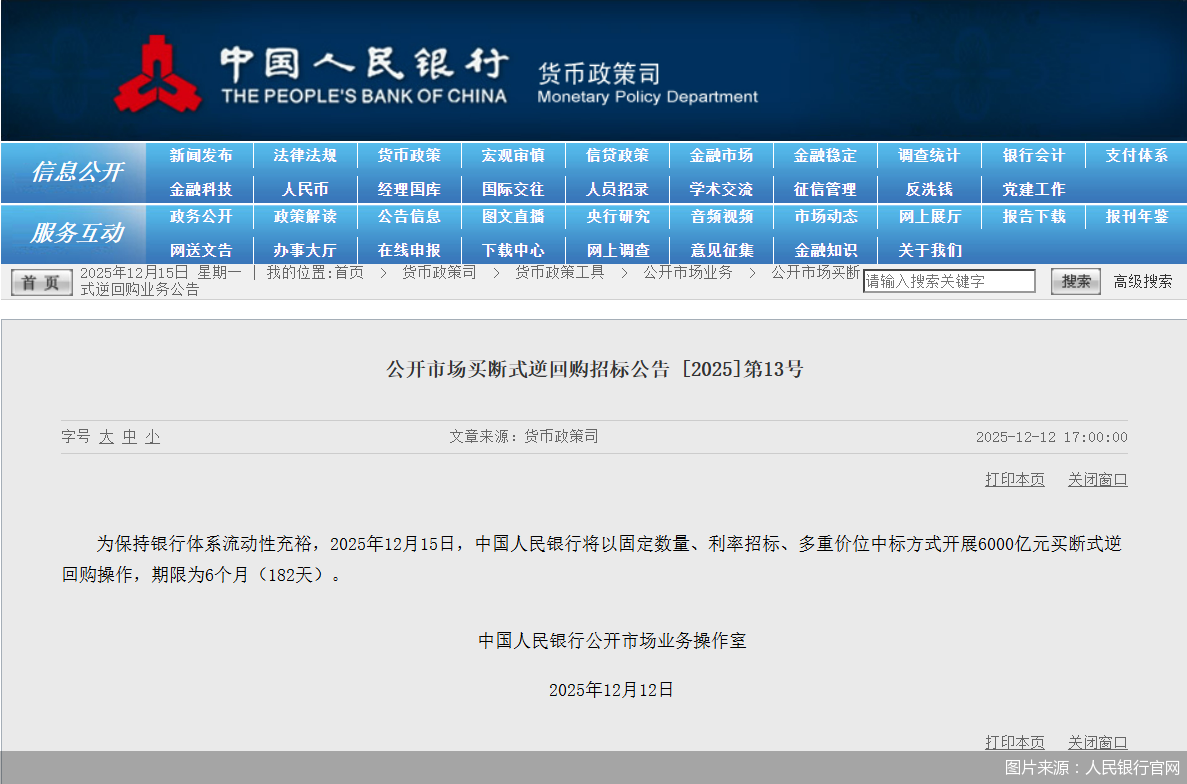
在中国国际经济交流中心主办的"2025—2026中国经济年会"上,中央财办分管日常工作的副主任、中央 农办主任韩文秀表示, 明年将根据形势变化出台实施增量政策,要协同发挥存量政策和增量政策集成 效应,推动经济稳中向好。要优化支出结构,强化国家重大战略的财力保障,推动更多资金资源投资于 人,统筹用好政府债券资金,更加注重惠民生、扩内需、增后劲。 业内人士表示,央行已经建立起一套流动性管理工具组合拳,可通过各种工具的配合使用,有效应对财 政税收、政府债券发行等短期波动,货币市场运行整体平稳,短端货币市场利率围绕政策利率中枢小幅 波动,银行体系流动性保持充裕。近期我国在工具创新上力度比较大,比如将国债买卖纳入货币政策工 具箱,创设两项支持资本市场的货币政策工具等,这些都将进一步提升我国流动性管理的效果。 来源丨中国商报微信综合自人民网、第一财经、中国财经报、中国基金报 封面丨CNSPHOTO 责编丨周巾然 白雅琦 付颢琬 为保持银行体系流动性充裕,12月15日, 央行以固定数量、利率招标、多重价位中标方式开展6000亿 元买断式逆回购操作,期限为6个月(182天)。分析人士认为,这一加量续作的操作,意在向市场注入 ...
人民银行加量续作6000亿元买断式逆回购,流动性支持持续加码
Bei Jing Shang Bao· 2025-12-15 14:07
北京商报讯(记者 岳品瑜 实习生 岳雯艳)为保持银行体系流动性充裕,2025年12月15日,人民银行以固定数量、利率招标、多重价位中标方式开展6000亿 元买断式逆回购操作,期限为6个月(182天)。从资金供需情况看,12月有4000亿元6个月期买断式逆回购到期,本次操作实现加量规模2000亿元,这也是6 个月期买断式逆回购连续第四个月实现加量续作。 | 信息公开 | | 新闻发布 | 法律法规 | 货币政策 | 宏观审慎 | 信贷政策 | 金融市场 | 金融稳定 | 调查统计 | 银行会计 | | | --- | --- | --- | --- | --- | --- | --- | --- | --- | --- | --- | --- | | | | 金融科技 | 人民币 | 经理国库 | 国际交往 | 人员招录 | 学术交流 | 征信管理 | 反洗钱 | 党建工作 | | | 服务互动 | | 政务公开 | 政策解读 | 公告信息 | 图文直播 | 央行研究 | 音频视频 | 市场动态 | 网上展厅 | 报告下载 | | | | | 网送文告 | 办事大厅 | 在线申报 | 下载中心 | 网上调查 | ...
策略周报:留意外部扰动,耐心伺机布局-20251214
East Money Securities· 2025-12-14 09:10
Group 1 - The report highlights a divergence in market performance between A-shares and Hong Kong stocks, with A-shares showing resilience due to positive signals from the Central Economic Work Conference, while Hong Kong stocks are pressured by weak earnings expectations and rising US Treasury yields [7][18][21] - The report notes that despite the Federal Reserve's interest rate cut, US Treasury yields have recently increased, indicating that the liquidity environment may not be as favorable as expected, which could affect market risk appetite [9][14][19] - The upcoming "super data week" is crucial for validating the effectiveness of the Fed's easing policies and assessing inflation risks, with November CPI and employment data being particularly significant [19][20] Group 2 - The report anticipates that the Bank of Japan will likely resume its interest rate hike cycle, which could lead to concerns about capital outflows and increased volatility in the market, although the impact is expected to be manageable due to prior market pricing [20][21] - The report suggests that the upcoming spring market rally is likely, driven by improved micro liquidity and risk appetite, with a focus on technology and cyclical sectors [25][29] - Investment recommendations include maintaining a core position in financial sectors with stable earnings and high dividend yields, while gradually shifting towards sectors with reasonable valuations and clear industry trends, particularly in the AI chain, renewable energy, and innovative pharmaceuticals [25][26][29]