
消费增长

Search documents
加拿大央行:预计在当前的关税下,二季度GDP萎缩1.5%,三季度GDP增长1%。预计三季通胀率为1.8%,核心通胀率为3.1%。在新贸易环境下,预计加拿大下半年出口有望”企稳”。人口增长乏力及投资疲软将制约加拿大下半年经济表现。2025年下半年及2026年消费增长或持续温和。
news flash· 2025-07-30 13:55
预计三季通胀率为1.8%,核心通胀率为3.1%。 加拿大央行:预计在当前的关税下,二季度GDP萎缩1.5%,三季度GDP增长1%。 人口增长乏力及投资疲软将制约加拿大下半年经济表现。 2025年下半年及2026年消费增长或持续温和。 在新贸易环境下,预计加拿大下半年出口有望"企稳"。 ...
连平:当下亟需出台更有力度的针对性举措
和讯· 2025-07-18 09:47
Group 1 - The overall economic performance in China is stable with improvements in exports and consumption growth, while facing challenges from the real estate market and external uncertainties [1][2] - The real estate market remains a significant negative factor for economic performance, with sales declining over 10% year-on-year in major cities and liquidity pressures on developers [3][4][5] - Real estate investment is expected to fluctuate around -10%, contributing to a decline in nominal GDP growth by 0.75 percentage points [5][6] Group 2 - Private investment growth is weak, with a continuous decline in fixed asset investment since 2023, primarily due to the downturn in the real estate market [6][7] - Structural issues, including market access restrictions and increased regulatory scrutiny, are contributing to the low enthusiasm for private investment [6][7] - Consumer spending may face challenges due to potential resource shortages in policy support and a conservative consumption attitude among residents [7][8] Group 3 - Export performance is under pressure from U.S. tariffs and trade barriers, particularly affecting labor-intensive industries [8][9] - Domestic demand remains weak, leading to structural deflationary pressures, with CPI and PPI showing declines [10][11] - Local government finances are strained due to declining land sales and high debt repayment pressures, limiting infrastructure investment capabilities [11][12] Group 4 - Monetary policy needs to improve coordination with fiscal policy to effectively support economic growth [12][13] - There is a need for targeted measures to support the real estate sector and enhance liquidity for developers [14][15] - Increased support for private enterprises and consumer spending is essential to stimulate economic activity [16][17] Group 5 - Recommendations include expanding fiscal support for trade enterprises and enhancing capital market stability through various financial tools [20][21][22] - The government should implement measures to alleviate the financial burden on local governments and improve their investment capabilities [23][24] - A proactive monetary policy approach is necessary to address deflationary pressures and stabilize the economy [24][25]


中国经济稳增长,还将如何发力
Zhong Guo Jing Ji Wang· 2025-07-17 23:25
Group 1 - The core viewpoint is that China's economy showed resilience in the first half of the year, achieving a growth rate of 5.3%, and is expected to maintain a stable and positive development trend in the second half [1][2] - The external environment is undergoing significant changes, with increased geopolitical tensions and weakened global economic growth, impacting China's economic transition from old to new growth drivers [1] - Consumer spending is highlighted as a key area of growth, with retail sales reaching 24.55 trillion yuan, a year-on-year increase of 5% [1] Group 2 - Experts indicate that while there are supports for stable growth and high-quality development in the second half, uncertainties in the external environment and domestic demand issues remain significant challenges [2] - Recommendations for policy design include preparing growth-oriented policies, accelerating the implementation of reform policies, deepening open policies particularly in the service sector, and strengthening stability policies related to employment and livelihood [2]
让“夜经济”成为消费增长的持久动能
Zheng Quan Ri Bao· 2025-07-13 16:14
Group 1 - The night economy is experiencing robust growth, with various cities launching themed activities to stimulate nighttime consumption, such as the "2025 Unnight Chongqing Life Festival" and the "2025 Night Life Festival" in Shanghai, featuring over 200 and 130 themed events respectively [1] - Cities are exploring the integration of the night economy with cultural tourism, technology, and sports, which has led to increased local consumption and tourism, making it a significant driver of domestic demand [1] - Despite the current growth, there is still untapped potential in the night economy, and further efforts in cultural empowerment and business innovation are needed to sustain its momentum [1] Group 2 - Enhancing the "cultural added value" of the night economy is crucial, with successful examples like the Dunhuang night market in Gansu and the "Datang Unnight City" in Xi'an showcasing local cultural integration [2] - Utilizing technology to drive business innovation and enrich nighttime consumption experiences, such as immersive night tours using AR/VR, is essential for future development [3] - Strengthening policy guidance and establishing a multi-departmental collaborative mechanism will promote the standardized development of the night economy, including optimizing transportation and safety measures [3]
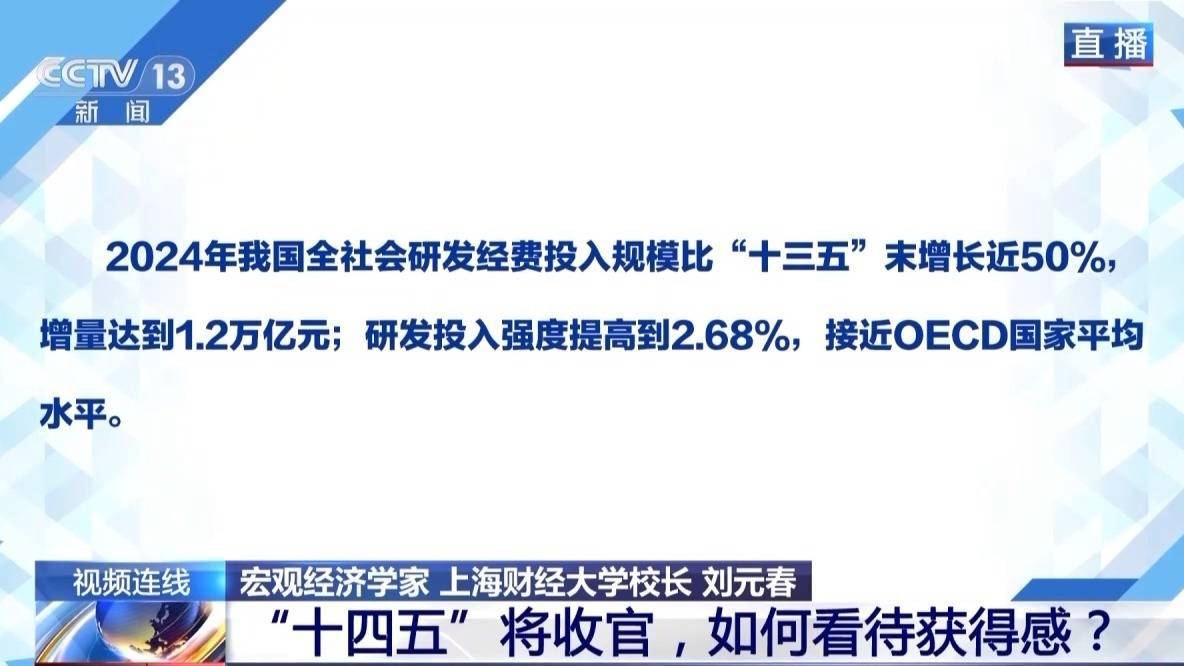
“十四五”将收官 获得感如何再升级?
Sou Hu Cai Jing· 2025-07-10 00:01
Group 1 - The average economic growth rate in China during the first four years of the 14th Five-Year Plan reached 5.5% [1] - China's R&D investment intensity has surpassed the EU average, currently at 2.68% of GDP, indicating a significant advancement in the innovation system [2][4] - A new innovation-driven development model has emerged in China, characterized by a large-scale market system fostering substantial innovation [5] Group 2 - To achieve new consumption growth, it is essential to stabilize income growth, which includes wages, property income, transfer income, and business income [8] - There is a need for a comprehensive plan to stabilize public expectations regarding current and future income [8] - Significant breakthroughs in demand structure, particularly in service consumption, are necessary for new growth points [8] Group 3 - There is a discrepancy between macroeconomic data and micro-level perceptions of growth, with different demographics experiencing varying levels of economic benefit [9] - To enhance the sense of gain among marginal groups, overall reform plans should be implemented to increase the proportion of the middle class and significantly boost social security spending [11]
日本央行审议委员高田创:预计消费将继续温和增长。
news flash· 2025-07-03 01:42
Core Viewpoint - The Bank of Japan's policy board member Takeda Soichi anticipates that consumer spending will continue to grow moderately [1] Group 1 - The expectation of moderate growth in consumer spending suggests a stable economic environment, which may influence investment strategies in consumer-related sectors [1]
经济日报:聚焦关键巩固消费增长势头
news flash· 2025-06-26 22:34
Core Insights - The article emphasizes the need to expand consumer demand and release consumption potential while acknowledging current achievements [1] Group 1: Consumer Development - To consolidate the positive trend in consumption, focus should be on key factors that drive consumption development [1] - Collaborative efforts are needed in enhancing consumption capacity, improving consumption conditions, innovating consumption scenarios, and optimizing the consumption environment [1] - These actions are essential for making consumption play a greater role in enhancing the internal dynamics and reliability of the domestic economic cycle [1]
野村陆挺: 多方式提振消费 培育长期动能
Zhong Guo Zheng Quan Bao· 2025-06-26 20:30
Core Viewpoint - The "trade-in" policy has significantly boosted China's retail sector in the first half of the year, with May retail data showing unexpected growth, particularly in home appliances [1][2]. Group 1: Retail Sector Performance - In May, China's total retail sales reached 4.13 trillion yuan, a year-on-year increase of 6.4%, marking the fastest monthly growth rate in 2024 [2]. - Retail sales of home appliances grew by over 50% year-on-year in May, indicating strong consumer demand driven by the trade-in policy [1][2]. - The trade-in policy has been identified as a key driver of consumption growth, with specific categories like home appliances, communication equipment, and furniture showing significant increases of 53.0%, 33.0%, and 25.6% respectively [2]. Group 2: Economic Outlook and Policy Recommendations - The economic outlook for the next few months remains positive, supported by the release of prior export orders and the ongoing impact of the trade-in policy on consumption [6]. - Recommendations for stimulating consumption growth include enhancing wealth and income through policies aimed at stabilizing the real estate and stock markets, as well as reforming social security and welfare systems [2][6]. - The need to create new consumption scenarios is emphasized, with examples like the Jiangsu province's city football league driving local economic activity in tourism, dining, and accommodation [3]. Group 3: Manufacturing and Innovation - China's manufacturing sector has shown significant advantages, with over 30% global market share and rapid advancements in key areas such as shipbuilding and artificial intelligence [4]. - The domestic innovative pharmaceutical industry is experiencing growth due to supportive policies and increased R&D investment, indicating a robust environment for technological advancement [4]. Group 4: International Market Competitiveness - Chinese companies that have survived intense domestic competition are demonstrating strong capabilities in international markets, reflecting their competitive strength [5].
人民财评:构建长效机制 以金融活水激荡消费动能
Ren Min Wang· 2025-06-26 05:30
Core Viewpoint - The People's Bank of China and other six departments issued guidelines to enhance financial support for consumption, aiming to unlock consumer potential and stimulate economic growth through 19 key measures [1]. Group 1: Financial Support for Consumption - The guidelines emphasize the importance of financial services in boosting consumption, particularly in light of slowing income growth and insufficient consumer confidence [1]. - Financial institutions are encouraged to strengthen services for private and small businesses, facilitating entrepreneurship and increasing disposable income through simplified loan processes [2]. - The guidelines propose enhancing the professional service capabilities of financial institutions, encouraging them to innovate credit products and provide loans to eligible consumption sector entities [3]. Group 2: Targeted Financial Measures - The guidelines advocate for financial support in key consumption areas, such as promoting trade-in services for consumer goods and enhancing credit support for related enterprises [4]. - There is a focus on expanding credit in service sectors like retail, hospitality, and home services, while also exploring financing models for new consumption types, including digital and green consumption [4]. - The guidelines aim to optimize the consumption environment by improving payment services and consumer rights protection, fostering a favorable atmosphere for consumption [4].