
行业集中度提升

Search documents
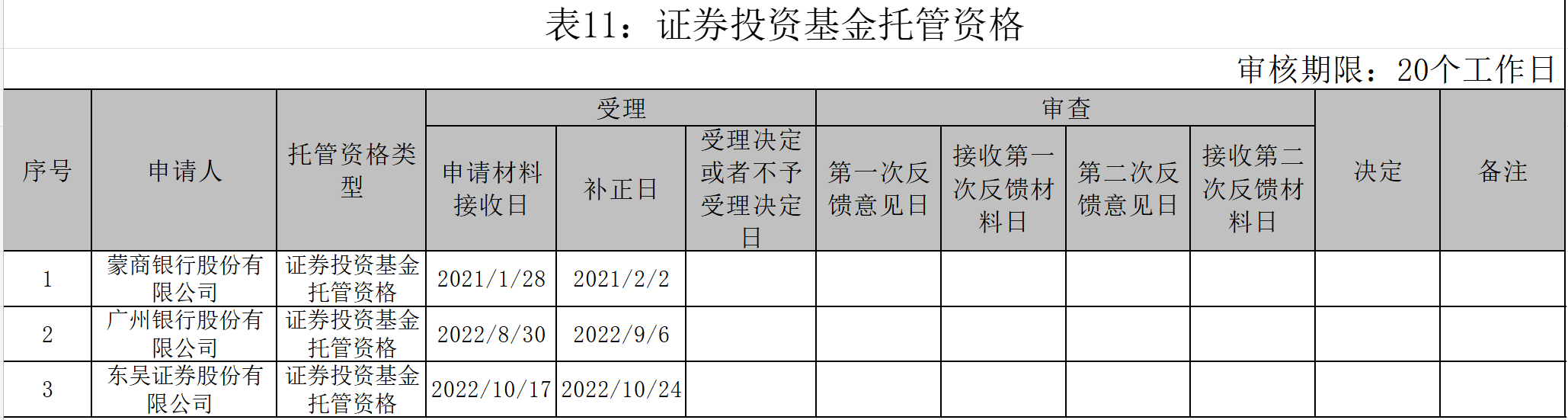
8个月内,6家券商撤回基金托管牌照申请
21世纪经济报道· 2025-08-21 04:08
Core Viewpoint - The recent regulatory changes in the fund custody sector have led to a significant withdrawal of applications from small and medium-sized securities firms, indicating a shift from quantity expansion to quality competition in the industry [1][7][10]. Group 1: Regulatory Changes and Impact - The China Securities Regulatory Commission (CSRC) has published data showing that only three institutions are currently applying for fund custody qualifications, with Dongwu Securities being the only remaining securities firm in the queue [1][3]. - A total of six small and medium-sized securities firms have withdrawn their applications for fund custody qualifications within just over eight months, primarily due to the new regulations raising the entry barriers [1][7]. - The new regulations require a minimum net asset of 300 billion RMB for securities firms, which many smaller firms cannot meet, leading to their withdrawal from the application process [7][8]. Group 2: Industry Concentration and Trends - The fund custody industry is experiencing a concentration trend, with banks and a few large securities firms managing approximately 80%-90% of public and private investment funds [10]. - Among the seven securities firms that previously applied for fund custody qualifications, only Dongwu Securities meets the new net asset requirement, highlighting the increasing disparity between large and small firms [8][10]. - The market is witnessing a "stronger get stronger, weaker get marginalized" dynamic, as larger firms capture over 80% of the market share while smaller firms are forced to pivot to lower-margin businesses [12]. Group 3: Strategic Value of Custody Licenses - Obtaining a fund custody license provides securities firms with strategic advantages, allowing them to integrate various services and enhance their revenue structure through value-added services [11]. - The top five securities firms in terms of fund custody numbers account for 65.71% of the total, indicating a significant concentration in the private fund sector [12]. - Smaller firms that cannot meet the new regulatory requirements may need to explore differentiated survival strategies, such as partnering with larger firms for operational support [12].


基金托管牌照扩容降温 年内6家券商撤回申请
2 1 Shi Ji Jing Ji Bao Dao· 2025-08-20 23:10
Core Viewpoint - The recent regulatory changes have led to a significant reduction in the number of brokerages applying for fund custody qualifications, with only three institutions remaining in the queue, primarily due to heightened entry barriers established by new regulations [1][2][3]. Group 1: Regulatory Changes and Impact - The China Securities Regulatory Commission (CSRC) has published a notice indicating that only three institutions are currently applying for fund custody qualifications, down from seven in the past [1][3]. - In just over eight months, six brokerages have withdrawn their applications for fund custody qualifications, primarily due to the new regulations that have raised the entry threshold significantly [2][5]. - The new regulations aim to shift the industry focus from "quantity expansion" to "quality competition," implementing "hard thresholds and dynamic supervision" to reshape the industry ecosystem [2][5]. Group 2: Financial Requirements - The new regulations require brokerages to have a net asset of at least 300 billion yuan, which has led many smaller brokerages to withdraw their applications as they do not meet this requirement [5][6]. - Prior to the new regulations, the minimum net asset requirement was 200 billion yuan, indicating a substantial increase in the standards for obtaining custody qualifications [5][6]. Group 3: Industry Concentration and Trends - The fund custody industry is experiencing a trend towards concentration, with banks and a few large brokerages controlling approximately 80%-90% of public and private fund custody [7]. - Over 70% of brokerages have not obtained fund custody qualifications, highlighting a growing disparity between larger and smaller firms in the industry [7][8]. - The top five brokerages in terms of fund custody account for 65.71% of the total custody numbers, indicating a significant concentration of business among leading firms [8]. Group 4: Future Outlook and Strategies - Smaller brokerages that cannot meet the new requirements may need to explore differentiated survival strategies, such as partnering with larger institutions for operational support [9][10]. - The custody license is shifting from being a "scarce resource" to a "capability certification," suggesting that larger brokerages will leverage technology to maintain their advantages while smaller firms may transition to service outsourcing roles [10].

基金托管牌照扩容降温,年内6家券商撤回申请
2 1 Shi Ji Jing Ji Bao Dao· 2025-08-20 11:37
Group 1 - The core point of the news is the significant reduction in the number of securities firms applying for fund custody qualifications, with only three remaining in the queue, primarily due to new regulatory requirements that have raised the entry barriers for such qualifications [1][2][4] - As of the end of 2024, there were originally seven securities firms applying for fund custody qualifications, but six have withdrawn their applications in just over eight months, leaving only Dongwu Securities remaining [1][4][8] - The new fund custody regulations aim to shift the industry focus from "quantity expansion" to "quality competition," implementing "hard thresholds and dynamic supervision" to reshape the industry ecosystem [1][7] Group 2 - The new regulations have increased the net asset requirement for securities firms to 300 billion RMB, which many smaller firms cannot meet, leading to a wave of withdrawals from the application process [6][7] - Among the seven firms that were previously in the application queue, only Dongwu Securities met the new net asset requirement, with a net asset of 429 billion RMB as of the first quarter of this year [8] - The current landscape shows that only 68 institutions in China have fund custody qualifications, with 36 being banks and 30 being securities firms, indicating a concentration of custody services among a few large players [4][9] Group 3 - The fund custody industry is experiencing a trend towards concentration, with banks and a few large securities firms managing approximately 80%-90% of public and private investment funds [9][10] - The top five securities firms in terms of the number of private fund custody services account for 65.71% of the total, highlighting the dominance of larger firms in the market [10] - The market dynamics suggest that smaller securities firms may need to explore differentiated survival strategies, such as collaborating with larger firms for operational support, as they face increasing marginalization [11]
ETF盘中资讯|产能出清加速!化工板块午后加速下探,回调现机遇?
Sou Hu Cai Jing· 2025-08-14 07:10
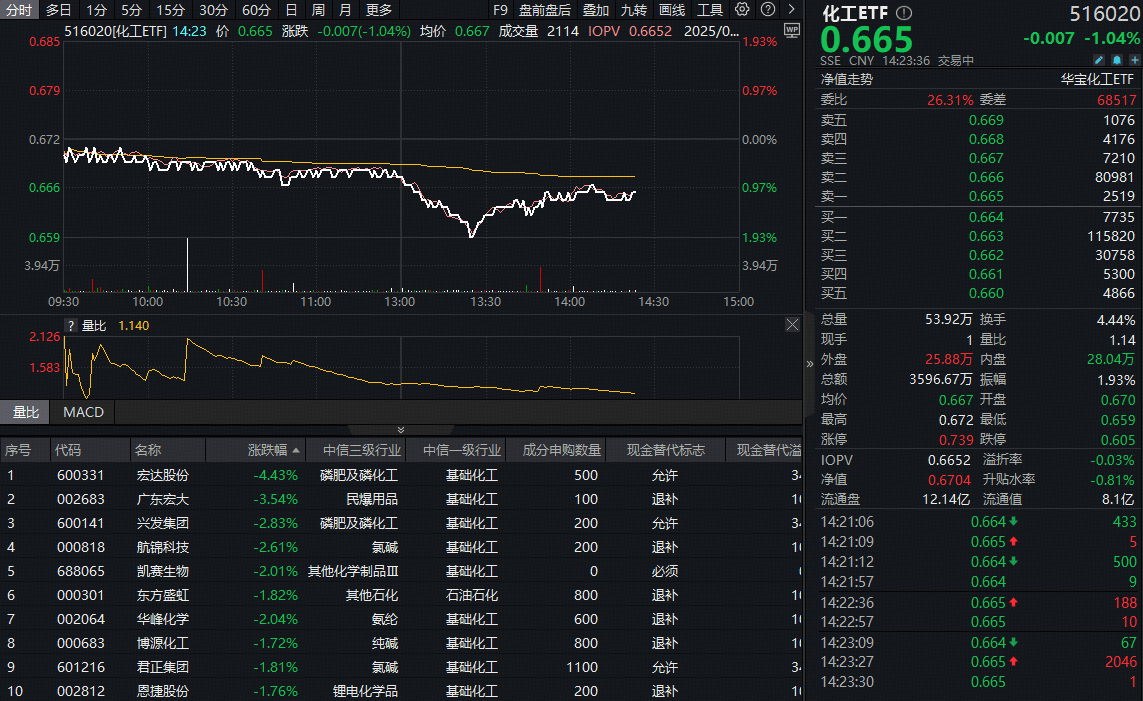
Group 1 - The chemical sector is experiencing a downward trend, with the chemical ETF (516020) showing a price drop of 1.04% as of the latest report, following a peak decline of 1.93% during the trading session [1] - Key stocks in the sector, including Hongda Co., Guangdong Hongda, and Xingfa Group, have seen significant declines, with Hongda Co. dropping over 4% [1] - The recent decline may be a normal correction after previous gains attributed to the "anti-involution" trend, suggesting that there may not be a need for excessive panic [3] Group 2 - The chemical industry is facing challenges such as overcapacity and intensified homogenization competition, leading to a decline in overall profit margins [3] - Recent policies aim to optimize industry layout, accelerate the elimination of inefficient capacity, and encourage market-oriented mergers and acquisitions, which could enhance industry concentration and benefit leading companies [3] - As of August 13, the chemical ETF (516020) has a price-to-book ratio of 2.09, indicating a low valuation at the 27.4 percentile over the past decade, suggesting attractive long-term investment opportunities [3] Group 3 - Looking ahead, the Chinese chemical industry is expected to gain market share as European and Northeast Asian facilities face pressure and exit the market, potentially restoring supply-demand balance [4] - The exit of overseas bulk chemical producers may create opportunities for Chinese fine chemical companies to replace imports and secure stable supply chains for downstream demand [4] - The chemical ETF (516020) tracks the CSI segmented chemical industry index, with nearly 50% of its holdings in large-cap leading stocks, providing a diversified investment approach within the sector [4]
产能出清加速!化工板块午后加速下探,回调现机遇?
Xin Lang Ji Jin· 2025-08-14 06:35
Group 1 - The chemical sector is experiencing a downward trend, with the chemical ETF (516020) showing a price drop of 1.93% at one point, and closing down 1.04% [2][4] - Key stocks in the sector, such as Hongda Co., Guangdong Hongda, and Xingfa Group, have seen significant declines, with Hongda Co. dropping over 4% [2][4] - The recent decline may be a normal correction after previous gains, as the sector had benefited from a "de-involution" trend [4] Group 2 - The chemical industry is facing challenges such as overcapacity and intensified homogenization competition, leading to a decline in overall profit margins [4] - Recent policies aim to optimize industry layout, accelerate the elimination of inefficient capacity, and encourage market-oriented mergers and acquisitions, which may enhance industry concentration [4] - The valuation of the chemical ETF (516020) is currently at a low point, with a price-to-book ratio of 2.09, indicating potential long-term investment value [4] Group 3 - The Chinese chemical industry has been gaining market share, while European and Northeast Asian facilities are under pressure and exiting the market, which may help restore supply-demand balance [5] - The exit of overseas bulk chemicals is expected to create opportunities for Chinese fine chemical companies to replace imports [6] - The chemical ETF (516020) tracks the CSI Sub-Industry Chemical Index, covering various segments and focusing on large-cap leading stocks, providing a strategic investment opportunity [6]
研报掘金丨开源证券:维持华峰化学“买入”评级,氨纶等景气低迷更显公司成本优势
Ge Long Hui A P P· 2025-08-13 07:22
开源证券研报指出,华峰化学Q2业绩超预期,氨纶等景气低迷更显公司成本优势,维持"买入"评级。 2025年H1,氨纶在行业供大于求的基本面下,产品价格已处于历史低位水平,需求增速放缓,整体呈 现走量不走价的态势。氨纶行业短期存在产能出清、环保政策倒逼、行业优胜劣汰趋势加剧等压力,但 行业集中度进一步提升,行业头部效应越发明显。公司作为氨纶、己二酸行业双龙头,持续巩固成本优 势,周期底部彰显龙头业绩韧性。随着氨纶渗透率仍在持续提升,氨纶景气有望复苏,未来公司作为龙 头有望充分受益。 ...

年报叠加一季报 上市公司亮点频频
Xin Hua Wang· 2025-08-12 06:27
Group 1 - The financial data released by companies indicates a mixed outlook for the capital market, with some high-growth industries continuing to perform well while others are facing challenges [1] - As of April 25, 2022, 2802 companies have released their 2021 annual reports, and 738 companies have published their Q1 2022 reports, reflecting ongoing market activity [1] - Companies are expressing confidence in their long-term development through share buybacks, increases in holdings, and dividends [1] Group 2 - In Q1 2022, 28 companies reported net profits exceeding 1 billion yuan, with 64 companies having net profits over 10 billion yuan for the previous year [2] - Some companies, like Yahua Group, reported significant profit increases, with a net profit of approximately 1.02 billion yuan in Q1 2022, a year-on-year growth of 1210.02% [2] - The energy and steel industries are experiencing high growth, contributing to improved performance for related companies [3] Group 3 - The steel industry is entering a phase of high-quality development, with ongoing consolidation and restructuring expected to enhance competitiveness [3] - Analysts predict that the steel market will see a recovery in Q1 2022, with demand expected to be higher in the second half of the year due to increased growth measures [3] - The livestock industry is facing unprecedented challenges, with several companies reporting significant losses, indicating a need for time to achieve overall profitability [4] Group 4 - As of April 25, 2022, there have been 2644 instances of major shareholders increasing their holdings, primarily citing confidence in the company's intrinsic value and future stability [4][5]

【券业观察】证券业整合向强而行
Zheng Quan Shi Bao· 2025-08-11 17:49
Group 1 - The Chinese securities industry is undergoing a profound transformation driven by the "building aircraft carrier-level brokerages" policy, leading to mergers among leading brokerages as a mainstream trend [1] - Mergers are based on the logic of economies of scale, business complementarity, and enhancing international competitiveness, with ideal combinations focusing on complementary strengths rather than simple overlaps [1][2] - The integration of brokerages under the same actual controller is a significant model, particularly for state-owned platforms, as it faces less resistance and allows for easier cultural integration [1][3] Group 2 - The merger wave is expected to significantly increase industry concentration, transitioning the market structure from fragmented competition to a multi-tiered structure of leading institutions, comprehensive brokerages, and specialized brokerages [2] - The merger trend will lead to positive changes in brokerage business models and profit structures, with a shift from traditional brokerage services to comprehensive financial services [2][5] - The focus on international competitiveness will be a key goal of mergers, with Chinese brokerages aiming to enhance their cross-border merger capabilities and international service offerings [2][3] Group 3 - International experiences indicate that industry concentration is a global trend, and mergers are crucial for growth, with successful integration being key to merger success [3] - Mid-sized brokerages are encouraged to take proactive roles in regional integrations, while smaller brokerages should consider strategic partnerships with larger firms [4][5] - A "lightweight" technology strategy is recommended for smaller brokerages, focusing on core business areas and collaborating with fintech companies to reduce development costs [5] Group 4 - The ongoing mergers and restructuring in the industry are expected to lead to an increase in market share for leading brokerages, highlighting a trend towards both concentration and differentiated ecosystems [5] - The transformation of brokerage business models will involve optimizing the structure between light and heavy asset operations, accelerating wealth management transitions, and embracing digital transformation [5] - The internationalization of the capital market presents multiple development opportunities for brokerages, driven by rising global asset allocation needs and the continuous growth of the Chinese economy [5]
丰山集团上半年净利3031.39万元 同比扭亏为盈
Zheng Quan Shi Bao Wang· 2025-08-11 11:28
Group 1 - The core viewpoint of the news is that Fengshan Group has shown significant financial improvement in the first half of 2025, with a revenue of approximately 619 million yuan, representing an increase of 18.74% year-on-year, and a net profit of about 30.31 million yuan, marking a turnaround from loss to profit [1] - The company has established an integrated product system of "fine chemical intermediates - pesticide raw materials - pesticide formulations," which creates a synergistic effect within the industry chain [1] - The self-produced raw materials provide stable raw material support for the production of formulations, ensuring internal demand during tight supply conditions in the raw material market, thus avoiding supply chain risks [1] Group 2 - The pesticide industry is experiencing an expansion trend in production, but there are structural differences within the industry due to environmental policies that have a deep and lasting impact [2] - The "14th Five-Year" national pesticide industry development plan requires a continuous decrease in the use of chemical pesticides by 2025, leading to the accelerated elimination of high-pollution capacities and increasing industry concentration as large enterprises leverage their financial, technical, and scale advantages [2] - Global agricultural planting areas remain stable, and the occurrence of pests and diseases is a key driver for pesticide demand, with specific regions experiencing high pest outbreaks stimulating the demand for insecticides and other pesticide products [2] Group 3 - During the reporting period, the company’s various business segments advanced in coordination, focusing on product quality improvement and brand enhancement in the pesticide sector through technological innovation and new product development [3] - The new energy electronic chemical products segment is accelerating product certification, customer development, and technological innovation while promoting collaborative research and development [3] - The fine chemical new materials segment is prioritizing the progress of new project construction, with the Hubei fundraising project entering trial production in January 2025 [3]
国金证券:粘胶短纤供给格局持续优化 “低库存+高开工”背景下行业景气度有望修复
智通财经网· 2025-08-11 03:56
Core Viewpoint - The report from Guojin Securities indicates that the viscose staple fiber industry is experiencing increasing concentration on the supply side, with limited new capacity in the short to medium term, while demand is expected to grow due to seasonal factors and rising production of non-woven fabrics [1][2]. Supply Side - The industry is witnessing a decline in production capacity, with a peak capacity of 530,000 tons in 2021, which has since decreased to approximately 481,500 tons by 2024, representing a reduction of about 48,500 tons or 9% [1][2]. - Policies have been implemented since 2017 to restrict energy consumption and pollution, leading to the exit of 55,500 tons of capacity from the market [2]. - The market concentration has improved significantly, with the top three companies holding a combined market share of 72% in 2024, up from 27% in 2014 [2]. Demand Side - The apparent consumption of viscose staple fiber has shown steady growth, increasing from 2.93 million tons in 2014 to 4.23 million tons in 2024, with a compound annual growth rate of approximately 4% [3]. - As of late July, the inventory days for viscose staple fiber were around 7.5 days, indicating a relatively low stock level, while the operating rate has remained high at 85% [3]. - The cotton sales rate for the 2024/25 season reached 96.5% by July 24, 2024, which is a 7.6 percentage point increase year-on-year, suggesting strong demand conditions [3].
