财富效应

Search documents
印度家庭黄金储备膨胀至近3.8万亿美元
Sou Hu Cai Jing· 2025-10-11 01:58
一份报告显示,印度家庭财富正在显著增长,在近期金价创纪录上涨后,他们持有的3.46万吨黄金(相 当于超过6,000头大象的重量)大幅升值。摩根士丹利经济学家Upasana Chachra等人写道,这笔跨越数 代积累的庞大黄金储备估值接近3.8万亿美元,在金价上行的背景下,正在为家庭资产负债表创造"积极 的财富效应"。对印度人而言,黄金深深融入文化、宗教和社会生活。这一最新估算远高于世界黄金协 会在2023年7月的报告,当时该报告估计印度家庭的黄金总储备量为约2.5万吨。印度是全球第二大黄金 消费国。 ...
美银:料香港9月份零售销售额将进一步改善
智通财经网· 2025-10-06 02:49
Core Insights - Bank of America reports that Hong Kong's retail sales in August increased by 3.8% year-on-year, surpassing the expected 2.0% growth, and showed a quarterly increase of 1.5% after a decline of 1.9% in July [1] Retail Sales Performance - The year-on-year growth in retail sales was supported by strong sales in luxury goods and non-essential items, with luxury sales (jewelry and watches) increasing by 16.4% compared to the previous year, up from 8.9% [1] - Clothing sales slightly rose to 3.2%, while department store sales slowed to 2.0% [1] - Sales of electronic products and durable goods rebounded from -8.3% to 0.4% [1] - Supermarket and food retailer sales declined by 0.9% and 3.5%, respectively, while automobile sales fell by 8.9% and fuel sales saw an expanded decline of 11.4% [1] Factors Supporting Retail Recovery - The recovery in retail sales is likely supported by various factors, particularly the improvement in visitor numbers, which has notably boosted luxury and non-essential sales [1] - In August, Hong Kong recorded 4.2 million visitors from mainland China, marking the highest monthly visitor count since the border reopened in 2022 [1] - Bank of America anticipates that the rise in Hong Kong stocks and stability in the real estate market in September will create a wealth effect, further improving retail sales [1]
美联储重启降息,对中产阶级的职业和财富意味着什么?
Hu Xiu· 2025-09-30 02:45
Core Insights - The article discusses the long-term negative impacts of ultra-low interest rates and quantitative easing initiated by central banks to stabilize the economy post-2008 financial crisis, highlighting that the middle class has become the "forgotten" group bearing the costs of these policies [3][4][8]. Group 1: Economic Consequences of Low Interest Rates - Low interest rates have led to a new era of corporate consolidation and market monopolization, reminiscent of the "Morganization" during the Gilded Age, where companies engage in anti-competitive acquisitions rather than internal innovation [9][10][11]. - The rise of "zombie companies," which survive on cheap credit without innovating or investing, has stifled economic growth and reduced opportunities for the middle class [25][27][28]. - The financialization of companies, characterized by stock buybacks funded by low-cost debt, has diverted funds away from business investments, leading to a slowdown in the creation of quality jobs [18][22][24]. Group 2: Impact on the Middle Class - The increasing market concentration limits career advancement opportunities for the middle class, as fewer companies dominate industries, making job mobility and internal promotions more challenging [13][15][16]. - The ultra-low interest rate environment punishes savers, undermining the traditional economic principle of earning interest on savings, forcing the middle class to either consume their savings or take on excessive risks for minimal returns [32][36]. - Pension systems are under severe strain due to low interest rates, which diminish expected returns on pension assets and inflate future payment obligations, leading to funding shortfalls [38][40][44]. Group 3: Wealth Inequality and Economic Disparities - The so-called "wealth effect" from rising asset prices primarily benefits the wealthiest, exacerbating inequality, as the majority of financial assets are held by the top 1% [45][46][54]. - The article highlights a "K-shaped" recovery where the financial elite thrive while the middle class struggles under rising living costs and financial repression [54][56]. - The middle class faces a bleak future, unable to secure reliable wealth accumulation or career advancement, trapped in a stagnant economic environment [58][60].


硅谷房产遭抢:买家举现金买房,80人看一套,成交价贵10几万美金
Sou Hu Cai Jing· 2025-09-18 08:41
Core Insights - The real estate market in Silicon Valley is thriving despite a nationwide downturn, driven by a surge in cash buyers fueled by the AI wealth wave [1][3] - In contrast to the rest of the U.S. where 39% of builders are lowering prices and 65% are offering discounts, Silicon Valley experiences intense competition with multiple cash offers exceeding listing prices [3][5] - The rapid wealth creation in Silicon Valley is unprecedented, with a significant increase in millionaires and billionaires, leading to record sales of luxury homes [5] Group 1: Market Dynamics - Silicon Valley's real estate market is characterized by cash transactions, with buyers often outbidding each other significantly, indicating a disconnect from national trends [3][5] - The presence of tech giants and startups in AI is creating a new class of wealthy individuals who are actively purchasing properties, thus driving demand [1][3] Group 2: Economic Implications - The wealth effect in Silicon Valley is creating a stark contrast with the broader U.S. market, where buyer activity has dropped to a ten-year low and sellers outnumber buyers by 36% [7] - The affordability crisis is evident, as even dual-income tech professionals struggle to manage high mortgage payments relative to their income, highlighting the economic pressures faced by the middle class [5][7]

浙商早知道-20250917
ZHESHANG SECURITIES· 2025-09-16 23:31
Market Overview - On September 16, the Shanghai Composite Index rose by 0.04%, while the CSI 300 fell by 0.21%. The STAR Market 50 increased by 1.32%, the CSI 1000 rose by 0.92%, and the ChiNext Index went up by 0.68%. The Hang Seng Index decreased by 0.03% [3][4] - The best-performing sectors on September 16 were comprehensive (+3.63%), machinery and equipment (+2.06%), computer (+2.06%), retail (+1.96%), and automotive (+1.82%). The worst-performing sectors included agriculture, forestry, animal husbandry, and fishery (-1.29%), banking (-1.15%), non-ferrous metals (-0.99%), defense and military industry (-0.5%), and food and beverage (-0.38%) [3][4] - The total trading volume for the A-share market on September 16 was 23,670.69 billion yuan, with a net outflow of 3.188 billion Hong Kong dollars from southbound funds [3][4] Key Insights Consumption Strategy - In the medium to long term, the first "systematic 'slow' bull" is expected to release a wealth effect, potentially slowly boosting consumption. Insurance funds and foreign capital entering the market are favorable for consumer blue chips, with positive signals from central Huijin increasing holdings in liquor ETFs. A top-down perspective suggests that the broad consumption sector is likely to benefit [5] - The market perceives that the wealth effect of the bull market is not significant. However, it is believed that the bull market can indirectly drive the wealth effect through a specific transmission path: A-share bull market → stabilization of second-hand housing prices in first-tier cities → stabilization of second-hand housing prices in other cities → recovery of real estate wealth effect. Investment opportunities in the consumption sector are worth noting, particularly in blue-chip leaders and emerging growth areas [5] - The driving factors include support from policies, funds, and sentiment, indicating that the first "systematic 'slow' bull" has quietly arrived, which may enhance the Sharpe ratio of the A-share market and indirectly boost consumption [5] Bond Market Insights - The current bond market adjustment differs significantly from historical bear markets, as the fundamentals, monetary policy, and curve shapes do not resemble past bear markets. Instead, it is more akin to an emotional adjustment under continuous risk preference shocks, anti-involution, and fund fee reduction [7][8] - There is a need to gradually break the mindset of a one-sided decline in yields and adapt to a fluctuating market pattern. However, based on the economic fundamentals and the core tone of moderate policy easing, a major bull-bear reversal has not yet been established [7][8] - The three core signals for a bull-to-bear transition include: 1. Policy bottom: Signs of marginal tightening in macro policies or expressions of tightening monetary policy 2. Fundamental bottom: Consistent and positive surprises in high-frequency and economic data 3. Sentiment bottom: A fragile and crowded trading structure triggered by the above two signals, leading to self-reinforcing sell-offs and deleveraging [8][9]
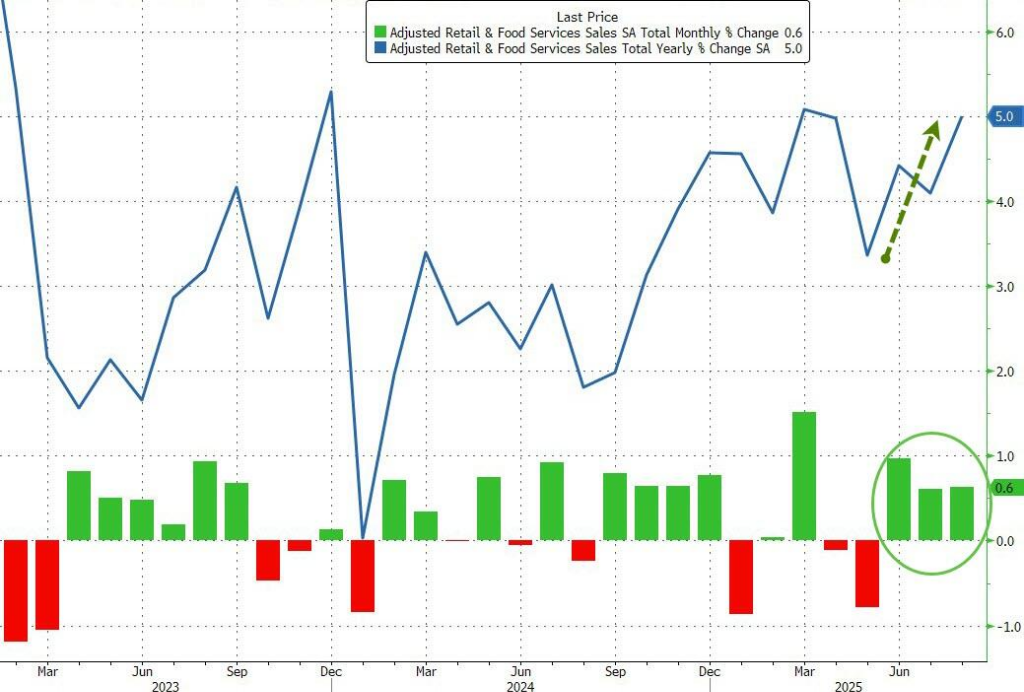
美国8月零售销售环比增0.6%超预期 实际零售销售连续11个月增长
Hua Er Jie Jian Wen· 2025-09-16 13:56
Core Insights - US consumer spending showed unexpectedly strong momentum in August, with retail sales data increasing for the third consecutive month. Real retail sales adjusted for inflation grew by 2.1% year-over-year, marking the 11th consecutive month of positive growth [1][5]. Retail Sales Performance - August retail sales increased by 0.6% month-over-month, surpassing the expected 0.2% and the previous value of 0.5% [1]. - Retail sales excluding automobiles rose by 0.7%, exceeding the forecast of 0.4% and matching the prior month's growth [1]. - Retail sales excluding automobiles and gasoline also increased by 0.7%, again above the expected 0.4% [1]. Sector Contributions - The retail growth in August was broad-based, with 9 out of 13 major categories reporting increases. Online retailers, clothing stores, and sporting goods stores were the primary drivers, likely reflecting back-to-school shopping [3]. - The restaurant sector rebounded with a 0.7% increase after a decline in the previous month [3]. - Despite expectations that auto sales would drag down overall data, this category continued to grow, albeit at a slower pace [3]. Key Indicators - A critical indicator known as the "control group" sales rose by 0.7% in August, significantly above the estimated 0.4%. This metric excludes food services, auto dealers, building material stores, and gas stations, serving as a core reference for calculating GDP [7]. Economic Context - Consumer spending capacity appears supported by several factors, including wage growth that outpaces inflation for many workers. Additionally, rising stock markets have contributed to a wealth effect, particularly benefiting higher-income groups [8]. - This strong performance contrasts with market concerns about economic slowdown and may influence Federal Reserve decision-making regarding interest rates [8].
杨德龙:资本市场走强带来财富效应 有利于提振消费促进经济增长
Xin Lang Ji Jin· 2025-09-15 07:30
Core Viewpoint - The article discusses the formation of MACD golden cross signals, indicating potential upward trends in certain stocks [1] Group 1: Stock Performance - Stocks exhibiting strong upward momentum are highlighted, attributed to the recent MACD golden cross signals [1] - The article suggests that these signals may lead to continued positive performance in the identified stocks [1] Group 2: Technical Analysis - The MACD (Moving Average Convergence Divergence) indicator is emphasized as a reliable tool for identifying bullish trends in the market [1] - The formation of a golden cross is noted as a significant event for traders and investors, often leading to increased buying activity [1]
从“无风险利率”到“无信任时刻”:储备货币的魔法如何失效?
Hu Xiu· 2025-09-11 04:41
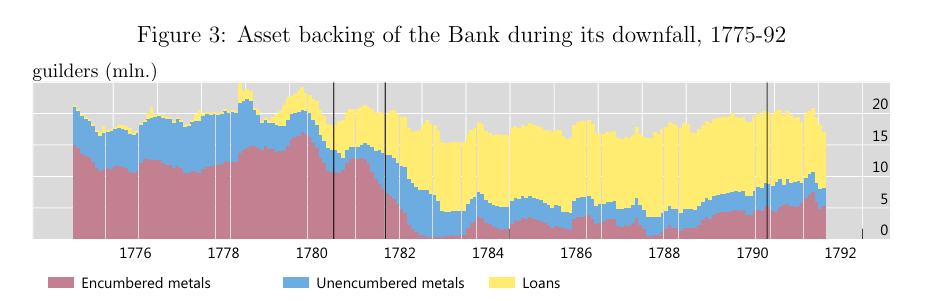
Group 1 - The article emphasizes the dominance of the US dollar in the global economy, highlighting its role in shaping wealth, borrowing costs, and economic stability in the US [1][2][3] - The concept of "American exceptionalism" is discussed as a double-edged sword, granting the US significant power while also leading to potential overreach and mismanagement of its economic privileges [6][13] - Historical examples of reserve currencies, such as the Dutch Guilder, illustrate the risks associated with over-leveraging and the eventual decline of once-dominant currencies [15][28] Group 2 - The article identifies five current trends indicating a shift in the global economic landscape, including excessive national debt, rising wealth inequality, and a move towards protectionist policies [38][42][45] - It notes that the international order is transitioning from cooperative multilateralism to confrontational unilateralism, with an increased use of financial and military power [50] - The potential for significant changes in the next 5-10 years is highlighted, suggesting that understanding these fundamental shifts is crucial for risk management and investment strategies [51][52]
贝森特“敲打”美联储:要有“人民性”,QE仅限紧急时刻,首次点名适度长期利率 (附本森特文章全文)
美股IPO· 2025-09-07 00:17
Core Viewpoint - The independence of the Federal Reserve is derived from public trust, and it must recommit to maintaining the confidence of the American people. The focus should be on three statutory responsibilities: maximum employment, price stability, and moderate long-term interest rates [1][2][14]. Group 1: Critique of Current Policies - The use of unconventional monetary policies since the 2008 financial crisis is described as a dangerous "functional gain" experiment, threatening the independence of the Federal Reserve [2][10]. - The overuse of unconventional policies and the expansion of functions have led to a concentration of wealth among asset owners, exacerbating inequality [4][12]. - The Federal Reserve's actions have created a perception that monetary policy is being used to accommodate fiscal needs, undermining its independence [7][13]. Group 2: Recommendations for the Federal Reserve - The Federal Reserve should return to its narrow statutory mission and reduce economic distortions, focusing on maximum employment, price stability, and moderate long-term interest rates [8][14]. - Unconventional policies like quantitative easing (QE) should only be used in "true emergencies" and in coordination with other government departments [2][8][14]. - A comprehensive, independent, and nonpartisan review of the Federal Reserve's monetary policy, regulation, communication, personnel, and research is necessary [8][13]. Group 3: Market Implications - The statements made by the Treasury Secretary are seen as a precursor to a significant shift in U.S. monetary policy, potentially paving the way for financial repression policies such as QE or yield curve control (YCC) [3][9]. - If such policies are implemented, they could lead to a weaker dollar and benefit commodities like gold, silver, and copper, as well as markets like A-shares and Hong Kong stocks [3][9].

高盛和摩根士丹利对于地产的研报对比看,能看出些什么有意思的东西?
Sou Hu Cai Jing· 2025-09-06 12:13
Group 1: Market Overview - Both Goldman Sachs and Morgan Stanley agree that the real estate market is still in a downturn, with signs of improvement beginning to emerge [3][4] - Goldman Sachs estimates that there are over 60 million unsold homes in China, with a clearance period of 36 months, while Morgan Stanley highlights a structural oversupply that could meet the housing demand for urban populations over the next five years [3][4] - New home sales are projected to decline by 37.7% year-on-year in 2024, with some third and fourth-tier cities experiencing price drops exceeding 15% [3] Group 2: Policy Effectiveness - Despite a 1.5 percentage point reduction in interest rates by the central bank in 2024, leading to over 2 trillion yuan in long-term funds, new residential mortgage loans have shrunk by 42% compared to the previous year [4] - Goldman Sachs estimates that resolving the "guarantee delivery" and inventory issues would require 8 trillion yuan in fiscal investment, equivalent to 35% of the national fiscal revenue for 2024 [4] - Morgan Stanley points out that the effectiveness of infrastructure investment has decreased significantly, with only 0.2 yuan of GDP growth generated for every 1 yuan invested, a 60% drop in efficiency compared to a decade ago [4] Group 3: Urban Disparities - In the first quarter of 2025, 30 monitored cities showed an 18% increase in new home transactions year-on-year, while lower-tier cities saw a 12% decline [5] - Asset price changes reflect this disparity, with second-hand home prices in Beijing's Chaoyang District slightly increasing by 0.3%, while prices in a central provincial capital have fallen below 2019 levels [5] Group 4: Diverging Recovery Narratives - Goldman Sachs believes that an 8 trillion yuan stimulus plan could create a "policy bottom," projecting a potential recovery in housing prices by the end of 2025 and a sales scale returning to 12 trillion yuan by 2027, still 40% lower than the peak in 2021 [6] - Conversely, Morgan Stanley warns that large-scale stimulus could exacerbate structural imbalances, with the total market value of real estate to GDP ratio remaining at 350%, compared to 169% in the U.S., suggesting that any stimulus could lead to new bubbles [6] Group 5: Economic Dynamics - Goldman Sachs emphasizes the positive impact of manufacturing upgrades, noting a 48% year-on-year increase in exports of new energy vehicles and photovoltaic equipment, which offsets a 0.7 percentage point drag on GDP from declining real estate investment [11] - Morgan Stanley highlights the ongoing erosion of wealth effects, stating that a 1% drop in housing prices could suppress consumption growth by 0.3 percentage points, potentially continuing until 2028 [13] Group 6: Consumer Perspectives - Homebuyers face challenges, with first-time mortgage rates in Beijing dropping to 3.1%, yet average monthly payments consuming 62% of household income, exceeding the international warning line of 40% [14] - Developers are struggling, as evidenced by a promotional offer in Zhengzhou where buying a new home includes a parking space, reflecting a net profit margin below 2% [14] - Younger generations show a 23% decline in home-buying intentions, preferring to invest in vocational education and experiential consumption [14] Group 7: Future Strategies - In major cities like Beijing and Shanghai, mortgage rates have fallen below public fund loan rates, creating a rare opportunity for first-time homebuyers in the second half of 2025 [15] - The asset allocation paradigm is shifting, with real estate's share in household assets needing to decrease from 78% to below 50%, while alternative investments like REITs and affordable rental housing are gaining attention [15] - Awareness of risks is increasing, with a projected 34% debt default rate among the top 50 private real estate companies in 2024 [15]