
贬值交易

Search documents
黄金上演高台跳水!倒车接人还是找“接盘侠”?华尔街激辩不休
Jin Shi Shu Ju· 2025-10-23 08:33
Core Viewpoint - Gold prices have experienced a significant decline of 7.6% after reaching historical highs, following a year-to-date increase of 63% [1][2] Group 1: Market Dynamics - Investors have been flocking to gold as a "devaluation trade" to hedge against a declining dollar amid concerns over government spending, rising debt, and potential inflation [1] - The recent drop in gold prices is attributed to technical overextension after a substantial rally, with momentum indicators deviating from normal levels [1] - The traditional perception of gold as a safe-haven asset has shifted, with some analysts suggesting it has gained "meme stock" status this year [1][2] Group 2: Investor Sentiment - There is a growing concern among some investors about a potential bubble in the gold market, as evidenced by extreme buying behavior and crowded trades [2] - Reports indicate that physical gold purchases have surged, with long lines forming at dealers, signaling a possible market frenzy [2] - Despite recent volatility, some analysts believe that factors such as political uncertainty and high government debt levels could continue to drive gold prices higher, with projections suggesting a potential rise to $4,700, a 15% increase from current levels [2]
After gold’s big plunge, here’s what history shows could happen next
Yahoo Finance· 2025-10-22 20:13
Core Viewpoint - Gold prices experienced a significant decline, with a notable one-day drop of 5.7%, raising questions about whether this marks a peak or a necessary correction in the market [3][4]. Price Movements - Gold for December delivery had rallied 56% year-to-date, peaking at $4,398 per ounce before the recent drop [2]. - Following the one-day decline, gold futures settled at $4,065.40, reflecting a further decrease of 1.1% [4]. Market Reactions - The recent drop was attributed to "gold tourists" being squeezed out and money managers selling to protect gains, indicating a shift in investor sentiment [3]. - Historical analysis shows that after similar declines of 5% or more, gold prices have typically rebounded, averaging a 1.82% increase one month later [5]. Market Sentiment - Analysts suggest that corrections like the recent decline are healthy for the market, with the potential for future gains despite current volatility [6]. - There is skepticism regarding gold's effectiveness as a hedge against the U.S. dollar, particularly in light of the debasement trade strategy [7].
黄金暴涨暴跌! 牛市真见顶了吗?
Jin Tou Wang· 2025-10-22 09:37
Core Insights - The gold market has experienced a significant adjustment, with prices showing a V-shaped recovery after a sharp decline of up to 3% [1][2] - The recent sell-off was primarily driven by technical overbought conditions and profit-taking after substantial gains earlier in the year, with gold prices still up nearly 60% year-to-date [2] - Geopolitical tensions and economic factors, including trade issues and potential U.S. interest rate cuts, have contributed to the volatility in gold prices [2][3] Market Dynamics - The recent decline in gold prices ended a rapid upward cycle that began in mid-August, influenced by a prevailing "devaluation trade" strategy and expectations of significant interest rate cuts by the Federal Reserve [2] - The end of the Diwali festival in India, a major gold consumer, has led to reduced physical demand, further impacting prices [2] - Reports of a potential U.S.-India trade agreement, which may lower tariffs, suggest a decrease in safe-haven demand for gold [2] Technical Analysis - Following a significant drop, gold prices are expected to consolidate around the $4,000 per ounce mark, with immediate resistance at $4,190 and support at $4,128 [4] - The price action indicates a potential bullish outlook if gold remains above the support level of $4,083, which coincides with the recent low and the ascending channel [4] - The maximum pressure point for gold is identified at $4,239.70, which corresponds to a 50% retracement level of the recent decline [4]
黄金白银价格突遇重挫,金价日跌幅创2013年以来之最
Sou Hu Cai Jing· 2025-10-22 00:40
Core Insights - On October 21, gold and silver prices experienced significant declines, with gold spot prices dropping by 6.3%, marking the largest single-day drop since April 2013, and silver spot prices falling by 8.7%, the largest drop since 2021. This decline was attributed to investor concerns over a potential bubble in precious metal prices, prompting them to sell to lock in profits [1][3]. Group 1: Market Reactions - The recent surge in gold and silver prices was largely driven by investor speculation that the Federal Reserve would implement a significant rate cut before the end of the year, alongside concerns over the U.S. budget deficit impacting financial markets [1][3]. - Following the price drop, Citigroup downgraded its rating on gold, citing concerns over high positions in the market. Analysts from Citigroup's commodity research team expect gold prices to stabilize around $4,000 per ounce in the coming weeks [3]. Group 2: Future Price Predictions - A representative from MKS Pamp SA indicated that current gold and silver prices are approaching "good entry points," with short-term gold prices expected to fluctuate between $4,000 and $4,500 per ounce, and silver prices between $45 and $50 per ounce [3]. - Bloomberg noted that rising global tensions have renewed demand for safe-haven assets, which may influence future price movements in precious metals [3].

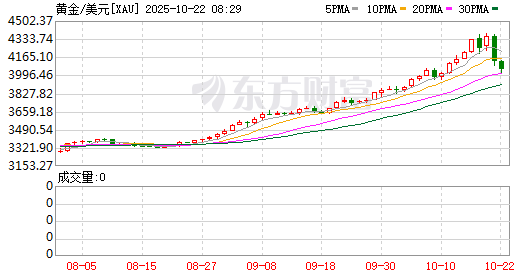
涨得猛跌得狠!金银高位“跳水” 创纪录涨势暂告一段落
智通财经网· 2025-10-22 00:29
Core Viewpoint - Recent sharp sell-off in gold and silver prices is attributed to investor concerns over high valuations following a historic price surge, leading to profit-taking [1][4] Group 1: Price Movements - Spot gold prices fell over 6.3%, marking the largest single-day drop in over a decade, while spot silver dropped by 8.7% [1] - The recent decline ended a bullish trend for both metals, which had reached historical highs just a week prior [1] - The surge in gold prices was driven by expectations of significant interest rate cuts by the Federal Reserve and a shift away from sovereign debt due to concerns over budget deficits [1] Group 2: Market Dynamics - Strong technical indicators contributed to the gold price correction, with support expected in the $4,000 to $4,050 range [3] - The influx of $8 billion into physical gold ETFs last week was the largest weekly inflow recorded since 2018, driven by concerns over U.S. economic credit quality [4] - The strong U.S. dollar has diminished the appeal of precious metals, coinciding with reduced market liquidity due to India's Diwali holiday [3] Group 3: Future Outlook - Analysts expect that the long-term factors supporting gold prices, such as central bank purchases, remain intact, with predictions of gold prices reaching around $4,500 per ounce next year [5] - The current speculative long positions in gold and silver may have accumulated, making them more susceptible to corrections [5] - Market volatility during upward trends is seen as a normal occurrence, and analysts maintain a positive outlook on the gold market fundamentals [5]
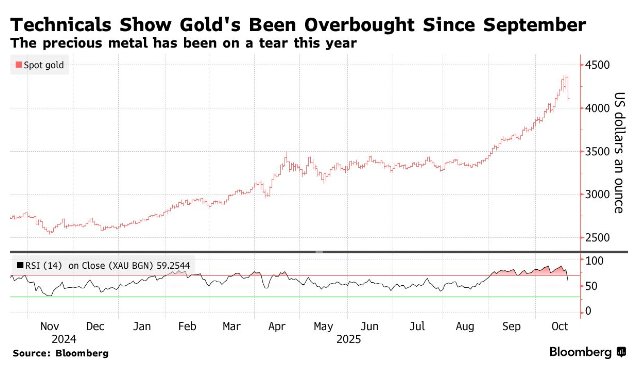
黄金已成“迷因资产”?“老债王”格罗斯建议等一等再入手
Jin Shi Shu Ju· 2025-10-21 08:20
Group 1 - Bill Gross, co-founder of PIMCO, warns investors to be cautious about the recent surge in gold prices despite concerns over the U.S. budget deficit and economic slowdown [1] - Gross highlights the potential risks in regional banks, referencing recent issues disclosed by Zions Bancorporation and Western Alliance Bancorp, and compares the situation to "cockroach risk" in the banking sector [1][2] - The memory of the Silicon Valley Bank collapse two years ago continues to impact market sentiment, leading to a significant drop in stock prices and a decline in the 10-year U.S. Treasury yield [1] Group 2 - Gross believes that the 10-year U.S. Treasury yield should be higher than the recent closing price of approximately 4.01%, suggesting a more reasonable level would be around 4.5% due to the large debt supply and budget deficit [2] - The surge in debt levels across major developed economies has caused investor unease regarding global currencies, leading to increased bets on precious metals and Bitcoin as a hedge against inflation [2] - Gold prices have risen over 60% this year, with some forecasts predicting prices could reach $10,000 per ounce by 2030 if the current trend continues [3] Group 3 - Gross indicates that the current rise in gold prices may be overextended, as evidenced by a significant drop after reaching a historical high of $4,380 per ounce [3][4] - The phenomenon of "fear of missing out" (FOMO) is influencing gold trading, making it difficult to objectively value the metal [4] - Despite bullish arguments for gold, such as potential Fed rate cuts and geopolitical uncertainties, there are signs of market overheating, including stable dollar rates and rising inflation-protected bond yields [4]
难圆其说!“贬值交易”炒作或已见顶?
Jin Shi Shu Ju· 2025-10-21 06:18
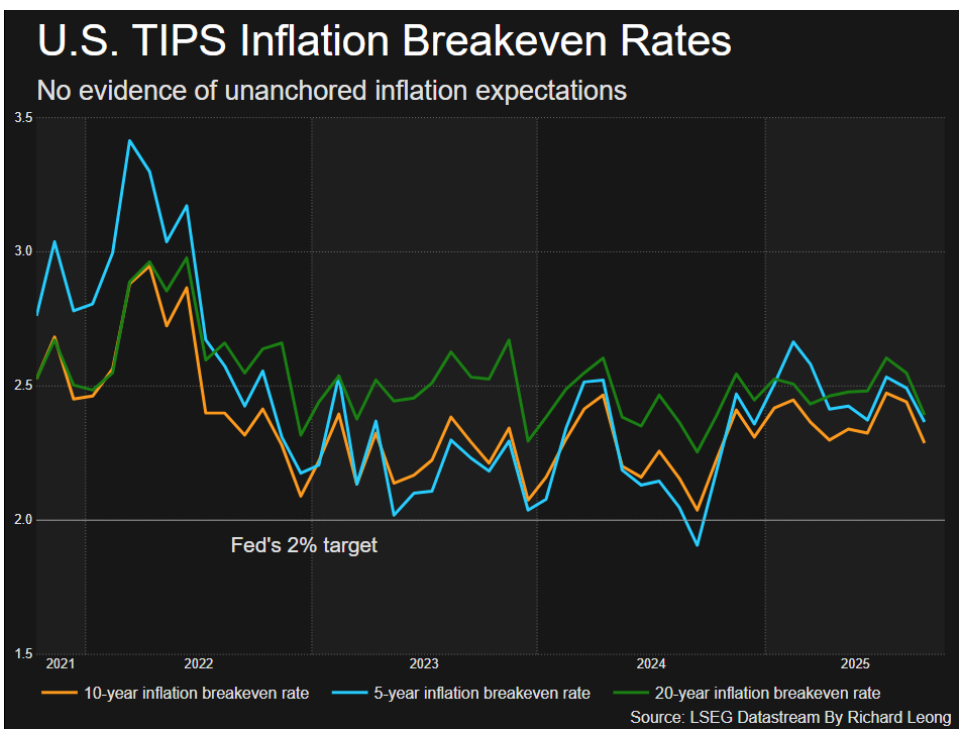
Core Viewpoint - Recent surges in gold, cryptocurrencies, and stock markets have sparked discussions about a "devaluation trade" in the dollar, while the bond and foreign exchange markets show contrasting trends [1] Group 1: Market Trends - Gold prices have surged by 50%, with other precious metals like silver and platinum also experiencing significant increases, indicating investor anxiety about certain risks [1] - The 10-year U.S. nominal Treasury yield fell below 4%, marking its lowest level since April, and has decreased nearly 60 basis points this year [2] - The 10-year TIPS breakeven inflation rate dropped to 2.275%, the lowest since June, while the 30-year TIPS rate fell to 2.21%, a new low since May [2] Group 2: Investor Sentiment - Despite concerns about devaluation, there is no evidence of a mass sell-off of the dollar or U.S. Treasuries, as indicated by the stability in the dollar index and its performance against other G10 currencies [4][6] - Approximately 80% of the portfolio funds flowing into the U.S. are hedged against currency risk, reflecting increased skepticism about the dollar's reliability [6] Group 3: Broader Economic Context - Concerns about fiat currency devaluation, particularly regarding the dollar, have intensified since the 2007-2009 financial crisis and the 2020-2021 pandemic, exacerbated by unconventional policies [8] - The current market situation may be influenced by multiple factors, including central bank asset diversification and private sector portfolio reallocation, rather than a straightforward narrative of devaluation [8]
DLS外汇:黄金飙升后,市场等待美联储的降息抉择
Sou Hu Cai Jing· 2025-10-21 03:55
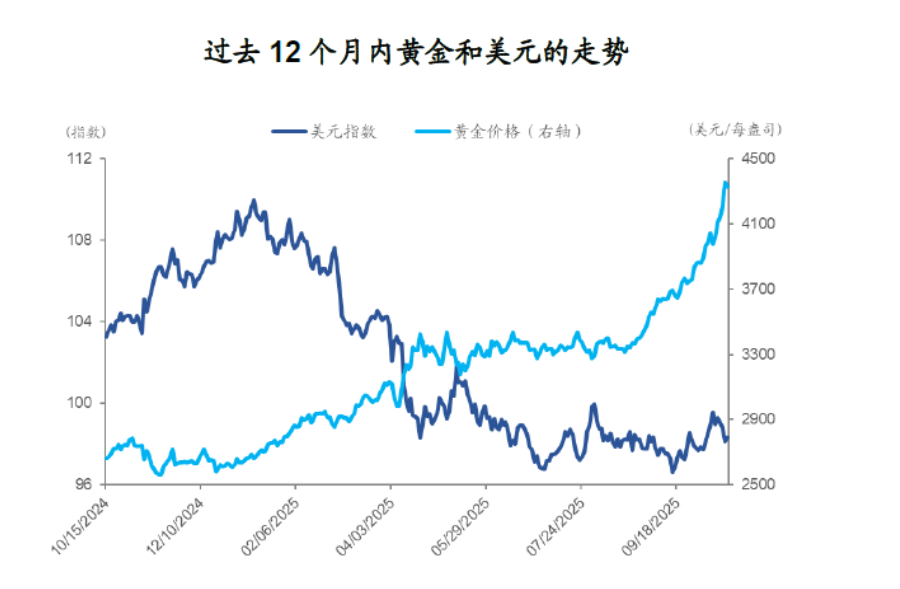
Group 1 - Gold prices have notably risen over the past year, surpassing $4,300 per ounce, while the US dollar has shown persistent weakness [1] - The stability in the US Treasury market contrasts with the rising gold prices, indicating a market concern regarding the long-term value of the dollar [1] - The differing performances of gold and US Treasuries point to a central question regarding the Federal Reserve's future policy direction, whether to prioritize rate cuts to prevent economic recession or to tighten policies to address potential inflation [1] Group 2 - The factors driving the strength of gold include concerns over the US potentially monetizing its high debt, global trade tensions, and geopolitical uncertainties, which have heightened risk aversion [1] - The US dollar index has declined approximately 10% from its peak at the beginning of the year, with the market now focused on whether the dollar will rebound or maintain its weakness [4] - The contrasting movements of gold and US Treasuries reflect the market's differing judgments on long-term risks versus short-term realities, with investor divergence centered on which economic signals will ultimately influence Federal Reserve decisions [4]
国泰君安国际:美元“贬值交易”狂热下 黄金与美债为何齐涨?
智通财经网· 2025-10-20 22:39
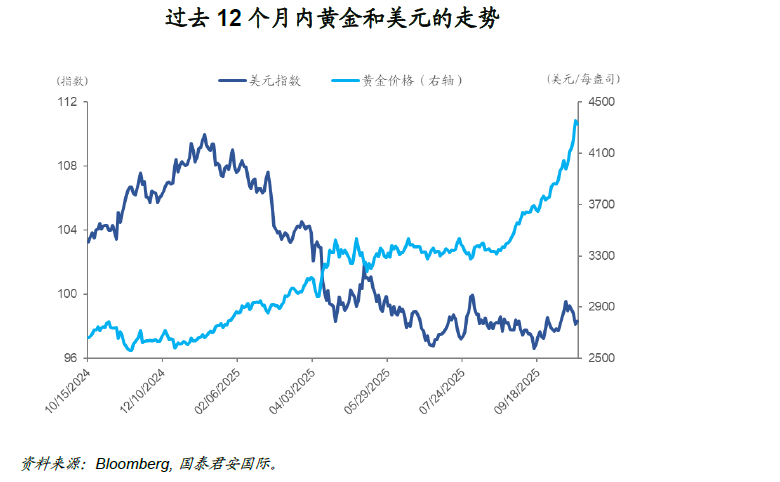
Core Viewpoint - The report from Guotai Junan International highlights a significant rise in gold prices, surpassing $4,300, amid a weakening US dollar and increasing discussions around "devaluation trades" [1][2][5]. Group 1: Gold Market Dynamics - Over the past 12 months, gold prices have surged due to concerns over the US potentially addressing its massive debt through deficit monetization, alongside heightened risk aversion from global trade tensions and geopolitical issues [2][5]. - The attractiveness of gold as a non-yielding asset has increased following the Federal Reserve's reintroduction of interest rate cuts, leading to a reassessment of dollar credit and supporting higher gold prices [2][5]. Group 2: US Dollar Performance - The US dollar index has declined nearly 10% from its peak at the beginning of the year, with recent fluctuations occurring within a low range, making the future trajectory of the dollar a key focus for "devaluation trades" [5]. - Despite the discussions around devaluation, the US Treasury market remains surprisingly calm, with long-term inflation expectations anchored around the Federal Reserve's 2% target [5][6]. Group 3: Market Sentiment and Federal Reserve Decisions - The rise in gold prices reflects a "no-confidence vote" on future monetary credit, particularly regarding the dollar, while US Treasuries are viewed as a "confidence vote" on policy credibility [6]. - The current market dynamics hinge on which economic signals will ultimately guide the Federal Reserve's decisions—whether to cut rates in response to potential recession or to tighten policies to combat inflation [6].
美元“贬值交易”:黄金、美债为何齐涨?
国泰君安国际· 2025-10-20 08:11
Group 1: Market Trends - Gold prices surged over 60% in the past 12 months, surpassing $4,300[5] - The US dollar index fell nearly 10% from its peak at the beginning of the year, currently fluctuating between 97 and 99[5][8] - The market is increasingly focused on "devaluation trades," betting on the US government diluting its debt through inflation[5] Group 2: Economic Factors - Concerns about the US government's ability to manage its debt have led to a loss of trust in the dollar, reflected in rising gold prices[24] - The long-term inflation expectations in the US remain stable around the Federal Reserve's 2% target, despite gold's rise[19][24] - The ongoing government shutdown has increased uncertainty, with over 70% probability that it will last more than 30 days[13][15] Group 3: Policy Implications - The Federal Reserve's potential shift towards a more dovish stance could lead to further interest rate cuts, impacting asset prices[19][24] - The interplay between inflation control and employment stability will be crucial in determining the Fed's future decisions[26] - Investors need to differentiate between long-term risks and short-term realities in the current market environment[25]