
固态电池技术

Search documents
德尔股份:在固态电池领域开发更广泛领域应用场景
Zheng Quan Shi Bao Wang· 2025-06-16 02:41
Core Viewpoint - The company is focusing on the development and commercialization of solid-state batteries, which have garnered significant interest from institutional investors due to their enhanced safety and high-temperature performance compared to traditional liquid batteries [1][2]. Group 1: Company Overview - The company, Del Corporation, is a global automotive parts supplier specializing in noise, vibration, and harshness (NVH) products, thermal insulation, lightweight products, electric pumps, motors, and automotive electronics [1]. - In 2018, the company established a subsidiary in Japan to focus on solid-state battery development, which received national invention patent authorization in 2024 [1]. Group 2: Investment and Projects - The company signed an investment cooperation agreement with the local government in Wuxing District, Huzhou, Zhejiang Province, to invest approximately 300 million yuan in new lithium battery pilot and industrialization projects, as well as smart motor industrialization projects [1]. - The company is currently selecting a base for its solid-state battery pilot and industrialization project and plans to accelerate the selection of pilot line equipment and construction [2]. Group 3: Technology and Performance - The company's solid-state batteries exhibit significantly improved safety and high-temperature performance compared to liquid batteries, having passed third-party testing for puncture, heating, and overcharging [2]. - The solid-state battery's high-temperature performance allows it to operate continuously under elevated temperatures without additional cooling systems, reducing customer usage costs and enhancing adaptability across various applications [2]. - The solid-state battery's safety is attributed to the absence of flammable materials during the manufacturing process, ensuring intrinsic safety [2]. Group 4: Application Potential - The solid-state batteries are suitable for humanoid robots due to their superior high-temperature performance, which simplifies thermal management system requirements, allowing for more battery cells to be stored in limited space [3]. - The company is exploring potential applications for its solid-state batteries in various sectors, including new energy vehicles, humanoid robots, two-wheeled electric vehicles, and energy storage [2].

固态电池研发加速推进 破解人形机器人续航难题
Zheng Quan Shi Bao· 2025-06-15 17:42
Core Viewpoint - The humanoid robot industry faces a significant challenge with battery life, specifically the "one hour charging for two hours working" dilemma, which hinders large-scale application. Solid-state batteries are seen as the ultimate solution due to their high energy density, safety, and long cycle life [1][2]. Battery Performance Challenges - Humanoid robots have stricter performance requirements for lithium batteries compared to traditional consumer electronics and electric vehicles. Current products struggle with long charging times and short operational durations due to limited internal space for battery expansion [2]. - Key technical bottlenecks affecting battery life include insufficient energy density, high discharge rates leading to performance degradation, and inadequate battery management systems (BMS) [2][3]. Energy Density and Discharge Issues - Current mainstream lithium batteries, such as ternary lithium batteries, have an energy density of only 240Wh/kg, which is below the 400Wh/kg threshold needed for longer operational durations. For instance, Tesla's Optimus robot can only operate for 2 to 4 hours with a 2.3kWh battery [3]. - High discharge rates required for complex movements in humanoid robots can cause overheating and reduce battery life. Existing battery materials struggle to balance power output and stability under high load conditions [3][4]. Innovations in Battery Technology - The main development directions for lithium battery technology in humanoid robots include high-nickel ternary batteries and solid-state batteries. High-nickel batteries can reduce size and weight, while solid-state batteries offer superior safety [5][6]. - Innovations in battery structure, such as square stacked batteries, enhance energy density by optimizing internal space utilization. New materials like lithium-rich manganese-based compounds are being explored to improve energy density by over 20% [5][6]. Safety and Charging Efficiency - Safety is paramount in robot applications, with a focus on creating a multi-layered safety system from cell safety to active system defenses. The use of solid-state electrolytes significantly reduces the risk of thermal runaway [8][9]. - Current battery products can achieve 80% state of charge in just 6 minutes, significantly reducing charging times and enhancing productivity [8][9]. Market Outlook and Collaboration - The global humanoid robot market is projected to exceed 5 million units and 400 billion yuan by 2035, driving a surge in lithium battery demand [12]. - Companies like Haopeng Technology and BetterRay are forming strategic partnerships with leading robot manufacturers to innovate in battery technology, focusing on miniaturization, lightweight design, and efficiency [12][13].

设备在固态电池加速落地过程中扮演的新角色
2025-06-15 16:03
固态电池获政策大力支持,终端车企如宝马、丰田积极推进,部分已进 入路试阶段。宁德时代、青岛金王等电池厂也在搭建固态产线,中试线 预计年中逐步拉通,预示产业链加速发展。 固态电池技术路线逐步采用干法方案,生产工艺对设备提出新需求,如 高压化设备,带动相关设备盈利。干法电极制造设备(包括混合设备) 是未来明确趋势,高压致密化、电解质与极片复合及封装工艺是关键。 固态电池应用场景广泛,包括低空领域、人形机器人、新能源汽车及储 能等。低空领域因价格敏感度较低,有望率先落地,其他领域亦具潜力, 推动固态产线发展,打开市场空间。 干法制备技术在固态电池生产中至关重要,涉及纤维化、滚压、叠片及 高压致密化等环节。干法混合、电极制造、高压致密化等关键步骤提升 产线价值,解决界面结合问题,为全固态电池大规模生产提供支持。 固态电池生产设备在前、中、后道工序均有显著变化。前道工序新增纤 维化、混合等设备需求,滚压机价值量大幅提升。中道工序叠片机需求 增长,后道工序化成分容环节涉及高压化处理,设备需求增加。 Q&A 固态电池加速落地过程中设备环节的变化有哪些? 固态电池加速落地过程中,设备环节发生了显著变化。首先,从政策层面来看, ...



电力设备与新能源行业6月第2周周报:小米公布固态电池专利,汽车行业反内卷推进-20250615
Bank of China Securities· 2025-06-15 13:48
Investment Rating - The industry investment rating is "Outperform the Market" [1][38] Core Viewpoints - The report highlights the ongoing growth in the electric equipment and new energy sectors, particularly in the electric vehicle (EV) market, where sales of new energy vehicles (NEVs) continue to rise, with May 2025 sales reaching 1.31 million units, a year-on-year increase of 37% [2][26] - The report emphasizes the importance of solid-state battery technology, with companies like Xiaomi filing patents, indicating a shift towards advanced battery technologies [1][26] - In the photovoltaic (PV) sector, the report notes the recognition of new technologies such as BC components in overseas markets and the improvement in conversion efficiency by leading companies [1][26] - The hydrogen energy sector is also highlighted, with ongoing policy support for its industrialization and recommendations to focus on companies with cost and technological advantages in electrolyzer production [1][26] Summary by Relevant Sections New Energy Vehicles - In May 2025, NEV production and sales reached 1.27 million and 1.31 million units, respectively, marking a year-on-year growth of 35% and 37% [2][26] - Major automakers have announced a reduction in payment terms for suppliers to 60 days to enhance supply chain efficiency [1][26] Power Batteries - In May 2025, the installed capacity of power batteries was 57.1 GWh, a month-on-month increase of 5.5%, with ternary batteries accounting for 10.5 GWh [2][26] - The report mentions Xiaomi's new solid-state battery technology patent, which aims to enhance ion transport efficiency [1][26] Photovoltaics - The report notes the launch of HIBC technology by Longi, achieving a conversion efficiency of 27.81%, pushing the efficiency of PV modules into the "25%+" era [1][26] - The focus on supply-side reforms in the PV sector is emphasized, particularly in the silicon material segment [1][26] Hydrogen Energy - The report discusses ongoing policy initiatives to promote hydrogen energy, including pilot projects in the energy sector [1][26] - Recommendations are made to pay attention to companies benefiting from hydrogen infrastructure development [1][26] Industry Dynamics - The report summarizes key industry dynamics, including the actions of major automakers to streamline supplier payment terms and the growth in NEV sales [1][26] - It also highlights the investment plans in nuclear fusion by the UK government, indicating a broader interest in energy innovation [1][26]
续航破1200km!小米加码固态电池,雷军造车的又一杀器曝光
Sou Hu Cai Jing· 2025-06-15 13:18
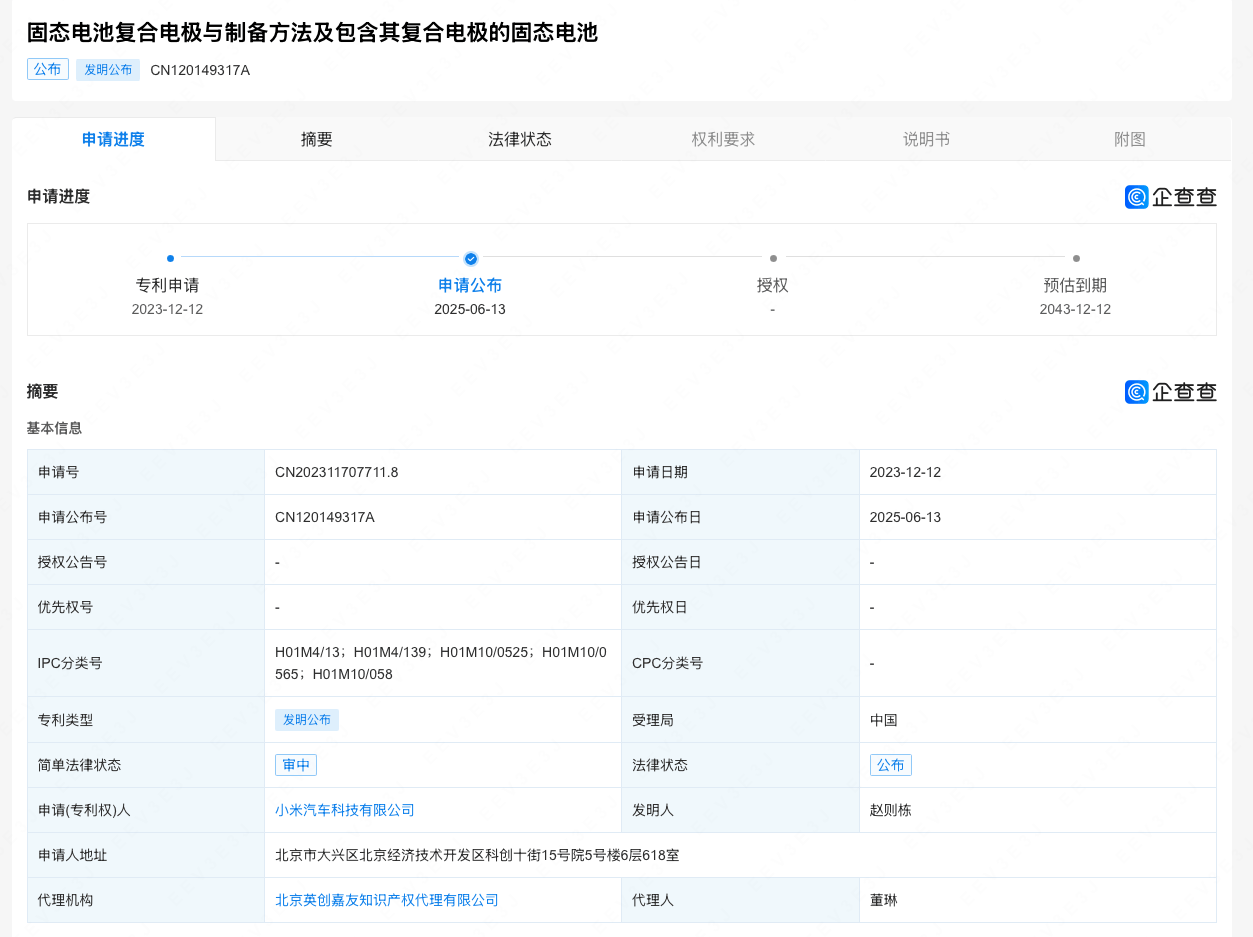
Core Viewpoint - Xiaomi Automotive has officially published a patent for "solid-state battery composite electrodes and preparation methods," indicating its commitment to developing solid-state battery technology, which is seen as a future trend in the electric vehicle industry [1][3][4]. Patent Details - The patent application number is CN202311707711.8, with a publication date set for June 13, 2025, and the application date being December 12, 2023 [2]. - The patent is categorized under IPC classifications related to battery technology, specifically focusing on solid-state batteries [2]. Technology Highlights - Xiaomi's solid-state battery features two main technological advancements: 1. Optimized structure that shortens the metal ion transport path within thick electrodes, enhancing the transport rate [7]. 2. The composite electrode has a high electrode loading capacity, achieving 480-500 mg/cm² for the positive electrode at a thickness of 2 cm, with a total battery area capacity of 60-70 mAh/cm² [8][9]. Market Position and Strategy - Xiaomi Automotive is positioning itself in the competitive electric vehicle market, emphasizing the importance of solid-state batteries for future growth and market survival [4][12]. - The company aims to achieve over 1000 km of pure electric range with its upcoming models, potentially exceeding 1200 km, which would place it among the leaders in electric vehicle range capabilities [10][20]. Competitive Landscape - Other automotive companies, such as BYD and Toyota, are also investing heavily in solid-state battery technology, with expected production timelines around 2027 [14][16][17]. - Xiaomi's entry into solid-state battery development is seen as a strategic move to secure a competitive edge in the rapidly evolving electric vehicle market [17][19]. Investment and Development - Xiaomi has been actively investing in various battery companies, indicating a strong commitment to advancing its solid-state battery technology [19]. - The company is focused on enhancing the performance and reliability of its electric vehicles, with a particular emphasis on battery technology as a key differentiator in the market [22][27].


固态峰会回顾 | 产学研共议产业链协同冲刺
高工锂电· 2025-06-15 05:36
Core Viewpoint - The article discusses the advancements and future directions in solid-state battery technology, highlighting the importance of solid electrolytes and the ongoing research and development efforts by various companies in the industry [5][6][22]. Group 1: Solid-State Battery Developments - Solid-state batteries are recognized as a crucial direction for the continued development of lithium batteries, with significant attention from society and support from national policies [5]. - Current projects aim to develop high-energy-density solid-state lithium batteries with energy densities of 350Wh/kg (single cell) and 260Wh/kg (system) [5]. - Innovations in solid electrolyte materials have achieved a conductivity of 10mS/cm and energy densities reaching 369.93Wh/kg, with ongoing large-capacity battery cycle tests [5]. Group 2: Research and Innovations - Research teams are combining ionic liquids with traditional organic electrolytes to enhance charging performance at high rates [6]. - New composite solid-state electrolytes with high ionic conductivity (0.78mS/cm) and excellent mechanical properties are being developed [6]. - Companies are focusing on improving the stability and cost-effectiveness of solid-state batteries while enhancing energy density from 300Wh/kg to over 500Wh/kg [10]. Group 3: Safety and Production Techniques - Companies like Zhongke Solid Energy are implementing in-situ polymerization techniques for safer solid-state battery production, achieving significant safety performance in tests [11]. - Innovations in manufacturing processes, such as the use of advanced rolling technologies, are being adopted to enhance the production of solid-state battery components [15]. - The development of high-performance solid electrolytes and battery designs aims to eliminate leakage risks and improve energy density for safer energy solutions [11][18]. Group 4: Market Trends and Future Outlook - The solid-state battery industry is expected to enter a new phase starting in 2025, with a focus on material innovation rather than price competition [22]. - Companies are exploring the use of metal-organic frameworks (MOFs) to enhance lithium-ion conduction and improve battery performance [22]. - A clear roadmap for engineering and mass production of solid-state batteries is being established, with significant production capacity planned for the coming years [19].

全固态电池上车,就差临门一脚了?
电动车公社· 2025-06-14 15:41
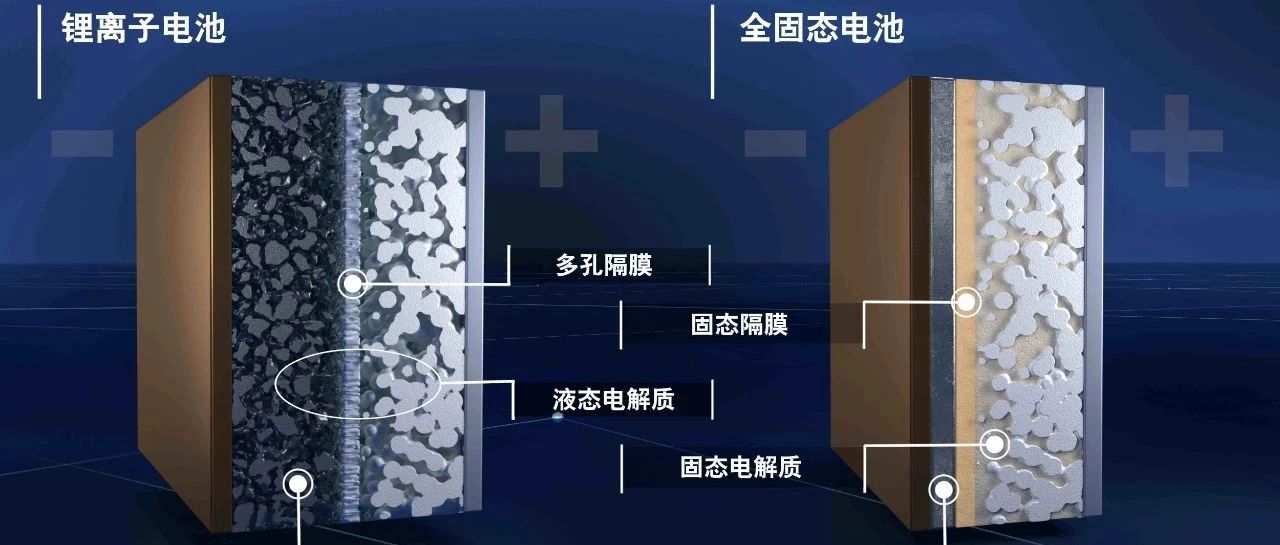
Core Viewpoint - The year 2026 is anticipated to be a breakthrough year for revolutionary technologies in the electric vehicle (EV) sector, particularly with the introduction of all-solid-state batteries by major automakers in China [1][2]. Group 1: All-Solid-State Battery Overview - Major Chinese automakers, including Changan, SAIC, GAC, Dongfeng, Geely, and Chery, have set 2026 as the target year for the deployment of all-solid-state batteries [2]. - All-solid-state batteries offer significantly higher energy density compared to traditional lithium batteries, with theoretical pure electric range reaching up to 2000 km [2][4]. - The non-flammable nature of the electrolyte in all-solid-state batteries eliminates the risk of thermal runaway and combustion [3][4]. Group 2: Industry Standards and Definitions - The China Society of Automotive Engineers has released the "All-Solid-State Battery Determination Method" (T/CSAE 434-2025), marking the first global standard defining what constitutes an all-solid-state battery [7][10]. - The standard aims to clarify the confusion between solid-state, semi-solid, and all-solid-state batteries, which has been a significant issue in the industry [11][10]. - The new standard specifies that the moisture content in the electrolyte of an all-solid-state battery must not exceed 1% [20]. Group 3: Technical Aspects and Testing - The testing method for determining all-solid-state batteries involves visual inspection for liquid leakage and a weight loss test under vacuum conditions [21][22][27]. - The method has been validated by over 50 companies, demonstrating a low error rate of less than 0.3% [27]. Group 4: Sulfide Electrolytes and Commercial Viability - Sulfide electrolytes are highlighted as the most commercially viable option for all-solid-state batteries, with several automakers announcing imminent production [35][38]. - Sulfide electrolytes exhibit high ionic conductivity, making them suitable for high charging rates and wide temperature ranges [38][41]. - The interface issue between the solid electrolyte and electrodes is a critical challenge that needs to be addressed for mass production [46]. Group 5: Challenges and Cost Considerations - Despite their advantages, sulfide solid-state batteries face challenges such as poor chemical stability and high production costs [52][67]. - The cost of materials, particularly germanium used in sulfide electrolytes, is significantly high, impacting overall battery production costs [68][70]. - Manufacturing processes for sulfide solid-state batteries require extremely dry conditions, leading to higher production costs compared to traditional batteries [74][76]. Group 6: Historical Context and Future Outlook - Japan initially led research in solid-state electrolytes but has fallen behind in commercializing these technologies due to a focus on hybrid and hydrogen fuel cell technologies [84][85]. - In contrast, Chinese battery manufacturers have made significant progress in the last decade, positioning themselves to lead in the all-solid-state battery market [87][88].
固态电池—未来能源的颠覆者,谁又是引领者?
雪球· 2025-06-12 07:51
Core Viewpoint - Solid-state batteries are regarded as the ultimate solution for next-generation batteries, with a commercial explosion expected between 2027 and 2030, potentially exceeding a global market size of 250 billion yuan, making it a key investment focus for investors [2]. Group 1: Technical Advantages of Solid-State Batteries - High safety due to the use of inert solid electrolytes, eliminating the flammability and explosion risks associated with traditional liquid batteries [3]. - Significant improvement in energy density, with examples like CATL's condensed battery reaching 500 Wh/kg, and future potential for even higher limits [4]. - Fast charging capabilities, with some technologies allowing for 80% charge in just 12 minutes, and cycle life reaching tens of thousands of times, far exceeding traditional batteries [4]. - Stability in extreme environments, operating between -40°C and 150°C, and supporting higher voltage cathode materials, suitable for applications in energy storage and aviation [5]. Group 2: Industry Advantages Driven by Policy and Market - Strong policy support from initiatives like the EU's "Battery 2030+" plan and China's "dual carbon" strategy, positioning solid-state batteries as a key development focus [6]. - Growing market demand in the electric vehicle and energy storage sectors, with expectations of double-digit growth in market size over the next five years. In Q1 2025, global investments in new solid-state battery projects exceeded 20 billion yuan, with a capacity planning of 50 GWh [7]. - Collaborative efforts across the entire industry chain, from materials to equipment and automotive companies, actively engaging in solid-state battery development [8]. Group 3: Competitive Landscape of Core Enterprises - CATL, as a global leader in lithium batteries, is at the forefront of sulfide and oxide solid-state battery technologies, planning to achieve mass production of all-solid-state batteries by 2027 [10]. - BYD leverages vertical integration and cost control advantages, aiming for demonstration vehicle deployment of all-solid-state batteries by 2027 and large-scale production by 2030 [11]. - Weilan New Energy (unlisted) has achieved mass production of semi-solid batteries for NIO vehicles and aims to capture 30% of the energy storage market by 2025 [12]. - Qingtao Energy (unlisted) has developed quasi-solid-state batteries with an energy density of 400 Wh/kg, achieving a production yield rate exceeding 95% [13]. Group 4: Impact of Solid-State Batteries on the Industry Chain - The transition to solid-state batteries is driving a restructuring of material systems, with a shift towards high-nickel ternary cathodes and lithium metal anodes, while sulfide electrolytes become core materials [15]. - New production equipment is required for solid-state battery manufacturing, such as dry electrode equipment and laser devices, creating a growth market for equipment manufacturers [16]. - Companies like Guoxuan High-Tech and Qingtao Energy are planning large-scale solid-state battery production, accelerating the industrialization process through collaboration [17]. Group 5: Challenges and Outlook - Technical challenges remain, including solid-solid interface impedance and lithium dendrite suppression, with actual energy density still lagging behind laboratory data [18]. - Initial high costs of all-solid-state batteries are expected to lead to a gradual market introduction of semi-solid forms, with a projected penetration rate of 10% for all-solid-state batteries by 2030 [19]. - The industry is anticipated to undergo price wars and comprehensive technical competition as technology matures and capacity is released, with 2027-2030 being a critical period for all-solid-state battery deployment [20].


固态电池—未来能源的颠覆者,谁又是引领者?
雪球· 2025-06-12 07:50
Core Viewpoint - Solid-state batteries are regarded as the ultimate solution for next-generation batteries, with a commercial explosion expected between 2027 and 2030, potentially exceeding a global market size of 250 billion yuan, making it a key investment focus in sectors like new energy vehicles, energy storage, and low-altitude economy [2] Group 1: Technical Advantages of Solid-State Batteries - High safety due to the use of inert solid electrolytes, eliminating the flammability and explosion risks associated with traditional liquid batteries [3] - Significant improvement in energy density, with examples like CATL's condensed battery reaching 500 Wh/kg, and future potential for even higher limits [4] - Fast charging capabilities, with some technologies allowing for 80% charge in just 12 minutes, and cycle life reaching tens of thousands of times, far exceeding traditional batteries [4] - Stability in extreme environments, operating between -40°C to 150°C, and supporting higher voltage cathode materials, suitable for applications in energy storage and aviation [5] Group 2: Industry Advantages Driven by Policy and Market - Strong policy support from initiatives like the EU's "Battery 2030+" plan and China's "dual carbon" strategy, positioning solid-state batteries as a key development focus [6] - Growing market demand in new energy vehicles and energy storage sectors, with expectations for double-digit growth in market size over the next five years; over 20 billion yuan invested in new solid-state battery projects in Q1 2025, with a capacity planning of 50 GWh [7] - Full industry chain engagement, with companies actively developing solid-state battery technologies, such as Rongbai Technology's ultra-high nickel cathode materials and Weilan New Energy's mass production of 280Ah energy storage cells [8] Group 3: Competitive Landscape of Core Enterprises - CATL, as a global leader in lithium batteries, is at the forefront of sulfide and oxide solid-state battery technologies, aiming for mass production by 2027 [10] - BYD leverages vertical integration and cost control, planning for demonstration vehicle deployment of solid-state batteries by 2027 and large-scale production by 2030 [11] - Weilan New Energy has achieved mass production of semi-solid batteries for NIO vehicles and aims for a 30% market share in energy storage by 2025 [12] - Qingtao Energy has developed quasi-solid-state batteries with an energy density of 400 Wh/kg, achieving a production yield rate exceeding 95% [13] Group 4: Impact of Solid-State Batteries on the Industry Chain - The material system is being restructured, with solid-state batteries driving the development of high-nickel ternary cathodes and lithium metal anodes, with sulfide electrolytes becoming core materials [15] - New equipment is required for solid-state battery production, such as dry electrode equipment and laser devices, creating a growth market for equipment manufacturers [16] - Companies like Guoxuan High-Tech and Qingtao Energy are planning large-scale solid-state battery production, accelerating the industrialization process through supply chain collaboration [17] Group 5: Challenges and Outlook - Technical bottlenecks remain, including solid-solid interface impedance and lithium dendrite suppression, with actual energy density still lagging behind laboratory data [18] - Initial high costs of all-solid-state batteries are expected to transition to semi-solid forms for market entry, with a projected 10% penetration rate for all-solid-state batteries by 2030 [19] - The industry is anticipated to undergo price wars and comprehensive technical competition as technology matures and capacity is released, with 2027-2030 being a critical period for all-solid-state battery deployment [20]

东兴证券:锂电板块景气度回暖 固态电池、钠电有望迎来规模化应用节点
Zhi Tong Cai Jing· 2025-06-12 07:12
Group 1: Industry Overview - The demand in the supply chain remains strong in Q1 2025, with the battery sector showing signs of recovery in both profitability and revenue [1] - The lithium battery sector is expected to see a rebound in overall prosperity, driven by new technologies like solid-state batteries, which are anticipated to catalyze market growth starting in the second half of 2024 [1] - The industry is projected to experience profit recovery and valuation enhancement from 2025 to 2026 as new technologies are commercialized [1] Group 2: Battery Sector Insights - The current landscape in the lithium battery supply chain is favorable, with stable supply-side changes expected to lead to simultaneous revenue and profit increases [2] - Leading companies with differentiated products and advanced manufacturing capabilities are likely to maintain profitability, while some second-tier manufacturers may capture new customer orders and benefit from the trend of industry globalization [2] - Companies like Guoxuan High-Tech (002074.SZ) and CATL (300750.SZ) are expected to benefit from the upcoming harvest period of production capacity and competitive advantages from differentiated products [2] Group 3: Material Sector Insights - Despite some companies facing declining profit margins and low capacity profitability, the concentration in the lithium battery material sector is expected to increase, leading to a potential recovery in profit levels [2] - The market share of ternary cathode materials is anticipated to rebound due to improved safety performance, with potential applications in semi-solid and sodium batteries [2] - Companies such as Huayou Cobalt (603799.SH) are expected to benefit from the positive outlook on ternary cathode materials [2] Group 4: New Technology Catalysts - Solid-state batteries are entering a rapid growth phase, with companies releasing technology solutions and industrial applications, which may accelerate the commercialization process [3] - Companies with a first-mover advantage in solid-state battery technology are likely to benefit significantly, with Guoxuan High-Tech being highlighted for its leading position [3] - Sodium batteries have reached a critical cost threshold for large-scale applications, particularly in extreme environment energy storage and electric two-wheelers, with companies like CATL and Huayang Co. (600348.SH) expected to benefit from this trend [3]
